Dragon's Back hike Hong Kong: the complete trail guide
How hard is Dragon's Back hike and how long does it take?
Dragon's Back is classified as moderate difficulty — the main ridge section involves some steep ascent but is well-paved and suitable for regular walkers in good shoes. The full route (Shek O Road to Big Wave Bay or Shek O village) is 8.5 km and takes 3–4 hours at a comfortable pace.
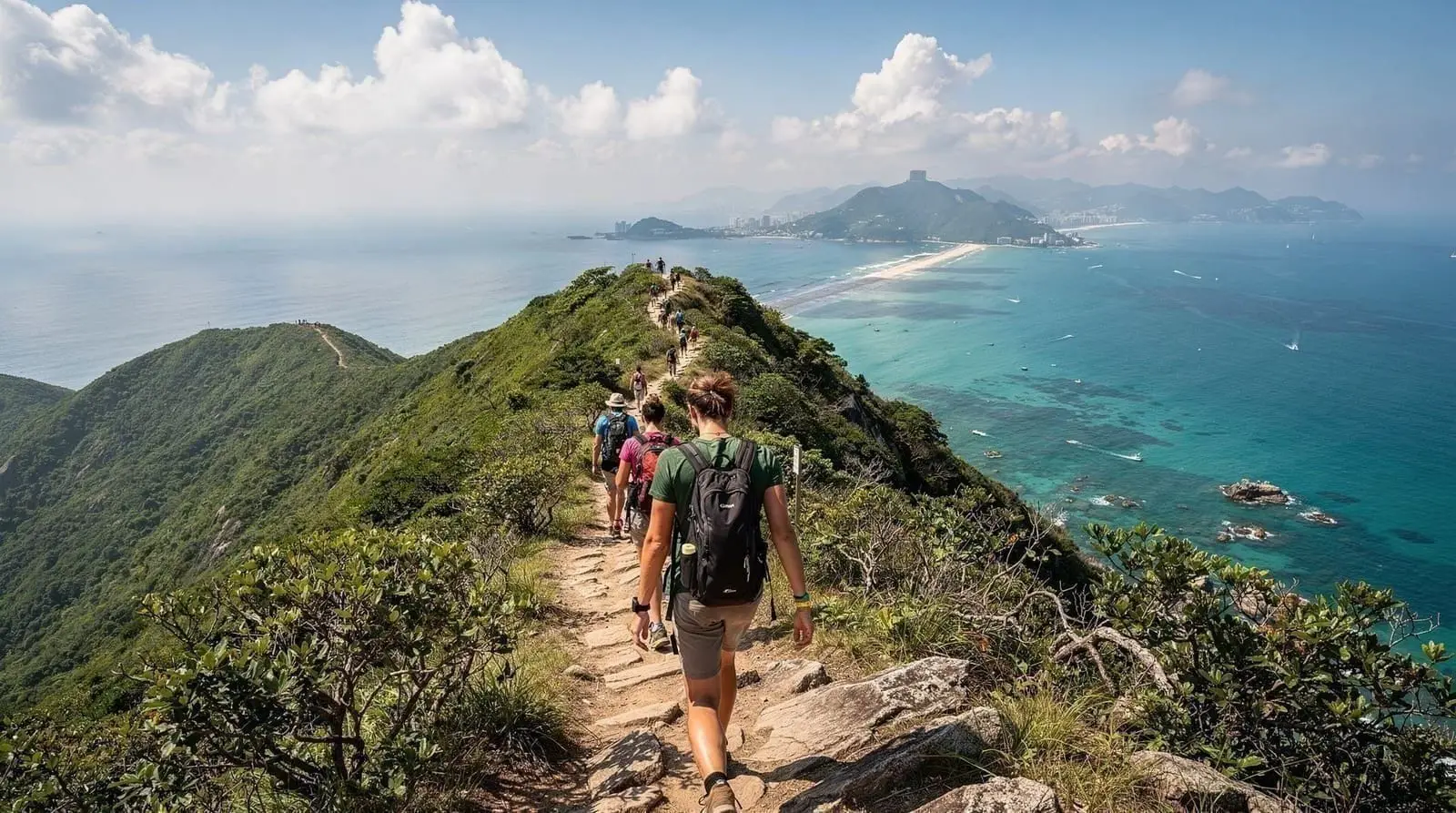
Dragon’s Back (龍脊) is Section 8 of the Hong Kong Trail — a ridge hike on the eastern side of Hong Kong Island that delivers some of the most dramatic coastal scenery you can access on foot anywhere in Asia, let alone in a major city. At the summit, 284 metres above sea level, the path follows the spine of a curved ridge above the South China Sea with views in every direction: Shek O village and beach below, the outer islands, the East Lamma Channel, and on clear days the open Pacific horizon.
The trail was named Asia’s best urban hiking trail by Time Asia magazine, and that assessment is still defensible in 2026. It is genuinely excellent — accessible, well-maintained, and ending at one of Hong Kong’s best beaches.
| Where | Shek O Road (Hong Kong Island east) to Big Wave Bay / Shek O |
| Distance | ~8.5 km, moderate difficulty |
| Time needed | 3–4 hours hiking, plus travel and beach time |
| Getting there | MTR to Shau Kei Wan, then bus 9 to To Tei Wan |
| Best time | October–December, before 9 am |
The route: what to expect
The standard Dragon’s Back hike follows Stage 8 of the Hong Kong Trail:
Trailhead: Bus stop at To Tei Wan on Shek O Road (accessible from Shau Kei Wan MTR). The trail begins at the Shek O Road bus stop; there is a small sign for the Hong Kong Trail.
The ascent: From Shek O Road, the path climbs steeply through dense vegetation for about 30–40 minutes. Steps have been installed for the steeper sections. The gradient is significant — you will be breathing hard — but there are no technical sections. Good hiking shoes with grip are recommended; trainers are fine on a dry day.
The ridge (the Dragon’s Back itself): Once you crest the ridge, the path levels out and becomes spectacular. You are walking along the spine of a curved hillside — like walking on the back of a giant sleeping dragon looking down at the sea on both sides. The path here is relatively flat with occasional dips and climbs along the undulating ridge. The views are continuous and 270-degree.
The descent: From the highest point (Shek O Peak, 284m), the path descends toward the coast. The standard route descends to Big Wave Bay (大浪灣, Tai Long Wan), a long sandy beach facing the open South China Sea. This is a genuine swimming beach — open water, surfable waves in the right season, lifeguards on duty in summer.
Shek O village: From Big Wave Bay, it is a 20-minute flat walk around the headland to Shek O village, a charming old fishing settlement with seafood restaurants and a small beach. Alternatively, from Big Wave Bay you can hike further along the coast to Shek O via the coastal path.
Key distances and timing
| Section | Distance | Time |
|---|---|---|
| Shek O Road to ridge | 1.8 km | 35–45 min |
| Ridge traverse | 3.2 km | 50–70 min |
| Descent to Big Wave Bay | 2.0 km | 30–40 min |
| Big Wave Bay to Shek O | 1.5 km | 20–25 min |
| Total | ~8.5 km | 2.5–4 hours |
The wide range in timing accounts for photography stops and pace. Most hikers do the route in 3–3.5 hours.
Getting to the trailhead
From Shau Kei Wan MTR (Island Line, easternmost station): Exit A3, walk to Shau Kei Wan Bus Terminus. Take bus 9 toward Shek O — this bus runs through Shau Kei Wan, along the coast road and up to Shek O Road. Get off at the “To Tei Wan” stop (ask the driver or watch the sign). Bus 9 runs every 15–20 minutes; journey time approximately 15 minutes. Fare: HKD 4.4 (Octopus).
Alternatively, take a green minibus (also from Shau Kei Wan terminus) — faster but less frequent.
By taxi from Central: Approximately HKD 140–180. Takes 30–40 minutes depending on traffic.
Getting back from Shek O or Big Wave Bay
From Shek O village: Bus 9 returns to Shau Kei Wan MTR. Runs approximately every 15–20 minutes. Check the posted schedule at the Shek O bus stop (the last bus of the day varies by season — confirm before you go).
From Big Wave Bay: Walk 1.5 km to Shek O and catch bus 9, or arrange a taxi from Shek O. Big Wave Bay has no direct bus service.
By taxi: Taxis can be found at Shek O village, especially on weekends. Expect HKD 150–200 to Central/Wan Chai.
Best time to hike Dragon’s Back
October to December: The best conditions. Visibility is at annual peak — 40+ km on clear days. Temperatures are 18–25°C. Trails are dry. Highly recommended.
March to April: Second-best window. Pleasant temperatures, lower humidity than summer.
May to September: Hot and humid. Temperatures 28–35°C with high humidity. Afternoon thunderstorms are common and can arrive quickly — hike in the morning and be down by noon in summer months. The trail can be slippery after rain. Avoid hiking during typhoon warnings (signal 3 or above).
January to February: Cooler (15–20°C), often misty. Can be atmospheric but visibility on the ridge may be limited by haze or cloud. Cold fronts from the north can make the ridge unexpectedly cold and windy — bring a layer.
Early morning: The ridge is significantly cooler and less busy before 9 am. On autumn weekends, the trail can get crowded from 10 am onward.
| Season | Visibility | Conditions | Verdict |
|---|---|---|---|
| Oct–Dec | 40+ km, best of the year | 18–25°C, dry | Ideal — go now if you can |
| Mar–Apr | Good | Mild, lower humidity | Strong second choice |
| May–Sep | Often hazy | 28–35°C, humid, storms | Morning only, watch typhoon signals |
| Jan–Feb | Variable, can be misty | 15–20°C, occasional cold wind | Fine but pack a layer |
Is Dragon’s Back worth it compared to other Hong Kong hikes?
Hong Kong has dozens of maintained country-park trails, so it is a fair question. Dragon’s Back wins on the combination of accessibility and payoff: no other trail this easy to reach by public transport delivers 270-degree sea views for nearly the whole ridge section, and few end at a genuine swimming beach with restaurants. Lantau Peak (934m, near Ngong Ping and the Big Buddha) is a harder, higher hike with arguably more dramatic summit views, but it demands a much earlier start and better fitness.
Sai Kung’s coastal trails have better sea-cave and island scenery but need a car or long bus ride to reach. For a half-day hike that fits around a Hong Kong sightseeing itinerary without derailing the rest of the day, Dragon’s Back is the right default choice — which is exactly why it is consistently the most recommended hike for first-time visitors and for Shenzhen day-trippers short on time.
Safety and realistic trail conditions
The steps and railings on the steeper sections are well maintained by the Agriculture, Fisheries and Conservation Department, and mobile signal covers almost the entire ridge, so getting help in an emergency is not a serious concern. The real risks are heat exhaustion in summer (there is no shade on the ridge and no water refill point) and slippery steps after rain — footwear with actual tread matters more than how “serious” a hiker you are.
Hikers with a fear of heights sometimes find the exposed ridge sections uncomfortable, though the path itself is wide and there is no scrambling or exposure requiring hands. If you want a gentler outdoor option with a similar payoff-to-effort ratio, the flat Lugard Road loop at Victoria Peak delivers continuous views with none of the climbing.
What to bring
- Good hiking shoes or trail runners (trainers are acceptable on dry days)
- 1.5–2 litres of water minimum — no water source on the trail
- Sunscreen and a hat — the ridge is fully exposed
- Light snack or energy bars — no food on the ridge
- Rain jacket if weather is uncertain (summer particularly)
- Charged phone with offline maps (Google Maps or Maps.me work well with downloaded areas)
- Camera — the photography from the ridge is outstanding
Difficulty and accessibility
Dragon’s Back is genuinely accessible for most moderately fit people. The key caveat: it is not suitable for heavy rain conditions (trail becomes slippery), it is not wheelchair accessible, and children under about 7–8 may find the steep ascent and descent tiring.
Older children (8+) generally manage it well, and it is a better outdoor experience for families with older children than many alternatives. See Hong Kong with kids for suitable age guidance.
Shek O beach and village: after the hike
Shek O village is one of the most pleasant places in Hong Kong to spend a post-hike afternoon:
Shek O Beach: A proper sandy beach, 300+ metres, with lifeguards in summer (April–October). The beach has changing rooms, outdoor showers, and food kiosks. Surfing is possible here and at Big Wave Bay when swells arrive from the southeast. Several local operators rent surf equipment.
Seafood restaurants: The village has several casual Cantonese seafood restaurants with fresh tanks of fish and shellfish. Peak Sun Restaurant and Shek O Thai Restaurant are locals’ favourites — the Thai-influenced Cantonese cooking reflects the Thai immigrant community historically present in Shek O. Budget HKD 150–250 per person for a seafood meal.
The village itself: Shek O village has a very different character from urban Hong Kong — quiet lanes, old houses, a few relaxed bars. Worth 30 minutes of exploration after eating.
Combining with other Hong Kong nature
Dragon’s Back is on the eastern side of Hong Kong Island; if you have a second day for hiking, the western side of Hong Kong Island (Pok Fu Lam Country Park, High West) offers contrasting terrain. Lantau Island has multiple day-hike options including the demanding Lantau Peak (934m).
For Hong Kong’s marine landscape, the Sai Kung Peninsula (New Territories) has world-class kayaking, sea cave exploration, and remote beaches — a different kind of nature day:
Sai Kung sea kayaking adventure Guided Dragon’s Back hike with transportPractical tips
- The To Tei Wan trailhead is easily missed — tell the bus driver where you want to get off, or set a GPS waypoint before boarding
- Mobile signal is good on the ridge and absent only in dense forest sections at the start
- The trail is well-signed with Hong Kong Trail markers (yellow/white posts with “H” prefix and section numbers)
- Dogs are welcome on the trail; it is popular with dog walkers from the Shek O area
- Last bus 9 from Shek O back to Shau Kei Wan runs at approximately 11 pm (confirm on the NWFB website)
- On weekends, the trail can be genuinely crowded between 10 am and 1 pm — early morning departure recommended
From Shenzhen as a day trip
Dragon’s Back works well as a half-day or full-day component of a Shenzhen day trip to Hong Kong. Take the high-speed rail to West Kowloon, then MTR to Shau Kei Wan (Island Line, changing at Admiralty) — allow 90 minutes total from Futian. Hike in the morning, lunch in Shek O, and return via Wan Chai or Central in the afternoon for the Symphony of Lights in the evening.
If you are building a longer stay around it, the Hong Kong in 2 days itinerary and the Shenzhen and Hong Kong 5 days itinerary both have room to slot in a Dragon’s Back morning without cutting the rest of the plan.
Frequently asked questions about Dragon’s Back
Do I need a guide to hike Dragon’s Back?
No. The trail is clearly signed with Hong Kong Trail markers, well-trodden, and popular enough that you will rarely be alone on it. A guide adds value mainly through local commentary and logistics (transport, timing), which is useful if you are short on time or nervous about navigation, but it is not required for a fit, moderately prepared hiker.
Can I do Dragon’s Back in one direction only and skip the beach?
Yes. Some hikers stop at Shek O Peak and descend back the way they came, or exit early via a side path to Tai Tam Road, skipping Big Wave Bay and Shek O village. This shortens the hike to roughly 4–5 km and 2 hours, but you lose the beach payoff at the end, which most people consider the best part.
Top-rated things to do in Hong Kong
Verified deep-linked GetYourGuide tours. Book through these links and we earn a small commission at no cost to you.