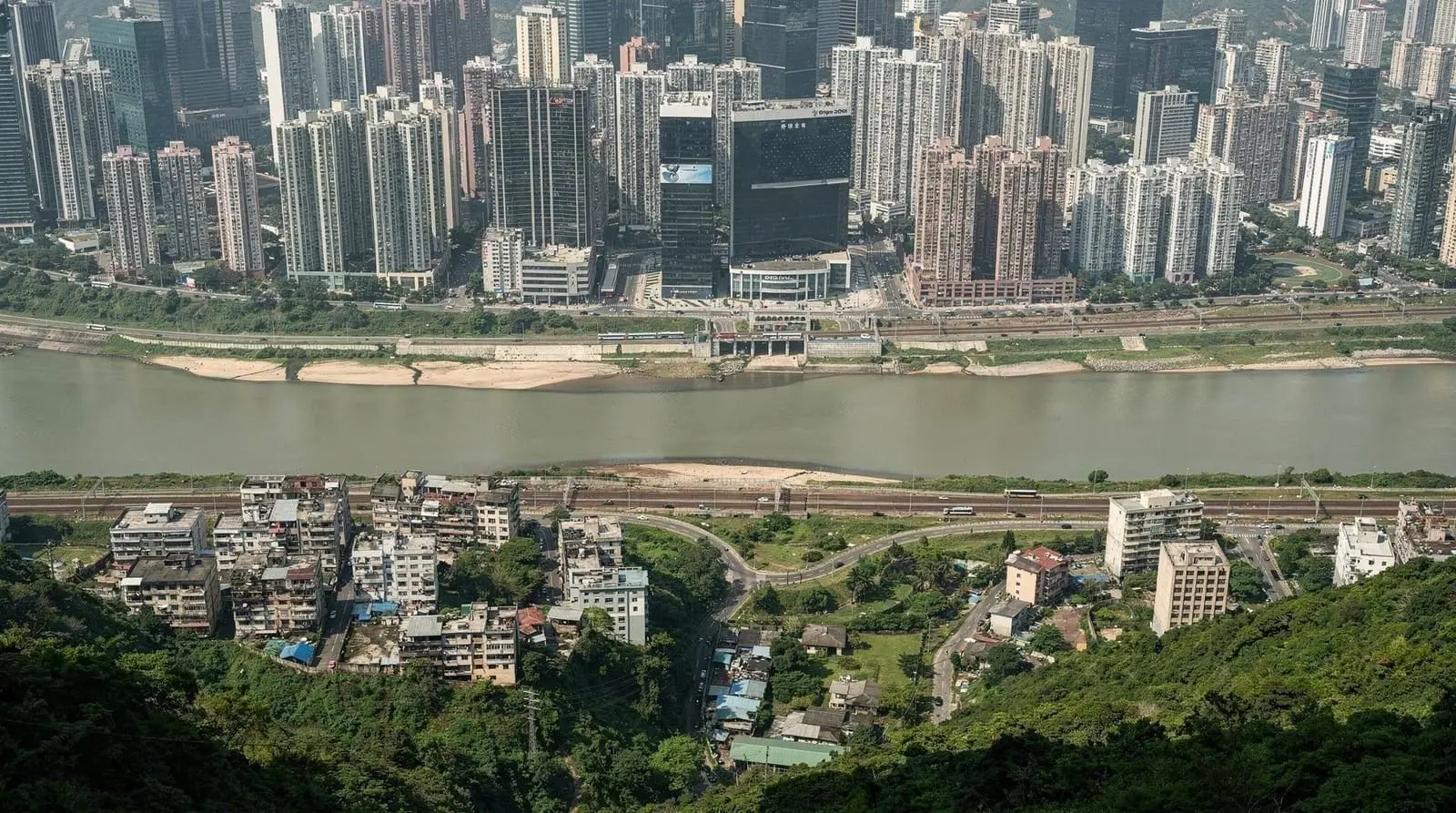
Shenzhen and Hong Kong in 5 days: the complete dual-city plan
| Where | Shenzhen (2 nights) + Hong Kong (3 nights) |
| Cost | ¥850–1,300/US$120–182 (Shenzhen) + HK$2,500–3,800/US$320–488 (Hong Kong) |
| Time needed | 5 days |
| Getting there | West Kowloon HSR (8 min) or Futian Checkpoint on foot |
| Best time | October–December or March–April |
Shenzhen and Hong Kong are 30 kilometres and an entirely different political and cultural world apart. That proximity is the point. No other border in the world separates two cities of this size, density and mutual economic entanglement across such a visible ideological divide. Five days gives you enough time to treat both cities as proper destinations rather than quick stops.
This plan allocates Days 1–2 in Shenzhen, a border crossing on Day 3 morning, and Days 3–5 in Hong Kong. The reverse order (HK first) works equally well — the crossing logistics are identical. Accommodation in both cities is booked separately; the border is not a logistical obstacle.
Pre-trip logistics
Visa and entry: Chinese visa requirements and Hong Kong entry are separate. Most Western passports enter Hong Kong visa-free for 90 days (or 30 days for some nationalities). For mainland Shenzhen, check whether your passport qualifies for the 144-hour visa-free transit or Greater Bay Area visa-on-arrival — both schemes have been expanded several times between 2024 and 2026. See the China visa guide.
Money: Carry both CNY and HKD, or plan to withdraw each at ATMs. WeChat Pay (with a foreign card linked) covers most expenses in Shenzhen; Hong Kong is card-friendly and cash-friendly. HKD is accepted in Macau but CNY is not standard in Hong Kong shops.
SIM: A dual-region eSIM (Airalo GBA plan or similar) saves switching. Hong Kong SIM with mainland data roaming is a clean alternative — Hong Kong data is not subject to the Great Firewall.
Day 1: arriving in Shenzhen — Huaqiangbei and OCT-LOFT
If arriving at Shenzhen Bao’an Airport (SZX), take the Airport Express (Line 11) to Window of the World station, then connect to your hotel area. If arriving from Hong Kong, see crossing options below.
Morning/Afternoon — Huaqiangbei: Start at the world’s largest electronics market. The SEG Electronics Market and Mingtong Digital City at Huaqiang Road North metro station (Lines 1/7) are the most navigable buildings. Useful purchases: USB-C cables, phone accessories, portable chargers at 40–60% of Western retail prices. Allow 90 minutes.
Late afternoon — OCT-LOFT: Take Line 1 west to Huaqiaocheng. The OCT-LOFT creative district in two converted factory campuses has independent galleries, design studios and the best daytime café scene in Shenzhen. OCAT (OCT Contemporary Art Terminal) usually has a rotating exhibition — entry ¥15/US$2 or free. Allow 2 hours.
Shenzhen 8-hour city walk covering tech highlights and design districtsDinner: Shekou waterfront, 20 minutes west by metro (Line 2, Sea World station). The lane behind Sea World Plaza has Korean BBQ, Sichuan hotpot and local Cantonese restaurants in the ¥70–120/US$10–17 range.
Accommodation: Shenzhen Marriott Nanshan (from ¥650/US$90) or Arcadia Hotel Shekou (from ¥480/US$67).
Day 1 budget: ¥400–600/US$56–84 per person.
Day 2: tech Shenzhen and Lianhuashan
Morning — autonomous vehicles and DJI flagship
Take a Didi to the Nanshan High-Tech Zone (Qianhai/Keyuan Avenue area). Ride the Apollo autonomous bus (¥3/US$0.4). Visit DJI’s Sky City flagship store for the drone simulator (¥50/US$7, 15 minutes). BYD’s showroom demonstrates its full electric vehicle lineup. Allow 2–3 hours.
Shenzhen future tech tour — self-driving cars, drones and robotsAfternoon — Dafen Oil Painting Village
Metro to Line 3, Dafen station. The Dafen Oil Painting Village (大芬油画村) houses roughly 800 studios producing paintings at every quality level. Watch artists at work, commission a custom portrait (¥300–800/US$42–110, 50×70 cm canvas, 3-day turnaround — you will be leaving Shenzhen, so arrange delivery or choose a ready piece). Allow 90 minutes.
Evening — Lianhuashan Park panorama and Futian dinner
Walk or Didi to Lianhuashan Park in Futian for the dusk hour — the city skyline view is best in the hour before sunset. Then dinner in Futian CBD: the Times Square mall basement food hall serves every major Chinese regional cuisine for ¥35–65/US$5–9 per dish.
Day 2 budget: ¥450–650/US$63–91 per person.
Day 3: crossing to Hong Kong — arrival and Kowloon
Morning border crossing
Check out of your Shenzhen hotel by 09:00 and head to the crossing. Two options:
West Kowloon HSR from Futian station (Line 4, Futian station): 8 minutes to Hong Kong West Kowloon, ~HK$75/US$10. Deposits you directly in Kowloon. Queue time typically 15–30 minutes in the morning. Best choice if you are staying in Kowloon or Hong Kong Island.
Futian Checkpoint pedestrian (Line 4, Futian station): walk across to Lok Ma Chau MTR station. Total time 30–60 minutes. Cheaper (metro fares only) but slightly more walking.
Afternoon — Tsim Sha Tsui and the harbour
Drop bags at your Hong Kong hotel and head to the Kowloon waterfront. The Avenue of Stars promenade along Tsim Sha Tsui gives you the Victoria Harbour view that is the iconic Shenzhen-to-Hong Kong contrast: from a city of concrete and neon to one of granite mountains and colonial-era skyline.
Take the Star Ferry from Tsim Sha Tsui to Central (HK$4/US$0.5) — it is genuinely the best HK$4 spent in Asia. The 10-minute crossing gives you the full harbour panorama.
Afternoon in Central: walk up to the Peak Tram lower terminus in Garden Road for a pre-evening tram ride (HK$62/US$8 return, book in advance online to skip queues). Victoria Peak in the late afternoon and the city at dusk from Sky Terrace 428 (additional HK$58/US$7.5) is one of the best urban panoramas in Asia.
Peak Tram and Sky Terrace 428 combo — skip the tram queueDinner in Central: Yung Kee Restaurant on Wellington Street (中環威靈頓街) — roast goose has been the city’s benchmark for 80 years. A meal for two with rice and vegetables: HK$350–500/US$45–64.
Accommodation: Salisbury YMCA Tsim Sha Tsui (from HK$900/US$116, best harbour-view budget option) or Hotel Icon (from HK$1,400/US$180, harbourfront, rooftop pool).
Day 3 budget: HK$800–1,200/US$103–154 per person (excluding accommodation).
Day 4: Hong Kong Island — markets, heritage and the Peak
Morning — Western District and Sheung Wan
Start in Sheung Wan (MTR Sheung Wan station). The dried seafood and herb wholesale district on Des Voeux Road West is operating at full pace by 08:30. Walk east along Hollywood Road for antique shops and the Man Mo Temple (1847, free entry, one of the city’s oldest surviving religious buildings). The Central-Mid-Levels escalator (the world’s longest outdoor escalator system, 800 m, free) connects the lower city to the residential hillside — walk up in the morning before it switches direction at 10:30.
Breakfast in Sheung Wan: Kau Kee Restaurant (九記牛腩) on Gough Street opens at 07:30 and serves the city’s most respected beef brisket and tendon noodle in broth (HK$52–68/US$6.7–8.8). Queue is long on weekends; arrive before 09:00.
Afternoon — Aberdeen and Ap Lei Chau
Take bus 70 from Exchange Square to Aberdeen (Aberdeen Promenade). The Aberdeen typhoon shelter still has a working fishing fleet — sampan tours of the harbour (HK$60–80/US$7.7–10 negotiated with the boatwomen at the pier) show the floating kitchens that define the area. The Jumbo floating restaurant complex was removed in 2022, but Wong Chuk Hang next door is developing rapidly with good independent restaurants.
Ap Lei Chau island bridge leads to a wholesale furniture district and Stanley Market (bus 6, 6A, 6X or 260 from Exchange Square) for a late-afternoon browse. Stanley Market is tourist-oriented but the beachfront promenade and Murray House colonial building are genuinely pleasant.
Dinner on Hong Kong Island: Lin Heung Tea House in Central (蓮香樓, 178 Wellington St) is old-school dim sum — trolleys still pushed by grandmothers, cash only, no reservations, opens at 06:00, last dim sum service 14:00. For dinner, Sing Kee in Central (星記冰室) does classic Hong Kong-style café food (cha chaan teng) — Hong Kong milk tea, egg tarts, brisket curry on toast.
Day 4 budget: HK$600–900/US$77–116 per person.
Day 5: Lantau Island — Big Buddha and Tai O then departure
Full day — Lantau
Take the MTR to Tung Chung (Line Tung Chung), then the Ngong Ping 360 cable car to the Ngong Ping village (HK$175/US$22.5 return, non-crystal cabin) — 25 minutes, spectacular aerial view of the coastline. The Tian Tan Buddha (天壇大佛, the Big Buddha) at the peak is 34 m tall and accessible by 268 steps. Free entry. The Po Lin Monastery complex below serves a reasonable vegetarian lunch (HK$100–150/US$13–19 for the set meal).
Take the afternoon bus (No. 21) from Ngong Ping down to Tai O fishing village — 30 minutes, HK$5. Tai O is a Lantau community of stilt houses built over a creek, inhabited primarily by Tanka fishing families. It is one of the most authentically preserved traditional communities in the SAR, and a genuine contrast to the urban density of the past four days. Try shrimp paste (蝦醬) sandwiches from stalls near the creek bridge (HK$15–20/US$2–2.5).
Return to Tung Chung by bus (No. 11, 30 minutes), then MTR to Hong Kong International Airport (HKG) if departing, or back to Kowloon.
Lantau Island Giant Buddha and Tai O guided day tourDay 5 budget: HK$500–700/US$64–90 per person.
Total 5-day budget (mid-range, excluding accommodation and flights): ¥850–1,300/US$120–182 for Shenzhen days + HK$2,500–3,800/US$320–488 for Hong Kong days.
Getting connectivity sorted before you cross
Mobile data is the single most common friction point on this trip, because the mainland and Hong Kong sit on opposite sides of the Great Firewall. Google Maps, WhatsApp and Instagram do not work on a mainland SIM without a VPN, but do work fine over a Hong Kong SIM’s roaming or an international eSIM. The eSIM and VPN in China guide covers which providers reliably work in 2026 and how to set up a VPN before you cross, since app stores for VPN clients are themselves blocked once you are on the mainland.
Shenzhen vs Hong Kong shopping: what to buy where
| Shenzhen | Hong Kong | |
|---|---|---|
| Best for | Electronics, components, custom tech | Branded goods, luxury, pharmacy items |
| Price advantage | 40–60% below Western retail on accessories | Duty-free on electronics, cosmetics, alcohol |
| Payment | WeChat Pay/Alipay essential | Cards and cash both fine |
| Bargaining | Expected in electronics markets | Not expected outside street markets |
Huaqiangbei in Shenzhen and the malls around Causeway Bay in Hong Kong serve genuinely different shopping needs — the Shenzhen shopping malls guide and the Hong Kong markets guide both go deeper if shopping is a priority for your trip.
If you want more than the Peak and Lantau in Hong Kong
This plan uses the classic Hong Kong highlights (Peak, Star Ferry, Lantau), but if you have already done these on a previous visit, the Dragon’s Back hiking trail is the best substitute for the Peak — a genuine ridge walk with sea views rather than a crowded viewing platform. See the Dragon’s Back hike guide for the route and timing; it fits into the Day 4 afternoon slot in place of Aberdeen if hiking appeals more than markets.
Frequently asked questions about Shenzhen and Hong Kong in 5 days
Is 5 days enough for both Shenzhen and Hong Kong?
Five days gives a genuine experience of both cities without feeling rushed. You see Shenzhen’s highlights (tech, design, food, waterfront) in two days and Hong Kong’s core (Peak, harbour, Lantau, street-level markets) in three. Ten days allows a deeper dive into both plus Macau and Guangzhou — see the greater Bay Area 2-week itinerary.
Which city should I visit first?
It depends on your flight routing. Arriving at Hong Kong International (HKG) and starting in Hong Kong is logistically smoothest if you are flying internationally. Arriving at Shenzhen Bao’an (SZX) means starting in Shenzhen. Either order works for the itinerary.
How difficult is the border crossing with luggage?
The Futian pedestrian crossing is the least arduous — you walk 10 minutes between the two immigration halls and connect directly to Hong Kong MTR at Lok Ma Chau. The West Kowloon HSR option is faster and more comfortable with heavy luggage. Avoid Lo Wu crossing (large queues) and Huanggang (vehicle-oriented) with luggage.
Can I use my Hong Kong Octopus Card in Shenzhen?
No. The Octopus Card works in Hong Kong only. In Shenzhen you need a Shenzhen Tong card or mobile payment via WeChat Pay. Buy the Shenzhen Tong at any Shenzhen metro station ticket office (¥50/US$7 deposit).
What is the cheapest way to get between Shenzhen and Hong Kong?
The pedestrian border crossing (Futian Checkpoint to Lok Ma Chau MTR) is cheapest — just metro fares on each side (typically under ¥15/US$2 Shenzhen-side plus HK$10/US$1.3 Hong Kong MTR to central Kowloon). The HSR at HK$75/US$10 is the premium fast option.
Do I need travel insurance for both territories?
Yes, and make sure your policy covers both mainland China and the Hong Kong SAR separately — some policies exclude one or the other. Standard travel insurance that covers “China” does not always cover Hong Kong SAR explicitly.
Will my phone work normally in Shenzhen?
Not without preparation. Google, WhatsApp, Instagram and most Western social media are blocked on mainland networks unless you use a VPN set up before you cross, or roam on a Hong Kong SIM (which is not subject to the Great Firewall). The eSIM and VPN in China guide has current, tested provider recommendations.
Top-rated things to do in Shenzhen
Verified deep-linked GetYourGuide tours. Book through these links and we earn a small commission at no cost to you.