Big Buddha and Ngong Ping 360: the complete Lantau Island guide
How do you get to the Big Buddha and how much does the cable car cost?
Take the MTR Tung Chung Line to Tung Chung station, then the Ngong Ping 360 cable car (HKD 175 round-trip standard cabin; HKD 265 crystal cabin). The 25-minute ride delivers you to Ngong Ping village, a 5-minute walk from the Buddha. Bus 23 from Tung Chung is the cheap alternative (HKD 17.50, 45 min).
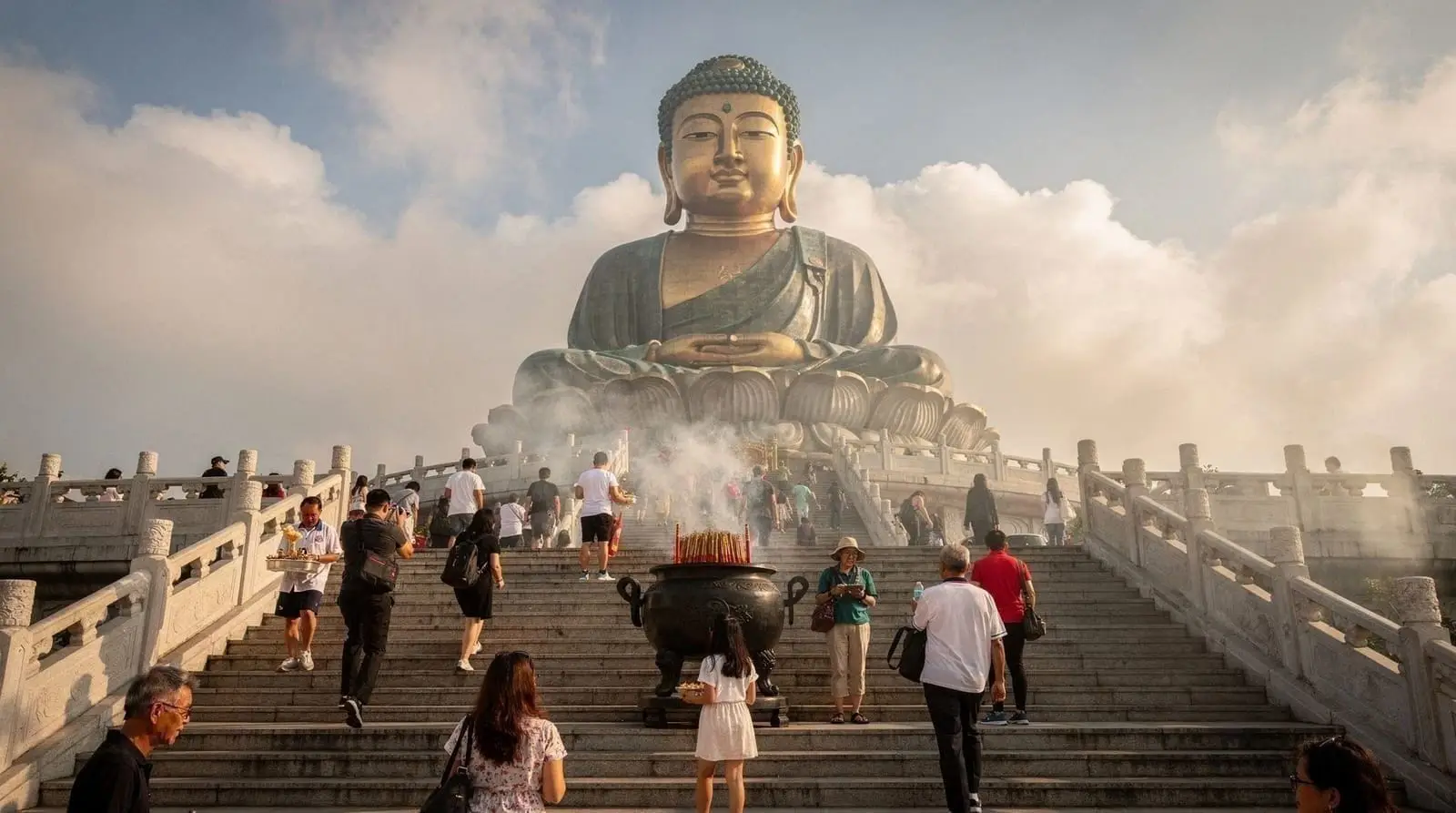
The Tian Tan Buddha — universally called the Big Buddha — sits at 34 metres tall on a lotus throne atop Ngong Ping Plateau on Lantau Island, the largest of Hong Kong’s islands. At 250 tonnes of bronze, it is one of the largest seated outdoor bronze Buddha statues in the world and has been one of Hong Kong’s defining images since it was completed in 1993. But visiting the Big Buddha is more than a single statue: it involves a spectacular cable car ride over mountains and sea, the working monastery of Po Lin, the atmospheric old village of Tai O, and the trails of Lantau Country Park. This guide covers all of it.
| Where | Ngong Ping Plateau, Lantau Island |
| Cost | around HKD 175 cable car round-trip, statue base free |
| Time needed | half day; full day with Tai O |
| Getting there | MTR to Tung Chung, then Ngong Ping 360 cable car |
| Best time | weekday morning, avoid Tuesdays (cable car closed) |
The Ngong Ping 360 cable car
The 360 gondola system connects Tung Chung (at sea level on Lantau’s northeastern coast) to Ngong Ping Plateau, 500 metres above sea level, in a 5.7 km gondola crossing that takes approximately 25 minutes. The views over Tung Chung Bay, the South China Sea, and the mountains of Lantau are exceptional — on a clear day you can see the airport’s runways and, in the other direction, the Big Buddha growing larger as you approach.
Cabin types:
- Standard cabin (enclosed, seats 8): HKD 175 adult round-trip / HKD 90 child (3–11) round-trip
- Crystal cabin (standard cabin with glass floor): HKD 265 adult / HKD 140 child — the glass floor shows nothing that cannot be seen from the windows, but it is a novelty
- Standard one-way (if hiking back or taking the bus): HKD 110 adult / HKD 55 child
Hours: 10 am – 6 pm Monday–Friday; 9 am – 6:30 pm Saturday, Sunday, and public holidays. Last cable car down leaves before these closing times — confirm at the terminal.
The cable car is closed on Tuesdays for maintenance (except public holidays). It also suspends service in high winds and bad weather — check the Ngong Ping 360 website on the morning of your visit if conditions look uncertain.
Queues at Tung Chung terminal are longest between 11 am and 2 pm. Arrive at opening time or after 3 pm for shorter waits.
Book Ngong Ping 360 cable car tickets onlineFor a guided tour that includes the cable car, skipping the queue:
Big Buddha guided tour with skip-line cable carThe cable car is only half of Lantau: a Big Buddha tour that adds the stilt-house fishing village of Tai O reaches the part of the island the day-trippers skip entirely.
The Big Buddha and Po Lin Monastery
Tian Tan Buddha: The Buddha is seated facing north, toward mainland China. The 268 steps from Ngong Ping village to the base of the statue are gradual and have rest points — most visitors in reasonable health can manage them. Admission to climb the steps and enter the base is free. The interior of the podium beneath the statue contains three galleries with dioramas illustrating the life of the Buddha, relic fragments, and bronze Bodhisattva statues. These galleries are HKD 40 (adults) / HKD 20 (children).
Photography of the Buddha is unrestricted from outside. Photography inside the base galleries is prohibited.
Po Lin Monastery: The working monastery adjacent to the Buddha is one of Hong Kong’s most significant Buddhist institutions. The monastery buildings visible to tourists include the main ceremonial hall, incense urns, and outdoor prayer areas. It is an active religious site — dress modestly (shoulders and knees covered is respectful) and maintain a quiet tone. The monastery accepts offerings from the public.
The monastery’s vegetarian restaurant is famous and frequently recommended: simple but high-quality Cantonese vegetarian food at prices significantly below Hong Kong average (approximately HKD 60–100 per person for a proper meal). Book in advance on weekends and public holidays — it fills up. Non-vegetarian visitors report the tofu dishes and vegetable dumplings are genuinely good.
Ngong Ping village: tourist trap or not?
Ngong Ping village is a Disney-esque commercial zone built by the cable car company between the cable car terminal and Po Lin. It contains retail shops, a tea house, several restaurants, and a small “Walking with Buddha” multimedia experience.
Honest assessment: the village is a commercial add-on designed to increase dwell time and spending. The shops sell generic Buddhist-themed souvenirs at tourist prices. The “Walking with Buddha” attraction (HKD 80–120) is harmless but skippable. You do not need to spend any time or money here to reach the Buddha — just walk straight through.
Tai O fishing village
Tai O sits on the western tip of Lantau Island, accessible by a 40-minute bus ride from Ngong Ping (route 21) or a separate 30-minute bus from Tung Chung (route 11). It is the most authentic fishing community remaining in Hong Kong: stilt houses built over tidal channels, traditional dried-fish and shrimp paste shops, small boat tours through the waterways looking for rare pink dolphins.
What you will find here that you will not find elsewhere in Hong Kong:
- Stilt houses (pang uk) over the water — built by the Tanka fishing community, still inhabited
- Shrimp paste production — the brown paste made from fermented shrimp that is fundamental to Cantonese cooking; Tai O producers sell directly from storefronts
- Pink dolphin boat tours — local operators run 30–45 minute motorized sampan tours looking for the Chinese white dolphin (which appears pink at the surface); sightings are not guaranteed but relatively common in the calm waters off Lantau
Allow 2 hours in Tai O minimum. The village is compact but genuinely distinctive, and the food — particularly the egg waffles, fishballs, and salted fish products — is worth a long lunch.
Combining the Big Buddha and Tai O in one day
This combination forms one of the best full-day excursions from central Hong Kong:
Suggested schedule:
- 9:00 am: Tung Chung (MTR Tung Chung Line). Board first cable car.
- 9:30–11:00 am: Arrive Ngong Ping. Climb to Big Buddha, visit base galleries, Po Lin vegetarian lunch (book ahead).
- 12:00–12:30 pm: Bus 21 from Ngong Ping to Tai O
- 12:30–2:30 pm: Explore Tai O — stilt houses, shrimp paste market, sampan tour
- 3:00 pm: Bus 11 from Tai O to Tung Chung (45 minutes)
- 4:00 pm: MTR back to Kowloon or Central
This is the approach used by many guided tours as well, and it is genuinely efficient.
Ngong Ping 360 + Tai O + Big Buddha guided full-day tourThe bus alternative: Route 23
If the cable car is closed (Tuesdays, bad weather) or you prefer a cheaper option, Bus 23 runs from Tung Chung Bus Terminus to Ngong Ping via Mui Wo. Journey time: approximately 45 minutes on the mountain road. Cost: HKD 17.50 (Octopus). The road winds through Lantau Country Park with views of the northern coastline — not as dramatic as the cable car, but scenic in its own right.
Bus 23 is also useful for the descent if you take the cable car up — vary your experience and see a different part of the island.
Hiking options on Lantau
Lantau Island has some of Hong Kong’s finest hiking terrain, and the Big Buddha area is a gateway to it. The Lantau Trail is Hong Kong’s longest hiking trail at 70 km, circling the island. Day hikers typically tackle single sections:
- Section 4 (Tung Chung to Lantau Peak): Steep 934m climb to Lantau Peak (Fung Wong Shan), the second-highest point in Hong Kong. Views on clear days reach as far as Macau. 3–4 hours one-way.
- Wisdom Path: A short (15–20 minute) walk from Ngong Ping village following a wooden path through bamboo and trees, with large wooden pillars inscribed with the Heart Sutra. Peaceful and uncrowded.
- Ngong Ping to Po Lin trail: A 2.4 km trail from Ngong Ping village to Shek Pik Reservoir, suitable for easy walking without major ascent.
For serious hikers, combine Dragon’s Back hike on the other side of Hong Kong Island with a Lantau hiking day for a two-day nature itinerary.
From Shenzhen
Lantau Island is the furthest from Shenzhen of Hong Kong’s main tourist areas, making it a full-day excursion rather than a quick afternoon trip. The most efficient approach from Shenzhen: high-speed rail to West Kowloon, then MTR directly to Tung Chung. The Tung Chung Line originates at Hong Kong Station (Airport Express interchange) and terminates at Tung Chung — about 35 minutes from Hong Kong Station.
The full Lantau day trip (Big Buddha + Tai O) combined with an evening Star Ferry crossing and Symphony of Lights in Kowloon makes for a very full but satisfying day. See Hong Kong from Shenzhen day trip for how to structure timing.
Practical tips
- Check the cable car’s operational status the morning of your visit — weather disruptions are not rare
- Weekdays (not Tuesday) have shorter cable car queues; Wednesday–Thursday are the quietest
- The Big Buddha is popular with tour groups; arriving at 9 am when the cable car opens dramatically reduces crowds at the statue
- Ngong Ping Plateau is 500m above sea level — bring a light layer even in summer, as wind can make it noticeably cooler
- Carry cash: some Tai O food stalls and sampan operators do not accept cards
- The Po Lin vegetarian restaurant fills quickly on weekends — book via phone (+852 2985 5248) or arrive before noon
Lantau versus other Hong Kong day trips
Lantau is the furthest and most self-contained of Hong Kong’s classic day trips, which changes how it should be planned. Compared to the Big Buddha alternative of Hong Kong Disneyland — also on Lantau but reached via a different MTR line — the Buddha/Tai O combination is slower-paced, cheaper, and more about scenery and culture than rides. If your Shenzhen or Hong Kong itinerary only has room for one full-day Lantau excursion, choose the Buddha and Tai O for nature and heritage, or Disneyland for a family theme-park day — doing both in the same trip needs two separate days.
Combining with a wider Hong Kong stay
For visitors basing themselves in Kowloon or on Hong Kong Island, Lantau is best treated as its own dedicated day rather than squeezed alongside central Hong Kong sights — the ferry, cable car, and bus connections all add up. If you’re building a longer Hong Kong in 2 days itinerary, put Lantau on whichever day has the most flexible schedule, since cable car closures and weather can shift plans. Families combining this with other days should also see Hong Kong with kids for how the Buddha, Ocean Park, and Disneyland fit together across a multi-day family trip.
Frequently asked questions about the Big Buddha
Is it worth taking the crystal cabin upgrade?
The glass floor adds novelty but little additional view — you can already see the full panorama from the standard cabin windows. The price premium is HKD 90 per person. Worth it if you are with children who will enjoy it; otherwise the standard cabin delivers the same essential experience.
Can I hike to the Big Buddha rather than taking the cable car?
Yes. The Ngong Ping trail from Tung Chung is about 5 km with significant ascent. Allow 2–3 hours one-way. The trail is well-marked but steep in sections. Wear proper hiking shoes and carry water.
Is the vegetarian restaurant reservation required?
Highly recommended on weekends and public holidays. On quiet weekdays, walk-in is usually possible. The restaurant is inside Po Lin Monastery grounds.
Are the pandas at the Big Buddha area?
No — pandas are at Ocean Park, not on Lantau. The Buddha area has no animal attractions beyond the dolphins visible on Tai O boat tours.
How accessible is the Big Buddha for visitors with limited mobility?
The cable car is wheelchair accessible. The Ngong Ping village is flat. The 268 steps to the base of the Buddha are steep and are not accessible by wheelchair — there is no lift. The Buddha can be viewed and photographed from ground level without climbing the steps.
Is a day trip to the Big Buddha feasible from Shenzhen?
Yes, but it’s a genuinely long day. High-speed rail to West Kowloon plus the MTR connection to Tung Chung takes roughly 60–90 minutes each way, and the Buddha/Tai O combination itself needs 6–7 hours. Depart Shenzhen by 08:00 to do it justice without rushing the Tai O portion.
Can I skip the cable car and still see the Buddha well?
Yes — Bus 23 from Tung Chung is a legitimate alternative at a fraction of the cable car price, and the mountain road views, while less dramatic than the gondola crossing, are still scenic. Use it if the cable car is closed (Tuesdays) or you want to save the fare difference.
Top-rated things to do in Hong Kong
Verified deep-linked GetYourGuide tours. Book through these links and we earn a small commission at no cost to you.