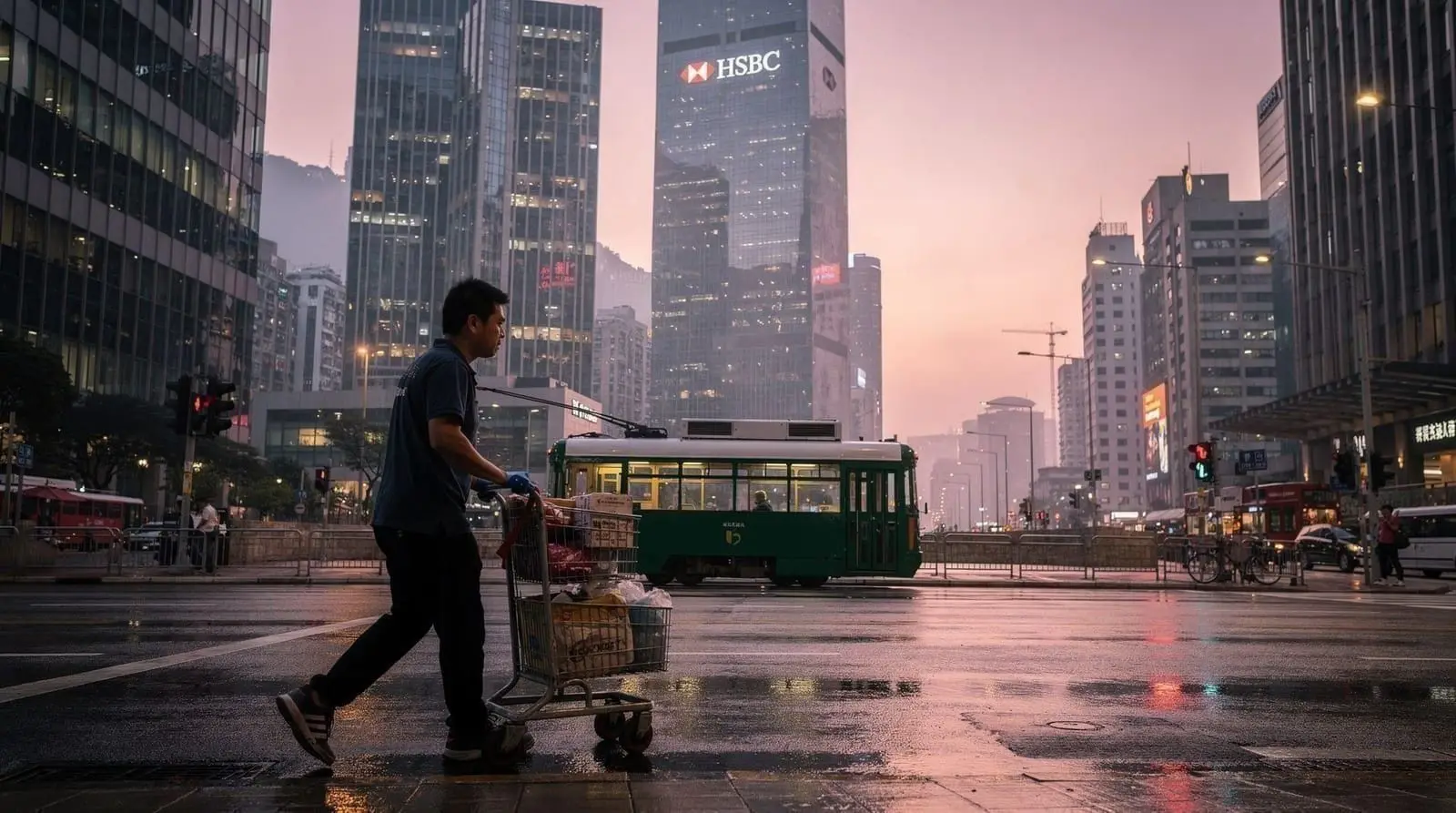
Hong Kong Island is where the city’s reputation was built and where its contrasts are sharpest. You can walk in ten minutes from the glass towers of the IFC to a 150-year-old temple on Hollywood Road; from a three-Michelin-star restaurant to a HKD 45 congee at a market stall that has been there for forty years.
| Where | North shore (Central–Causeway Bay) plus the quieter south side |
| Cost | Tram HKD 3; Peak Tram round trip HKD 90; meals HKD 40–350 |
| Time needed | 1–2 days for the north shore; 3 days with the south side |
| Getting there | MTR Island Line; tram (ding ding) for the north shore corridor |
| Best time | October–April for comfortable walking and hiking weather |
The north shore — from Sheung Wan through Central, Wan Chai, and Causeway Bay to Chai Wan — is a continuous dense urban strip, connected by the HK Tram (ding ding), the MTR, and the iconic Mid-Levels Escalator. The south shore is a different proposition: quieter villages, real beaches, and the trail network that makes Hong Kong’s hiking reputation legitimate.
Getting onto and around the Island
From the MTR’s Hong Kong station (Central) you’re immediately in the financial core. From Admiralty you can walk to Pacific Place mall and Harcourt Road. From Wan Chai and Causeway Bay stations you surface directly onto the commercial streets that make sense of Hong Kong’s shopping density.
The HK Tram (the ding ding — named for its bell) runs the full east–west length of the north shore, from Kennedy Town (westernmost) to Shau Kei Wan (east). Flat fare HKD 3 with Octopus. It’s slow — 10–15 km/h in traffic — but an excellent orientation ride, and the views from the upper deck through North Point and Causeway Bay are worth it. Do not take it if you’re in a hurry.
The Central–Mid-Levels Escalator runs from Queen’s Road Central up the hill through SoHo to Conduit Road. Free, open daily from 6:00–10:00 am (runs downward, for commuters) and 10:00 am–midnight (upward). 800 metres long. The streets branching off it — Shelley Street, Staunton Street, Elgin Street — are where Hong Kong’s best casual restaurants concentrate.
Central: finance, food, and colonial bones
Central is both the business district and the visitor hub, and the two coexist without too much friction. The old architecture on Pottinger Street, the granite steps of Duddell Street (the last surviving Victorian gas lamps in Hong Kong, lit every night), and the 1913-era Legislative Council Building are a 10-minute walk from the IFC towers.
Man Mo Temple on Hollywood Road is the most atmospheric temple on Hong Kong Island — permanently fragrant with coils of incense suspended from the ceiling, two deities (Man, god of literature; Mo, god of war), and a neighborhood that transitions from temple-supply shops to high-end antique dealers within two blocks. Free entry; open daily 8:00 am–6:00 pm.
PMQ (Police Married Quarters) on Aberdeen Street is a former colonial police barracks converted into a design market with 100-plus independent designer studios. Quality varies enormously, from tourist-grade ceramics to genuinely excellent Hong Kong-designed fashion and homewares. Free to browse; weekends are most active.
Lan Kwai Fong: the bar strip south of D’Aguilar Street. Mostly for the early-to-mid-career expat crowd and tourists. Drinks are expensive (HKD 80–120 for a cocktail), quality is adequate rather than excellent. Go on a Friday evening for the street energy; skip it otherwise in favor of the better bars in Wan Chai or the rooftop bars in Sheung Wan.
The Peak: what to do, what to skip
Victoria Peak at 552 metres gives you the panorama that defines Hong Kong in every photograph. The view is real and worth the effort. What requires navigation is the tourist infrastructure layered on top.
The Peak Tram has been running since 1888 and the ride itself — 27 degrees of incline, city dropping away beneath you — is one of Hong Kong’s genuine experiences. From the lower terminus at Garden Road (MTR: Central, exit J2, then 10-minute walk uphill or minibus 1A) to the upper terminus: 7–8 minutes. Single journey HKD 52 upward / HKD 37 downward; round trip HKD 90. Buy the combined Peak Tram + Sky Terrace 428 ticket in advance to use the priority lane — weekend queues can be 45–60 minutes for walk-up buyers.
Book your Peak Tram + Sky Terrace ticket with priority accessSky Terrace 428: the glass observation deck at the top. HKD 100–130 separate entry. Worth it for 360-degree views including the south side of the island, which you can’t see from the tram terminus. What to skip: the Peak Tower shopping mall and the Madame Tussauds inside it. Overpriced and unnecessary.
Peak Circle Walk: the circular path around the peak at 400 metres altitude, 3.5 km, roughly 1 hour, free. Starts and ends at the Peak Tower. This gives you views that the terrace doesn’t — westward toward Lamma Island, north toward Kowloon, east toward Quarry Bay. Wear comfortable shoes and go in the morning before clouds build.
Lugard Road and Harlech Road: the quieter sections of the walk. Almost no one beyond the first 400 metres from the terminus. Excellent birding in the trees.
Sheung Wan and SoHo: the authentic side
Sheung Wan (west of Central, MTR: Sheung Wan) has Hollywood Road — antiques, galleries, and Buddhist supply shops — running east–west through the neighborhood. The antique shops on the upper section (west of Central Police Station) are genuine dealers; the eastern end gets more tourist-grade. Browse freely; you are expected to ask prices before committing.
SoHo (South of Hollywood Road, up the Escalator) is the cluster of restaurants and bars that makes Hong Kong’s casual dining so disproportionately good. Staunton Street and Elgin Street have the densest concentration. Recommendations that hold up in 2026: Chachawan (Thai, HKD 200–350/person), Posto Pubblico (Italian, HKD 280–400), and the cluster of Japanese izakayas on nearby Peel Street. Mid-range dinner runs HKD 200–350 per person without wine.
The Cat Street Market (Upper Lascar Row, just off Hollywood Road): flea market for vintage antiques, Mao-era memorabilia, old coins, and miscellaneous objects. Bargain to 40–50% of the opening price. Mornings are best; most stalls close by 5:00 pm.
Wan Chai: the city’s working core
Wan Chai (east of Central, MTR: Wan Chai) has been the city’s working-class neighborhood, red-light district, and now a mix of offices, wet market, and some excellent restaurants. The Wan Chai Wet Market on Cross Street (open 6:00 am–1:00 pm) is one of Hong Kong’s best — not a tourist attraction but a working market where restaurant chefs shop. Stalls sell fresh seafood, char siu, tofu, and vegetables at prices significantly below supermarkets.
Roast meats: several excellent roast meat shops within 5 minutes of the MTR. Sun Sin Kee on Johnston Road has been doing char siu and roast goose since the 1980s. A lunch plate with rice, char siu, roast goose, and vegetables runs HKD 65–90 (USD 8–12).
Lockhart Road in the evening still has the bar density it always did; the tone has shifted from expat sailor bars to a mix of local bars, sports-screening venues, and a few live music venues. Less edgy than its reputation suggests. Quality beer at Wanch on Jaffe Road; reasonable cocktails at Roundhouse Taproom.
Hong Kong Arts Centre and the surrounding museum strip near Wan Chai MTR: the Hong Kong Museum of Art (reopened 2019 with modernized galleries), the Hong Kong Arts Centre with rotating exhibitions, and the Convention and Exhibition Centre with harbor views. Museum entry HKD 10–50.
Causeway Bay: shopping density
Causeway Bay (MTR: Causeway Bay, exit E) is where Hong Kong’s shopping density peaks. Times Square mall, SOGO department store, and Hysan Place stack seven to nine floors of retail each. The blocks between them — Lee Garden Road, Leighton Road, Jardine’s Crescent — have street-level boutiques ranging from local fashion designers to knock-off watch dealers.
Jardine’s Crescent market (open to late evening): fresh food, cheap clothing, and household goods in a covered street market. Not a tourist market — prices are local, stalls are utilitarian. Excellent for budget cooking supplies or casual day-to-day shopping.
Victoria Park: large public park between Causeway Bay and Tin Hau, open dawn to 10:30 pm. Morning tai chi, flower market stalls on weekends, tennis courts. During the Mid-Autumn Festival (September/October) the park hosts the largest lantern-lighting event in Hong Kong. The typhoon shelter east of the park has floating restaurants — atmospheric but overpriced; treat as an experience rather than a value meal.
Dragon’s Back and the south side
Dragon’s Back is consistently rated among Asia’s top urban hikes, and for once the superlative is accurate. The 8.5 km trail (grade: easy-moderate) runs along a ridge above Big Wave Bay on the east side of Hong Kong Island, with unobstructed South China Sea views on both sides at the ridge. Trailhead at To Tei Wan (Bus 9 from Shau Kei Wan MTR) or Tai Tam (various buses); the trail ends at Shek O village with a famous local dai pai dong and a bus back to town. Allow 2–2.5 hours for the hike itself, 4–5 hours with transport and lunch. No entrance fee.
Aberdeen fishing village on the south shore retains some of the floating village character that made it famous, though the actual population living on boats is now small. The Jumbo Kingdom floating restaurant had its moment of fame (and sank controversially in 2022 while being towed — a genuine tourist trap avoided by its own removal). The Aberdeen sampan rides (small boats touring the typhoon shelter and remaining boat households, HKD 80–120 per person) are atmospheric and worth 30 minutes.
Stanley on the southern peninsula was the island’s British colonial town and still has a pleasant market, a reasonable seafood waterfront, and the 19th-century Murray House. The Stanley Market (daily 10:30 am–6:30 pm) sells linens, tourist goods, and casual clothing at prices lower than tourist-facing Kowloon. Bus 6 from Central Bus Terminus (Exchange Square); 30–40 minutes.
Book a guided Dragon’s Back hike with transport and local guideNorth shore vs. south side: how to split your time
| North shore (Central–Causeway Bay) | South side (Dragon’s Back, Stanley, Aberdeen) | |
|---|---|---|
| Character | Dense, urban, commercial | Quiet, coastal, hiking and beaches |
| Minimum time | 1 full day | Half a day |
| Getting there | MTR direct | Bus or minibus, 25–40 min from Central |
| Best for | First-time visitors, food, shopping | Repeat visitors, hikers, a change of pace |
| Combine with | Kowloon for the harbor view | Lantau Island for more nature |
If you only have one day on Hong Kong Island, stay on the north shore — Central, Sheung Wan, the Peak. If you have two or more, dedicate a half or full day to the south side; it feels like a different city entirely and most first-timers are surprised how close it is. One day is genuinely enough to cover the north shore essentials (Central, the Peak, a dim sum lunch) but it means skipping Dragon’s Back and the south side entirely — a real trade-off worth deciding on before you land rather than mid-trip.
Where to stay on Hong Kong Island
Hotels on Hong Kong Island cost 15–30% more than equivalent quality in Kowloon for the same standard, but the Central and Wan Chai locations put you walkable to the tram, the Escalator, and the ferry pier.
Luxury: Four Seasons Hotel Hong Kong (8 Finance Street, Central) is the Island’s leading contemporary luxury property — harbor views, Michelin-starred Caprice restaurant, HKD 4,000–8,000 per night. Mandarin Oriental Hong Kong (5 Connaught Road Central) is the heritage counterpart — opened 1963, still impeccably run, HKD 3,500–7,000. Both have direct MTR access (Hong Kong station). Island Shangri-La (Pacific Place, Admiralty) is fractionally more accessible at HKD 2,000–4,500 with an excellent atrium and a strong buffet breakfast.
Mid-range: JW Marriott at Pacific Place (Admiralty) is efficient and well-connected. HKD 1,500–2,500. Bishop Lei International House (4 Robinson Road, Mid-Levels) is a budget-friendly guesthouse with a pleasant view from mid-levels — HKD 600–900 per night with genuine value.
Budget: The cheapest legitimate hotels on the Island side run HKD 700–1,000. L’hotel Causeway Bay Harbour View and the Hotel Proverbs Hong Kong (Wan Chai) are in this range. Below HKD 700, Kowloon is a better option.
Eating and drinking: a street-level summary
The Escalator corridor (Staunton, Elgin, Shelley streets) has the densest casual restaurant concentration in Central. Budget HKD 150–350 per person for dinner at the mid-range restaurants here. For a cheaper evening, walk 200 metres west to the cha chaan tengs on Stanley Street or to the ramen on Wellington Street: HKD 60–120 per person.
Breakfast: Best value is a cha chaan teng set — scrambled egg and spam on toast, instant noodles in soup, or congee, with Hong Kong milk tea or yuenyeung (coffee-tea mix). HKD 40–60. Every neighborhood has one. Look for the Formica tables and the handwritten menu on the wall.
Dim sum at lunch: Lin Heung Tea House on Wellington Street (Central) is the old-style dim sum institution — no English menu, no concessions, trolley service, genuinely excellent cooking. Arrive before 11:00 am for a seat. Budget HKD 120–200 per person for a proper dim sum lunch.
Night dining: The cluster of Cantonese restaurants on Elgin Street and the surrounding blocks serves until midnight. For post-midnight eating, the 24-hour cha chaan tengs on Johnston Road in Wan Chai are the practical option.
Drinking: Soho and Lan Kwai Fong are the established bar districts. Craft beer is stronger in the Wan Chai / Kennedy Town scene: The Globe on Graham Street, Roundhouse Taproom on Lockhart Road, and Young Master Brewery’s taproom in Kennedy Town are the references. Cocktail bars in the IFC and Pacific Place mall arcades cater to the finance crowd: expensive (HKD 130–180 per cocktail), high quality.
Practical transport summary
Trams: Flat fare HKD 3 (Octopus). Slow but good for short hops along the northern shore when you’re not in a rush.
Minibuses: Green minibuses cover routes not on the MTR network. Fares HKD 3–7; pay with Octopus on most routes. The minibus from Admiralty to Stanley (green 40) takes 25 minutes; Bus 6 from Exchange Square also covers the route for HKD 9.
Taxis: Red taxis cover Hong Kong Island. Flag fall HKD 27. Most drivers navigate via phone GPS now; English is usually adequate. Traffic on the northshore (Connaught Road, Des Voeux Road) is heavy during rush hours — walk or take the tram for short distances.
Peak-hour MTR: 8:00–9:30 am and 5:30–7:00 pm southbound/northbound on the Tsuen Wan and Island lines hit genuine crush conditions. Wait one train if you have luggage; the next train is never more than 4 minutes.
Star Ferry connection: The Star Ferry from Central Pier 7 to Tsim Sha Tsui (HKD 5, 8–10 minutes) is both a practical Kowloon connection and one of Hong Kong’s best-value sightseeing experiences — the harbor crossing at dusk, with the skyline lighting up on both sides, rivals anything on a paid cruise. See the Star Ferry guide for the full timetable and photography tips, and the Symphony of Lights guide if you want to time the crossing around the nightly light show.
Weather note: Hong Kong Island’s hills mean noticeably cooler air at the Peak than at sea level — bring a light layer even on a warm day, since the temperature difference can be 3–5°C. Summer humidity (June–September) makes the Dragon’s Back hike considerably more strenuous than the distance suggests; carry more water than you think you’ll need and start early to beat both the heat and the afternoon thunderstorm risk.
Winter (December–February) is comfortably cool for both walking and hiking, occasionally dipping cold enough in the evenings that a jacket is genuinely useful — a rarity for a subtropical city, and the clearest skies of the year for photographing the harbor from the Peak or the Sky Terrace, making it the single best season to visit if photography is a priority.
Internal connections for planning
For the Kowloon side of the harbor, see the Kowloon destination guide and Tsim Sha Tsui guide. For outlying islands, see the Lantau Island guide. For the full planning structure of a Hong Kong visit within a Pearl River Delta trip, see the Hong Kong and Macau 4-day itinerary and the Shenzhen and Hong Kong 5-day itinerary.
For things to do beyond what’s covered here — cultural experiences, cooking classes, boat tours — see the Hong Kong things to do hub.