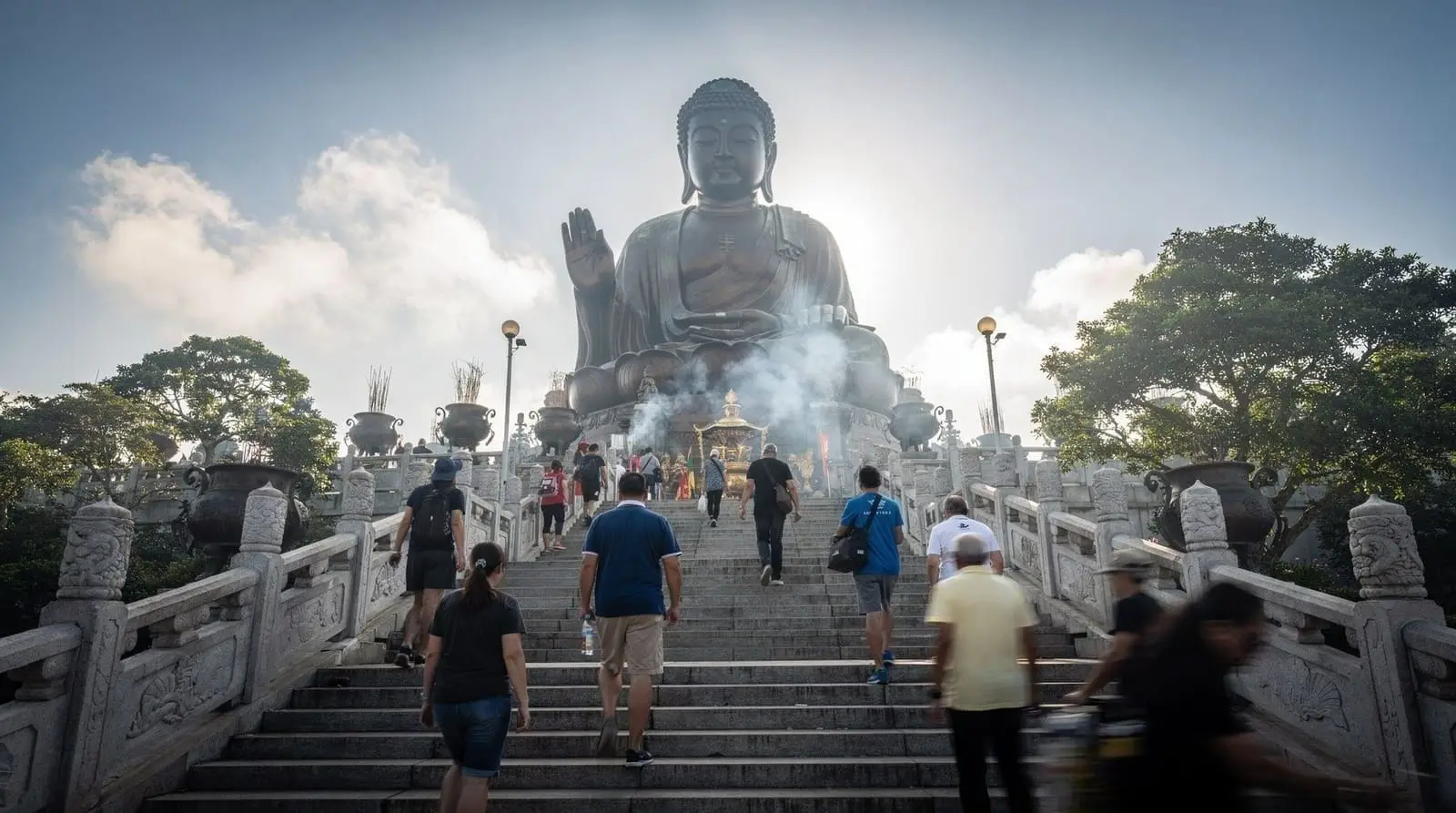
Lantau is Hong Kong’s largest island — larger than Hong Kong Island itself — and yet it holds about one-tenth the population. Most of it is country park, with the peaks of Lantau Peak (934 m) and Sunset Peak looming over the western reaches, the fishing village of Tai O preserved in its stilt-house form, and the Tian Tan Buddha sitting at 500 metres altitude with its back to the sea.
This is a different Hong Kong from the urban density of Kowloon or Hong Kong Island. The pace is slower by Hong Kong standards (which means merely busy rather than frantic), the air is cleaner, and there are enough quiet walking trails through village landscapes and mountain terrain to spend multiple days without repeating a step.
Two caveats: the Ngong Ping cable car and the Big Buddha area are genuinely popular and genuinely crowded on weekends and public holidays. And Hong Kong Disneyland, while a legitimate day out for families, is an entirely separate experience from the island’s natural and cultural attractions — plan them on different days.
| Where | West of Hong Kong Island, MTR Tung Chung Line |
| Cost | Cable car around HKD 235; Big Buddha steps HKD 45; ferry HKD 22–40 |
| Time needed | 1 day for Big Buddha + Tai O; separate day for Disneyland |
| Getting there | Tung Chung MTR (28 min from Central) or ferry to Mui Wo |
| Best time | October–April for clear cable car views; weekdays for smaller crowds |
Getting to Lantau
MTR Tung Chung Line: From Hong Kong station (Central) to Tung Chung takes 28 minutes, HKD 22.10. This is the base for the cable car, Citygate Outlets mall, and buses to Ngong Ping, Tai O, and Mui Wo. The airport and HZMB bridge port are also at the western end of this line.
Ferry from Central Pier 6 to Mui Wo: 35 minutes on the express, HKD 40 (ordinary ferry HKD 22, 55 minutes). Mui Wo is the main town on Lantau’s east coast, with bus connections to Ngong Ping and Tai O. The ferry approach gives you the first aerial view of Lantau’s mountains.
Bus from Tung Chung: Bus 23 runs Tung Chung → Tai O (45–50 minutes, HKD 11.70); Bus 11 runs Tung Chung → Ngong Ping (25 minutes, HKD 7 — available when cable car is closed or for budget access).
For Disneyland: Sunny Bay MTR station (Tung Chung Line, then transfer to the Disneyland Resort Line, 2 stops).
Ngong Ping and the Big Buddha
Ngong Ping 360 cable car: 25 minutes from Tung Chung tower to the Ngong Ping plateau, crossing Tung Chung Bay and rising into the mountains. The standard cabin fits 8 people; the crystal cabin has a glass floor. Standard return HKD 235 adult; crystal cabin HKD 340. Book online for the priority boarding lane — weekend walk-up queues regularly reach 60–90 minutes.
Book Ngong Ping 360 cable car tickets with priority boardingTian Tan Buddha: The 34-metre seated bronze Buddha is genuinely impressive at scale — the largest outdoor seated bronze Buddha in the world when completed in 1993. Visible from the cable car approaching and from the plateau below. Climbing the 268 steps to the base platform (HKD 45) is worthwhile for the close-up views and the perspective looking down over the Po Lin Monastery courtyard. The Buddha’s face is expressive rather than serene — worth examining closely. Free to view from the plaza; the interior (with relic chamber) is included in the step-climb ticket.
Combine Big Buddha entry with skip-line cable car accessPo Lin Monastery: The working Zen Buddhist monastery adjacent to the Big Buddha. The main hall dates from 1985; the complex has been expanded significantly around the Buddha. The vegetarian lunch at the monastery restaurant (HKD 120–160 per person, midday–2:00 pm) is good and popular — arrive by 11:30 am to secure a seat. The monasticenvirons are worth 30 minutes of walking without paying for anything.
Ngong Ping village: The plaza around the cable car terminal has the expected tourist infrastructure — Wisdom Path (38 wooden lotus columns inscribed with the Heart Sutra, genuinely beautiful, free, 5-minute walk from the plaza), and the Walking with Buddha exhibition. Avoid the Ngong Ping 360 theme street package and the character shows — they add cost without adding substance.
What to skip: The cable car company sells multiple “experience packages” combining the ride with cultural shows and meals at inflated prices. The cable car itself is the experience. Buy the cable car ticket and navigate everything else independently.
There is a footpath under the cable car, and it changes the visit entirely: a private hike to the Big Buddha from Tung Chung climbs the same route the monks used, with the statue appearing gradually instead of all at once.
Tai O: the fishing village that stayed
Tai O is on Lantau’s western coast — 45 minutes by bus from Tung Chung (Bus 23) or Ngong Ping (Bus 21). The village is built on a tidal channel and the surrounding stilts, with houses extending over the water on wooden and metal poles that have been here for generations. The village has roughly 2,000 residents, compared to a historical peak of 40,000 when fishing and salt-evaporation were the local industries.
This is genuine working-class Cantonese village life, not a theme park recreation. The population is elderly; younger generations have moved to urban Hong Kong. What remains is atmospheric: the colourful painted houses on stilts, the winding alleys between them, the smell of drying shrimp paste and salted fish from the stalls along the main market street, the small boats in the channel.
The waterway: Sampan boat tours of the channels run from the rope bridge area (HKD 60–80 per person, 20 minutes). You may spot Chinese white dolphins in the outer estuary — sightings are not guaranteed but not rare either. A longer boat tour focusing on dolphin-watching (1–1.5 hours, HKD 200–300) departs from the same area.
Shrimp paste: Tai O’s renowned preserved shrimp paste (har cheung) is a Cantonese cooking staple. The best comes in small earthenware jars from the family shops along Tai O Market Street — not from the tourist-facing stalls at the village entrance. Price HKD 30–60 per jar; worth bringing home.
Food in Tai O: The seafood restaurants on the waterfront serve fresh catch at decent prices (HKD 200–350 per person for a proper meal). The market stalls sell dried seafood snacks — dried squid, shrimp crackers — at HKD 10–30 each. Lunch at The Tai O Heritage Hotel (the former police station, now a boutique hotel and restaurant) is more expensive (HKD 280–450 per person) but the courtyard setting and the Cantonese food quality justify the premium.
Lantau hiking: what’s accessible
The 70 km Lantau Trail loops the island in 12 sections. Most sections are moderate to strenuous; Lantau Peak (section 3–4) is challenging with 400+ metre elevation gain. All sections are free and open.
Accessible day sections:
Section 2 (Mui Wo to Pui O): 5.5 km along the south coast, beach access at Cheung Sha (one of Hong Kong’s longest beaches), relatively flat. 2–3 hours.
Section 5 (Shek Pik to Fan Lau): 7 km of the south coast with reservoir views. Trailhead reachable by bus from Tung Chung.
Section 7 (Pak Kung Au to Ngong Ping): 5.8 km with Lantau Peak ascent options. Demanding but rewarding; best in clear autumn weather for views north to Guangdong.
Hiking from Tung Chung to Ngong Ping (avoiding the cable car): the Ngong Ping Sunset Peak Trail climbs 7.5 km with 550 m elevation gain. Allow 3–4 hours. Shuttle back via Bus 11 to Tung Chung.
Hong Kong Disneyland
Hong Kong Disneyland (MTR: Disneyland Resort) opened in 2005 and is the smallest of the six Disney parks globally. That smaller scale is actually its main advantage for families with young children — the park is walkable in a single day without feeling rushed, queues are generally shorter than at Tokyo or Shanghai Disneyland, and the Fantasy Castle expansion (completed 2023) added a full Frozen, Tangled, and Rapunzel land complex.
Admission 2026: HKD 689 (adult), HKD 499 (children 3–11). Book online for the 10% discount and to guarantee entry on peak days (Christmas, CNY, summer holidays). The park operates on timed-entry on busy days.
For families visiting Hong Kong with children, Disneyland is typically one of two or three full-day activities (the other usually being Ocean Park). It is not worth visiting as a solo adult or couple without strong Disney enthusiasm — the park is good at what it does, but what it does is specifically for families.
Mui Wo and the east coast
Mui Wo (Silvermine Bay) is the main town on Lantau’s east coast, connected to Central by ferry (35 minutes express / 55 minutes ordinary, HKD 22–40) and to Tung Chung and Ngong Ping by bus. It’s a quiet residential town rather than a tourist destination — a good base for hikers tackling the Lantau Trail sections from the east, and for families wanting a beach alternative to the western villages.
Silvermine Bay Beach immediately southwest of the ferry pier: public beach, clean, lifeguards May–October, changing facilities. Not Hong Kong’s most impressive beach (Cheung Sha on the south coast is better) but accessible without a significant walk. Small restaurants and cafes along the waterfront charge HKD 80–150 for lunch.
Buses from Mui Wo: Bus 1 to Ngong Ping (55 minutes, HKD 19); Bus 2 to Tung Chung (35 minutes, HKD 15.40). These mountain bus routes climb and descend through the center of the island on roads with significant views when not in cloud.
Cheung Sha and the south coast beaches
Lantau’s south coast (Bus 1 from Mui Wo, 20 minutes; or Bus 11 from Tung Chung, 25 minutes) holds two of Hong Kong’s best beaches:
Upper Cheung Sha Beach: 1.5 km of sand, the longest natural beach in Hong Kong. Wide beach with gentle slope; suitable for families with young children. Surf can reach 1 metre on southwest swell. Changing rooms, barbecue pits, and the Stoep restaurant (South African-influenced, HKD 150–250 per person, one of Hong Kong’s better beach restaurants) sits at the north end.
Lower Cheung Sha: the southern section, quieter and slightly rockier, with a more local clientele. Fewer facilities but less crowded.
Pui O Beach: east of Cheung Sha, accessible by Bus 1 from Mui Wo. Buffalo wander the adjacent wetlands — Lantau’s water buffalo are a wild remnant of its agricultural past and now protected. The area around Pui O has a cycling path (bicycle hire available at Mui Wo, HKD 40–80 per half-day) running through the Buffalo land.
Choosing your Lantau day: three itineraries compared
Lantau rewards a focused day more than an attempt to see everything. Here’s how the three main options compare:
| Itinerary | Time needed | Approx. cost/person | Best for |
|---|---|---|---|
| Big Buddha + Tai O | Full day | HKD 300–400 (cable car, food, transport) | First-time visitors, culture and village atmosphere |
| Lantau Trail hiking (Section 2 or 7) | Full day | HKD 50–100 (transport + snacks) | Hikers wanting mountain and coastal scenery |
| Hong Kong Disneyland | Full day | HKD 700–900 (ticket + food) | Families with young children |
Combining Big Buddha and Tai O in one day is realistic and popular — most visitors do exactly this. Combining a hike with the Big Buddha area is possible only for the shorter sections (2 or 5); Disneyland genuinely needs its own day given the admission cost and the different pace. For a broader look at family-oriented Hong Kong planning beyond Lantau, see the Hong Kong with kids guide, and for a comparison with Hong Kong’s other big theme park, the Ocean Park guide.
When to visit: month-by-month
| Months | Cable car visibility | Crowds | Notes |
|---|---|---|---|
| Oct–Nov | Best — clear autumn air | Moderate, busier on weekends | Ideal for hiking Lantau Peak and photography |
| Dec–Feb | Good, occasional cold fronts | Lower on weekdays | Cooler temperatures suit long walks |
| Mar–Apr | Good, improving | Rising toward Easter | Comfortable temperatures before summer humidity |
| May–Sep | Poor — frequent fog and rain | High on weekends, lower on weekdays | Cable car closures possible on typhoon days |
Practical information for Lantau
Food: Tung Chung town (adjacent to the MTR station and Citygate mall) has the most consistent food options — the Citygate food court has reliable choices at HKD 60–120 per meal. In Ngong Ping, the monastery vegetarian restaurant is the best lunch option. In Tai O, the waterfront seafood restaurants serve fresh catch. Bring water and snacks for hiking days; resupply points on trails are minimal.
Weather and the cable car: The Ngong Ping plateau is frequently in cloud between May and September. The cable car may close on windy days (typhoon signals 3 and above). Check the Ngong Ping 360 website or app for real-time closure status before making the trip specifically for the cable car. If the cable car is closed, Bus 11 from Tung Chung covers the route but without the aerial views.
Crowds: Ngong Ping and the Big Buddha area are significantly more crowded on weekends and public holidays than weekdays. Arrive before 10:00 am on a weekday for the most comfortable experience. Tai O is busiest on weekend afternoons (11:00 am–3:00 pm) when day-trippers from Tung Chung arrive; early morning or after 4:00 pm is calmer.
Fitness for hiking: The Lantau Peak section (Section 3–4) involves sustained climbing and should not be attempted in summer heat or typhoon approach weather. Other sections are more accessible. Proper hiking shoes (not sandals), 1.5 litres of water per person, sun protection, and a trail map (available free from the Country Parks visitor centre at Tai Po) are minimum kit.
Getting back from Tai O: Bus 21 runs Tai O to Ngong Ping (20 minutes, HKD 8.50) for cable car descent. Bus 23 runs Tai O to Tung Chung (45–50 minutes, HKD 11.70). The last buses from Tai O run around 10:30 pm; check the KMB website for exact last departure times as they change seasonally.
Photography on Lantau
Lantau rewards photographers willing to walk a little further than the Ngong Ping plaza. The Big Buddha from the Wisdom Path viewpoint, five minutes from the cable car terminal, frames the bronze statue against the surrounding hills without the crowd of the main approach steps. At Tai O, the best light on the stilt houses comes in the late afternoon (around 4:00–5:00 pm), when the tide is often out and the sun angles low across the channel — arrive after the day-trip crowds from Tung Chung have thinned.
The Ngong Ping 360 crystal cabin, despite the premium price, gives an aerial perspective over Tung Chung Bay that is otherwise unavailable without a boat or drone. On the south coast, Cheung Sha Beach at sunset (the beach faces roughly southwest) is one of the few spots in Hong Kong where you can photograph an unobstructed sea horizon without towers in the frame.
A quieter alternative base: staying overnight on Lantau
Most visitors treat Lantau as a day trip from central Hong Kong, but overnighting changes the experience meaningfully. Tai O has a handful of guesthouses in converted stilt houses (HKD 400–800 per night) that let you experience the village after the day-trippers leave — genuinely quiet, with only the sound of the tide and the occasional fishing boat. Ngong Ping itself has one hotel (the Ngong Ping SG Davis Hostel, YHA-affiliated, budget dorms and private rooms) useful for an early start on the Lantau Trail or a sunrise view over the Buddha before the crowds arrive.
Tung Chung has standard international hotels (HKD 800–1,500) convenient for the airport and Disneyland but with none of Lantau’s rural character. For most itineraries built around the Hong Kong and Macau 4-day itinerary, a day trip is sufficient — an overnight is worth considering only if hiking multiple Lantau Trail sections or wanting the quiet version of Tai O.
Connecting Lantau to your itinerary
Lantau sits naturally at the end of a Hong Kong visit — arrive from the city, spend the day, then take the MTR from Tung Chung directly to Hong Kong Airport for departure. The Airport Express from Tung Chung adds one station to get to HKIA (3 minutes, HKD 11).
For the broader Pearl River Delta trip, see the Hong Kong and Macau 4-day itinerary and the Hong Kong destination guide. For planning the full PRD loop, see the Pearl River Delta grand loop 10-day itinerary.
For guided options covering the Big Buddha and Tai O village together, the things to do in Hong Kong hub has current tour listings. For the harder Lantau Peak trail and other hikes around the territory, the Dragon’s Back hike guide covers Hong Kong’s other signature trail for comparison, and the markets guide has ideas for a rainy-day alternative if the cable car is closed.