Hong Kong and Macau in 4 days: the classic SAR double
Hong Kong and Macau share the Pearl River estuary and a certain colonial-heritage aesthetic, but they are distinct cities with different languages (Cantonese throughout, but Macau has Portuguese as a co-official language), different food cultures, different streetscapes and wildly different ambitions. Four days split between them — three nights in Hong Kong, one in Macau — is the classic introduction to the two SARs.
| Where | Hong Kong (3 nights) + Macau (1 night) |
| Cost | HK$2,000–3,500/US$256–449 per person, excl. accommodation |
| Time needed | 4 days |
| Getting there | Ferry between the two SARs, 55–70 minutes |
| Best time | October–December or March–April for clear harbour views |
The ferry from Hong Kong to Macau takes 55–70 minutes (depending on departure pier and sea conditions). This plan integrates that crossing seamlessly, with Day 3 as the Macau overnight.
Entry requirements
Both Hong Kong and Macau are Special Administrative Regions of China with separate immigration policies. Most Western passports enter both visa-free for 90 days (varying by nationality). They are separate from mainland China — your mainland China visa (or exemption) does not cover Hong Kong or Macau entry. Double-check your specific passport’s entitlement on the Hong Kong Immigration Department website before travel.
Day 1: Kowloon — markets, temples and the harbour
Morning — Mong Kok and Sham Shui Po
Arrive at Hong Kong International Airport and take the Airport Express to Kowloon (HK$100/US$13, 22 minutes). Check in at your Kowloon hotel. For mid-range: Hotel Pen, Tsim Sha Tsui, from HK$900/US$116/night. Budget: YHA Mei Ho House Heritage Hostel in Sham Shui Po, from HK$420/US$54 (dormitory) — a beautifully converted 1950s housing block with genuine heritage character.
Mong Kok in the morning is the densest urban commercial district in the world by measured density. The Ladies’ Market (Tung Choi Street) runs from 12:00; the electronics and computer zone around Apliu Street Flea Market (Sham Shui Po) opens from 09:00. The Goldfish Market on Tung Choi Street is open from morning and is one of the city’s more eccentric specialised markets.
Breakfast: Mido Café in Yau Ma Tei (美都餐室, 63 Temple Street) is one of the last surviving 1950s-era Hong Kong cha chaan teng (Hong Kong-style café) with the original terrazzo floors and rattan furniture. Milk tea, pineapple bun with butter, scrambled eggs — the full set: HK$55–75/US$7–10.
Afternoon — Wong Tai Sin Temple and Kowloon markets
Wong Tai Sin Temple (黃大仙祠, MTR Wong Tai Sin station) is the busiest Taoist temple in Hong Kong and an active place of worship, not a heritage prop. Fortune telling stalls surround the complex — the kau cim (fortune sticks) consultation with a professional interpreter at the surrounding stalls costs HK$50–100/US$6–13 and is a genuine cultural experience, not a tourist scam (the interpreters are accredited practitioners). Temple entry: HK$2/US$0.25.
The night market on Temple Street (Yau Ma Tei, opens from 17:00) is an institution — mainly tourist-oriented but genuinely entertaining for an hour. Street food stalls at the Yau Ma Tei typhoon shelter serve dai pai dong (open-air restaurant) style: stir-fried clams, steamed fish, wok-fried vegetables for HK$80–150/US$10–19 per person.
Evening — Symphony of Lights harbour cruise
The Tsim Sha Tsui harbourfront at 20:00 is the setting for the Symphony of Lights — a coordinated light and laser show projected across the Hong Kong Island skyline from 20:00 (Mon–Sat). Free from the Avenue of Stars promenade. A harbour cruise during the show is the premium version.
Star Ferry Symphony of Lights harbour cruise — best viewing angle on the waterDay 1 budget: HK$500–750/US$64–96 per person (excluding accommodation).
Day 2: Hong Kong Island — the Peak, Central and Aberdeen
Morning — Peak Tram and Victoria Peak
Take the MTR to Central (exit J2) and walk up Garden Road to the Peak Tram lower terminus. The tram operates from 07:00 and the first ride of the day has the shortest queues. The historical funicular railway dates to 1888 and climbs 373 m on a 27-degree gradient — the angled cabin produces the disorienting impression that the city is tilting. Peak Tram Sky Terrace 428 at the summit offers 360-degree views; clear days (best October–December, March–April) reveal the South China Sea beyond Lamma Island.
Peak Tram and Sky Terrace 428 combo ticket — skip the tram queue onlineThe Peak Galleria above the terminus has a Tim Ho Wan dim sum branch (one of the most accessible of the Michelin-rated chain: HK$130–180/US$17–23 for a full meal). Alternatively walk the Peak Circle Walk (3.5 km, free, well-signposted) before descending by bus No. 15 to Central.
Afternoon — Sheung Wan and the Western District
The SoHo-Hollywood Road area in Sheung Wan blends 19th-century warehouse buildings with contemporary galleries and restaurants. The Man Mo Temple on Hollywood Road (1847, free entry) is the oldest remaining place of worship in the city. Pottinger Street — a narrow stone-stepped lane unchanged since the colonial period — connects Hollywood Road to the Mid-Levels escalator below.
Pawn (The Pawn, 62 Johnston Road, Wan Chai) is a restored 1888 pawnshop now operating as a restaurant: Cantonese-British fusion menu, HK$180–250/US$23–32 for lunch. More affordable: Tai Cheong Bakery (泰昌餅家, 35 Lyndhurst Terrace, Central) — the egg tarts are a legitimate city institution at HK$13/US$1.7 each.
Evening — Aberdeen typhoon shelter and dinner
Bus 70 or 72 from Exchange Square to Aberdeen. The working typhoon shelter still houses a few dozen fishing families on live-aboard junks. Sampan tours (HK$60–80/US$7.7–10, negotiate at the pier) offer a 30-minute circuit of the shelter. Jumbo Kingdom floating restaurant was towed away in 2022, but Aberdeen Promenade has several good seafood restaurants: The Floating Restaurant (Aberdeen Restaurant Ltd) does market-price seafood (HK$200–350/US$26–45 per person).
Day 2 budget: HK$700–1,100/US$90–141 per person.
Day 3: ferry to Macau — peninsula history and Cotai casinos
Morning — ferry crossing
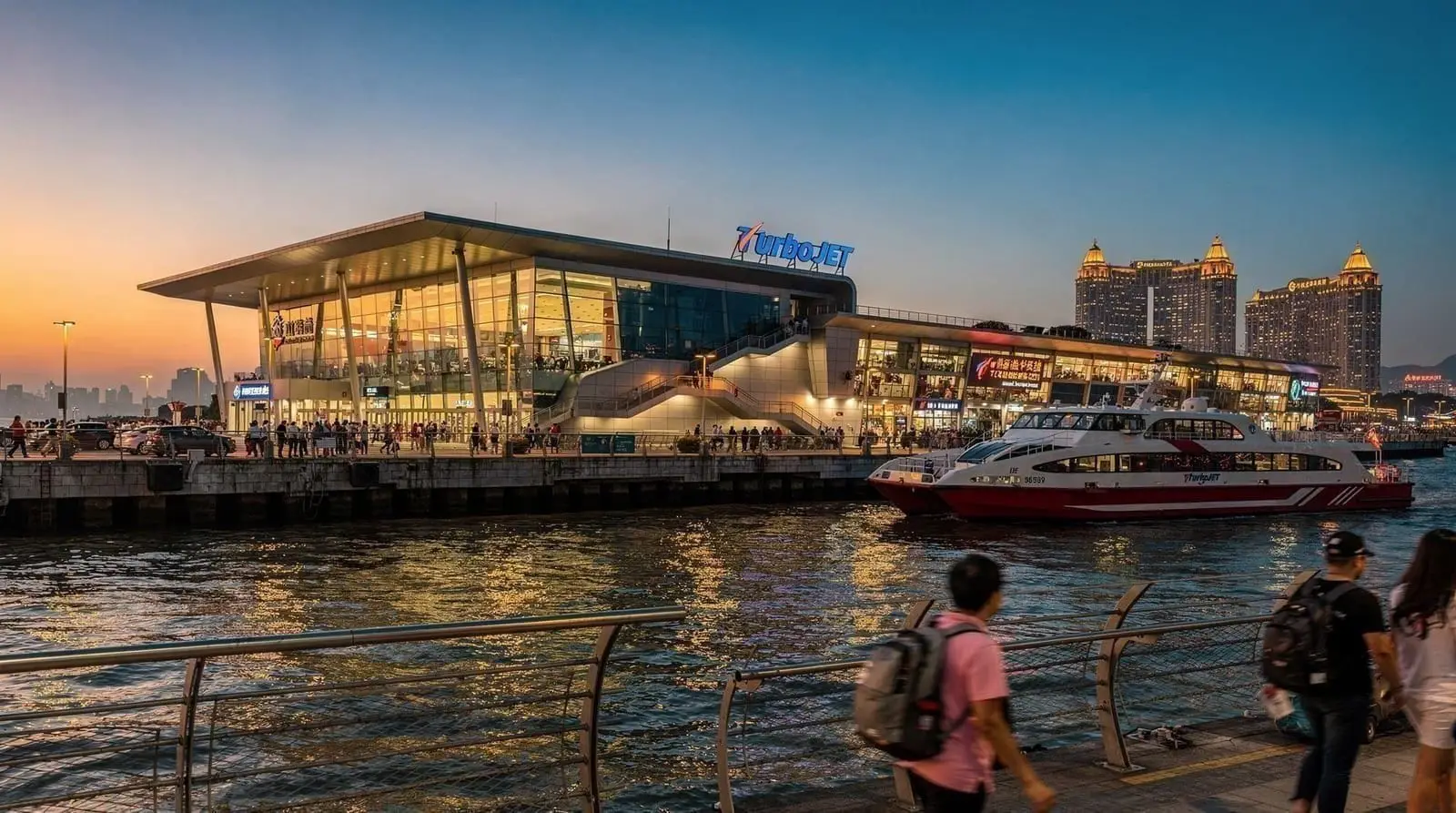
Turbojet and Cotai Water Jet ferries depart from Hong Kong Macau Ferry Terminal (Sheung Wan, opposite the Shun Tak Centre) and from Hong Kong International Airport Temporary Ferry Terminal. Journey time: 55–70 minutes. Standard economy: HK$160–200/US$21–26 one way; weekend premium: up to HK$280/US$36. Book in advance online (especially on weekends when the ferry is used by Macau gamblers returning from Hong Kong visa runs).
Hong Kong to Macau ferry tickets — book in advance for weekend crossingsAfternoon — Macau Peninsula historic centre
The Macau Peninsula UNESCO World Heritage core (inscribed 2005) covers 22 Portuguese colonial-era buildings and public spaces within walking distance of each other. Start at the Ruins of St Paul’s (聖保祿天主堂遺址), the baroque facade of a 17th-century Jesuit church, now one of Asia’s most photographed monuments. The National Museum of Macau (behind the ruins, MOP$15/US$2) explains the layered Macanese-Chinese history well.
Senado Square (議事亭前地) — the Portuguese-patterned black-and-white wave mosaic plaza — is the city’s civic centre. On the surrounding streets: pastelaria (pastry shops) selling pastéis de nata (egg tarts, MOP$7/US$0.9 each — slightly different from the Hong Kong version, slightly better). Ceramicarte pottery shop on Rua da Felicidade sells hand-painted azulejos (Portuguese tiles) from MOP$80/US$10.
Lunch at Restaurante Litoral (海灘餐廳, 261 Rua do Almirante Sérgio) — the best Macanese restaurant in the city, serving African chicken, caldo verde and Portuguese bacalhau (salt cod). Lunch for two: MOP$280–380/US$35–47.
Evening — Cotai Strip casinos
The Cotai Strip on the reclaimed land between Taipa and Coloane islands is the world’s highest-grossing casino zone (surpassed Las Vegas on gross gaming revenue in 2007 and has not looked back). The Venetian Macao is the spectacle: a 1:1 replica of the Grand Canal in Venice inside a 40-floor casino hotel, with gondoliers singing Italian arias at MOP$118/US$15 per ride. No entrance fee; the casino floor is open to non-gamblers.
The Wynn Palace has a 3-D projection mapping show on its exterior performance lake (nightly at 20:00, free from the main entrance). MGM Cotai has rotating art installations in its Grand Spectrum atrium.
Dinner: The Venetian food court has surprisingly good Cantonese roast meats (MOP$65–85/US$8–11) alongside an international spread. Or Sands Cotai Central’s The Plaza food hall for more variety at MOP$80–120/US$10–15.
Accommodation in Macau: Mid-range — Four Points by Sheraton Macao, Cotai Central (from MOP$750/US$94/night). Budget — San Va Hospedaria on Rua Felicidade (from MOP$280/US$35/night, historic 1920s guesthouse, shared bathrooms).
Day 3 budget (Macau day): MOP$500–800/US$62–100 per person.
Day 4: Macau Tower and return to Hong Kong
Morning — Macau Tower and Coloane
Macau Tower (澳門旅遊塔) on the southern peninsula tip offers the observation deck (MOP$155/US$19) and the world’s highest commercial bungee jump (233 m, MOP$2,988/US$373 — advance booking essential). For non-jumpers, the SkyWalk along the outer rim of the observation deck (MOP$558/US$70 for the full circuit) is hair-raising enough.
Macau Tower observation deck ticketColoane Village (take Bus 25 from central Macau, 30 minutes) is the undeveloped outlying island that escaped the casino frenzy. Lord Stow’s Bakery (路氏葡撻, 1 Rua do Tassara) invented the Macau egg tart formula in 1989 — the queue is always long, the tart is always worth it (MOP$15/US$2). The village chapel (1928) and the black-and-white painted streets are genuinely tranquil.
Afternoon — return ferry to Hong Kong
Ferries back to Hong Kong depart from the Macau Ferry Terminal in the Outer Harbour or from Taipa Ferry Terminal (Cotai). The Cotai Water Jet from Taipa to Hong Kong Macau Ferry Terminal takes 55 minutes. Book in advance — weekend afternoon departures sell out.
Return to Hong Kong airport or onward travel. If departing from HKG, the Airport Express from Hong Kong station (Central) takes 24 minutes (HK$115/US$15) and allows in-city luggage check-in for most airlines.
Day 4 budget: MOP$300–500 + HK$200–400/US$65–115 per person.
Total 4-day budget (mid-range, excluding accommodation): HK$2,000–3,500/US$256–449 per person including ferry costs.
Ferry or HZMB bridge to Macau?
This plan uses the ferry because it is simpler for most itineraries — direct from a Hong Kong Island pier to central Macau in under 70 minutes, no bus transfer required. The Hong Kong–Zhuhai–Macau Bridge is the more interesting option if you also want to see Zhuhai, or if you are travelling with luggage you would rather not carry through a ferry terminal. The HZMB bridge guide covers both directions, the separate departure terminal on Lantau, and why the crossing takes about the same total time as the ferry once you account for the shuttle bus.
Macau beyond the Cotai casinos
If four days feels heavy on gambling-adjacent spectacle, it does not have to be — the historic centre and the Macanese food scene are substantial enough to fill the entire Macau day without setting foot on a casino floor. The Macau historic centre guide has a self-guided walking route through all 22 UNESCO sites, and the Macanese food guide explains why the cuisine (a genuine Portuguese-Chinese-African fusion, not a marketing term) deserves more attention than it gets from casino day-trippers.
Extending to Shenzhen or Guangzhou
Four days covers Hong Kong and Macau well but leaves out the mainland entirely. If your schedule allows a fifth or sixth day, crossing to Shenzhen from Hong Kong takes as little as 8 minutes by the West Kowloon HSR — see the Shenzhen and Hong Kong 5-day itinerary for how to fold in a mainland leg without disrupting this plan’s structure. For a full multi-city loop instead, the Pearl River Delta grand loop uses this exact 4-day HK/Macau block as its middle section.
Frequently asked questions about Hong Kong and Macau in 4 days
Do I need separate visas for Hong Kong and Macau?
Yes — Hong Kong and Macau have separate immigration policies from mainland China and from each other. Most Western passports enter both SAR visa-free (usually 90 days for Hong Kong, 30–90 days for Macau depending on nationality). Confirm your specific passport entitlement.
How do I get from Hong Kong to Macau?
By high-speed ferry from either the Hong Kong Macau Ferry Terminal in Sheung Wan or the Cotai Water Jet pier at the Hong Kong Macau Ferry Terminal. Journey 55–70 minutes. Alternatively, use the Hong Kong–Zhuhai–Macau Bridge (HZMB) by bus or shuttle — 45-minute crossing, but requires a separate departure terminal on Lantau Island (Passenger Clearance Building). For most visitors, the ferry is simpler.
Is Macau just casinos?
No. The UNESCO historic centre is substantial and genuinely moving — a Portuguese colonial city of the 17th–19th centuries that coexists with Chinese temples and markets. The Cotai casino strip is a distinct zone you can engage with or ignore. Many visitors find the mix of baroque ruins, pastelarias and Macanese cuisine more interesting than the casinos.
What is the best area to stay in Hong Kong?
Tsim Sha Tsui in Kowloon gives the best harbour views, easiest access to the Star Ferry, and proximity to the night markets and Temple Street. Hong Kong Island’s Sheung Wan and Wan Chai have better independent restaurants and nightlife. For airport access, Tsim Sha Tsui and Central are equally convenient via the Airport Express.
Can I visit Hong Kong and Macau without visiting mainland China?
Yes — both are completely separate from mainland China entry requirements. You can visit both SARs without a Chinese visa or a mainland visit. If you also want to add Shenzhen or Guangzhou, see the Shenzhen and Hong Kong 5-day itinerary.
Should I take the ferry or the HZMB bridge between Hong Kong and Macau?
For most travellers without a car, the ferry is simpler — direct pier-to-pier in under 70 minutes. The bridge is worth considering if you also want to see Zhuhai on the same crossing, or if you would rather avoid a ferry terminal with heavy luggage; see the HZMB bridge guide for the full comparison.
Top-rated things to do in Hong Kong
Verified deep-linked GetYourGuide tours. Book through these links and we earn a small commission at no cost to you.