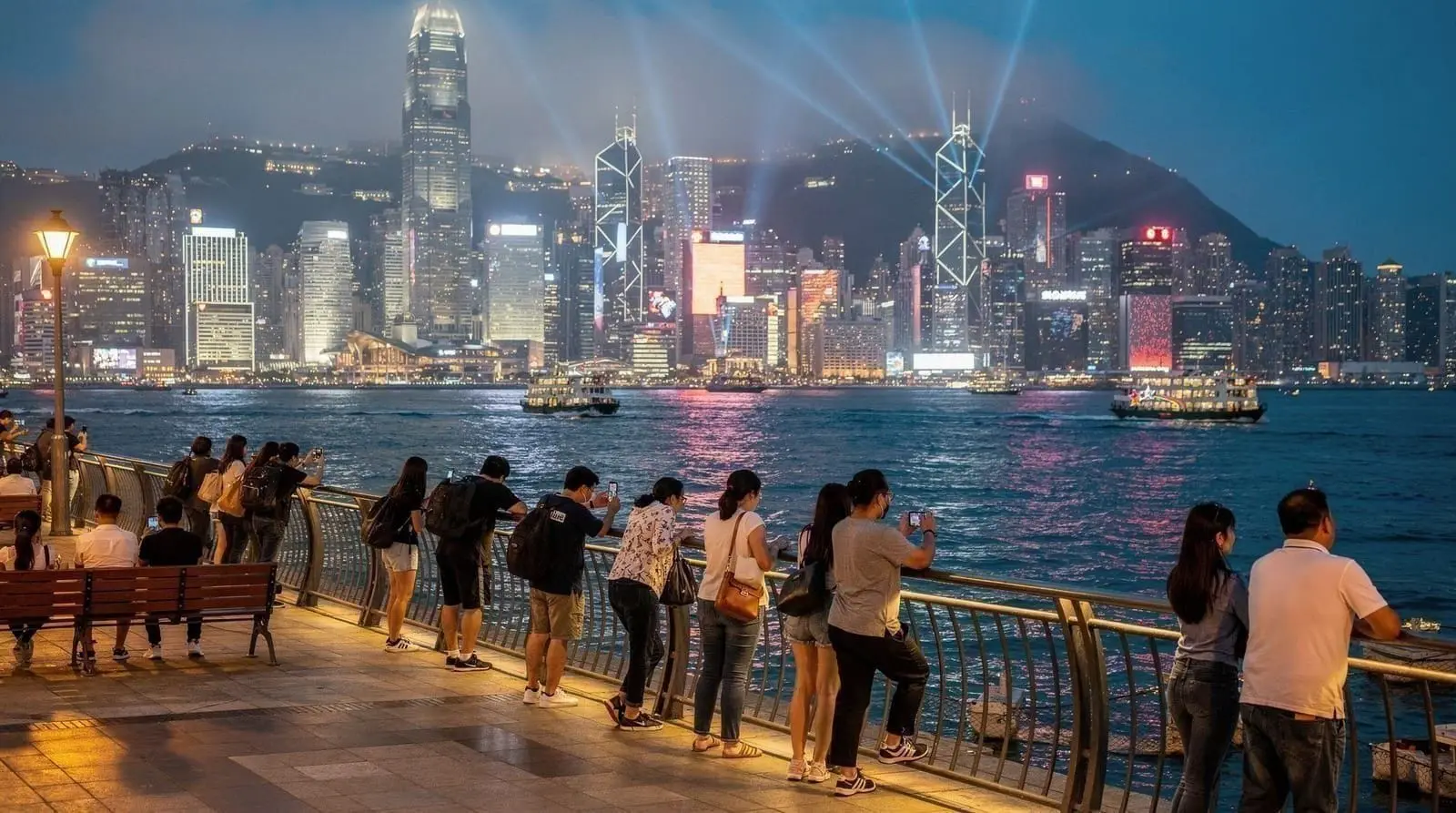
Cross Victoria Harbour from Hong Kong Island’s Central on the Star Ferry for HKD 4.40 and Kowloon announces itself immediately as a different proposition. The streets are louder, the neon is denser, the smells from roast meat shops and street stalls hit you before you’ve left the ferry pier. This is where Hong Kong’s working-class Cantonese culture is most concentrated and where the city’s best-value eating sits.
| Where | Southern tip of the Kowloon Peninsula, Hong Kong |
| Cost | Hotels 15–30% cheaper than the Island; meals HKD 45–180 |
| Time needed | 1 full day minimum; 2 days for Mong Kok, Sham Shui Po, Wong Tai Sin |
| Getting there | Star Ferry (8 min) or MTR from Hong Kong Island |
| Best time | October–April; avoid June–September typhoon season |
Kowloon occupies the southern tip of the mainland peninsula that extends toward Victoria Harbour. Its southern apex — Tsim Sha Tsui — has the harbor views and the upscale hotels. North from there, the density increases: Jordan, Mong Kok, Prince Edward, Sham Shui Po. Each district has a distinct character while running together in the kind of unbroken urban fabric that makes Hong Kong what it is.
Getting around Kowloon
The MTR’s Tsuen Wan Line is the backbone: Tsim Sha Tsui → Jordan → Mong Kok → Prince Edward, all walkable intervals apart. The Kwun Tong Line adds access to Wong Tai Sin and Kowloon Bay. The West Rail Line connects to Sham Shui Po and runs northwest toward Yuen Long and the New Territories.
Nathan Road is the main north–south artery and one of Hong Kong’s most famous shopping streets — though its significance has faded somewhat as retail has spread throughout the peninsula. Still useful as a navigation spine.
Minibuses fill the MTR gaps. Bus 1 and 1A cover Nathan Road from the Star Ferry terminal to Mong Kok. Fares HKD 3–6, pay with Octopus.
Jordan: the transition district
Jordan sits between the tourist polish of Tsim Sha Tsui and the working-class energy of Mong Kok. Several things worth seeking out:
Temple Street Night Market (MTR: Jordan, walk north on Temple Street): open daily from around 5:00 pm to midnight. Cheap electronics, phone cases, tourist-grade watches, Cantonese opera singers near the temple at the north end, and fortune tellers in small stalls. The market restaurant stalls along the western side serve adequate dai pai dong food (HKD 60–100 per person) — treat it as atmospheric rather than culinary. Bargain at every stall; 40–60% of opening prices is realistic for non-electronics items.
The Jade Market (under the elevated road near Jordan Road and Kansu Street, MTR: Jordan): daytime market of roughly 450 stalls selling jade, pearls, and semi-precious stones. Open daily 10:00 am–6:00 pm. Understanding jade quality takes more expertise than a tourist can acquire in 20 minutes; most stalls sell tourist-grade stones at tourist prices. Worth browsing for atmosphere; spend serious money on jade elsewhere (reputable stores in Central with authentication).
Good food at Jordan prices: Yue Kee (Reclamation Street, 15-minute walk north of Jordan MTR) is a casual roast goose restaurant with a 60-year track record. Roast goose on rice HKD 80–110. Kam’s Roast Goose on Jordan Road (the branch, not the flagship in Wan Chai) has Michelin recognition and HKD 120–180 plates of its celebrated goose — still exceptional value.
Mong Kok: the full-force version
Mong Kok (MTR: Mong Kok or Prince Edward) was for decades cited as the world’s most densely populated district — the exact ranking has shifted, but the density remains visceral. Sai Yeung Choi Street South (the Pedestrian Zone) on weekend evenings becomes a moving crowd of remarkable compression. It’s worth experiencing once.
The Ladies’ Market on Tung Choi Street: fashion, accessories, phone cases, cheap jewellery from 400-plus stalls. Open noon–11:30 pm daily. Prices start at absurdity and end at 50–60% of opening with confident bargaining. Quality is variable. Better for casual summer clothing and accessories than for anything requiring quality confidence.
Sham Shui Po (MTR: Sham Shui Po) is where Mong Kok’s density meets genuine utility. Apliu Street flea market deals in second-hand electronics — camera lenses, old phones, components, military surplus, vintage audio. Prices are often genuinely low if you know what you’re buying. Cheung Sha Wan Road has Hong Kong’s fabric district — wholesale and retail textile merchants, useful if you’re having clothing made.
Tim Ho Wan original (Kwong Wa Street, Sham Shui Po): The world’s most affordable Michelin-starred restaurant. HKD 18–52 per basket of dim sum, star earned in 2010 and held since. The baked BBQ pork buns are the signature; the shrimp dumplings (har gow) and turnip cakes are close runners. Arrive before 10:00 am to avoid waits. Open daily from 9:00 am.
Chi Lin Nunnery (MTR: Diamond Hill): a 1990s-rebuilt Tang Dynasty Buddhist nunnery and the adjacent Nan Lian Garden — landscaped grounds with lotus ponds, pavilions, and a permanent exhibition of Buddhist art. Free entry to the garden; free entry to the nunnery. One of the few genuinely quiet large spaces in Kowloon. Open daily 9:00 am–5:00 pm (nunnery); 7:00 am–9:00 pm (garden).
Wong Tai Sin Temple (MTR: Wong Tai Sin): Hong Kong’s most active Taoist temple complex, visited by locals for fortune-telling and prayer rather than tourism. The smoke from thousands of incense sticks, the forecourt crowded with worshippers shaking the fortune-stick cylinders, the fortune readers clustered in the arcade outside — this is sincere religious practice, not performance. Free entry (donation appreciated). Open daily 7:00 am–5:30 pm.
Take a guided tour of Wong Tai Sin and understand the ritualsSham Shui Po is the district that has resisted the rents, and it eats accordingly: a food tour of Sham Shui Po covers the cha chaan tengs and the noodle shops that the guidebooks put in Central at three times the price.
Kowloon food: the honest briefing
Kowloon’s food is better per dollar than Hong Kong Island’s, and in some categories — roast meats, dai pai dong, old-style noodle shops — it’s better period. What you give up is the concentration of high-end international restaurants (more of those sit in Central and Wan Chai). What you get is depth of authentic Cantonese cooking.
Congee: Sang Kee (Dundas Street, Mong Kok) serves Cantonese congee in the traditional style — smooth, long-cooked rice porridge with preserved egg and pork (pei dan sau yuk), or fish, or sampan-style with multiple toppings. HKD 45–70 a bowl. Open from 7:00 am.
Wonton noodles: Mong Kok is full of noodle shops; the ones without English menus and with three items on a handwritten sign are usually the most reliable. Look for bright shrimp-pink wontons floating in a clear pork bone broth.
Dim sum lunch: Lin Heung Kui (Sham Shui Po) is the Kowloon equivalent of Lin Heung Tea House — traditional-style yum cha with carts still circulated by servers calling out items. Arrive before 10:30 am for the full cart experience.
Street food on Fa Yuen Street (between Dundas Street and Nelson Street, Mong Kok): one of Hong Kong’s better casual street food strips — fish balls, curry squid, egg waffles, stinky tofu. Prices HKD 10–25 per item. Evenings are most active.
Kowloon for cultural experiences
Join a Kowloon markets, food, and culture walking tourThe Hong Kong Museum of History (Chatham Road South, MTR: Tsim Sha Tsui) has the best overview of Hong Kong’s history from prehistoric times through the handover and beyond. Permanent exhibition HKD 30; temporary exhibitions vary. Closed Tuesdays.
Kowloon Walled City Park (MTR: Lok Fu or Kowloon Bay) occupies the site of the former Walled City — the famously ungoverned enclave demolished in 1994. The park is a standard Qing Dynasty-inspired garden now, but the remaining gate house has a well-presented photographic history of the Walled City that’s worth 30 minutes. Free entry, open daily 6:30 am–11:00 pm.
Kowloon City (MTR: Kowloon Tong, then cab or walk) around the demolished Kai Tak runway area is in ongoing redevelopment, but the Thai food district around Lung Kong Road remains — a concentrated strip of Thai restaurants serving to the large Thai community in the district. Genuinely good Thai food at HKD 100–150 per person, distinct from the pan-Asian restaurant version.
Kowloon Park (MTR: Tsim Sha Tsui): A genuine green break in the peninsula’s densest tourist zone, with an aviary, a Chinese garden section, and an outdoor swimming pool complex open to the public in summer. Free entry to the park itself; the pool has a small admission fee. Sunday mornings bring a gathering of domestic workers on their day off, picnicking and socializing across the lawns — a genuine slice of Hong Kong’s social fabric rather than a curated attraction, and a useful reminder that Kowloon’s density coexists with real, lived-in public space.
Where to stay in Kowloon
Kowloon is generally 15–30% cheaper for equivalent hotel quality than Hong Kong Island, which makes it the sensible base for most visits.
Budget (HKD 300–600 per night): Chungking Mansions (36–44 Nathan Road, TST) has dozens of guesthouses across its 17 floors. The building is entirely legitimate — ignore the dramatic reputation from Wong Kar-wai films. Rooms are tiny but functional; most include breakfast. The security guard system (bags scanned on entry) is standard and effective. Similarly, Mirador Mansions (54–64 Nathan Road) has a similar guesthouse setup with fractionally better average quality.
Mid-range (HKD 800–1,600 per night): The Mira Hong Kong (118 Nathan Road, Mong Kok) is a design-led hotel with reasonable amenities and a good pool. iclub Sheung Wan Hotel on the Island side is comparable but this note focuses on Kowloon. Hotel Panorama (8A Hart Avenue, TST) has harbor views from upper floors without the flagship-hotel pricing.
Luxury (HKD 2,500+): The Peninsula Hong Kong (Salisbury Road, TST) is the reference — opened 1928, maintained impeccably, rooftop helipad, Rolls-Royce fleet for transfers. Worth the lobby visit for the architecture even if not staying (afternoon tea in the lobby, HKD 480 per person, is a genuine Hong Kong institution). InterContinental Hong Kong (18 Salisbury Road) has the best harbor-view rooms in Kowloon; upper floors with Victoria Harbour aspect are among the most photographed hotel rooms in Asia.
Practical logistics for Kowloon
Getting to Kowloon from the airport: Airport Express to Kowloon station (28 minutes, HKD 105); taxi approximately HKD 280–350 plus tunnel toll. The Airport Express allows in-town check-in at Kowloon station — you can drop bags and check in before continuing to your hotel, very useful for early arrivals.
Crossing to Hong Kong Island: Star Ferry from TST Pier 7 to Central Pier 7 (8 minutes, HKD 4.40) or to Wan Chai (10 minutes, HKD 4.40). These are the most pleasant options and the ones that preserve the harbor experience. Alternatively, the MTR via Tsuen Wan Line through the Cross-Harbour Tunnel (3 minutes, HKD 10–12) is faster and air-conditioned but loses the scenery entirely.
Useful Kowloon apps: Google Maps works normally in Hong Kong and has accurate MTR overlays. CityMapper Hong Kong has good minibus routing. The MTR mobile app has fare calculators and route planning. Octopus app (iOS/Android) can top up your Octopus card without a kiosk.
Mobile payment: Octopus pays for almost everything in Hong Kong. Beyond that, most restaurants and shops in Kowloon accept Visa and Mastercard. Mobile payment (Apple Pay, Google Pay) accepted at most convenience stores, MTR gates, and larger merchants. WeChat Pay and Alipay are also accepted at many Kowloon merchants — particularly useful if coming from Shenzhen where you’ve already set up Alipay.
Safety note: Kowloon is safe by any global standard. The only area requiring routine caution is around Chungking Mansions, where touts and currency exchange operators can be persistent. Walk past without engaging if not interested; the police kiosk on Nathan Road directly opposite the building is always staffed. Mong Kok on weekend evenings is crowded but not dangerous.
Weather note: Kowloon’s dense street canyons trap heat more than the Island’s harbor-facing waterfront, so summer walking (June–September) feels noticeably hotter and more humid at street level in Mong Kok or Sham Shui Po than on a breezy Central sidewalk. October–April is comfortable for the extended walking that markets and food streets reward; carry water and take shade breaks in the shopping malls if visiting in summer.
Connectivity: Hong Kong has no internet restrictions, so a VPN isn’t needed within Kowloon itself. If your trip also includes Shenzhen or Guangzhou, set up your mainland eSIM and VPN before crossing — see the eSIM and VPN in China guide for the mainland side of the same trip.
Day-trip logic from Kowloon
Kowloon’s position in the wider Pearl River Delta is significant: the West Kowloon High Speed Rail Terminus (MTR: Austin station, 5 minutes from TST) connects directly to Shenzhen Futian in 14 minutes and to Guangzhou South in 47 minutes. This makes Kowloon the natural hub for a multi-city PRD trip — you can breakfast in Kowloon, lunch in Shenzhen, and return for dinner.
The HZMB connection to Macau starts from the Hong Kong Port on Lantau (MTR: Tung Chung Line to Tung Chung, then shuttle bus 10 minutes to the port): total from TST approximately 60–75 minutes. Or take the ferry from the Shun Tak Centre in Sheung Wan, a 15-minute MTR ride from TST.
For the full Pearl River Delta multi-city planning, see the Pearl River Delta grand loop 10-day itinerary and the greater Bay Area 2-week itinerary.
Kowloon vs. Hong Kong Island: the honest comparison
| Kowloon | Hong Kong Island | |
|---|---|---|
| Hotel cost | 15–30% cheaper for equivalent quality | Higher, but walkable to the tram and Escalator |
| Food value | Better per dollar — roast meats, dai pai dong | More high-end international dining |
| Atmosphere | Denser, louder, more working-class Cantonese | More colonial, financial, polished |
| Markets | Temple Street, Ladies’ Market, Apliu Street | Cat Street, PMQ design market |
| Full guide | — | Hong Kong Island and Central |
Most repeat visitors end up basing in Kowloon for value and food, then crossing to the Island for the Peak, the tram, and an evening or two in SoHo — the 8-minute Star Ferry makes switching sides a non-decision rather than a commitment.
Connecting to the wider trip
Kowloon is covered in more detail from the Tsim Sha Tsui page for the southernmost tip. The Hong Kong guide overview connects Kowloon to the full itinerary. For things to do beyond this page, see the Hong Kong things to do hub. The Shenzhen and Hong Kong 5-day itinerary allocates specific Kowloon time within the broader Pearl River Delta loop.