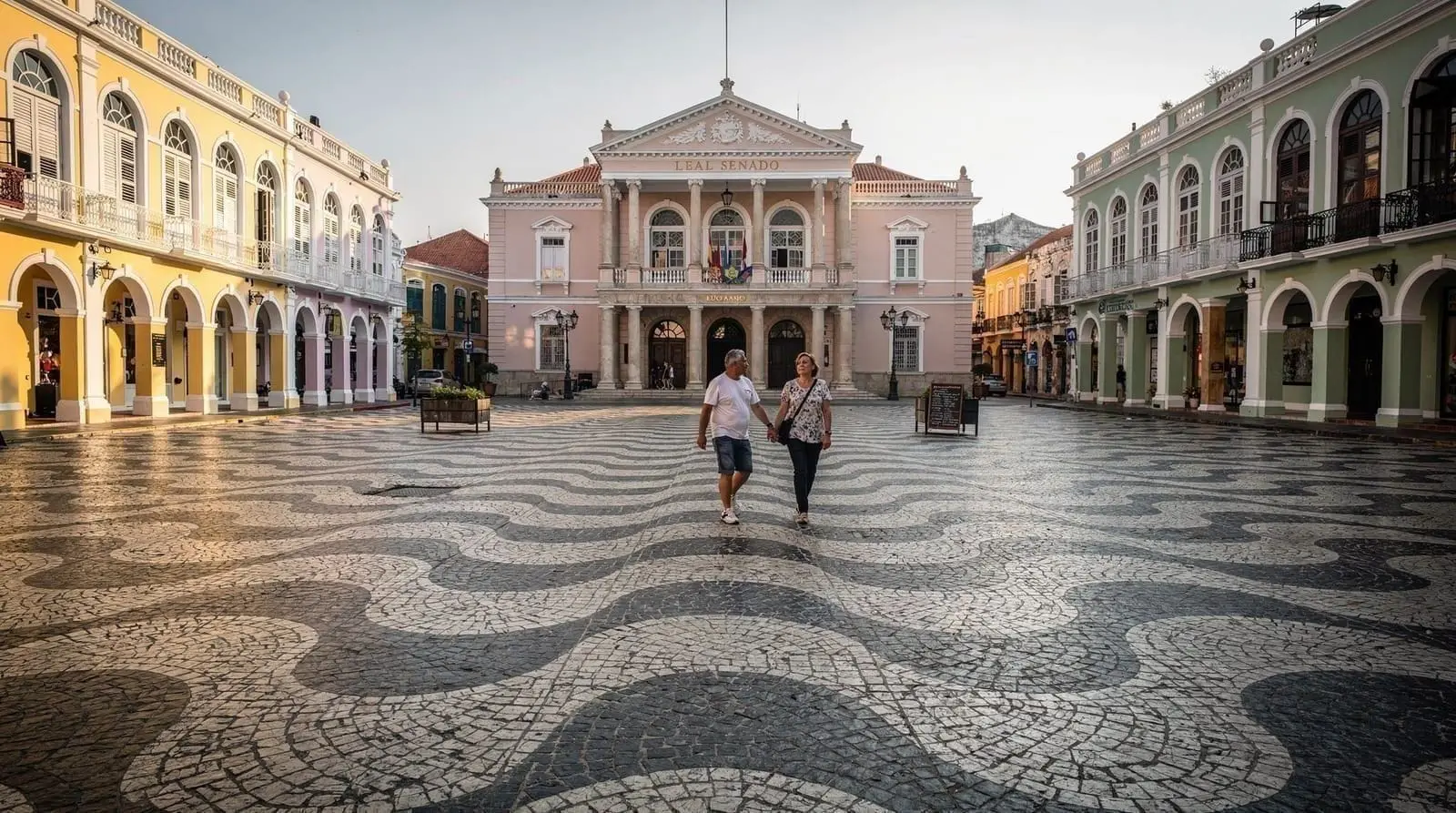
The Macau peninsula is where the city’s 500-year history as a Portuguese trading port is most legible. The streets here follow the logic of a different era — steep alleys between whitewashed baroque churches, mosaic pavements around plazas named for Portuguese saints, incense-fogged Taoist temples within 50 metres of 18th-century Catholic convents. It is a genuinely unusual place, not quite Chinese and not quite European, and the UNESCO designation (2005) reflects this uniqueness correctly.
The full Macau guide covers entry logistics, ferry options, and the broader itinerary. This page focuses on what to see and do on the peninsula itself, including Taipa village across the first of the two bridges to Cotai.
| Where | Macau peninsula, connected to Taipa by bridge |
| Cost | Most temples/ruins free; museum entries around MOP 5–15 |
| Time needed | 1 full day for the UNESCO circuit; half a day more for Taipa |
| Getting there | Bus 32 from Outer Harbour terminal, or a 10-minute walk |
| Best time | Weekday mornings for photography; October–April for comfortable walking |
The UNESCO historic circuit: a practical walk
Start at Senado Square (Largo do Senado) — the ferry terminals have buses (route 32 from Outer Harbour, 5 minutes) or a 10-minute walk inland. The square’s black-and-white stone mosaic paving pattern (limestone and basalt, Portuguese wave design) extends for 200 metres. The Leal Senado building (the Senate, now the Institute for Civic and Municipal Affairs) on the north side is one of Macau’s finest colonial buildings — the courtyard is open to visitors and has a library upstairs with a painted ceiling. Free; open Monday–Saturday 9:00 am–9:00 pm.
From Senado Square, the church of São Domingos (St. Dominic’s) is 30 metres north — a cream-and-white Baroque church with a museum of sacred art in the sacristy above. Free; open 10:00 am–6:00 pm daily. The main nave is cool and quiet even when the square outside is busy.
Continue north uphill along Rua do São Paulo — a 200-metre shopping street of souvenir shops, bakeries, and egg tart vendors — to the Ruins of St. Paul’s. The facade stands alone because the church behind it burned in 1835 and the ruins were left as a monument. Read the carved stonework carefully: it encodes Jesuit theology in a visual narrative — the Virgin Mary defeating evil, Japanese martyrs, a Tempest-ship, Hell. The Portuguese and Chinese iconography is deliberately and carefully combined. The crypt below the stairs houses Christian relics and a small museum; free entry, open daily 9:00 am–6:00 pm.
Walk left from the top of the St. Paul’s stairs 200 metres to the Fortaleza do Monte (Monte Fort): the hilltop fortress and the Macau Museum inside it (MOP 15 entry, closed Monday). The battlements give the best panoramic view of the peninsula — the Macau Tower to the south, the Grand Lisboa’s egg-shaped tower in the middle ground, the Inner Harbour and the mainland beyond.
Na Tcha Temple: immediately to the right of the Ruins of St. Paul’s (east side, barely visible from the main tourist flow). A tiny 1888 Taoist temple dedicated to the child warrior deity Na Tcha. Its proximity to the Catholic church is the best physical illustration of Macau’s religious pluralism. Free; open 8:00 am–5:00 pm.
Walk south and west 20 minutes to reach A-Ma Temple (Rua de São Tiago da Barra) at the southern tip of the peninsula. The oldest temple in Macau (circa 1488), dedicated to A-Ma the sea goddess. Five pavilions climb the hillside in a meandering path; the highest gives water views toward the Outer Harbour. Free entry; open 8:00 am–6:00 pm.
Take a full-day walking tour of the Macau peninsula, Taipa, and ColoaneThe Inner Harbour district
The Inner Harbour (Porto Interior) is Macau’s working waterfront — a row of crumbling two- and three-storey colonial buildings along the waterfront road (Rua das Lorchas), with the Pearl River estuary on one side and the Portuguese-named streets of Barra on the other. This is less manicured than Senado Square and more atmospheric for it.
The harbor itself is still used by fishing boats and the smaller Zhuhai–Macau ferries. In the morning, the smell of fish and brine is intense; by mid-morning it has cleared to something more neutral. The buildings along Rua das Lorchas have not all been preserved; some are mid-demolition or awaiting decisions. Walk it now — in five years this area may look significantly different.
Pawnshops and heritage buildings: Macau’s pawnshop trade is historically significant (Cantonese-Portuguese partnership financing trade). Several historic pawnshop towers survive along Avenida de Almeida Ribeiro — recognizable by their battlemented parapet style. One has been converted into the Grand Lisboa hotel.
Eating on the peninsula: where locals go
The tourist-facing restaurants around Senado Square and the Ruins of St. Paul’s are generally adequate but priced at tourism premium. Two blocks away, prices drop significantly and authenticity increases:
A Lorcha (Rua do Almirante Sergio 289, near A-Ma Temple): One of Macau’s most respected Macanese restaurants, run by the same family since 1991. Portuguese salt cod (bacalhau) and African chicken are the signatures. Lunch and dinner; MOP 180–280 per person. Reservations recommended for dinner.
Espaco Lisboa (Rua das Gaivotas, Coloane village — technically not the peninsula, but 30 minutes by taxi): Worth the trip for serious Macanese food tourists. Smaller menu, more precise execution of traditional dishes.
Rua da Felicidade (Street of Happiness, between Senado Square and the Inner Harbour): Macau’s former red-light district is now a restored heritage street of red-lantern-hung two-storey houses, most converted to cafes and casual Macanese restaurants. The street photography is excellent. Eat here at lunchtime for a full Macanese lunch at MOP 80–130 per person. Avoid the tourist-facing spots; walk the full street and choose based on what’s busy with locals.
Café Sao Paulo (Rua do Cunha, Taipa): Among the best quick egg tart and coffee stops. The Portuguese-style custard tarts (MOP 8–10) with a bica espresso (MOP 15) is the appropriate Macau breakfast.
Lord Stow’s Bakery (Rua do Tassara, Coloane Village): The original Portuguese egg tart bakery founded by Andrew Stow in 1989. The flaky-crust version sold here is the original form that later franchised across Macau and Hong Kong. Queue expected on weekends; MOP 10–12 per tart.
Taipa village: across the first bridge
Taipa village is connected to the peninsula by the Taipa bridges and accessible by free casino shuttle or a MOP 50–70 taxi from the Outer Harbour terminal. It predates the Cotai reclamation and retains a distinct character — Portuguese-influenced townhouses on the main streets (Rua do Cunha, Rua do Carmo), a village square with the church of Our Lady of Carmel, and the Taipa Houses Museum (five restored colonial villas showing domestic life from the early 20th century; entry MOP 5, closed Monday).
Rua da Cunha (the main market street, Taipa village): 200 metres of bakeries, pork chop bun vendors, dried seafood stalls, and casual restaurants. This is Macau’s best street food concentration. Budget MOP 20–50 for a snack tour of the street; MOP 100–150 for a sit-down meal at one of the casual restaurants.
Pork chop bun: The competition between Taipa bakeries for the best pork chop bun is sincere. Pou Tai Un (Rua do Cunha) and its neighbors each have loyalists; the differences are slight. Buy from whichever has the shortest queue as a proxy for freshness.
Taipa village by night: The lanterns light up after 6:00 pm and the crowd is a mix of Macanese families, Hong Kong visitors, and resort guests. More atmospheric than during the afternoon tourist peak. The restaurant terraces along Rua do Carmo are pleasant for an outdoor dinner before returning to Cotai.
Grand Lisboa and the casino approach
If you want to see one casino on the peninsula, the Grand Lisboa (Avenida de Lisboa) is the one — the gold egg-shaped tower is Macau’s visual landmark (the tallest building on the peninsula at 261 metres) and the casino floor below it has the art collection that distinguishes it from generic casino floors: Han Dynasty bronzes, Tang horses, Qing jade, and Song ceramics are displayed in cases among the slot machines. The Robuchon au Dôme restaurant at the top carries Joel Robuchon’s legacy (three Michelin stars; MOP 2,000+ per person).
The casino architecture tour guide approach — treating Cotai and the peninsula casinos as architectural tourism without gambling — is entirely valid and the casinos do not require you to play to enter the non-gaming floors.
Rainy day and hot weather options
Macau’s summer humidity and occasional heavy rain (June–September) can make an all-day walking circuit uncomfortable. On those days, the peninsula still has good indoor options: the Macau Museum inside Fortaleza do Monte (MOP 15) is air-conditioned and covers roughly 45 minutes of history; the Grand Lisboa’s non-gaming floors, including the art collection, are free to walk through and fully covered; and the Wynn Macau’s Performance Lake and Tree of Prosperity show (peninsula side, near the Outer Harbour terminal, free every 15–30 minutes) gives an air-conditioned lobby stop between outdoor sections.
If the rain is heavy, shift the day toward Taipa’s covered market street rather than the peninsula’s open plazas — the awnings along Rua da Cunha offer more continuous shelter than Senado Square. Umbrellas are sold cheaply (MOP 20–40) at convenience stores throughout the peninsula if you’re caught without one.
Coloane: beyond the peninsula and Taipa
Coloane is the southernmost part of the Macau SAR, connected by road from Taipa and by bus (Route 26A from central Macau, 40 minutes, MOP 6). It is the quietest corner of Macau — a handful of villages, hiking trails, two beaches, and the Lord Stow’s Bakery that started the Portuguese egg tart craze.
Coloane Village: The village square has the Chapel of St. Francis Xavier (1928, small but architecturally elegant), a bronze statue of the navigator Zheng He, and the terrace cafes of Café Nga Tim on one side. Lord Stow’s Bakery is 100 metres down the main lane — queue expected on weekends, MOP 10–12 per tart. This is the original Andrew Stow recipe; the many “Lord Stow’s” branches elsewhere in Macau and Hong Kong are licensed but this is where it started.
Hac Sa Beach: Macau’s largest beach, 1.5 km of dark volcanic sand on Coloane’s southern shore. Black sand beach (hac sa means “black sand” in Cantonese) — unusual enough to register visually. The Fernando’s restaurant at the north end of the beach has been serving Portuguese grilled chicken and bacalhau to repeat customers for 30+ years. HKD 150–250 per person for a full lunch with wine. Cash only, no reservations, queues on weekends.
Seac Pai Van Park: Country park at Coloane’s western end with a walking trail, aviary, and a small zoo. More useful for families with children than dedicated sightseers. Free entry; open daily 9:00 am–7:00 pm.
Coloane Trail: 8 km hiking circuit through the Coloane hills, reaching Alto de Coloane (170 m, a small peak by any standard but with views over the Zhuhai border and across the Pearl River estuary). Allow 2.5–3 hours for the full loop. Trailhead near the Seac Pai Van bus stop. Comfortable footwear required; the trail has several steep sections.
Peninsula, Taipa, or Coloane: where to spend limited time
If you have less than a full day, this comparison helps decide where to focus:
| Area | Character | Time needed | Best for |
|---|---|---|---|
| Peninsula (Senado Square, St. Paul’s) | Dense UNESCO heritage, most crowded | 3–4 hours | First-time visitors, photography, egg tarts |
| Taipa village | Portuguese townhouses, best street food | 2–3 hours | Macanese food, quieter than the peninsula |
| Coloane | Village, beach, hiking trail | Half day | Escaping the crowds, Lord Stow’s original bakery |
A single full day covers the peninsula circuit plus Taipa comfortably. Coloane is worth adding only on a second day or if you specifically want the beach or hiking trail — see the Macau with kids guide for how families typically split the time.
Gambling context for the peninsula
The Macau peninsula has three significant casinos beyond the Grand Lisboa: the Lisboa (the older, original property, connected to the Grand Lisboa by a walkway), the Sands Macao (Cotai’s predecessor, now somewhat dated compared to the newer resorts), and the smaller local-facing casinos along Avenida de Almeida Ribeiro.
For visitors, these are of lower interest than Cotai’s megacasinos but the Sands Macao lobby has a free entertainment program — lion dances, magic shows, cultural performances — that runs on weekend evenings without requiring you to enter the gaming floor. Check the schedule at the concierge.
The peninsula casinos see proportionally more mainland Chinese visitors who arrive by sea or HZMB bus and head directly to gaming without spending time in the historic centre. This means the UNESCO heritage district is notably calmer on casino-peak evenings than it might otherwise be.
Getting around the peninsula
The peninsula is walkable for most of the main tourist circuit — Senado Square to the Ruins of St. Paul’s is 200 metres uphill; A-Ma Temple to the Outer Harbour terminal is 1 km. Comfortable shoes and a light day bag are the practical requirements.
Public buses: MOP 6 flat fare (cash or Macau Pass card, available at convenience stores). Routes 3, 3A, 3X, 10, 10A, and 12 cover most peninsula tourist sites from the ferry terminals. Route 26A covers the Cotai and Coloane extension.
Taxis: Metered, flag fall MOP 19 (~USD 2.40), very inexpensive by Hong Kong standards. Most drivers navigate by GPS; addresses in English are usually sufficient. Taxi apps (99Taxi, MyTaxi Macau) are available as alternatives to street hailing.
Rickshaws: A few human-powered rickshaws still operate near the ferry terminal — primarily as a photographic curiosity and tourist attraction. MOP 150–200 for a 15-minute circuit around the harbor area. Not a practical transport option; purely for the experience.
Walking tip: The UNESCO monument circuit from Senado Square covers roughly 4 km if you do the full loop including the Inner Harbour and A-Ma Temple. Allow 3–4 hours at a sightseeing pace with photographs. The map from the tourist information kiosk at Senado Square marks all 25 UNESCO sites and is the most useful navigation aid.
Practical notes for peninsula visitors
Currency in detail: MOP 100 notes and HKD 100 notes are accepted interchangeably at the MOP:HKD rate of approximately 1:1.03. Street vendors, taxis, and small restaurants will accept either without comment. Supermarkets and convenience stores similarly accept both. ATMs dispense MOP by default but HKD from machines specifically labelled as dual-currency.
Senado Square crowd timing: The square is most crowded on Saturday and Sunday afternoons (noon–5:00 pm) and during Chinese New Year. Visiting on a weekday morning produces dramatically better photography conditions and a calmer experience. The egg tart and pork chop bun vendors maintain similar freshness regardless of crowd level, but the wait times are much shorter off-peak.
Photography: The UNESCO buildings are photogenic from street level without any special access or fee. The Fortaleza do Monte battlements and the Penha Hill (with the Bishop’s Palace and a panoramic terrace, accessible by foot from the south end of the peninsula) offer the best elevated viewpoints.
Restaurants near tourist sites: The restaurants immediately surrounding the Ruins of St. Paul’s and Senado Square are mostly adequate but priced at tourist premium — MOP 120–180 for a Macanese lunch that would cost MOP 70–100 two blocks away. Walk 200–300 metres off the main tourist axis and prices normalize quickly.
Connecting the peninsula to your Macau plan
The peninsula’s historic circuit pairs naturally with a half-day or full day in Cotai for a complete Macau picture. The Macau destination overview has the full logistics. For the Pearl River Delta loop that includes Macau, see the Hong Kong and Macau 4-day itinerary.
Book a Macau historic city walking tour with lunch and port pickupThe things to do in Macau hub has current tour listings for guided walks, food tours, and evening programs on the peninsula. For the Macanese dishes mentioned above in more depth, see the Macau food guide; for a first-time visitor’s version of the Senado Square walk, the historic centre guide covers it step by step; and if you’re coming as a day trip from Hong Kong, the Macau day trip guide has ferry and HZMB logistics.
Practical shopping and souvenirs on the peninsula
Beyond food, the peninsula has a few worthwhile shopping stops that don’t involve a casino. San Ma Lo (New Central Street, parallel to Rua da Cunha’s peninsula equivalent) has small shops selling almond cookies, beef jerky, and preserved meats — Macau’s classic edible souvenirs. Choi Heong Yuen Bakery and Koi Kei Bakery both have multiple peninsula branches offering free samples before you buy; a box of almond cookies runs MOP 40–70.
Antique and curio shops cluster on Rua de São Paulo below the Ruins — mostly reproduction porcelain and religious icons rather than genuine antiques, priced accordingly (MOP 50–300). For anything claiming to be a genuine period antique, treat the price with the same skepticism you’d apply anywhere in the region.