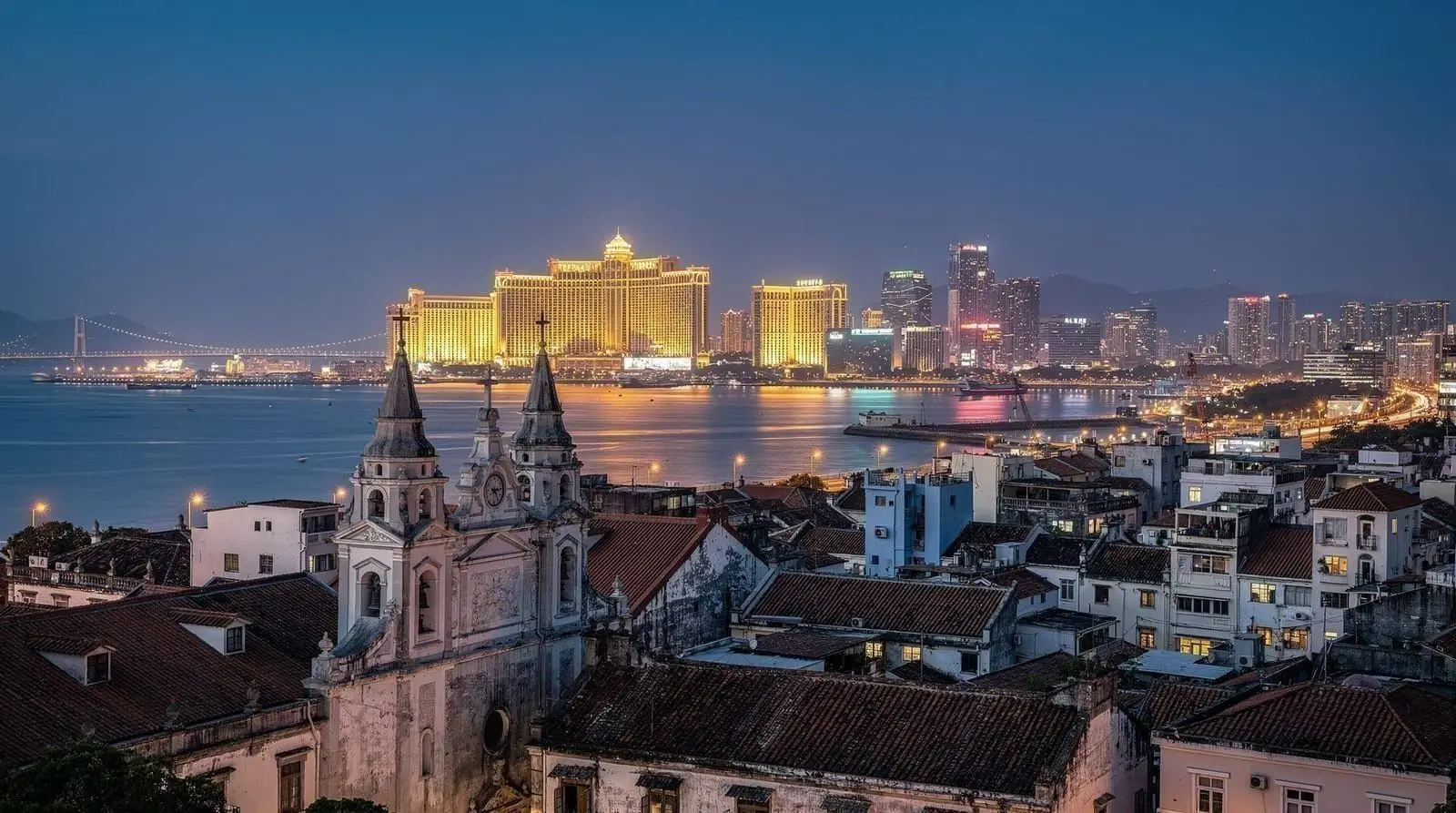
Macau is the smallest city in the world by area with a casino industry that, in peak years, has earned more revenue than Las Vegas. But reframe it slightly and you get a different picture: a UNESCO World Heritage historic city of extraordinary integrity, with Baroque churches, Portuguese mosaic pavements, and colonial government buildings preserved because — not despite the fact that — the casino economy fund preservation rather than allowing demolition.
The two Macaus co-exist without much friction. You walk from the Ruins of St. Paul’s (a 17th-century Jesuit church facade standing alone on a hill after the 1835 fire that destroyed the rest) down Senado Square’s wave-pattern mosaic pavement, eat a pork chop bun at a street bakery for MOP 25, and then take a bus to Cotai where the Venetian Macao reproduced the entire Grand Canal inside a casino lobby.
For visitors on the Hong Kong and Macau 4-day itinerary, Macau is typically a one- or two-night stop. For those coming directly from Shenzhen via the HZMB bridge (45 minutes), it’s a logical stop in the Pearl River Delta loop.
| Where | Pearl River Delta, 55 min ferry from Hong Kong or HZMB bus from Shenzhen |
| Cost | Ferry HKD 170–230; historic sites mostly free; MOP 15 museum entry |
| Time needed | 1 day for the historic peninsula; 2–3 days with Cotai and Coloane |
| Getting there | TurboJET ferry from Shun Tak Centre, or HZMB bus |
| Best time | October–April; avoid Grand Prix weekend (November) unless attending |
Getting to Macau
From Hong Kong (most common approach):
- TurboJET ferry: HKD 170–230 one way, 50–55 minutes. Departs from Shun Tak Centre (Sheung Wan MTR, exits E1/E2) and from HKIA ferry terminal. Ferry runs roughly every 15–30 minutes during the day; booking ahead on weekends and holidays is strongly recommended. Arrives at Macau Outer Harbour Ferry Terminal (peninsula) or Taipa Ferry Terminal (Cotai).
- HZMB shuttle bus: HKD 65 one way, 40–45 minutes on the bridge itself (total journey with immigration: 60–75 minutes). Departs from Hong Kong Port (on Lantau Island near HKIA). The bridge crossing is scenic and the bus is significantly cheaper; useful if starting from the airport side.
Free casino shuttles: All major Cotai casinos (Venetian, Galaxy, Parisian, Studio City) run free shuttle buses from both Macau ferry terminals. Use them to get to Cotai from the peninsula ferry terminal if that’s your destination, or as free transportation between the casino district and ferry terminals.
From Shenzhen: HZMB bus from Shenzhen Bay Port, crossing the bridge to Zhuhai/Macau. Journey: 90–120 minutes total. Less common than the Hong Kong route but efficient for Shenzhen and Macau combinations.
The historic centre: where to spend your time
The Ruins of St. Paul’s (Daisan Ching Lam or Rua de São Paulo) are Macau’s defining image — the elaborate Baroque stone facade of the 17th-century Church of the Mother of God, standing alone on a hillside after the 1835 fire. The facade is genuinely beautiful and genuinely worth the climb up the 68 stone steps. The crypt beneath (free entry) holds relics and a small museum. Admission free; open daily 9:00 am–6:00 pm.
Senado Square (Largo do Senado): The main historic square, 200 metres downhill from St. Paul’s, paved in the classic Portuguese wavy black-and-white mosaic. The surrounding buildings — the Leal Senado (the Senate building), the church of São Domingos — date from the 18th and 19th centuries and are in excellent condition. This is the best place to eat pork chop buns and egg tarts from the competing vendors around the square while watching Macau’s character reveal itself.
The UNESCO Historic Centre of Macau encompasses 25 historic buildings and public spaces across the peninsula, all within walking distance of each other. An annotated walking route covers most of the key sites in 2–3 hours. Free guide maps at any tourist information kiosk (the main one is at Senado Square).
A-Ma Temple (Rua de São Tiago da Barra, at the southern tip of the peninsula): Macau’s oldest temple, from around 1488, dedicated to A-Ma (the goddess of seafarers). The temple is built into the hillside in a series of pavilions connected by rock-carved paths. Small fishing boats are painted on rocks. Deeply atmospheric; free entry; open daily 8:00 am–6:00 pm.
Fortaleza do Monte: The 17th-century fortress on the hill above the Ruins of St. Paul’s, which once housed the mint and served as the city’s main defensive position. Free entry; extraordinary panoramic views from the battlements across the peninsula and toward Cotai’s towers. The Monte Fort platform is one of the better viewpoints in Macau.
The Macau Museum is housed inside the Monte Fort and covers Macau’s history from early settlement through the present. Modest but well-curated. Admission MOP 15 (about USD 2). Closed Monday.
Join a guided walking tour of the Ruins of St. Paul’s and Macau’s historic centreMacanese food: the underrated reason to visit
Macanese cuisine is one of the world’s genuine fusion cuisines — not fusion in the contemporary restaurant-marketing sense, but the result of 450 years of Portuguese traders and settlers mixing cooking techniques and ingredients from Portugal, Africa (particularly Mozambique and Goa), and Guangdong. The result is dishes with no real parallel anywhere else.
Pork chop bun (porco bun): Macau’s street food signature. A crispy pork chop served in a lard-enriched Portuguese bread roll. The bakeries along Rua da Cunha in Taipa village and the vendors around Senado Square sell them for MOP 20–30. Pou Tai Un Bakery and Sei Kai Kei (near the Inner Harbour) are the old-establishment references; the one in your line of sight is usually fine.
Egg tarts (pastéis de nata): The Portuguese custard tart, slightly different from the Hong Kong version — thicker custard, flakier crust. Ou Mun Café on Travessa de São Domingos sells them for MOP 8–10. Margaret’s Café e Nata (Rua Coelho do Amaral, near Lisboa Hotel) is the famous reference, with queues most mornings.
Minchi: Macanese comfort food — minced pork or beef stir-fried with potatoes, onion, soy, and molasses, served with a fried egg on top. Found at traditional Macanese restaurants like O Santos (Rua do Cunha, Taipa) and A Petisqueira (Rua de São João, Taipa). Budget MOP 80–130 for a full meal.
African chicken (galinha à africana): Roasted chicken with a coconut-peanut-chilli-pepper sauce — the dish most directly showing the Mozambique influence. Restaurants in the Inner Harbour area and Taipa serve it; allow MOP 100–150 per person for a full meal with sides.
Serradura (sawdust pudding): A Portuguese-Macanese dessert of cream, crushed Marie biscuit, condensed milk, and whipped cream in layers. MOP 20–30 at most bakeries and cafes. A Lorcha restaurant on Rua do Almirante Sergio is the standard reference for Macanese desserts.
A practical one-day walking route
For visitors with exactly one day, this order works well: start at the Ruins of St. Paul’s by 9:30 am before the tour groups arrive, walk downhill to Senado Square for an egg tart, continue to A-Ma Temple at the southern tip (30 minutes on foot, or a short taxi), then cross to Taipa village for a Macanese lunch on Rua da Cunha.
Spend the afternoon at the Fortaleza do Monte for the best panoramic view, then return to the peninsula for dinner at one of the Inner Harbour restaurants before catching an evening ferry back to Hong Kong. This route covers the essential UNESCO sites, the best food, and avoids doubling back — see the Macau peninsula guide for a more detailed version of the same circuit with exact walking times.
Macau Tower and outdoor experiences
Macau Tower (Largo da Torre de Macau, 1 km south of the Inner Harbour ferry terminal, bus 32 from the terminal): The 338-metre tower has an observation deck at 223 metres (MOP 145 adult) and a revolving restaurant. The main draw, however, is the outdoor activities:
- Bungee jump: at 233 metres, the world’s highest commercial bungee jump (AJ Hackett operation). MOP 3,988 on weekdays, MOP 4,788 weekends. The price is significant; the experience is reportedly unrepeatable.
- Skywalk X: walking around the outer rim of the tower at 233 metres without a handrail (only a harness). MOP 688. Less extreme than the bungee, still produces the appropriate physiological response.
- Tower climb: climbing to the outer rim at 338 metres via a safety-wire-attached ladder. MOP 888.
The tower’s lower floors are mall and restaurant; the revolving restaurant at 260 metres (The 360 Café) serves a buffet at MOP 488+ per person — not necessary given the observation deck entry is included.
When to visit: seasonality at a glance
| Months | Weather | Crowds | Notes |
|---|---|---|---|
| Oct–Dec | Dry, mild 18–24°C | Moderate | Best overall combination of weather and crowds |
| Jan–Feb | Cool, occasional cold snaps | Very high around Chinese New Year | Avoid CNY week specifically; otherwise comfortable |
| Mar–Apr | Mild, occasional rain | Moderate | Good shoulder-season option |
| May–Sep | Hot, humid, typhoon risk | High on weekends | Indoor Cotai time increases; outdoor sightseeing harder |
| November | Mild | Very high during Grand Prix weekend | Hotel prices roughly triple during the race |
Macau beyond the peninsula: Cotai and the resort strip
For visitors who do want the casino-resort experience, Cotai is Macau’s answer to the Las Vegas Strip, scaled up: the Venetian’s canal reproduction, the Parisian’s half-scale Eiffel Tower, and Studio City’s suspended Ferris wheel are all within walking distance (or a short free shuttle) of each other. The Macau peninsula guide covers the historic side in depth, and the Macau Tower guide has the full breakdown of the bungee, Skywalk, and observation deck options mentioned above. Families splitting time between the two should see the Macau with kids guide for which Cotai attractions suit which ages.
Practical notes for Macau
Money: MOP is Macau’s official currency but HKD is accepted almost universally at roughly 1:1 (technically HKD 1 = MOP 1.03). Casinos pay out winnings in HKD. ATMs dispense MOP. For simplicity, HKD works everywhere; convert any MOP change to HKD before departing as MOP is not accepted outside Macau.
Internet: No Great Firewall in Macau. Google, WhatsApp, Instagram work normally, same as Hong Kong. No VPN needed.
Casino age limit: 21 years old minimum to enter the casino floors. Children can be in hotel areas and shopping/restaurant areas but not gaming floors.
Water: Tap water safe to drink directly.
English: Moderate in hotels and tourist areas; less reliable than Hong Kong elsewhere. Having a translation app helps for ordering at local restaurants away from the tourist circuit.
Transport within Macau: Free casino shuttles cover most journeys between the peninsula and Cotai efficiently. Public buses are inexpensive (MOP 6 flat fare) but routes are confusing for first-time visitors. Taxis are metered, inexpensive by Hong Kong standards (flag fall MOP 19), and widely available.
Gaming budget warning: If you plan to try the casinos, set a hard limit beforehand. The Cotai casinos are designed by the world’s most capable behavioral architects to maximize time and money spent. The games are not rigged in the illegal sense; they simply have persistent mathematical edges. Budget what you’re comfortable losing and stop at that figure.
Frequently asked questions about Macau
How long do I need in Macau?
One day is enough to cover the UNESCO historic centre (Ruins of St. Paul’s, Senado Square, A-Ma Temple) and have a proper Macanese lunch in Taipa village. Two days adds Cotai Strip and Coloane village (the preserved village at the southern end with Seac Pai Van park and Hac Sa beach). Three days is comfortable and leisurely. More than three days requires a specific reason (the Grand Prix in November, a casino resort stay, specific events).
Is Macau family-friendly?
Yes, away from the casino floors. The historic centre is excellent for families — walkable, visually rich, with cheap street food. Cotai has multiple family-oriented attractions: the Parisian Macao has a half-scale Eiffel Tower (observation deck MOP 100–150), the Venetian has indoor gondola rides and a dedicated kids’ entertainment zone, and Studio City has a Batman Dark Flight 4D ride. The casino hotel pools are typically open to hotel guests.
Do I need to book ferries in advance?
On weekdays, walk-up tickets are usually available. On Friday evenings, all day Saturday and Sunday, Chinese New Year, Golden Week, and the Formula 3 Grand Prix weekend (November), book at least 1–2 days ahead. The TurboJET app and website handle online booking with a small surcharge.
Can I visit Macau on the 240-hour China visa-free transit?
Yes, but with one important caveat: entering Macau from the Chinese mainland during your 240-hour window effectively ends your mainland access for that window — Macau counts as leaving the mainland, and re-entering would require a new 240-hour window. If you’ve entered China via the 240-hour transit and want to include Macau, position it as your exit point before flying onward.
Is it safe to visit Macau?
Yes. Macau has very low violent crime rates. The casino areas are heavily surveilled and effectively the safest locations in Macau. The main risks are the standard tourist-area pickpocketing in crowded spots (Senado Square, ferry terminals) and, for those gambling, the financial risk of sustained casino play. Occasional scams target visitors near the Inner Harbour ferry terminal — ignore touts offering “special tour packages” or “guaranteed casino win systems.”
What’s the easiest way between Macau and Hong Kong?
The TurboJET ferry is the default — 50–55 minutes, runs frequently, departs from both the Hong Kong side (Shun Tak Centre or HKIA) and two Macau terminals. The HZMB bus (HKD 65) is cheaper and takes 40–45 minutes on the bridge itself, but involves bus boarding and the total journey with immigration runs 75–90 minutes. The ferry wins on overall convenience unless you’re departing from near HKIA.
What is the Grand Prix circuit in Macau?
The Macau Grand Prix (Formula 3, World Touring Car Cup, Superbikes) runs in November on the Guia Street Circuit — a 6.12 km street circuit using public roads through the peninsula. It’s one of the world’s most technically demanding street circuits, first run in 1954, and qualifying and race weekends see the city’s hotel prices roughly triple. If you’re not attending specifically for the racing, November Grand Prix weekend is a poor time to visit. Check the FIA calendar for exact dates each year.
Where can I try authentic Macanese food on a budget?
Avoid restaurants immediately surrounding the Ruins of St. Paul’s — they serve Macanese food at tourist markups. Instead: Lord Stow’s Bakery in Coloane village (the original Portuguese egg tart bakery) and the bakeries in Taipa village market; A Petisqueira for sit-down Macanese in Taipa at mid-range prices (MOP 100–150 per person); Café Nga Tim in Coloane for a quiet terrace lunch. The Rua da Cunha strip in Taipa village has the best concentration of street-food vendors and casual Macanese cafes at MOP 20–60 per item.
Is Macau or Cotai better for a first visit?
Spend most of a first visit on the historic peninsula and Taipa village — that’s where Macau’s distinct character actually lives. Cotai’s casino resorts are impressive as architecture and worth a few hours, but the experience is closer to Las Vegas than to anything specifically Macanese. If you have only one day, prioritize the peninsula; add Cotai only if you have a second day or a specific interest in the resorts themselves.
Can I combine Macau with a Shenzhen or Guangzhou trip?
Yes, and it works well. From Shenzhen, the HZMB bridge bus from Shenzhen Bay Port takes 90–120 minutes total to Macau. From Guangzhou, the standard route is HSR to Zhuhai or Hong Kong followed by the bridge or ferry. Macau fits naturally as a 1–2 night stop within a broader Pearl River Delta loop rather than as a standalone trip for most non-gambling travelers.