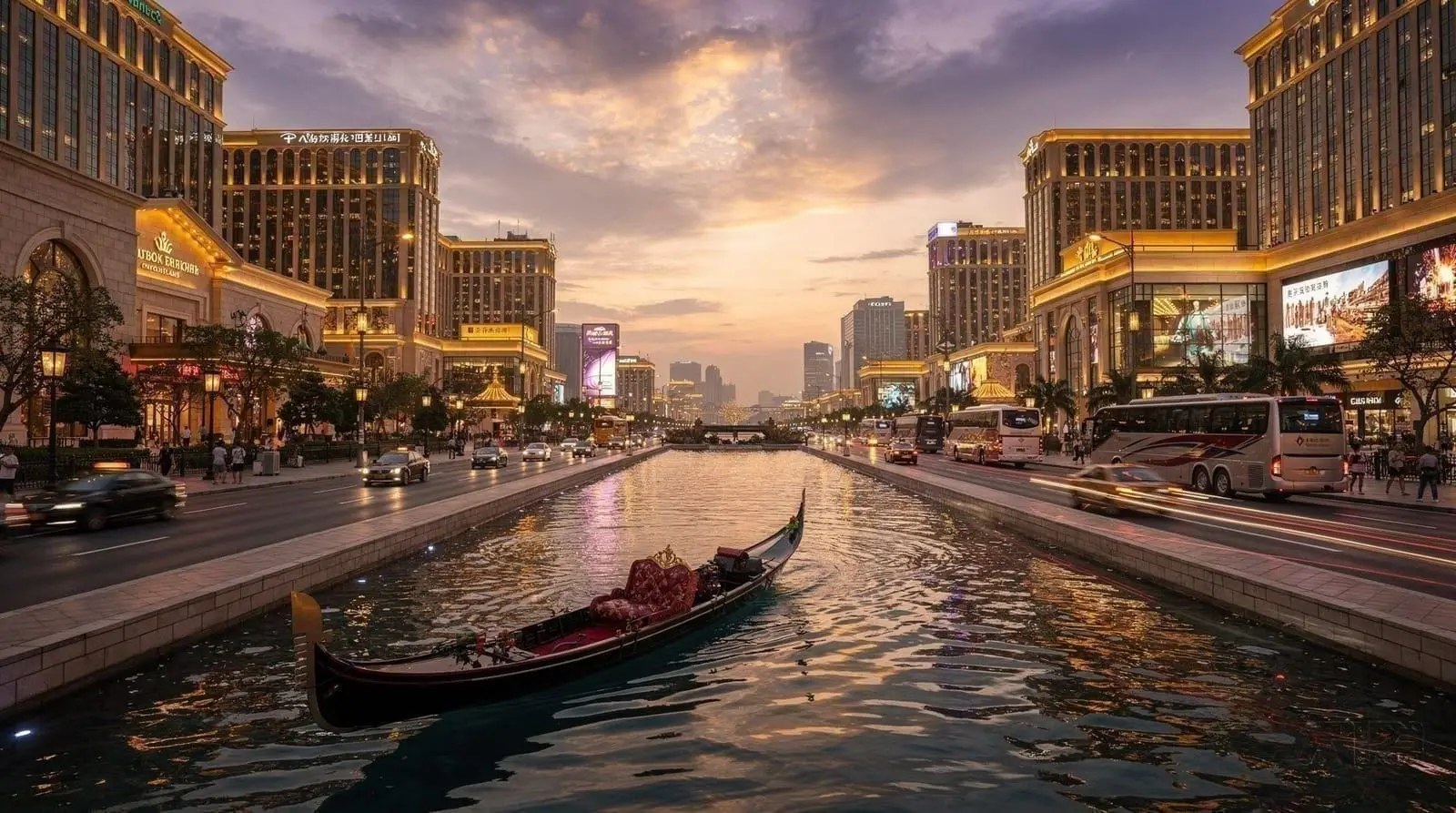
Cotai didn’t exist until 2005. Before then it was open water between Taipa and Coloane — a tidal channel in the Pearl River estuary. Then Sheldon Adelson’s Las Vegas Sands Corporation began filling it in and building on it. The Venetian Macao opened in 2007 with 35,000 square metres of casino floor (then the world’s largest) and 3,000 hotel suites. Others followed. By 2026 the Cotai Strip holds roughly 13 integrated resort complexes on 5 km of reclaimed land, with more under construction.
The scale requires surrendering ordinary architectural reference points. The Venetian’s Grand Canal Shoppes are not a shopping mall with a canal theme — they are a full-scale reproduction of St. Mark’s Square and several Venetian canal scenes, inside a building, with a painted sky ceiling, working gondolas, and street performers in period costume. It is surreal and genuinely impressive as an achievement of constructed environment.
| Where | Reclaimed land between Taipa and Coloane, Macau |
| Cost | Free to walk; gondola rides and observation decks around MOP 100–200 |
| Time needed | Half a day for a walk-through; 1–2 nights for a resort stay |
| Getting there | Free casino shuttles from both Macau ferry terminals |
| Best time | Year-round (indoors); avoid Chinese New Year and Golden Week |
Getting to Cotai from Shenzhen or Hong Kong
Most visitors reach Cotai via the historic Macau peninsula or directly from Hong Kong. From Shenzhen, there’s no direct ferry — the practical route is via Hong Kong or Zhuhai. From Hong Kong, high-speed ferries run to the Macau Outer Harbour terminal (roughly an hour), or you can cross the Hong Kong–Zhuhai–Macau Bridge by bus, which drops you closer to the peninsula side before a shuttle onward to Cotai.
Either way, budget a full day if Cotai is a side trip rather than an overnight stay — see the Macau day trip from Hong Kong guide for the logistics, or the Hong Kong and Macau 4-day itinerary if you’re combining both cities properly.
Getting to Cotai
Free casino shuttles: Every major resort runs free shuttle buses from both the Macau Outer Harbour Ferry Terminal (peninsula side) and the Taipa Ferry Terminal (Cotai side). These are the most practical way to move between the historic peninsula and Cotai. Frequency runs every 10–15 minutes during peak hours; look for the shuttle bus stops just outside the ferry terminal exits (clearly signposted). The Venetian, Galaxy, and Parisian shuttles are most frequent and most broadly useful.
Taxi from the historic peninsula: MOP 70–100, 15–20 minutes depending on traffic. Meters run; no need to negotiate.
Cotai Light Rapid Transit (LRT): Macau’s new light rail system has Cotai stations. The LRT is expanding; check current coverage as it was partially operational as of 2026.
The major resorts
The Venetian Macao (Estrada da Baía de Nossa Senhora da Esperança): The original Cotai resort, still the largest hotel in Asia by room count (3,000 suites, all over 70 square metres). The Grand Canal Shoppes mall extends across two full floors — 350 shops including every luxury brand plus mid-range international retailers. The gondola rides through the indoor canal (MOP 188 per person, approximately 10 minutes) are a specific kind of absurdist fun. The casino floor (88,000 square metres) is staggering but oppressive if crowds are your thing. The hotel rates are more reasonable than you’d expect: standard suites from HKD 1,200 per night midweek, rising to HKD 3,000+ on weekends.
The Parisian Macao (Estrada do Istmo): Las Vegas Sands’ follow-up to The Venetian, featuring a half-scale Eiffel Tower (56 metres, about half the height of the actual Eiffel Tower). The tower observation deck (MOP 100–150) has views across Cotai and toward the historic peninsula. The resort is smaller than The Venetian and somewhat easier to navigate. The Arc de Triomphe replica and Haussmanian facade details are well-executed, which is damning with faint praise but accurate.
Galaxy Macau (Estrada da Baía de Nossa Senhora da Esperança): The Galaxy resort complex comprises five hotels across two phases — the JW Marriott, Ritz-Carlton, Banyan Tree, Okura, and Raffles are all on site. The amenity package includes what is claimed to be the world’s largest skytop wave pool (2,000 square metres), multiple outdoor pools, and an artificial Grand Resort Deck. HKD 2,000–5,000+ per night for the luxury brands; the Galaxy Hotel itself is more accessible at HKD 900–1,600.
Studio City (Estrada do Istmo): The entertainment-first resort in the MGM/Melco portfolio, with a giant figure-8 Ferris wheel between two retro-Hollywood-style towers. The Batman Dark Flight 4D ride, a Warner Bros. Infinite Loop go-kart track, and a children’s entertainment floor make this the most family-suited resort if Disneyland isn’t the priority. Rooms from HKD 800–1,400 per night.
MGM Cotai (Avenida da Nave Desportiva): The newer, more architecturally considered entry — a “spectacle box” design with a large central arena (Spectacle) hosting light shows and performances. More restrained than the replica-architecture of its neighbors, which makes it feel different but not necessarily better by the standards of Cotai tourism.
Take a guided tour covering Cotai resorts and Coloane villageEating in Cotai
The concentration of high-end hotels means a genuine concentration of high-end restaurants — Cotai has accumulated more Michelin stars per square kilometre than most cities.
Wing Lei Palace (Wynn Palace): Two Michelin stars, regarded as Macau’s best Cantonese fine dining. A tasting menu runs MOP 1,200–1,600 per person without wine. Reservation required weeks in advance for weekends.
Robuchon au Dôme (Grand Lisboa, technically peninsula but connected to Cotai via shuttle): Three stars, Joel Robuchon’s only three-star property in Asia as of his death in 2018. Carries the legacy carefully. MOP 2,000–3,500 per person.
Noodle & Congee Corner (Venetian food court level): Budget-friendly Cantonese noodles and congee, HKD 80–120 a bowl, in a food court context. A useful break from casino food pricing.
The Food Court at Galaxy: Multiple outlets, HKD 60–150 per meal, covering Cantonese dim sum, Japanese ramen, Korean, and international fast food. The most practical budget eating in Cotai.
The Taipa Village market street (15 minutes walk or short taxi from central Cotai) has authentic Macanese street food and local restaurants at a fraction of resort prices — see the Macau Peninsula and Taipa section for details.
Nightlife and entertainment
Join a Macau Cotai Strip night tourThe Cotai Arena (The Venetian) holds 15,000 and hosts major international concerts and boxing events. Annual programming includes Cantopop superstars during Chinese New Year (typically January–February), international pop acts on Asia legs, and combat sports events. Tickets via Ticketmaster or resort box offices; HKD 400–2,000 depending on act and seating.
The House of Dancing Water at City of Dreams was Macau’s celebrated large-scale water acrobatics show — it ran for over a decade and was considered one of the world’s most spectacular live performances. It closed temporarily in 2020 and its resumption status should be verified before planning a visit around it.
Casino nightclubs: most major resorts have a nightclub or live music venue. Marquee at The Venetian and the club at Studio City are the most active. Door charges HKD 200–400; drinks HKD 100–200. The clientele is mainly mainland Chinese and Hong Kong visitors, with a mix of Western visitors.
The casino floor: what to expect as a tourist
If you choose to visit the casino floor (minimum age 21, enforced with ID checks), the experience varies significantly between resorts. The Venetian’s casino is the most overwhelming — three floors, 3,000+ slot machines, 800 table games, a cigarette-smoke level that is noticeably higher than international norms even with the ventilation systems. High-roller areas (the “VIP rooms” or “private rooms”) are closed to non-invited guests.
Table minimums in 2026: HKD 500 (approximately USD 64) is a typical minimum at baccarat tables during standard hours; HKD 200 at some slots. Weekend evenings and public holidays push minimums higher at prime tables. Baccarat dominates Macau’s casino floors — it accounts for roughly 85% of gaming revenue. Craps tables are rare compared to Las Vegas; roulette is more common.
The mathematics: Baccarat’s house edge is among casino games’ lower edges (approximately 1.06% on banker bets, 1.24% on player bets) — but “lower edge” means the house still wins over any sufficient number of hands. The speed of play (150–200 hands per hour) means the theoretical edge is applied rapidly. Set a loss limit before entering.
The atmosphere: Cotai’s casino floors are predominantly mainland Chinese in clientele, with a significant contingent of Southeast Asian high rollers. The social dynamic is different from Las Vegas — less performative, more serious, with many solo players using statistical tracking cards on baccarat.
Cotai’s hotel pools and amenities
The hotel pool complexes in Cotai are among the most extensive in Asia, and non-casino guests underestimate them. During summer (June–September), they are genuinely a primary draw.
Galaxy Macau Grand Resort Deck: The top Cotai pool complex — 2,000 square metres of wave pool, water slides, sand beach (real sand imported), multiple pools at different temperature settings. Access for hotel guests (HKD 200–300 pool access for non-guests at some periods). The sky-top section has views across the Cotai reclamation.
Venetian pool: Standard outdoor hotel pools across two levels. Adequate but not spectacular compared to Galaxy.
Wynn Palace: An indoor/outdoor pool with garden terraces and a more serene aesthetic than the larger resort pools. Most suitable for guests seeking quiet over spectacle.
Shopping in Cotai
The Grand Canal Shoppes at The Venetian (3.5 km of shopping in a single mall, three levels) has the widest selection. The luxury anchors — Louis Vuitton, Gucci, Prada, Cartier — are on the upper level; mid-range international brands (Tommy Hilfiger, Coach, Swarovski) on lower levels. Prices in Macau’s duty-free areas are sometimes lower than Hong Kong equivalents for watches and spirits, though the differentials have narrowed.
The Venetian’s Grand Canal Shoppes also has a dedicated food hall (the Grand Court Food Hall, B1 level): Chinese, Japanese, fast food, and dessert stalls at HKD 60–150 per meal. Practical option for a quick lunch between resort visits.
Outlet shopping: The Shoppes at Cotai Central (between The Venetian and The Parisian) has outlet sections with 20–40% reductions on past-season fashion. Practical if you have luggage space; specific searches are more likely to pay off than casual browsing.
Cotai on a budget
Cotai has a reputation for being expensive, and the headline hotel rates and Michelin menus support that. But a genuinely low-cost day is possible: entry to every resort is free, the shuttle buses are free, the Grand Canal Shoppes and Parisian’s plaza cost nothing to walk through and photograph, and the food-court meals listed above (HKD 60–150) undercut a sit-down restaurant anywhere in Hong Kong or central Macau. Skip the gondola ride and observation decks if the budget is tight — the architecture is free to admire from ground level, and the fountain shows at Wynn Palace cost nothing.
Travellers approaching Cotai from the mainland side often combine it with a wider loop: the Zhuhai border crossing and the Hong Kong–Zhuhai–Macau Bridge both connect into this corner of the Pearl River Delta, and a budget-conscious multi-city trip can use the Shenzhen on a budget guide as a template for cost expectations elsewhere in the region.
Cotai for families
The Cotai resorts are better calibrated for families than the Macau peninsula casinos, primarily because the scale of their non-gaming entertainment infrastructure is larger:
Studio City: Batman Dark Flight 4D attraction (MOP 150–200 per ride); 4-storey Ferris wheel visible from outside; Aqua World (water park, MOP 250–350 for unlimited use). Younger children (3–10) tend to have the best time here.
The Parisian Macao: Half-scale Eiffel Tower observation deck (MOP 100–150); reasonably child-friendly food court options; swimming pools designed with family sections.
Wynn Palace: The floral installation art in the atrium, the gondola-style cable car between the casino lobby and the exterior garden, and the performances fountain show (free, every 30 minutes, 11:00 am–midnight) are all non-gambling entertainment that children and adults both engage with.
Cotai vs. the historic peninsula: quick comparison
If you only have one day in Macau, this is the choice that matters most.
| Cotai Strip | Historic Peninsula | |
|---|---|---|
| Character | Megacasino resorts, Vegas-scale spectacle | Portuguese-colonial streets, Ruins of St. Paul’s |
| Best for | Families, resort stays, indoor entertainment | History, food, walkable heritage |
| Half-day feasible? | Yes — resorts are walkable via connected shuttles | Yes — Senado Square area is compact |
| Food style | Michelin fine dining, food courts | Macanese classics — see the Macau food guide |
| With kids | Studio City, Parisian Eiffel deck | Fortress, museums — see Macau with kids |
Two or three days lets you do both properly rather than rushing either.
Honest assessment of Cotai
Cotai is worth seeing because the scale and audacity of what has been built here is genuinely unlike anything else on earth. The argument that it’s a tacky imitation of Las Vegas misses the point — it is Las Vegas elevated to a scale Las Vegas itself never reached, in a denser urban context, with better food and a different cultural overlay.
That said: if your visit to Macau is one day, the historic peninsula wins by a significant margin. The Cotai experience is memorable for different reasons — the Ruins of St. Paul’s because of history and beauty; Cotai because of sheer overwhelming scale. Both are worth experiencing in a two- or three-day Macau visit. See the Macau destination overview for the complete picture, and the Macau Tower guide if you’re pairing Cotai with the peninsula’s own observation deck.
For planning the Macau leg of a Pearl River Delta trip, see the Hong Kong and Macau 4-day itinerary and the Pearl River Delta grand loop 10-day itinerary. For tours in Macau, see the things to do in Macau hub.