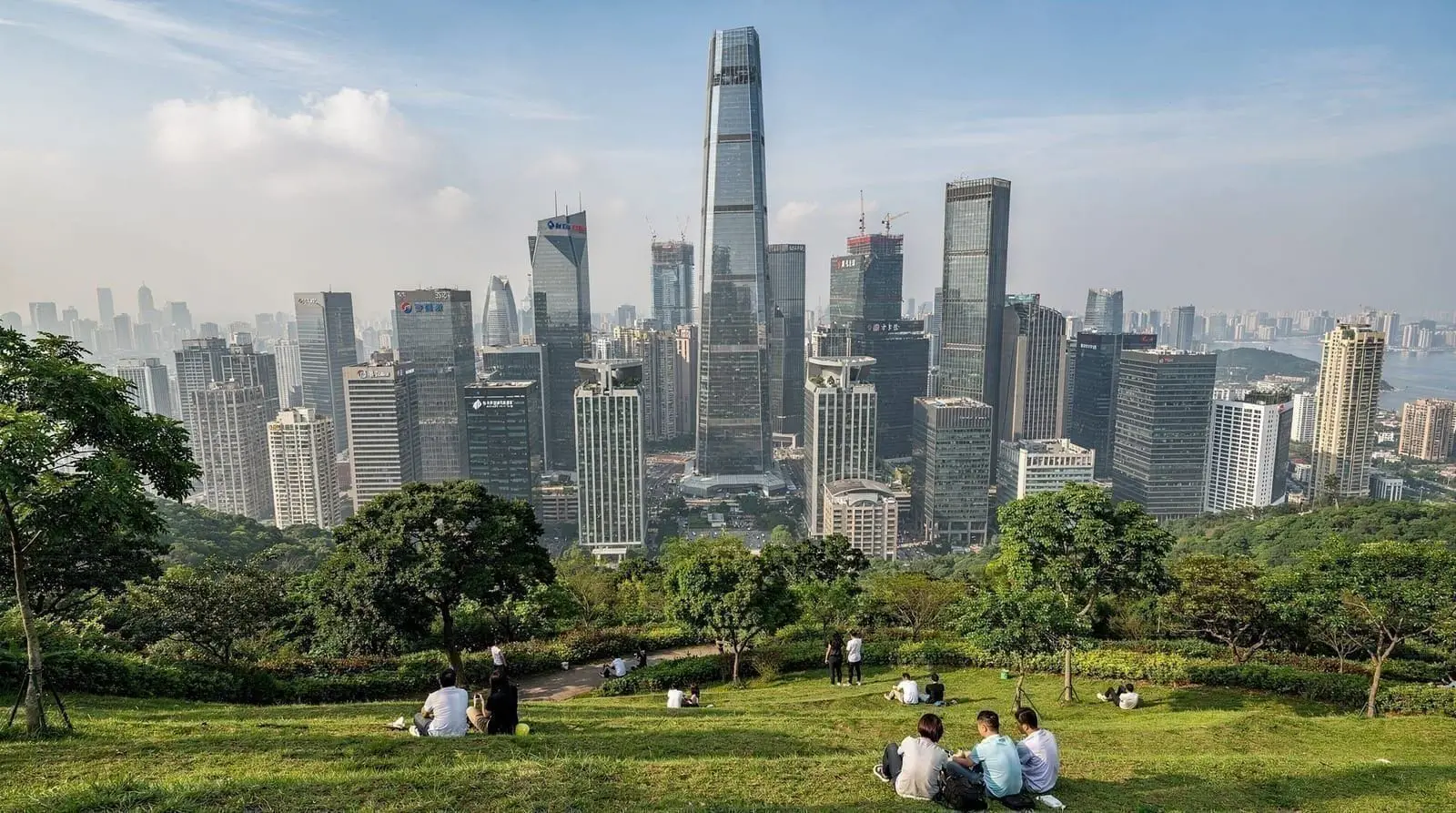
Shenzhen is not what most travelers picture when they think of China. There is no ancient temple skyline, no imperial palace, no 3,000-year history. What Shenzhen has instead is stranger and more interesting: a city that went from a fishing village of 30,000 people to a metropolis of 17 million in roughly 40 years, built almost entirely by internal migrants, and now home to some of the world’s most consequential technology companies.
Come for Huaqiangbei — the planet’s largest electronics market. Stay for the Chaoshan beef hotpot at midnight, the contemporary art in OCT Loft, the surprisingly empty beaches of Dapeng Peninsula, or the high-speed train that gets you to Hong Kong West Kowloon in 14 minutes.
| Where | Pearl River Delta, bordering Hong Kong |
| Cost | Metro CNY 2–14/trip; meals CNY 20–120; hotels CNY 200–1,600/night |
| Time needed | 3–5 days minimum; 7+ with Hong Kong, Macau, or Guangzhou day trips |
| Getting there | HSR from Hong Kong West Kowloon (14 min) or metro border crossing |
| Best time | October–November and March–April; avoid June–August heat and typhoons |
Why Shenzhen deserves more than a day trip
Every week, thousands of travelers cross the border from Hong Kong, spend six hours in a shopping mall, and go back thinking they’ve seen Shenzhen. They haven’t. The city’s best things take time to find.
Shenzhen’s character comes from its migrant DNA. Unlike Guangzhou or Beijing, almost nobody who lives here is from here. The population arrived from Hunan, Sichuan, Guangdong, Fujian, and dozens of other provinces — and they brought their food, their dialects, and their work ethic. The result is a city that feels perpetually unfinished, perpetually energetic, and perpetually inventing itself.
That energy shows up in concrete ways: DJI drones on display in a flagship store next to a noodle stall that has been serving Chaoshan beef brisket since 1993. An oil painting village (Dafen) that produces 60% of the world’s decorative oil paintings, staffed by trained artists from art schools across China. A theme park built in 1994 that still draws millions of visitors. And a metro system with 17 lines, 441 stations, and zero tolerance for delays.
This guide covers all of it — district by district, with real prices, honest transit times, and the things that are actually worth your time.
Shenzhen districts at a glance
Shenzhen is enormous. Understanding its geography before you arrive saves hours of confused metro riding.
Futian is the formal business and civic center — home to the CBD, the main convention complex (Futian/Lok Ma Chau border crossing), Civic Center, Lianhuashan Park, and the high-speed rail station (Futian Station) that connects to Hong Kong in 14 minutes. It’s organized and slightly sterile, but the Futian district has some of the city’s best Cantonese restaurants and the Shenzhen Convention Center area.
Nanshan and Shekou is where Shenzhen’s international community concentrates. Tencent HQ is here, along with DJI, SEA World (an actual repurposed ocean liner), expat bars in Shekou, and the ferry terminal for Guangzhou. Window of the World theme park sits on Nanshan’s western edge. The Nanshan-Shekou area is the most livable and walkable part of the city for foreign visitors.
Luohu is the oldest commercial district and home to the original Lo Wu border crossing into Hong Kong. Dongmen pedestrian street, Luohu Commercial City (the infamous multi-floor shopping complex across from the border), and some of the city’s best working-class dim sum restaurants are here. See the Luohu guide for detail.
OCT (Overseas Chinese Town) covers a cluster of theme parks and contemporary art spaces anchored by the OCT-LOFT creative district — Shenzhen’s equivalent of a 798 art zone, with galleries, independent cafes, and design studios. Full breakdown in the OCT Overseas Chinese Town guide.
Dapeng Peninsula is the city’s natural escape — a protected ecological zone 90 minutes east with Ming-dynasty forts, 50 km of coastline, and camping spots. Covered in depth in the Dapeng Peninsula guide.
Yantian sits along the eastern coastal corridor. It’s quieter than central Shenzhen, known for seafood, and less visited. See the Yantian guide for what’s there.
Comparing Shenzhen’s neighborhoods
For quick reference, here’s how the main districts stack up:
| District | Character | Best for | Metro access |
|---|---|---|---|
| Futian | Formal CBD, HSR hub | First-timers, fast Hong Kong access | Excellent |
| Nanshan/Shekou | Walkable, international | Longer stays, ferry connections | Good |
| Luohu | Gritty, budget, border | Shopping, street food | Good |
| OCT | Theme parks, art | Families, culture | Good |
| Dapeng Peninsula | Coastal, natural | Beaches, hiking | Bus + metro combo |
| Yantian | Quiet coastal | Off-circuit beach and seafood | Moderate |
Getting to Shenzhen
From Hong Kong (most common entry)
High-speed rail (HSR): Hong Kong West Kowloon Station to Futian Station takes 14–24 minutes. Trains depart every few minutes; tickets cost HKD 85–170 (~USD 11–22) depending on seat class. This is the fastest and most comfortable option. Immigration is co-located at West Kowloon — you clear Chinese immigration before boarding, so you exit directly into Futian with no second checkpoint.
Metro via border crossing: Take the Hong Kong MTR East Rail Line to Lo Wu or Lok Ma Chau, cross the border on foot, and connect to Shenzhen Metro Line 1 (Lo Wu) or Line 4 (Futian/Lok Ma Chau). Door-to-door from Central Hong Kong: 60–80 minutes. Cost: HKD 40–55 MTR + CNY 5–15 Shenzhen Metro. This is the budget option.
Ferry (Shekou): Cross-border ferry from Hong Kong China Ferry Terminal (Tsim Sha Tsui) or Tuen Mun to Shekou takes 30–60 minutes, depending on origin. Ticket: HKD 80–130 (~USD 10–17). Good if you’re heading to Nanshan or Shekou directly.
By air
Shenzhen Bao’an International Airport (SZX) handles direct international flights from Southeast Asia, the Middle East, and a handful of European cities via connecting hubs. Metro Line 11 (Airport Express) runs directly to the city center. Fare: CNY 23–36 (~USD 3–5); journey time: 40–50 minutes to Futian.
Book a private airport transfer from SZX (Tesla vehicles available)By high-speed rail from mainland China
Shenzhen North Station (Longhua District) is the main intercity HSR hub, connecting to Guangzhou South (25–30 min, CNY 54–75), Beijing (8–9 hours), and beyond. Futian Station handles the Hong Kong–Guangzhou express but fewer long-distance services.
Getting around Shenzhen
Metro
The Shenzhen Metro is the backbone. 17 lines, 441 stations, CNY 2–14 depending on distance. English signage and bilingual announcements throughout. Buy a Shenzhen Tong card (CNY 20 deposit + load balance) for a 5% discount on every trip. Contactless payment (Visa/Mastercard) works at international gates at major stations, but not universally — the Tong card is more reliable.
Hours: 06:20–23:00 most lines; Lines 11 and 14 run until midnight.
Didi
Didi is the mainland China equivalent of Uber. Download the app before arriving, link WeChat Pay or Alipay (both now accessible to foreigners with Visa/Mastercard). English interface available. Standard fare for most cross-district rides: CNY 20–50 (~USD 3–7). Substantially cheaper than taxis and more convenient.
Taxis
Available but less practical. Drivers rarely speak English — have your destination written in Chinese characters. Meters work correctly; airport taxis slightly more expensive. Starting fare: CNY 10 for first 3 km.
Visa and entry
Shenzhen 5-day SEZ visa-on-arrival: Available at Lo Wu, Huanggang, and Shekou crossings. Cost: CNY 168 (~USD 25) for most nationals; CNY 314 (~USD 46) for UK; CNY 956 (~USD 138) for US. Valid for Shenzhen only — you cannot visit Guangzhou or other mainland cities. No advance booking; processed in minutes.
240-hour visa-free transit: If you hold a ticket onward to a third country, you can stay 10 days in mainland China (including Shenzhen, Guangzhou, and other provinces). Valid for 55+ nationalities. Exiting to Hong Kong or Macau resets the window.
Standard tourist visa (L visa): Obtained in advance from a Chinese embassy. Allows unrestricted mainland travel, multiple cities, up to 30 or 60 days.
Check the China visa and border crossing guide for current 2026 rules — they changed significantly in late 2025.
Money and payments
CNY (Renminbi) is the only currency on the mainland. Cash is declining but still needed for 5–10% of vendors.
WeChat Pay and Alipay are now accessible to foreigners (2026). Link your Visa or Mastercard to either app, verify with passport, and pay by QR code everywhere — restaurants, metro, convenience stores, street stalls. Transaction limit: CNY 5,000 per transaction; CNY 35,000/year. Transactions under CNY 200 are fee-free; 3% above. Setup takes about 15 minutes.
ATMs are widespread. Expect a 2–3% fee on foreign cards. Withdraw CNY 1,000–2,000 (~USD 150–300) as backup for the 5% of places that don’t take mobile payments.
Connectivity
Mainland China has the Great Firewall. Google, Gmail, WhatsApp, Instagram, YouTube, and most Western news sites are blocked on Chinese SIM cards. The solution in 2026 is a travel eSIM — international roaming plans legally bypass the Firewall via roaming gateways. Setup: scan QR code, 2-minute install, works instantly. Cost: USD 1–4 for 1–2 GB over 4–7 days. Providers: Jetpac, Nomad, Trip.com. Install before crossing the border.
VPNs work intermittently and are less reliable for tourists. eSIM is the cleaner option.
Food: the migrant city advantage
Shenzhen’s food scene is underrated precisely because it doesn’t have a local cuisine to market. The city is too young for culinary traditions — but it has 17 million migrants from every province in China, all of whom brought their home cooking.
Chaoshan (Teochew) cuisine is the most visible. Beef hotpot at places like Niu Ba Ba (牛爸爸) in Futian: raw beef sliced paper-thin, cooked in clear broth at the table, CNY 120–200 (~USD 18–30) per person. The condiment is a pale soy-based sauce with Sha Cha (sand tea) paste — nothing like Sichuan hotpot.
Hunanese food (from Hunan Province) is the spicy counterpoint. Red-chili-braised pork (Mao’s red braised pork), steamed fish with chopped chilies, stir-fried preserved vegetables. Restaurants cluster in workers’ neighborhoods near Longhua and Longgang Districts. Budget: CNY 40–80 (~USD 6–12) per person.
Dim sum is strong here despite Shenzhen not being a Cantonese city by default. The Sunday morning yum cha ritual at Hilton Hotel Shenzhen or Guangdong Hotel: CNY 60–120 (~USD 9–18) per person, booking recommended.
Street food at Dongmen: The Dongmen pedestrian area in Luohu has stinky tofu, fried squid, Cantonese egg waffles (gai dan jai), and bubble tea stalls. Budget CNY 20–40 for a full walk-through snacking session.
Things to do in Shenzhen
Huaqiangbei electronics market
There is nowhere else on Earth like Huaqiangbei. SEG Plaza, Huaqiang Electronics World, and the dozens of buildings around them collectively form a market that sells every electronic component known to humanity, plus consumer electronics at prices that make Amazon look expensive. Tourists typically buy phone accessories, cables, drones, and tech gadgets. Traders come to source components.
Trap warning: The upper floors of some buildings sell counterfeit goods and low-quality knockoffs. Stick to verified shops on ground and lower floors, test everything before paying, and don’t buy anything you can’t return. Join a guided Huaqiangbei insider tour if you want expert navigation and price negotiation help.
Window of the World
A theme park in Nanshan with scaled-down replicas of 130 world landmarks — the Eiffel Tower at roughly 1:3 scale, the Parthenon, Niagara Falls, and more. Kitsch, yes, but executed with unexpected quality and vastly more enjoyable than the description suggests. The light show at night is genuinely impressive.
Book Window of the World tickets in advanceTicket: CNY 220 (~USD 32) at the gate; CNY 150–180 (~USD 22–26) booked online. Metro: Line 1, Window of the World station.
Dafen Oil Painting Village
In Buji Sub-district (Longgang), Dafen is a neighborhood where 8,000 trained painters produce an estimated 60% of the world’s commercially distributed oil paintings. You can watch them work, commission a portrait or copy of a famous painting, and buy original art starting at CNY 200 (~USD 30). A 3-hour tour through the Dafen village with a local guide contextualizes what you’re seeing. A masterwork copy (Monet, Van Gogh, Klimt) runs CNY 300–1,500 depending on size and detail.
Lianhuashan Park and Civic Center
The formal center of Shenzhen. Lianhuashan (Lotus Hill) Park has a famous Deng Xiaoping statue, jogging paths, kite-flying areas (peak on weekend afternoons), and good city views. Below the hill, the Civic Center is a dramatic public architecture piece worth walking past. Free entry. Metro: Lianhuashan Park station (Line 2).
Shenzhen Museum
Two campuses: the History and Folk Museum (near Civic Center) covers Shenzhen from fishing village to SEZ. Good English labels. Free entry. Hours: Tuesday–Sunday, 10:00–18:00. Metro: Line 2/4, Children’s Palace station.
Splendid China Folk Culture Village
Adjacent to Window of the World, this park combines scale models of Chinese landmarks (much older, more weathered than Window of the World) with ethnic minority cultural performances. Book Splendid China entrance tickets here. Ticket: CNY 190 (~USD 28); combo with Window of the World: CNY 320 (~USD 47). Better for families with children than solo travelers.
OCT-LOFT contemporary art district
A converted industrial complex in Nanshan with galleries, independent bookstores, design studios, and coffee shops. Much smaller and less pretentious than Beijing’s 798 but with a similar energy. Best explored without a plan on a weekday morning. Adjacent to B10 Live music venue. See the full OCT guide.
Sample one-week Shenzhen itinerary
For visitors following the “3–5 days minimum, 7+ with day trips” guidance above, here’s how a full week typically breaks down: Day 1 — arrival, settle into Futian, evening walk around Lianhuashan Park and the Civic Center. Day 2 — Huaqiangbei electronics market in the morning, Dongmen and Luohu Commercial City in the afternoon (see the Luohu guide). Day 3 — Window of the World and Splendid China in Nanshan (full day; see the OCT Overseas Chinese Town guide).
Day 4 — Nanshan and Shekou for Tencent-area walking, Sea World, and OCT-LOFT. Day 5 — day trip to Dapeng Peninsula for beaches and the Ming-dynasty fort. Day 6 — day trip to Hong Kong via the 14-minute HSR. Day 7 — Yantian for a quieter beach morning, or a day trip to Guangzhou for Cantonese food and the Canton Tower. This flow minimizes backtracking across the metro system and pairs naturally with the 3-day and weekend itineraries if you have less time.
Day trips from Shenzhen
Shenzhen’s position makes it a natural hub for the Greater Bay Area.
Hong Kong: 14 minutes by HSR from Futian. A full day in Hong Kong is genuinely manageable from a Shenzhen base. See Hong Kong and the Shenzhen and Hong Kong 5-day itinerary.
Macau: Take the HSR to Hong Kong (14 min), then the HZMB shuttle bus (40 min) to Macau — total transit: under 90 minutes. Or take a direct ferry from Shekou (75–90 minutes). A Hong Kong–Macau 4-day itinerary works well with a Shenzhen base.
Guangzhou: HSR from Shenzhen North to Guangzhou South: 25–30 minutes, CNY 54–75 (~USD 8–11). Full day exploring Guangzhou is easy as a day trip. The Guangzhou–Shenzhen foodie itinerary covers this in depth.
Dapeng Peninsula: 90 minutes by bus or Metro Line 8 + bus. Full natural day — coastal hiking, old fort, beach. See Dapeng Peninsula.
Language and communication in Shenzhen
Mandarin dominates, unlike Hong Kong’s Cantonese, and English proficiency is noticeably lower than in Hong Kong even in tourist-facing businesses. Metro announcements and signage are bilingual, and major hotels handle English adequately, but street-level interactions — ordering food, negotiating at markets, giving a taxi address — usually require a translation app.
A few practical notes: download a translation app with an offline Chinese pack before arriving, since data connections can be inconsistent underground; have your hotel address and any specific destinations saved in Chinese characters (screenshot from Amap or Baidu Maps) to show taxi and Didi drivers; and expect that younger residents in Nanshan and Futian are more likely to have functional English than older residents in Luohu or the Hubei migrant food strip.
None of this should discourage independent exploration — pointing at menu items, using a phone camera to translate signs, and a friendly attitude cover the vast majority of situations. Most restaurants outside malls have picture menus or a menu board with photos even without English text, which makes ordering considerably easier than the lack of translation might suggest.
Where to stay in Shenzhen
Futian District suits travelers prioritizing transport links (HSR to HK, metro everywhere) and business-area amenities. Hotel options: Grand Hyatt Shenzhen (CNY 900–1,600/night, ~USD 130–235), Shenzhen Marriott Hotel Tian’an City Centre (CNY 700–1,200/night, ~USD 103–176), and mid-range options near Civic Center around CNY 400–600/night (~USD 59–88).
Nanshan/Shekou is better for travelers wanting walkable neighborhoods, expat-facing restaurants, and the ferry terminal. Shenzhen Marriott Hotel Nanshan, Westin Shenzhen Nanshan, and dozens of business hotels in the CNY 500–1,000/night range.
Luohu is convenient for the Lo Wu border crossing and Dongmen shopping but less comfortable than Futian or Nanshan. Budget hotels from CNY 200–400/night (~USD 30–59).
Budget tip: Hostels exist in all districts at CNY 80–150/night (~USD 12–22) for dorms.
Honest tourist-trap warnings
Huaqiangbei counterfeit gear: Test electronics before paying. Avoid unmarked stalls selling sealed boxes — the product inside may differ from what’s shown. Never pay full asking price; counter at 40–50% of initial quote.
Border touts: At Lo Wu and Huanggang crossings, touts offering money exchange, SIM cards, and guided tours should be declined. Rates are poor, cards are overpriced, and “guides” often lead to commission shops.
Overpriced tech tours: Several operators market “technology tours” at USD 100+ that visit showrooms you can enter for free. If you want guidance in Huaqiangbei, a reputable GYG tour like the tech tour with drone delivery demo is legitimately structured. Random operators on the street are not.
Taxi overcharging: Use Didi. Period.
Frequently asked questions about Shenzhen
How many days do I need in Shenzhen?
Three days covers the main highlights: Huaqiangbei, Window of the World or OCT-LOFT, one neighborhood food exploration, and a half-day in Futian or Nanshan. Five days is comfortable with a day trip to Hong Kong or Dapeng Peninsula. A week suits travelers doing the full Pearl River Delta loop.
Is Shenzhen safe?
Yes. Shenzhen ranks among the safest large Chinese cities by crime statistics, and the 2026 situation is stable. Standard urban precautions apply — don’t display expensive items in crowded markets, be cautious in the electronics district around money, and use Didi rather than hailing random taxis. Solo female travelers report Shenzhen as comfortable and well-lit.
Can I visit Shenzhen without a Chinese visa?
Yes, with the 5-day SEZ visa-on-arrival (available at Lo Wu, Huanggang, and Shekou crossings). Cost: CNY 168–956 depending on your passport nationality. Valid for Shenzhen only — if you want to visit Guangzhou or elsewhere on the mainland, you need a full tourist visa or qualify for the 240-hour visa-free transit policy.
Do I need cash in Shenzhen?
Not much. WeChat Pay and Alipay are now accessible to foreigners linking foreign Visa/Mastercard cards — they work for 90–95% of transactions including street stalls, taxis (via Didi), and convenience stores. Carry CNY 500–1,000 (~USD 75–150) in cash for the minority of vendors who don’t accept mobile payment.
Can I use Google Maps in Shenzhen?
Not on a Chinese SIM. Google is blocked by the Great Firewall on mainland networks. Get a travel eSIM (from Jetpac, Nomad, or Trip.com) before you arrive — international roaming bypasses the Firewall legally, and Google Maps works normally. Alternatively, download Maps.me or Amap (AutoNavi) for offline use.
What is the best district to stay in for first-time visitors?
Futian, without a doubt. It has the best metro connectivity, the HSR station for Hong Kong day trips, a variety of restaurants, and safe, modern streets. It is slightly corporate but works as a base for the entire city.
When is Shenzhen most crowded?
Chinese New Year (February) brings the largest domestic travel surge and many businesses close. National Day Golden Week (October 1–7) is the second-largest crowd period. Both are also peak prices. The two weeks before Spring Festival (late January) see massive migration as workers return to home provinces — chaotic for public transport.
Is Shenzhen worth visiting just for shopping?
Yes. Luohu Commercial City (near Lo Wu border), Dongmen pedestrian street, Huaqiangbei electronics district, and the high-end malls in Futian and Nanshan collectively offer a range of shopping that is hard to match in the region. For electronics specifically, Huaqiangbei is the global reference. For fashion bargains, Dongmen. For international brands, any Futian mall.
How does Shenzhen compare to Hong Kong for a first-time China visitor?
They’re complementary rather than substitutes. Hong Kong has colonial-era architecture, English signage throughout, and no Great Firewall; Shenzhen has the mainland’s energy, price levels, and payment culture (WeChat Pay, Alipay) at a fraction of Hong Kong’s cost. Most itineraries benefit from doing both — the 14-minute HSR link makes switching between them nearly frictionless. See the Shenzhen vs Hong Kong guide for a full side-by-side comparison.
What should first-time visitors get wrong about Shenzhen?
The most common mistake is treating it as a shopping-only day trip from Hong Kong. Six hours in Huaqiangbei and Luohu Commercial City gives a narrow and somewhat unflattering impression. The food scene (built entirely on internal migration from every Chinese province), the contemporary art at OCT-LOFT, and the genuinely good beaches at Dapeng Peninsula are the things that change people’s minds about the city — but they require staying at least 2–3 days to reach.