Dafen Oil Painting Village Shenzhen: what it is and how to visit
What is Dafen Oil Painting Village and is it worth visiting?
Dafen is a village in Longgang where roughly 8,000 artists and assistants produce oil painting reproductions and originals for global export. You can tour the studios, watch painters at work, buy originals or reproductions, and commission custom portraits. Entry is free. Allow 2–3 hours.
Dafen (大芬村, Dàfēn Cūn) is one of those Shenzhen places that you cannot entirely categorise. It is simultaneously a working-class migrant community, a global art supply chain hub, a tourist attraction, and a genuinely interesting place to spend a few hours watching people paint. It sits in the Buji sub-district of Longgang, about 25 minutes by metro from Futian CBD.
| Where | Buji sub-district, Longgang, about 25 minutes from Futian by metro |
| Cost | Free to walk around; paintings from around CNY 80, portraits CNY 300–600 |
| Time needed | 2–3 hours |
| Getting there | Metro Line 3 to Dafen Station, Exit A |
| Best time | Tuesday–Friday, 10:00–15:00 |
The story of Dafen starts in 1989 when a Hong Kong entrepreneur named Huang Jiang moved to Shenzhen and set up a small studio producing oil painting reproductions for export. The business model was simple: hire painters from Sichuan, Hunan, and Jiangxi provinces (where art school graduates far outnumbered opportunities), train them in efficient reproduction techniques, and sell the output to hotels, interior decorators, and galleries in Europe and North America. The village grew around that model. By the early 2000s, Dafen was producing an estimated 60% of all oil painting reproductions in global trade.
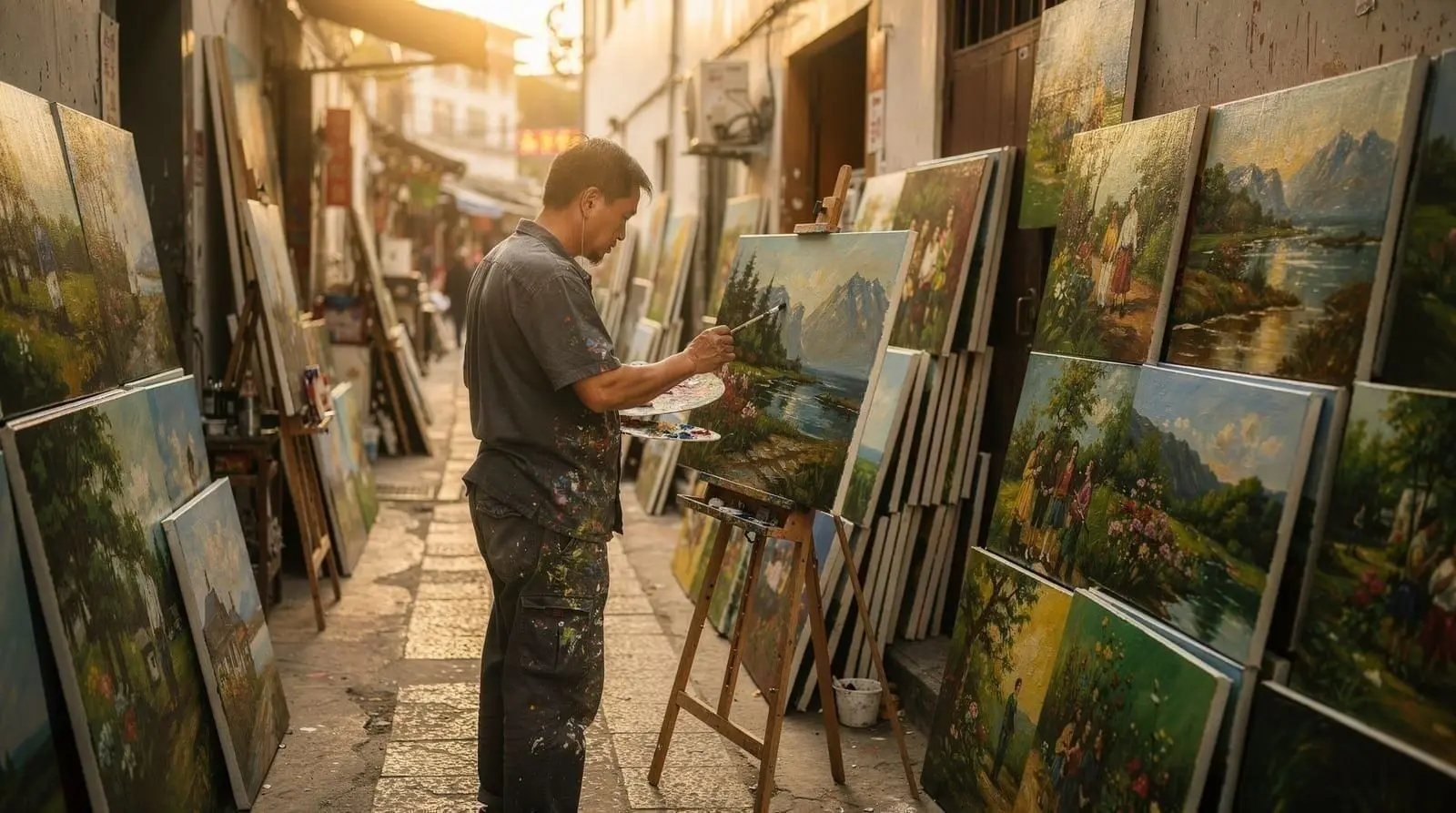
What you walk into today is a dense, navigable grid of streets where almost every ground-floor space is a studio or gallery. Artists sit in front of canvases visible through open doors. The smell of linseed oil and turpentine is constant. Works in progress hang on every surface.
What to expect in Dafen
The village covers roughly 4 square kilometres but the concentrated painting district is smaller — about a 15-minute walk across the core area. There is no formal entrance, no ticket, and no required route. You walk in from the metro station and explore.
The studios range from one-artist operations (a single painter with a stack of canvases) to larger workshops with 10–20 people working simultaneously. Some studios specialise in specific genres: one shop might produce nothing but Van Gogh copies; another focuses on Chinese landscape paintings; a third does hyperrealist portraits.
The range of quality is wide, and this is the key thing to understand before you visit.
Reproduction paintings: the bulk of production is Van Gogh, Monet, Rembrandt, and other European masters. These reproductions vary enormously in quality from very good (technically skilled, careful colour matching) to tourist-grade (rough brushwork, inaccurate colours). Price range: CNY 50–500 for a standard 60×90 cm reproduction, with quality roughly tracking price. The higher-end studios producing careful copies for serious collectors charge CNY 500–2,000 or more depending on size and complexity.
Original paintings: perhaps 15–20% of Dafen’s studios now focus on original work. The best of these are genuinely skilled contemporary Chinese painters who have established themselves here because of low studio costs and proximity to the export infrastructure. Original contemporary works in multiple styles — landscape, figurative, abstract — start at CNY 300 for small works and go up significantly for established Dafen artists.
Portrait commissions: one of the most popular options for visitors. Bring a high-resolution photo on your phone (most studios require a quality reference image) and commission a painted portrait. A standard 50×60 cm oil portrait from a skilled painter costs CNY 300–600 and takes 7–14 days. Most studios can ship internationally. Make sure to agree on the exact size, medium (oil vs. acrylic), and background treatment before paying — and ask to see examples of finished portraits before committing.
How to navigate Dafen
The core painting district runs off Dafen Road (大芬路) and Dafen Oil Painting Village Square (大芬广场). The square has a fountain and some outdoor sculpture — this is the centre point from which streets radiate.
Walking north from the square into the alleyways gives you the densest concentration of working studios. This is where you are most likely to see painters at work rather than just finished canvases for sale.
The western edge of the district has the more upscale galleries — larger spaces, better-framed works, and air conditioning. These are also the places where English is most commonly spoken. If you want to have a conversation about what you are looking at or commission something, start here.
There is a small Dafen Art Museum at the northern edge of the district (free entry, Tuesday–Sunday 10:00–17:30) that contextualises the village’s history and shows rotating exhibitions of original work by Dafen-based artists. Worth 30 minutes.
Buying art at Dafen: practical advice
If you intend to buy, go with a budget in mind and be prepared to haggle gently — initial prices in the tourist-facing galleries are often 20–40% above what they will accept. The studios in the back alleys charge more honest prices because they deal mostly with trade buyers who know the market.
For reproduction paintings, the critical quality indicators are:
- Brushwork consistency: look at the surface closely. Poor reproductions have visible texture inconsistencies where speed has overridden accuracy.
- Colour fidelity: if you know the original, compare on your phone. The best reproductions nail the colour temperature.
- Canvas quality: higher-end reproductions use Belgian linen rather than cheap cotton canvas; you can see this in the texture at the edges.
For original paintings, ask whether the artist has a WeChat store or portfolio — many Dafen artists maintain social media galleries that show their full body of work and prices are consistent.
Shipping: the village has multiple packing and shipping services. International shipping for a rolled canvas (paintings can be removed from stretcher frames, rolled, and shipped in a tube) costs CNY 150–400 depending on destination. Most studios can arrange this.
Join a guided 3-hour Dafen Oil Painting Village tourWhat kind of visitor Dafen suits
Dafen is not for everyone, and being upfront about that saves a wasted trip. It suits visitors who enjoy watching craft in progress, are curious about the supply chains behind mass-produced art, or want a genuinely non-touristy commission to take home. It does not suit visitors expecting a gallery-style contemporary art experience, or those short on time who only have room for one culture stop in Shenzhen — in that case, the Shenzhen Museum or OCT-LOFT Creative Park are more efficient uses of a single afternoon.
| Visitor type | Verdict |
|---|---|
| Curious about craft/production | Strong yes |
| Wants a unique, affordable souvenir | Strong yes |
| Contemporary art enthusiast | Better served by OCT-LOFT |
| Very short on time (half-day only) | Skip in favour of a central attraction |
Getting to Dafen from Shenzhen city centre
By metro: Metro Line 3 (Longgang Line) to Dafen Station (大芬站), Exit A. Walk 5 minutes south along Dafen Road. From Futian CBD (Futian Station), take Line 3 eastbound — about 25 minutes, CNY 5–6. From Luohu border crossing, Line 1 east then transfer to Line 3 — about 35 minutes total.
From Hong Kong: cross at Futian/Lok Ma Chau or Lo Wu, take the metro to Futian or Luohu, then Line 3 east to Dafen. Total time from TST in Kowloon: approximately 75 minutes.
By taxi or Didi: from Futian CBD, about CNY 35–45 and 30–35 minutes in moderate traffic.
When to visit
Dafen is technically open every day, but the village is most active on weekday mornings when the trade buyers are visiting and the studios are at full production. Weekend afternoons get more tourists. Monday is the quietest day.
Best visiting time: Tuesday–Friday, 10:00–15:00. You will see the maximum number of artists working, the studios will be well-lit, and the alleyways have the best energy.
Avoid: Chinese New Year week (mid-February 2026) and the week after, when many artists return to their home provinces. The village is significantly depopulated during this period.
Combining Dafen with the rest of Longgang and a wider day
Dafen sits far enough from the tourist core that most visitors treat it as a dedicated half-day rather than an add-on. If building a fuller day around it, the Shenzhen Futian neighbourhood guide has lunch and dinner options for either side of the metro journey, and the day trips from Shenzhen guide has other out-of-centre options if Dafen is one stop on a longer exploratory day. Visitors building a broader itinerary around the city’s less-touristed neighbourhoods should also check Shenzhen in 3 days, which has room to slot in a half-day cultural detour like this one without crowding out the headline sights.
Dafen in the broader Shenzhen art context
Dafen raises a question that is worth sitting with: is what happens here art or industry? The answer is probably that the distinction matters less here than it does in the traditional art world. The painters of Dafen are highly skilled craftspeople who have developed facility with oil paint that formal art education might not have given them. Some have used that foundation to develop personal practices. Others are content with the trade work and the income it provides.
For a contrast in creative culture, the OCT-LOFT Creative Park in Nanshan represents Shenzhen’s contemporary art-world ambitions — galleries showing conceptual work, design studios, and international artist residencies. The two places together give you the full spectrum of how Shenzhen thinks about visual culture.
The Shenzhen Museum in Futian’s Civic Centre area covers the city’s cultural history more formally, including its art and craft traditions. That is a useful counterpoint if you want institutional context before or after visiting Dafen.
For shoppers interested in the intersection of design and commerce more broadly, Dongmen Street’s art supply section in Luohu stocks the raw materials used in Dafen — canvas, stretcher frames, pigments — at trade prices.
Frequently asked questions about Dafen
Can I watch painters working at Dafen?
Yes. Studios in Dafen are almost always open to the street, and many painters work with the door open or in courtyard spaces visible from the path. There is no etiquette barrier to stopping and watching — artists are used to being observed. If you want to photograph a specific painter at work, ask first with a gesture to your phone; most will agree.
How much do paintings at Dafen cost?
Reproduction paintings (Van Gogh, Monet, etc.) start at about CNY 80–150 for small formats (30×40 cm) and CNY 200–500 for standard sizes (60×90 cm). Quality varies significantly with price. Original paintings by Dafen artists start at CNY 300–500 for small works. Custom portrait commissions: CNY 300–600 for a 50×60 cm oil portrait (14-day production time).
Is it ethical to buy reproduction paintings at Dafen?
Reproduction painting is legal when the original works are in the public domain (pre-20th century works: Van Gogh, Rembrandt, Monet, da Vinci). Reproducing works by living artists or recent artists still under copyright is more legally complex and ethically questionable. Most Dafen production focuses on public domain masters, so for most purchases, this is not an issue. Original works by Dafen artists are straightforwardly ethical and often excellent value.
How do I get a portrait commission shipped home?
Most studios that do portrait commissions have established shipping relationships. After the painting is completed (typically 7–14 days), the studio rolls the canvas, ships it in a protective tube. International shipping (unframed, rolled) to Europe or North America costs CNY 150–400 via DHL or SF Express. Customs value declaration needs to match what you paid — get a receipt. Some studios also frame and ship framed works in wooden crates; this costs significantly more (CNY 400–800 for international shipping) but arrives ready to hang.
Is Dafen suitable for a half-day trip combined with something else in Longgang?
Longgang is a large district with little else geared toward international visitors near Dafen specifically, so most people treat it as a standalone half-day rather than pairing it with another attraction in the immediate area. It combines more naturally with a full day that also includes central Shenzhen sights before or after, given the roughly 25-minute metro ride each way from Futian.
Top-rated things to do in Shenzhen
Verified deep-linked GetYourGuide tours. Book through these links and we earn a small commission at no cost to you.