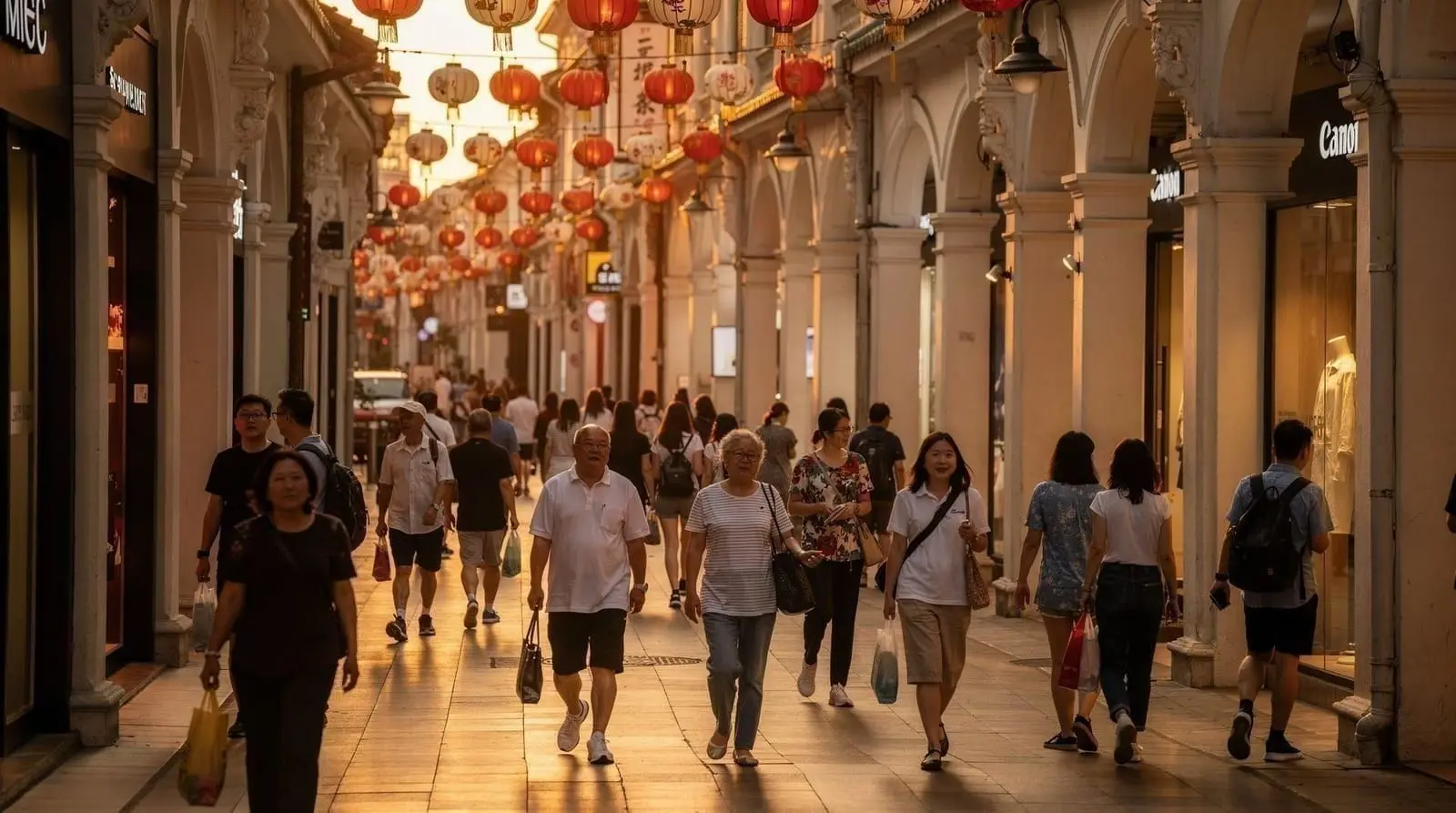
Luohu is the part of Shenzhen that has been around long enough to have opinions. While Futian was being engineered as a civic showcase and Nanshan was building tech campuses in organized park zones, Luohu grew up around the Hong Kong border — accumulating the grit, the street-level energy, the haggling culture, and the migrant-city food that make it the most characterful district for travelers who want something less planned.
The Lo Wu crossing — the border checkpoint that connects Luohu to Hong Kong’s MTR East Rail Line — is the highest-volume Shenzhen–Hong Kong land crossing. That volume has shaped everything about the neighborhood: restaurants serving workers on tight schedules, currency exchange stalls at every corner, phone case vendors targeting weekend visitors, and the labyrinthine Luohu Commercial City built directly into the crossing exit, which has been selling tourists goods of variable provenance since the mid-1990s.
Dongmen, a few minutes walk northwest of the border, is where the city’s actual character asserts itself — narrow pedestrian streets with food stalls, clothing markets, old teahouses, and the kind of continuous commercial activity that feels organic rather than designed.
| Where | Southeast Shenzhen, on the Hong Kong border |
| Cost | Dim sum from CNY 60/person; Dongmen snacks CNY 10–30 each |
| Time needed | Half day for shopping; full day with Dongmen and dim sum |
| Getting there | Metro Lines 1, 2, 3, 5 to Luohu or Laojie stations |
| Best time | October–April; avoid Dongmen’s narrow lanes in July–August heat |
Lo Wu border crossing: what to expect
The Lo Wu (Luohu) crossing is the most popular land crossing between Shenzhen and Hong Kong, and that popularity means queues. On the Hong Kong side: Lo Wu MTR station (East Rail Line, terminus). On the Shenzhen side: Luohu Metro station (Lines 1 and 4), directly connected by enclosed walkway to the immigration exit hall.
Operating hours: 06:30–24:00. Closed between 00:00 and 06:30. For late-night crossings, Huanggang (24/7, northeast of central Luohu) is the alternative — less convenient but never closes.
Immigration timing expectations:
- 06:30–08:30 (commuter peak): 30–50 minutes
- 09:00–14:00 (mid-morning, post-commuter): 20–35 minutes
- 14:00–18:00 (off-peak): 15–25 minutes — the consistently fastest window
- 18:00–21:00 (evening return peak): 40–65 minutes
- Weekend afternoons (13:00–18:00): 45–75 minutes during holiday and shopping season
Hong Kong MTR journey: Lo Wu to Mong Kok: approximately 30 minutes, HKD 21. Lo Wu to Admiralty: approximately 40 minutes, HKD 28. Buy your Octopus card on arrival in Hong Kong or use Visa/Mastercard contactless.
Practical tip: If you’re going to Hong Kong and returning the same day, Futian Station HSR is faster and more comfortable (14 min to West Kowloon vs 50+ min to Mong Kok). Lo Wu is better for travelers whose hotel is in northern Hong Kong (Mong Kok, Kowloon Tong) or who prefer the MTR’s flat-rate pricing.
Luohu Commercial City
The six-floor shopping complex built directly adjacent to the Lo Wu immigration exit has been drawing cross-border visitors since it opened in the late 1990s. It is, depending on your perspective, a genuine shopping destination, a tourist trap, or an anthropologically interesting artifact of Shenzhen’s early open-economy period. All three assessments are partially correct.
The building’s reputation was built on replica luxury goods — handbags, watches, shoes, electronics — that mimicked high-end brands with varying degrees of success. That trade still exists here, but it has been pushed to less visible sections as enforcement has increased over the past decade. What’s more prominent in 2026 is a mixed market covering legitimate Chinese brands, electronics accessories, tailoring, massage services, and food stalls.
Floor-by-floor guide (approximate):
- B1 and G/F: Snack food, fast food, convenience goods. This level has the highest proportion of legitimate purchases.
- 1F: Clothing and fashion accessories. Mix of local brands, unbranded goods, and some replica items.
- 2F–3F: Electronics accessories, phone cases, portable gadgets. Haggling is expected; start at 50% of asking.
- 4F–5F: Tailoring (custom-made suits, dresses, and alterations — a legitimate service at competitive prices); massage parlors (CNY 80–200 per hour).
- 6F: Mixed; massage, additional clothing, some food.
Honest advice on shopping here: Buy phone accessories, cables, and basic gadgets with confidence — prices are genuinely cheap and the goods are as described. Tailoring at 4F is a legitimate service; allow 2–3 days for completion, prices are CNY 200–600 for a basic suit shell that you supply fabric for, CNY 800–2,500 for the full suit with fabric. Don’t buy anything that claims to be a famous brand at a fraction of retail price — the legality of importing such goods varies by destination, and customs confiscation is common.
Operating hours: 09:00–22:00 daily. Busiest on weekends and Hong Kong public holidays when cross-border shopping traffic peaks.
Dongmen pedestrian street
Dongmen (东门) is the commercial and food heart of old Luohu — a pedestrian zone that runs between Laojie (Old Street) Metro station and Dongmen Metro station on Line 1. The main street is wide and modern, with chain stores and cosmetics outlets. The real Dongmen is in the older market lanes to the north and east of the main drag — narrower streets where the food stalls operate.
Allow 2–3 hours for a proper Dongmen food walk. Key items to try:
Egg waffles (鸡蛋仔, gai dan jai): The Cantonese bubble waffle format — egg-rich batter cooked in ball-shaped iron molds, served hot from the press. The crispy exterior and custardy interior are addictive. Price: CNY 12–18 per serving. Multiple stalls compete on Dongmen’s main street; the best ones have lines. Avoid the stalls with English menus near the tourist entrance — they overprice and under-quality relative to stalls deeper in the market.
Stinky tofu (臭豆腐, chou doufu): Fermented tofu deep-fried to a crispy exterior, served with chili oil and pickled vegetables. The smell is extreme; the taste is completely different from what the smell suggests — earthy, complex, satisfying. The best stalls have the strongest smell (indicating proper fermentation). Price: CNY 10–15 per portion. A Hunan-style preparation (more aggressively fermented) is available at stalls run by Hunan migrants; the Cantonese version is milder.
Chaoshan beef rice rolls (牛肉肠粉): Thin steamed rice-flour sheets wrapped around fresh-sliced beef (sometimes with preserved egg or chive), dressed with oyster sauce, sesame paste, and light soy. Price: CNY 18–28 per dish. Chaoshan cuisine is well-represented throughout Luohu given the large Chaoshan migrant community from Guangdong’s eastern coast.
Roast meats (烧味, siu mei): Char siu (蜜汁叉烧, Cantonese BBQ pork), roast duck, crispy-skinned roast pork (烧肉), and soy chicken are the Cantonese roasting canon. Several roast meat shops along Dongmen’s side streets sell by weight (CNY 50–120 per jin, 0.5 kg) for takeaway or serve over rice at adjacent canteens for CNY 28–45 per plate.
Bubble tea: Heytea (喜茶) on Dongmen’s main street has consistent quality at CNY 18–32 per drink. The queue is real and reflects the quality — it’s consistently one of the best bubble tea chains in China. Independent stalls cheaper (CNY 8–15) but more variable.
Cantonese egg tarts (蛋挞, dan tat): Pastry crust filled with smooth egg custard. CNY 5–10 each from bakeries in the Dongmen market area. The Portuguese-style version (葡式蛋挞, puff pastry with slightly charred top) from bakeries in the eastern market section is particularly good.
Join a guided Dongmen market and electronics tour for insider food and shopping accessDim sum in Luohu: working-class yum cha
The residential streets around Luohu Metro station — particularly north of the station along Renmin South Road and the cross streets toward Guomao — have some of Shenzhen’s best value dim sum. These are neighborhood restaurants serving the people who live and work here, not tourists; the pricing reflects that.
A typical Luohu dim sum experience: arrive at 07:30–09:00 (dim sum stops being served at most places by noon). A teapot is placed at your table immediately; you pay for the tea (CNY 8–15 per table). Paper menus list items by type; mark the quantity and a server collects and processes. Alternatively, older establishments still use the trolley service (push carts) where you select from what’s offered as it passes your table.
Representative prices:
- Har gow (steamed shrimp dumplings, 3 pieces): CNY 14–22
- Siu mai (pork and shrimp dumplings, 3 pieces): CNY 12–20
- Cheung fun (rice rolls with shrimp, BBQ pork, or beef): CNY 18–28
- Turnip cake (fried or steamed): CNY 12–18
- Congee (plain or century egg + pork): CNY 15–25
Honest advice: Sunday dim sum in Luohu is crowded, full stop. If you want the experience without the wait, arrive before 09:00 or choose a Tuesday or Wednesday morning. The quality doesn’t change; the atmosphere at 08:00 on a Tuesday — local older residents reading newspapers, the rattle of bamboo steamers, the smell of pu-erh tea — is more characterful anyway.
Luohu for first-time mainland China arrivals
For many travelers, the Lo Wu crossing is their first physical step onto mainland China, and Luohu is designed — intentionally or not — to absorb that transition. The immigration hall processes both Chinese and foreign passport holders through separate but adjacent queues; foreign passport lines move independently and are usually shorter than the domestic lines during commuter peaks.
On the far side, the exit hall opens directly into Luohu Commercial City, so the first thing most arrivals see is a wall of shop touts rather than a city street — disorienting for a first visit, and worth being mentally prepared for. Basic orientation: the Luohu Metro station entrance is clearly signed from the immigration exit hall, WeChat Pay and Alipay setup (covered in the Shenzhen main guide) is worth doing before crossing rather than after, and a Shenzhen SIM or eSIM should be active before you reach the hall, since Hong Kong data plans stop working the moment you cross.
The Sham Chun River and Renmin Park
The Shenzhen River (深圳河, historically Sham Chun River in Cantonese) runs along the southern edge of Luohu, forming the physical border with Hong Kong. There’s no tourist infrastructure along the riverbank, but the riverside path near Renmin Park provides an unexpectedly quiet 30-minute walk with views across the water to Hong Kong’s New Territories farmland and low hills.
Renmin Park (人民公园) is one of Shenzhen’s oldest parks — dating to the 1950s, unusual for a city that barely existed then. It has mature camphor trees, a lotus pond, and a relaxed atmosphere distinct from the commercial intensity that dominates the rest of Luohu. Free entry. Metro: Guomao station (Line 1), Exit A, 10 minutes walk south.
The Hubei migrant food strip
The blocks around Guomao Metro station host a dense cluster of Hubei-province restaurants — a consequence of Wuhan, Hunan, and broader central China migrants who settled in Luohu during the 1990s manufacturing boom. The cuisine here is distinctly non-Cantonese:
Hot dry noodles (热干面, re gan mian): Wuhan’s signature breakfast dish — alkaline wheat noodles tossed in sesame paste, light soy, and chili oil. CNY 10–15 per bowl. Not a soup — the noodles are dry and the sauce clings to each strand.
Lotus root stuffed with glutinous rice (糯米藕): Sections of lotus root packed with sweet glutinous rice and simmered with osmanthus-flower syrup. CNY 20–30. Available from sweet food stalls rather than restaurants.
Braised pork belly (红烧肉): Hunanese-style braised pork in soy, rice wine, and rock sugar. Similar to Mao’s famous red-braised pork (毛氏红烧肉). CNY 35–55 per portion with rice.
Finding these restaurants: exit Guomao Metro station Exit A, walk north along Bao’an South Road for 5 minutes, turn left into the residential side streets. Follow the lunch-hour worker crowds — these stalls have no English signage and don’t need it.
Wutong Mountain and the eastern hills
East of central Luohu, the Wutong Mountain National Forest Park occupies the hills rising to 943.7 meters at the summit — Shenzhen’s highest point. Accessible via bus 365 from Guomao station, or Metro Line 5 to Buji station and then bus transfer.
The mountain has multiple trail routes from 3 km (easy, 1 hour) to 8 km (moderate, 3–4 hours to the summit). Summit views extend across to Hong Kong on clear days (October–November best). Facilities: water sources on the main trails, simple food stalls at the trailheads. Entry: free to the park; CNY 10–20 for some specific scenic areas.
Honest note: Wutong Mountain is genuinely worth 4 hours on a clear autumn day. On hazy weekday mornings, save it for Dapeng Peninsula instead.
Choosing a border crossing: Lo Wu vs the alternatives
Luohu’s Lo Wu crossing is only one of several ways between Shenzhen and Hong Kong, and it isn’t always the fastest:
| Crossing | Journey to HK | Best for |
|---|---|---|
| Lo Wu (Luohu) | ~30–40 min to Mong Kok | Travelers whose HK hotel is in northern Kowloon |
| Futian HSR | 14 min to West Kowloon | Fastest option; day-trippers returning same day |
| Huanggang | 24/7, similar speed to Lo Wu | Late-night crossings after 00:00 |
| Shekou ferry | 30–60 min to Tsim Sha Tsui | Travelers based in Nanshan/Shekou |
For a full comparison of crossing options and current visa rules, see the China visa and 240-hour transit guide and the Hong Kong–Shenzhen border crossings guide. If you’re deciding whether to base yourself in Hong Kong or Shenzhen entirely, the Shenzhen vs Hong Kong comparison covers the broader tradeoffs.
Luohu after dark
Luohu is not primarily a nightlife district — that role belongs more to Nanshan and Shekou — but the streets around Dongmen and Guomao have a genuine evening scene worth knowing about. The roast meat shops and dim sum halls mentioned above mostly close by 21:00, but a second wave of small hotpot restaurants and skewer (串, chuan) stalls opens from around 18:00 and runs past midnight, catering to shift workers and late shoppers leaving Luohu Commercial City.
A CNY 40–70 plate of lamb and vegetable skewers with a cold Tsingtao beer is a reasonable way to end a Dongmen food walk. The area immediately around the border is quieter after 22:00 as day-trippers head back across, which — combined with the neon signage still lit along Dongmen’s main drag — makes for good photography if you enjoy the contrast between a mostly-emptied commercial strip and a still-busy border town.
Shopping beyond Luohu Commercial City
Dongmen clothing market: The Dongmen Wholesale Clothing Market (东门服装批发市场) behind the main pedestrian street sells clothing at genuine wholesale prices. Individual buyers are welcome but prices are normally quoted per carton (10–50 units). Negotiate a single-piece surcharge; expect to pay 150–200% of wholesale for one item. Quality ranges from basic to quite good; check stitching and fabric before purchasing.
Mobile phone accessories wholesale: Several small malls near Laojie Metro station specialize in phone accessories at near-wholesale prices. Similar goods to Huaqiangbei, slightly less selection but often fewer crowds. A phone case for a current iPhone or Android model: CNY 15–40; braided cables: CNY 12–25.
Jade and antiques: Luohu has a small cluster of antique and jade stalls along Jiefang Road south of the Civic Square. Quality varies enormously. Genuine antiques are rare; decorative pieces and reproductions are more common. Don’t pay antique prices for anything unless you genuinely know what you’re buying.
Practical information for Luohu
Metro connections:
- Line 1 west to Futian and Nanshan
- Line 3 west to Longgang (Shenzhen’s eastern suburbs)
- Line 5 northeast toward Yantian and the eastern coast
- Line 2 north toward Bao’an and the airport corridor
Didi from central Luohu:
- To Futian CBD: CNY 15–25, 20–30 minutes
- To Nanshan Sea World: CNY 50–70, 40–55 minutes
- To Shenzhen Airport: CNY 80–120, 55–75 minutes
Accommodation in Luohu: Budget hotels cluster around the Lo Wu border crossing area, serving cross-border commuters and overnight shoppers. Expect CNY 180–320/night for basic business hotel rooms. Quality is variable; recent TripAdvisor or Ctrip reviews are more reliable than star ratings for this area.
Mid-range options (CNY 400–700/night): Mandarin Hotel Shenzhen near Guomao, Park Lane Hotel. Both offer better comfort with slightly more distance from the border noise and crowds.
Honest assessment: Luohu is a convenient transit-and-shopping district, not a comfortable residential base for an extended stay. If you’re in Shenzhen primarily for Luohu shopping and street food, 1–2 nights is optimal. For a multi-day Shenzhen trip, base yourself in Futian and day-trip to Luohu.
Honest tourist-trap warnings for Luohu
Border touts: People offering currency exchange, SIM cards, taxi services, and guided tours near the Lo Wu exit should be declined. Exchange rates are poor (5–10% below bank rates), SIM cards are overpriced, and “guide” services lead to commission shops.
Restaurant touts in the border mall area: Restaurants immediately inside Luohu Commercial City that aggressively target exiting travelers have tourist pricing — expect to pay 2–3x what you’d pay 5 minutes walk away.
Counterfeit goods: The legal situation for exporting counterfeit branded goods from China varies by destination country. Many customs services in Europe, North America, and Australia confiscate such goods on arrival. Don’t pack something you can’t afford to lose to customs.
Onward from Luohu
- Shenzhen main guide for city-wide overview and planning
- Futian — 20 minutes west for Lianhuashan Park, Huaqiangbei, and the HSR station
- Yantian — Line 5 northeast, 35–45 minutes, for coastal seafood and quieter atmosphere
- Dapeng Peninsula — Bus E11 from Luohu area or Metro Line 5 + connection, 90 minutes, for nature and beaches
- Shenzhen on a budget — Luohu is central to the budget itinerary
- Shenzhen metro guide — for navigating between Luohu and the rest of the city
- Is Shenzhen safe? — practical safety notes that apply directly to the border and market areas
- Where to stay in Shenzhen — comparing Luohu against Futian and Nanshan as a base
- Things to do in Shenzhen