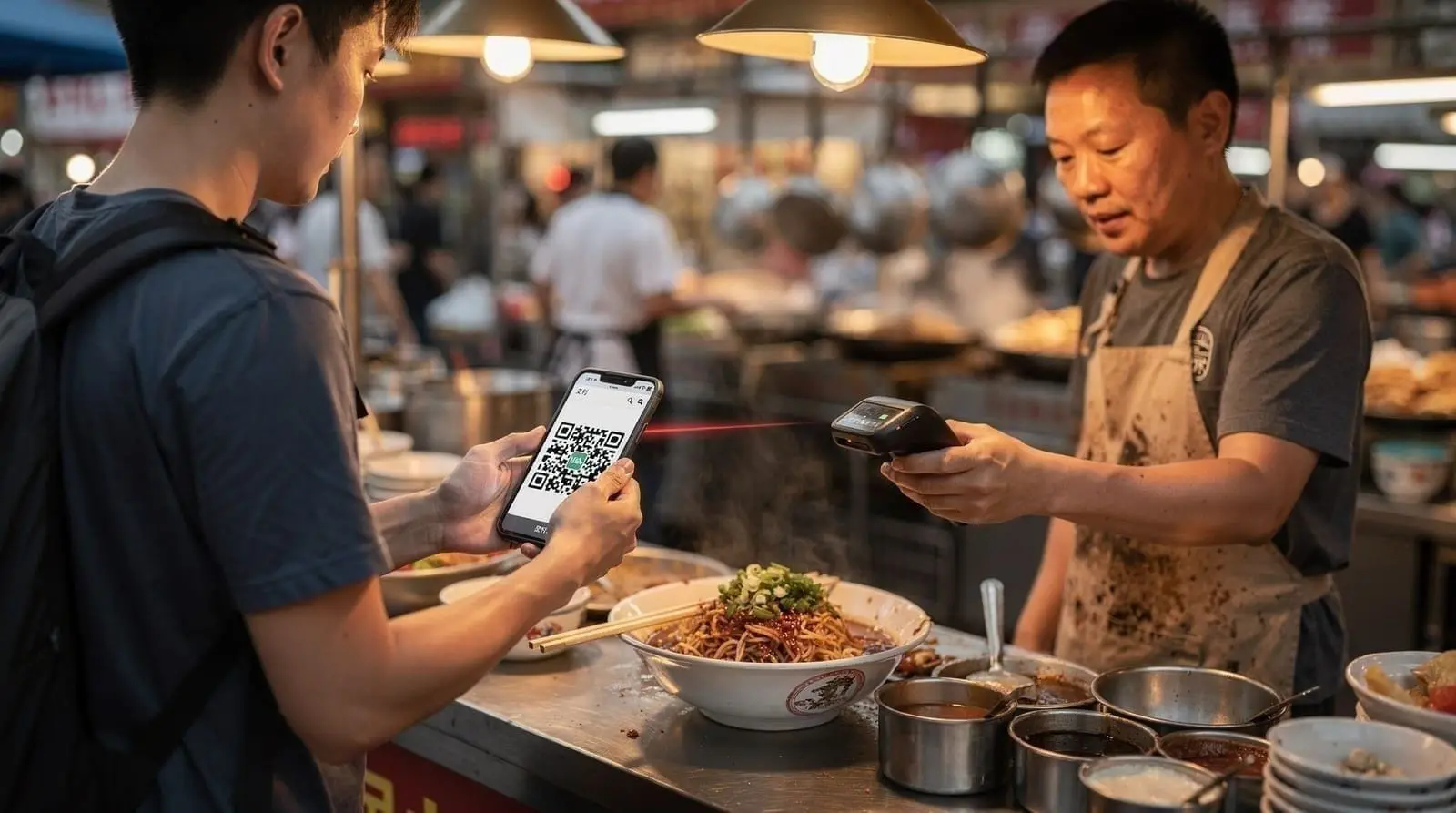
WeChat Pay and Alipay for foreigners: complete 2026 guide
Can foreigners use WeChat Pay or Alipay in China?
Yes. Since 2023 reforms, both apps accept foreign Visa and Mastercard. Setup takes about 15 minutes: download the app, link your card, upload a passport photo. Annual spending limit is CNY 35,000 (~USD 5,150).
Shenzhen has been functionally cashless for years. Street stalls, taxis, restaurants, museums, convenience stores — the vast majority of transactions happen via QR code. For most of those years, this left foreign visitors in an awkward position: watch locals tap and go while you fumbled for RMB notes nobody wanted to accept.
That changed in 2023, when China opened both WeChat Pay and Alipay to international bank cards. By 2026 the process is smooth, automated, and fast. This guide explains exactly how to set up both apps, what the limits and fees are, where you will still need cash, and how much to carry.
Before you arrive, do this on home Wi-Fi. It will take 15 minutes and save you a lot of frustration on arrival.
| Setup time | About 15 minutes, before you fly |
| Cost | Free to set up; 3% fee above CNY 200/transaction |
| Annual limit | CNY 35,000 (~USD 5,150) per app |
| Where | Works across mainland China (not Hong Kong/Macau) |
| Do first | Link card and verify passport on home Wi-Fi |
Why mobile payments matter so much in Shenzhen
Shenzhen sits at around 95% QR-code acceptance across merchants. That includes metro ticket machines, theme park food stalls, wet markets, pharmacies, and Didi rides. A foreign visitor without a working payment app is not just inconvenienced — they can genuinely struggle to pay for things that locals consider self-evident.
Hotels and upscale restaurants usually accept international Visa or Mastercard via physical terminal. But the moment you step outside the international hotel corridor into real Shenzhen — the food courts in Huaqiangbei, the stalls in Dongmen, a coffee at a local indie cafe — you need mobile payment.
See our Shenzhen 3-day itinerary for how these payments weave into a typical visit.
WeChat Pay for foreigners: step-by-step setup
WeChat is the dominant app in China: messaging, social media, mini-programs, and payments all in one. Setting up WeChat Pay on a foreign card takes five steps.
Step 1 — Download WeChat. Use the App Store or Google Play before you arrive. The app is available globally.
Step 2 — Create an account. Register with your mobile number. WeChat may ask a local contact to verify your account if the number is from certain countries — use a family member or friend who already has WeChat, or set up with a local Chinese SIM or eSIM on arrival.
Step 3 — Open WeChat Pay. Go to Me → Pay → Cards → Add Credit/Debit Card. WeChat Pay accepts Visa, Mastercard, and JCB from foreign-issued cards.
Step 4 — Verify identity. You will be prompted to upload a photo of your passport. The verification is largely automated and typically completes in under 10 minutes. Approval rate is around 98% for standard tourist passports.
Step 5 — Set a payment PIN. Six digits. Done.
Once set up, you can pay by scanning a merchant QR code (scan their code) or by showing your personal QR code for the merchant to scan. Both work.
If you need help navigating menus in Chinese, the app has an English-language option under Settings → Language.
Alipay for foreigners: step-by-step setup
Alipay is Ant Group’s equivalent: slightly more prevalent in southern China and e-commerce but equally accepted in Shenzhen. Foreign card setup is similar to WeChat Pay.
Step 1 — Download Alipay. Available globally in both app stores.
Step 2 — Choose the International version. When you open Alipay for the first time, select “International” rather than mainland China. This routes you to the foreign-card flow rather than requiring a Chinese bank account.
Step 3 — Add your card. Alipay for foreigners accepts Visa, Mastercard, and Discover. No JCB at time of writing.
Step 4 — Identity verification. Passport photo upload, automated review, typically under 10 minutes. Same 98% automated approval as WeChat Pay.
Step 5 — Done. No payment PIN required for Alipay — it uses biometrics (Face ID or fingerprint) or your phone’s screen lock.
Alipay’s interface is friendlier to English speakers out of the box. It also has a built-in translation feature for menus, which is a separate but genuinely useful tool.
Transaction limits and fees (2026)
Both apps share the same government-mandated limits for foreign-card users:
| WeChat Pay | Alipay | |
|---|---|---|
| Single transaction limit | CNY 5,000 (~USD 735) | CNY 5,000 (~USD 735) |
| Annual spending limit | CNY 35,000 (~USD 5,150) | CNY 35,000 (~USD 5,150) |
| Higher single-transaction limit | CNY 20,000 (with additional verification) | CNY 20,000 (with additional verification) |
Fees work the same way on both platforms:
- Below CNY 200 per transaction: no fee
- Above CNY 200 per transaction: 3% service charge
That 3% fee is worth factoring into your budget. A CNY 1,000 restaurant bill (about USD 147) costs CNY 30 extra (~USD 4.40) in fees. Not ruinous, but not nothing. The fee is taken from your linked card in your home currency at the prevailing exchange rate.
The 2026 exchange rate sits around 1 USD = 6.8 CNY. Use our currency tool for live rates before you travel.
WeChat Pay vs Alipay: which should you use?
For most tourists, the practical answer is: set up both, then use whichever the merchant prefers. Some display only one QR code; having both avoids situations where you can only pay one way.
If you must pick one to start with:
WeChat Pay is better if you are already using WeChat to communicate. You will have the app open constantly anyway, and payment is one tap away from any conversation.
Alipay is slightly friendlier in English and integrates with more international booking platforms. Its map and restaurant-discovery tools are also useful for navigating Shenzhen.
Neither is technically superior for a tourist in Shenzhen. The 95% acceptance rate applies to both.
Where cash is still necessary
About 5% of vendors in Shenzhen remain cash-only in 2026. This cluster tends to be:
- Very small street food stalls, particularly those run by older operators. The egg-waffle cart near Dongmen, the tofu-flower lady at the wet market — these sellers often have no QR code, and even if they do, the mobile network at a busy outdoor stall may be unreliable.
- Some public toilets charge CNY 0.5–1 for entry and accept coins only.
- Rural day-trip stops — if you head to the hills of Dapeng or the fishing villages of the eastern coast, card acceptance drops off fast.
- Tipping is not part of Chinese restaurant culture. Do not feel obliged. If you want to express appreciation, tell the staff directly; tips handed to servers are usually declined.
How much cash to carry
For a 5–7 day trip to Shenzhen, carry CNY 1,000–2,000 (approximately USD 150–300). This covers:
- Small street food purchases
- Emergencies where mobile payment fails
- Public transit if your transit card or phone dies
- Occasional rural or market vendors
You do not need more than this unless you are planning extended rural travel or shopping heavily at traditional markets where haggling in cash is expected.
Plan your overall spending with our budget calculator.
ATMs: getting CNY on arrival
International ATMs are widely available in Shenzhen. Look for Bank of China, ICBC, China Construction Bank, or HSBC branches — all accept foreign Visa and Mastercard debit cards.
Typical fees for a foreign card withdrawal:
- Your home bank’s international fee: usually 2–3% or a flat USD 3–5
- The Chinese ATM: usually no additional fee (Bank of China and ICBC waive ATM fees for foreign cards)
- Currency conversion: built into the exchange rate, typically 0.5–1% above mid-market
Withdraw CNY 1,000–1,500 in one go to minimise per-withdrawal fees. Shenzhen Bao’an International Airport has ATMs in the arrivals hall on both T3 and T4 sides.
Currency exchange: airport, hotel, or bank?
If you prefer to bring CNY from home, you will get a poor rate. If you exchange at your hotel, the rate is usually 3–5% below mid-market. Your best options:
Bank of China branches offer the official exchange rate with a small commission. Passport required.
ATM withdrawal is usually equivalent or marginally better than a bank exchange for amounts under CNY 3,000.
Avoid airport kiosks (not Bank of China branded ones) — they advertise “0 commission” but make the margin on the exchange rate itself, often 4–6% worse than mid-market.
See the visa and entry guide and budget planner for overall trip cost context.
Practical scenarios: paying for common things in Shenzhen
Understanding the theory is useful. Understanding how payment works in practice — day by day, purchase by purchase — is more useful.
Metro: Shenzhen Metro ticket machines accept WeChat Pay and Alipay at every station. The Shenzhen metro guide covers line-by-line navigation for visitors. Scan the QR code on the machine to purchase a single-journey ticket. Alternatively, use the Shenzhen Metro app to link WeChat Pay for direct gate scanning — hold your phone to the gate reader and the fare deducts automatically. This is how locals ride.
Didi (ride-hailing): Didi’s app links directly to WeChat Pay. Once WeChat Pay is set up, booking a Didi requires no additional payment setup. This is especially useful if you are navigating Shenzhen’s neighborhoods beyond the metro line. The fare is deducted when you complete the journey. This is the most reliable way to get around when you cannot speak Mandarin — the app translates pickup and drop-off points.
Restaurants: QR codes are on every table in modern restaurants. Scan to view the menu, order, and pay — all without summoning a server. This is how locals do it, and it is genuinely faster. In older restaurants without table QR codes, the server brings a handheld QR terminal at the end of the meal.
Convenience stores: FamilyMart, 7-Eleven, and CU stores in Shenzhen all accept WeChat Pay and Alipay at the register. Scan the app’s payment QR code when prompted.
Theme parks: Window of the World, Splendid China, and Happy Valley all accept WeChat Pay and Alipay for both entry tickets and in-park food purchases. Buying tickets via WeChat Pay at the gate is common — no need for cash or foreign credit card terminals.
Wet markets and traditional markets: here is where cash remains useful. The produce sellers at Dongmen Old Street market, the seafood stalls at Shekou Yutang market — these are often cash-only. Have CNY 200–500 in small notes when exploring these.
Pharmacies: the major chains (Guoda, Haiwang Xing, Laiyikang) all accept WeChat Pay and Alipay. This matters for unexpectedly needed medicine, sunscreen, or toiletries.
Troubleshooting common setup problems
“My card was declined when linking”: confirm with your bank that international online transactions are enabled. Some banks block card-not-present international transactions by default — a single call or app toggle usually resolves this. Prepaid Visa cards frequently fail; use a regular credit or debit card.
“I cannot receive the SMS verification code”: some international mobile numbers do not receive SMS from Chinese servers reliably. Try: wait 5 minutes and request again, ensure your phone is not blocking international SMS, or try a different number (a travel SIM that supports SMS works well).
“The identity verification is stuck”: passport verification is automated but depends on photo quality. Ensure good lighting, no glare on the passport photo page, and that all four corners of the document are visible in frame. Re-upload if the first attempt times out.
“The merchant’s QR code does not scan”: rare but happens. Either the QR code is damaged/faded, or there is a network issue. Ask the staff to show their QR code on their device screen instead (most have a dynamic QR on a phone or tablet as backup).
“I exceeded the transaction limit”: for single purchases above CNY 5,000, you need to request additional identity verification within the app. This takes 1–3 business days and raises the limit to CNY 20,000 per transaction. Plan ahead if purchasing expensive electronics or jewellery.
Setting up before arrival: checklist
- Download WeChat and Alipay at home, on your home network
- Create accounts with your home mobile number
- Link your Visa or Mastercard to each app
- Complete passport identity verification (do this before landing — verification servers can be slow on roaming connections)
- Do a test transaction of CNY 1 to confirm setup (some coffee shops in major airports now accept Alipay/WeChat Pay, or send CNY 1 to yourself as a WeChat Pay transfer)
- Withdraw CNY 1,000–2,000 on arrival or bring cash from home for the first day
If your mobile payment needs to work from day one (for example, paying for the metro from the airport), completing setup before you board your flight is worth the 15-minute investment.
For connectivity while setting up — including how to access your home apps and avoid the Great Firewall — see our companion guide on eSIM and VPN options in China.
Using WeChat Pay and Alipay across the Greater Bay Area
WeChat Pay and Alipay work across all of mainland China. They do not work in Hong Kong or Macau unless you have a separate Hong Kong-issued card linked.
In Hong Kong, Octopus Card (the transit card) and international credit/debit cards at physical terminals are the norm. WeChat Pay HK and Alipay HK are separate apps from their mainland equivalents. If you are crossing the border frequently — via the Lo Wu or Futian checkpoints or the HZMB bridge — budget for dual payment systems. The Greater Bay Area visa guide covers entry requirements if you are planning multi-city travel.
Guangzhou and Zhuhai, being mainland cities, work exactly as Shenzhen does. If your Greater Bay Area itinerary includes all four cities, your Shenzhen-configured WeChat Pay will work everywhere except Hong Kong and Macau.
Splitting a bill or paying for a group
Both apps handle group payments reasonably well, though neither is as slick as Western split-bill apps. In WeChat, the “AA” (Chinese slang borrowed from English for splitting evenly) function inside a group chat lets one person pay the restaurant and then request equal shares from everyone else in the chat — useful if you are travelling with friends who all have WeChat set up.
Alipay has a similar group-payment collection feature under its “Collect Money” tool. For a simpler approach that avoids setting up group chats mid-trip, many travellers just designate one person to pay the full bill on their linked card and settle up later via a Western app like Wise or Venmo once back on home Wi-Fi — this sidesteps any confusion over exchange rates mid-meal.
What to do if you lose your phone
Losing the phone that holds your only payment method is a real risk worth planning for before you travel, not after. Both WeChat Pay and Alipay let you freeze payment functions remotely by logging into the app from another device or the web version and locking the account — do this immediately if a phone is lost or stolen. Keep a note (written down, not just on the lost phone) of your account recovery email and the customer service numbers for both apps.
This is also a strong argument for the CNY 500–1,000 cash buffer mentioned below: if your phone is gone, you need a way to pay for a taxi and a meal until you can restore access. A physical backup card (a second Visa or Mastercard not linked to either app) kept separately from your phone is the more resilient version of the same precaution.
Fitting payment setup around your border crossings
If your trip includes Hong Kong, Guangzhou, or Macau alongside Shenzhen, plan your payment setup around the border crossing itself rather than assuming one system follows you everywhere. Crossing at Lo Wu or Futian, or via the HZMB bridge toward Macau, marks the point where your mainland-configured WeChat Pay stops working and you switch to Octopus or a physical card. Build a small mental checklist for crossing days: confirm you still have cash in the currency you are entering, and do not assume a Shenzhen QR code will scan on the other side.
Frequently asked questions about WeChat Pay and Alipay for foreigners
Do I need a Chinese phone number to use WeChat Pay or Alipay?
No. Since the 2023 reforms, both apps allow foreigners to register with international mobile numbers and link foreign-issued cards. You do not need a Chinese SIM. Some WeChat accounts created with international numbers are asked to have an existing WeChat user verify them — this is a one-time anti-spam step, not a payment restriction.
Will my card get declined when linking to WeChat Pay or Alipay?
Most foreign Visa and Mastercards work. Cards that are sometimes declined: prepaid Visa cards, cards with strict international transaction blocks, or corporate cards with restricted online authorisation. If your first card fails, try a second card or contact your bank to confirm international online payments are enabled.
Is there a fee every time I pay?
No fee on transactions below CNY 200. A 3% fee applies above CNY 200. This is charged by the platform (WeChat/Alipay), not your home bank. Your home bank may additionally charge an international transaction fee — check your card’s terms.
What happens when I reach the CNY 35,000 annual limit?
Transactions will be declined until the calendar year resets (January 1). The limit is generous enough that most tourists will not come close — CNY 35,000 is roughly USD 5,150, more than most people spend on a single China trip. If you travel frequently, track usage in the app’s transaction history.
Can I use WeChat Pay or Alipay to pay for hotels and flights in China?
Yes. Most Chinese booking platforms (Trip.com, Ctrip, Fliggy) and many hotel payment terminals in the GBA accept WeChat Pay and Alipay. For major hotels, a physical card terminal is always available as a backup.
What should I do if my payment fails at a critical moment?
Keep CNY 500–1,000 cash in your wallet as a backup. If the payment app itself fails (server error, authentication timeout), having cash means you are never stuck. Offline transit cards (Shenzhen Tong) also work without internet and cost CNY 30 deposit at any metro station.
Is it safe to link my foreign bank card to WeChat Pay or Alipay?
Both platforms are regulated by the People’s Bank of China and use end-to-end encryption. Your card details are tokenised — the merchant never sees your card number. The risk profile is comparable to linking a card to Apple Pay or Google Pay. Use a dedicated travel card with low limits if you prefer extra caution.
Can I get a refund to my linked foreign card?
Yes. Refunds from merchants using WeChat Pay or Alipay are returned to the original payment method, including foreign cards. Processing typically takes 3–15 business days depending on your card issuer’s international processing times.
Can I split a restaurant bill with friends using WeChat Pay?
Yes, within a WeChat group chat the “AA” split-bill function lets one person pay the merchant and then request even shares from everyone else. It works well if your whole group already has WeChat set up; if not, it is often simpler for one person to pay and settle up later via a separate app once you are back on home Wi-Fi.
What happens if I lose my phone with WeChat Pay or Alipay on it?
Log in from another device or the web version of either app and freeze the payment function immediately. Keep your account recovery email and each app’s customer service number written down somewhere other than the lost phone, and carry a small cash buffer plus a separate backup card so you are not stranded while you sort out recovery.
Top-rated things to do in Shenzhen
Verified deep-linked GetYourGuide tours. Book through these links and we earn a small commission at no cost to you.