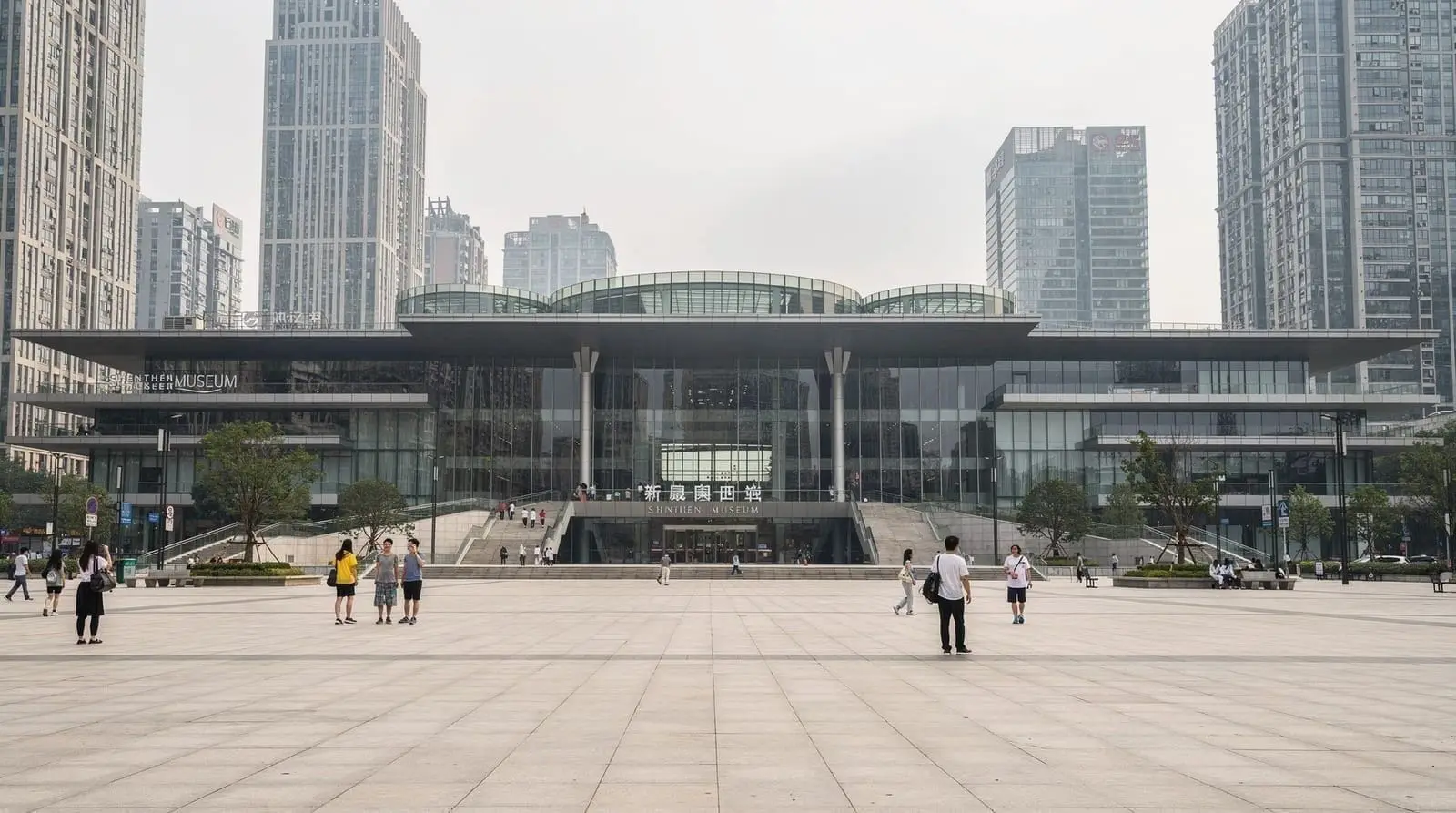
Shenzhen Museum guide: history, art, and free admission
Is Shenzhen Museum free and what does it cover?
Yes, free with passport registration at the entrance. The main building covers ancient Guangdong history and Shenzhen's modern development as a Special Economic Zone. The separate History of Modern Shenzhen Museum (Old Market Site) covers the reform era. Both open Tuesday–Sunday 10:00–18:00, closed Mondays.
Shenzhen Museum (深圳博物馆, Shēnzhèn Bówùguǎn) is one of the most honest cultural attractions in the city — a public institution that grapples directly with the question of what Shenzhen is, historically and culturally, without the airbrushing that often comes with official history.
The museum has two separate sites. The main museum is in the Civic Centre area of Futian, a modern building opened in 2008. The Old Market Site branch (originally the Shenzhen City History Museum, now the History of Modern Shenzhen Museum) is in the old part of Luohu, near Dongmen. Both are free with passport registration.
This guide covers primarily the Futian main building, which is the more accessible for tourists.
| Where | Civic Centre, Futian (main); Dongmen, Luohu (Old Market Site) |
| Cost | Free, passport registration required |
| Time needed | 2–3 hours main building; 1 hour Old Market Site |
| Getting there | Metro Line 4 to Children’s Palace or Line 1 to Civic Centre |
| Hours | Tue–Sun 10:00–18:00, last entry 17:30, closed Mondays |
If you are building a Futian day around it, the Futian neighbourhood guide and the Futian district overview both cover what else sits within walking distance.
What is inside the Futian main museum
The museum occupies a large modern building west of the Shenzhen Concert Hall, with five permanent exhibition wings and rotating temporary exhibitions.
Wing 1 — Ancient Guangdong: this is the most underrated part of the museum. It covers the history of the region from Neolithic settlements (around 5,000 years ago), through Bronze Age communities, to the Han dynasty colonisation of the Pearl River Delta. The exhibits include Neolithic pottery unearthed from Shenzhen’s own territory, Han-era bronze and ceramic grave goods, and Song dynasty (960–1279) artifacts found during Shenzhen’s rapid construction in the 1980s and 1990s. Shenzhen’s common reputation as a city with “no history” is directly refuted here — the territory has been inhabited for millennia.
Wing 2 — Folk Culture of Guangdong: the material culture of the Hakka and Cantonese communities that lived in what is now Shenzhen before the Special Economic Zone era. This section is particularly strong on domestic material culture — furniture, clothing, household implements — and the social structures of Guangdong’s clan villages. Dioramas reconstruct traditional Hakka courtyard house interiors. The Hakka connection is relevant because many of Shenzhen’s oldest families are Hakka, and the Dapeng Peninsula area (east Shenzhen) still has Hakka clan villages largely intact.
Wing 3 — Reform and Opening Up: the most politically significant section, and handled with more nuance than you might expect. This exhibition covers Shenzhen’s transformation from a fishing village and agricultural area into a Special Economic Zone after 1979. The chronology is well-documented with photographs, economic data charts, and reconstructed spaces — an early-1980s factory floor, a mid-1990s electronics market. Archival photographs from the first decade of the SEZ are the most compelling exhibits here; the visual contrast between the 1979 and 1999 cityscapes tells the story more effectively than any text.
Wing 4 — Natural History: covers the ecology of the Pearl River Delta region. Less engaging for most tourists but well-produced. Highlights: the display on mangrove ecosystems (Shenzhen Bay mangroves are one of the city’s significant natural features) and the local avifauna section (the bay is on major bird migration routes).
Wing 5 — Contemporary Art Rotating Gallery: the museum hosts 4–6 temporary exhibitions per year in this space. Quality varies. Some exhibitions are excellent (recent shows have included photography of Shenzhen’s early construction era, and a design survey from Shenzhen Design Week). Check the current programme on the museum’s official WeChat account before visiting.
Practical information
Admission: Free. You must register at the entrance with your passport — the staff scan it and issue a ticket. This takes 2–5 minutes and is a requirement for foreign visitors. No online pre-booking needed.
Opening hours: Tuesday–Sunday, 10:00–18:00. Last entry 17:30. Closed Mondays and selected public holidays (specific dates posted on WeChat account).
Time needed: Allow 2–3 hours for the main permanent collections. If a temporary exhibition interests you, add 45–60 minutes. The whole museum can be done in 3.5 hours comfortably.
Audio guide: available in English at the information desk (CNY 30 deposit, return on departure). The audio guide covers the Ancient Guangdong and Reform sections most comprehensively — the Natural History section is audio guide-free. Exhibition text panels are bilingual (Chinese and English) throughout.
Photography: permitted throughout with phones and personal cameras. No flash, no tripods in crowded exhibition rooms.
Getting there
By metro: the museum is a short walk from several Futian stations.
- Line 4, Children’s Palace Station, Exit A: walk south along the Civic Centre axis, about 12 minutes on foot past Lianhuashan Park’s southern entrance.
- Line 1, Civic Centre Station, Exit B: the museum is about 8 minutes’ walk west along Fuzhong Road.
- Line 11, Chegongmiao Station: about 15 minutes east on foot or CNY 12 by Didi.
By taxi or Didi: search “深圳博物馆” (Shenzhen Museum) — the new location in Futian is well-known to drivers. From Luohu border: CNY 30–40, 25–30 minutes.
The museum address: Block E, Shenzhen Civic Centre, 184 Fuzhong Road, Futian District. The building has a large sign in both Chinese and English and sits on the west side of the Civic Centre plaza.
The museum sits directly north of Lianhuashan Park, close enough to combine both in one morning — climb the park’s summit first while the light and crowds are best, then walk south to the museum for the middle of the day.
Is Shenzhen Museum worth your time?
For anyone spending more than a day in the city, yes — it is the single best way to understand how a fishing village became a megacity in under half a century, and it costs nothing beyond a few minutes at the registration desk. Visitors purely chasing skyline views or shopping can reasonably skip it, but anyone curious about why Shenzhen looks the way it does will get more context here than anywhere else in the city. It pairs naturally with a broader itinerary — see the Shenzhen in 3 days itinerary for where a museum morning fits against the rest of the city’s highlights.
The Old Market Site branch: History of Modern Shenzhen Museum
The museum’s second location is at Dongmen, in the Luohu district — the area that was the commercial heart of the original Shenzhen town before the SEZ era. The building occupies a 1930s structure that was once the Shenzhen Market (东门老街, Dongmen Lao Jie).
This branch focuses specifically on the development of the market town from the Qing dynasty through the Republican era (1912–1949) and into the communist period. It is smaller than the Futian building but more intimate, and the building itself has more character — brick and timber construction in a commercial vernacular style.
Getting there: Metro Line 1 to Laojie Station (Old Street Station), then 5-minute walk north to Dongmen Pedestrian Street. The museum is signed from the street.
The two branches can be combined in a single day — a morning at the Futian main museum and an afternoon at the Dongmen branch, with lunch in the Dongmen street food area between visits.
Shenzhen Museum in context: understanding the city’s history
One of the most common misconceptions about Shenzhen is that it is a city without a past. This is a myth perpetuated partly by Shenzhen’s own promotional instincts (modern, tech-forward, future-oriented) and partly by the genuine speed with which the built environment changed after 1979.
The museum’s most valuable contribution is demonstrating that the territory of modern Shenzhen had a substantial human history before 1979 — Hakka clan villages, fishing communities on the coast, agricultural settlements in the interior valleys, and the historical town of Nantou (now partially preserved in Nanshan) that served as the administrative centre of the region for centuries.
The Old Town of Nantou (南头古城, Nántóu Gǔchéng) in Nanshan is a living companion to the museum’s history section — a surviving walled town from the Ming dynasty now surrounded by modern development. See the Nanshan and Shekou district guide for details on visiting Nantou Old Town.
Dafen Oil Painting Village in Longgang and OCT-LOFT in Nanshan represent the contemporary art culture whose roots the museum’s design section traces. Visiting the museum before Dafen or OCT-LOFT gives a useful historical frame for understanding Shenzhen’s cultural development.
For visitors interested in the Hakka cultural dimension, the museum’s folk culture section pairs well with an excursion to Dapeng Peninsula, where several Hakka clan villages (including Dapeng Ancient Fortress) are largely intact — see the Dapeng Fortress and beaches guide for the full day-trip plan. The Shenzhen Hakka food guide is a good pairing if the folk culture wing leaves you curious about the cuisine as well as the material culture.
Shenzhen is a comfortable, low-crime city to explore a museum-and-park day in on foot — see the is Shenzhen safe guide if that is a concern before your trip.
Frequently asked questions about Shenzhen Museum
Do I need to book ahead to visit Shenzhen Museum?
No advance booking required. Walk in, register your passport at the entrance desk, and you receive a free entry ticket. On weekends and public holidays, the registration process can take 5–10 minutes if there is a queue. Arrive at opening (10:00) on weekdays for the shortest wait.
How much time should I spend at Shenzhen Museum?
The five permanent wings take 2–3 hours to see properly. If you rush through, you can cover the highlights (Ancient Guangdong and Reform and Opening Up sections) in 90 minutes. Adding the temporary exhibition adds another hour. A full visit with audio guide takes 3.5–4 hours.
Is the museum text translated into English?
Yes. All major panel text in the permanent exhibitions is bilingual (Chinese and English). Labels on individual objects are often Chinese only. The audio guide (CNY 30 deposit, returned on departure) provides English narration for the most important sections.
Is the museum accessible for wheelchair users?
Yes. The Futian main building is fully accessible with elevators between floors, accessible toilets, and paved paths throughout. The Old Market Site branch in Dongmen is a historic building with some accessibility limitations — ground floor is accessible, upper level has stairs only.
What is Shenzhen Museum’s temporary exhibition programme?
The museum runs 4–6 temporary exhibitions per year in the contemporary art gallery wing. Past exhibitions have included major photography surveys, design retrospectives from Shenzhen Design Week, and loans from other Chinese museums. The programme is announced on the museum’s official WeChat account (“深圳博物馆”) and the website. Quality varies year to year.
Is there a café or restaurant at Shenzhen Museum?
A small café operates near the entrance hall (ground floor) — coffee, tea, and light snacks. Hours: 10:00–17:00. The Civic Centre area has better lunch options within walking distance: a cluster of Cantonese restaurants on Fuzhong 4th Road, 5–8 minutes’ walk east. For street food, the area around Children’s Palace Station (a 12-minute walk north) has morning stalls running through midday.
Can I combine Shenzhen Museum with Lianhuashan Park in one day?
Yes, and it is one of the most efficient half-days in Futian. The park’s southern entrance is roughly a 10-minute walk north of the museum. Most visitors climb the summit first thing in the morning (07:00–09:00) while the light and the tai chi culture are at their best, then walk south for the museum’s opening at 10:00. See the Lianhuashan Park guide for the climb details and photography timing.
Top-rated things to do in Shenzhen
Verified deep-linked GetYourGuide tours. Book through these links and we earn a small commission at no cost to you.