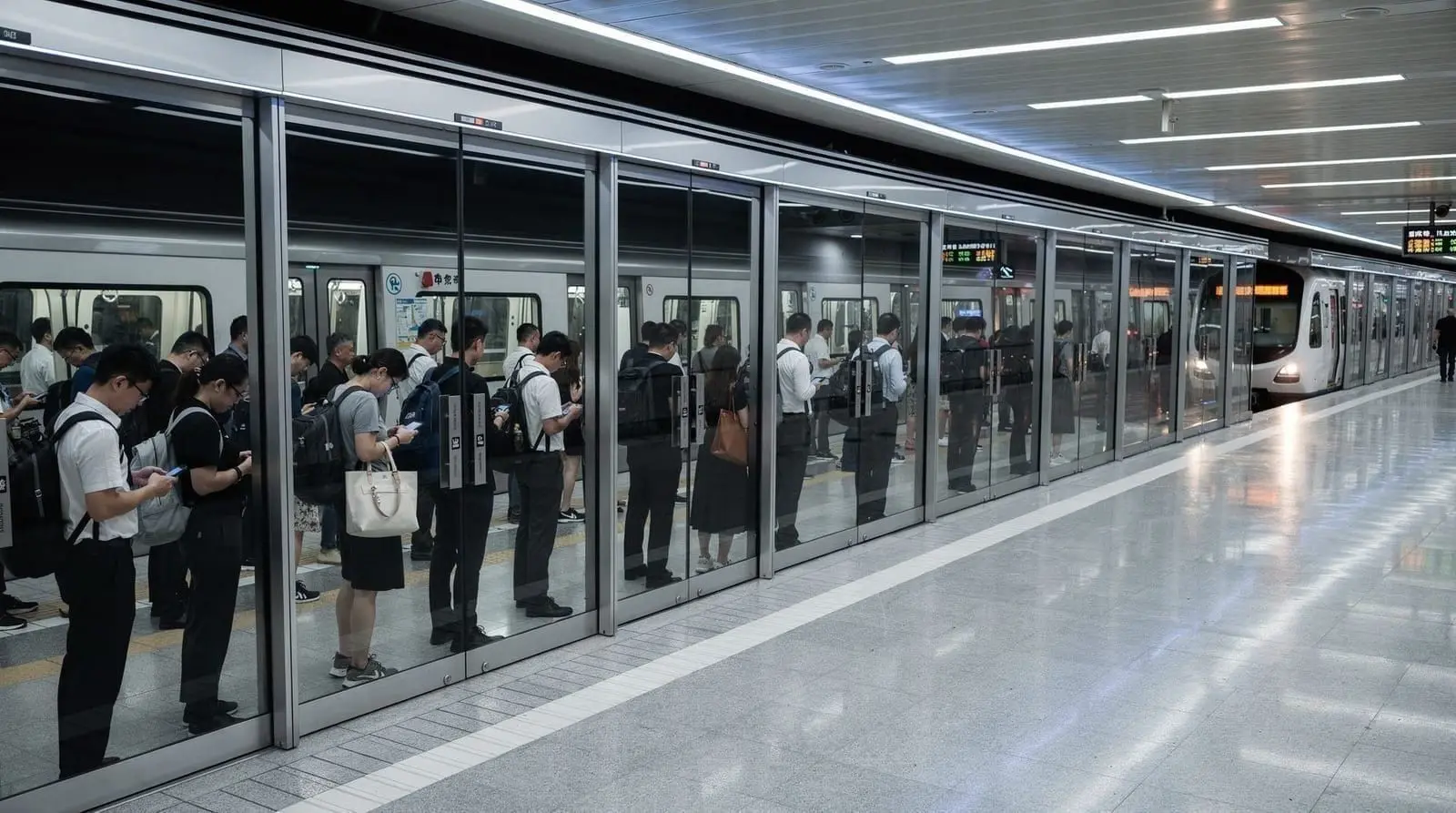
Shenzhen metro guide for visitors: lines, fares, and tips
Is Shenzhen metro easy for non-Chinese speakers?
Yes. Full English signage, bilingual Mandarin and English announcements, and a logical numbering system make it straightforward. Fares range from CNY 2 to CNY 14. NFC contactless payment works at select international-enabled gates.
Shenzhen has one of the best metro systems in China, and it is genuinely easy to use as a visitor with no Mandarin. The network now covers 17 lines, 441 stations, and 634.5 kilometres of track — making it larger than the London Underground or the Paris Métro. Fares start at CNY 2 for the shortest journeys. Trains are clean, air-conditioned, and almost always on time.
This guide covers everything a visitor needs: how to pay, which lines matter for tourism, key station connections, getting to and from the airport, reaching the border crossings into Hong Kong, and the practical questions that come up in the first hour of using the system.
| Network | 17 lines, 441 stations, 634.5 km of track |
| Fares | CNY 2–14, distance-based |
| Best payment | NFC contactless bank card or Shenzhen Tong (5% discount) |
| Hours | Approx. 06:20–23:00, no overnight service |
| Signage | Full English + Pinyin, English announcements |
Getting oriented: the network structure
Shenzhen’s metro lines radiate from the Futian CBD area — the city’s modern central business district — and extend outward in all directions. The system uses a straightforward numbered naming convention (Line 1, Line 2, and so on) with colour coding on maps. Each line also has a Chinese name (Line 1 is the Luobao Line, Line 4 is the Longhua Line, and so on), but you do not need to memorise these — numbers work everywhere.
The lines most relevant to visitors:
Line 1 (Luobao Line) — the main east-west spine Runs from Luohu in the east (the main Hong Kong border crossing) westward through Futian, past the OCT development area and Window of the World, and out to the airport area in the west. This is the single most useful line for tourists. Colour: green.
Line 2 (Shekou Line) — southern Shenzhen and Shekou port Connects Shekou (where ferries to Hong Kong and Zhuhai depart) with Futian and eastern Shenzhen. Useful for the ferry terminal, Sea World in Shekou, and the eastern shopping neighbourhood Dongmen. Also serves Shenzhen Futian HSR station. Colour: yellow.
Line 4 (Longhua Line) — Futian border crossing and north Runs from the Futian/Lok Ma Chau border crossing southward into Futian and then north toward Longhua. Useful specifically for the Futian border crossing into Hong Kong and the high-speed rail connection. Colour: blue.
Line 11 (Airport Express) — fastest route to Bao’an airport Runs from Futian through Shenzhen North HSR hub to Bao’an International Airport. Some trains are express services that skip intermediate stations. This is the line for flights and airport arrivals at SZX. Operating hours extend to midnight. Colour: magenta.
Line 9 — OCT Loft and Nanshan cultural sites Useful for reaching the OCT Loft creative park and other Nanshan cultural venues. Connects with Line 1 at Window of the World station. Colour: light blue.
For a fuller list of which stations serve which sights, the Shenzhen destination guide and the things to do in Shenzhen with kids itinerary both map attractions to their nearest station.
Accessibility on the Shenzhen metro
Shenzhen’s network is one of the more accessible metro systems in Asia for visitors with mobility needs. Every station has lifts connecting the platform to street level (not just stairs and escalators), tactile paving guides the route for visually impaired travellers, and platform screen doors on every line prevent track access. Staff at the manned gate (usually beside the ticket machines) will open a wide accessible gate on request — useful for wheelchairs, large luggage, or strollers. The main practical difficulty is not the trains but the stations themselves: some interchange stations (Window of the World, Shenzhen North) involve long underground corridors between lines, so allow extra transfer time.
Fares and how they are calculated
Shenzhen metro fares are distance-based. There is no zone system — the fare is calculated automatically based on the kilometres between your entry and exit stations:
| Distance | Fare |
|---|---|
| Up to 4 km | CNY 2 |
| 4–12 km | CNY 3–4 |
| 12–24 km | CNY 5–7 |
| 24–40 km | CNY 8–10 |
| Over 40 km | CNY 11–14 |
Most tourist journeys — say, Luohu to Window of the World, or Futian CBD to Shekou — cost CNY 4–6. The maximum fare of CNY 14 covers only the longest end-to-end trips. For reference, CNY 2 is roughly USD 0.28; CNY 14 is roughly USD 1.95.
Unlike some cities, there is no flat-fare day pass sold as standard for tourists — a handful of stations sell a 1-day unlimited-ride ticket (around CNY 25) aimed mainly at conference attendees and short-stay visitors doing many short hops, but for most itineraries paying per-journey via NFC card or Shenzhen Tong works out cheaper and is far simpler to obtain.
How to pay
You have four practical options as a foreign visitor:
Shenzhen Tong card (深圳通) The rechargeable transit card used by Shenzhen residents. It gives you a 5% discount on all metro fares. The card costs CNY 20 (refundable deposit) plus whatever balance you load onto it. Buy at any staffed ticket counter at any station. Accepted on all metro lines, buses, and some taxis. If you are staying in Shenzhen for more than 2–3 days, the discount and convenience make this worthwhile. You can refund the deposit at any station before you leave.
Individual tickets Bought at self-service machines at every station. The machines have English language settings (tap the language selector button). Enter your destination station, the machine calculates the fare, you pay (coins, CNY notes, Alipay, WeChat Pay, or UnionPay card), and receive a token or QR code. This is the slowest option but requires no setup.
NFC contactless payment (Visa/Mastercard) Select gates — labelled as international-enabled and marked with contactless symbols — accept tap-to-pay Visa and Mastercard directly. Tap your phone or physical card to the reader. No app or account setup required. This is the most convenient option for short visits: look for the specific international lanes, usually marked with card logos near the standard gates.
Alipay / WeChat Pay If you have set up a foreign-card-linked account on either app, you can pay via QR code at the fare gates. Works well if you have already configured these apps for shopping elsewhere. See the WeChat Pay and Alipay for foreigners guide for the setup process.
Getting to and from Shenzhen Bao’an Airport (SZX)
Line 11 is the airport express. From Futian CBD, take Line 11 westbound toward Airport North. The station you want is Airport North (机场北), which connects directly to the T3 terminal via a free inter-terminal shuttle. Journey from Futian takes approximately 40–50 minutes; from Luohu, allow 60–75 minutes including the Line 1 to Line 11 transfer at Window of the World or Shenzhen North.
Line 11 has express trains (快车) that skip some intermediate stops and are noticeably faster than all-stops services. The fare is the same either way. Check the platform display — express trains are marked clearly.
Line 11 operates from approximately 06:00 to midnight, covering most early departures and late arrivals.
If you are arriving after midnight with heavy luggage, a Didi (Shenzhen’s main ride-hailing app, similar to Uber) from the airport to Futian costs approximately CNY 80–120 and takes 30–50 minutes depending on traffic. Download Didi and set it up before you arrive in China — it requires a local phone number verification, which is easier to arrange with an eSIM before you land.
Reaching the Hong Kong border crossings by metro
Two border crossings are directly served by the Shenzhen metro:
Luohu / Lo Wu The busiest pedestrian border crossing between Shenzhen and Hong Kong. On the Shenzhen side, take Line 1 to Luohu station — it is the eastern terminus of the line. Walk across the immigration halls. On the Hong Kong side, you are at Lo Wu MTR station on the East Rail Line, which connects to Kowloon (Hung Hom, about 50 minutes) and Hong Kong Station via Admiralty.
Luohu is open daily roughly 06:30–24:00. It is the most convenient crossing if you are coming from Futian CBD, eastern Shenzhen, or anywhere on Line 1. Expect queues at weekends and public holidays — budget 30–60 minutes for clearance during busy periods.
Futian / Lok Ma Chau A quieter alternative to Luohu, preferred by commuters who work in the Futian financial district. On the Shenzhen side, take Line 4 to Futian Checkpoint (福田口岸) station. On the Hong Kong side, you are at Lok Ma Chau on the East Rail Line — same connections to Kowloon and central HK.
Futian/Lok Ma Chau tends to have shorter queues than Luohu on most days. It is the better option if you are near Futian station or coming from Shenzhen North.
For a full comparison of all border options including the high-speed rail and bus routes, see the Hong Kong–Shenzhen border crossings guide.
Key tourist routes with journey times
Luohu border to Futian CBD Line 1 westbound, 4 stops, approximately 10 minutes. CNY 2–3. This is the first metro journey most visitors from Hong Kong make.
Futian CBD to Window of the World Line 1 westbound, 8 stops, approximately 20 minutes. CNY 4. Window of the World station exit A deposits you directly in front of the park entrance.
Futian to OCT Loft creative park Line 1 westbound to Window of the World, then transfer to Line 9 one stop to Qiaocheng East (侨城东). Or walk 12 minutes from Window of the World station. Total journey from Futian: about 25 minutes.
Luohu to Shenzhen North (HSR hub) Line 4 northbound from Luohu area (transfer at Huaqiangbei or Shenzhen North on Line 1 then Line 4) — this route is less direct than using Futian as the HSR entry point. If you are connecting to national HSR from Luohu, take Line 1 to Window of the World, transfer to Line 9 to Hongling, then Line 4 north to Shenzhen North. About 55 minutes total.
Futian to Shekou / Sea World Line 2 westbound from Futian to Shekou Port (蛇口港) or Sea World (海上世界). About 30 minutes, CNY 5–6. Shekou is Shenzhen’s most relaxed waterfront neighbourhood with good Western-style restaurants and the ferry terminal for services to Hong Kong and Zhuhai.
Futian to Dongmen (shopping) Line 1 eastbound to Laojie (老街) station. About 12 minutes, CNY 3. Dongmen is Shenzhen’s historic commercial street market, now a mix of fast fashion, electronics, street food, and tourist novelty shops.
Navigating with English only
The Shenzhen metro is well-adapted for English-speaking visitors. Specifically:
- All station names are displayed in both Chinese characters and Pinyin romanisation (e.g., 福田 / Futian)
- Directional signage at every junction uses both languages
- Overhead announcements on trains are made in Mandarin, then Cantonese, then English — you will hear the English station name before each stop
- The metro map available at information counters and downloadable via the metro’s official app includes English labelling
- Fare machines have an English language option
The main challenge is not signage — it is knowing which exit to use. Large stations can have 10–15 exits, each lettered A through (sometimes) N. Google Maps works on the Shenzhen metro for navigation but requires a VPN to function in mainland China (see the eSIM and VPN guide). Apple Maps also works for navigation without a VPN. Alternatively, the Shenzhen Metro app (available on iOS and Android) has an English interface and offline navigation that does not require VPN access.
Crowding, rush hours, and when to avoid the metro
Shenzhen’s metro carries tens of millions of journeys per week, and it shows at peak times. The main rush hours are:
- Morning peak: 07:30–09:30 — Line 1 between Luohu and Futian, and Line 4 between Futian Checkpoint and central Futian, are packed. If you are heading from the border to the city at this time, expect a full carriage.
- Evening peak: 17:30–20:00 — similar congestion on the same corridors, plus Line 11 toward the airport can be crowded if there are many evening departures.
- Weekend afternoons (13:00–18:00) — shopping areas like Luohu Commercial City, Dongmen, and the Window of the World vicinity see leisure crowds rather than commuters; lines serving these areas can be busy.
Outside these windows, the metro is comfortable and rarely feels cramped. If you are doing a day of sightseeing starting around 10:00, you will mostly avoid the worst congestion.
Public holidays — National Day Golden Week (early October), Chinese New Year, and Labour Day (May 1) — push the whole network toward capacity for days at a time, particularly the routes toward Window of the World, Splendid China, and the border crossings. If your trip coincides with one of these windows, build in extra time for every journey and consider starting sightseeing earlier than usual to beat the crowds; the best time to visit Shenzhen guide covers which weeks to avoid altogether if your dates are flexible.
Standard operating hours
Most lines operate from approximately 06:20 to 23:00. Lines 11 and 14 run slightly later hours, to around midnight. There is no overnight metro service in Shenzhen — after 23:00 you will need a taxi or Didi.
Last trains on any given line are staggered — the last train from a terminus departs around 22:30–23:00, so the last trains pass intermediate stations progressively later. Check the departure board at the station or the metro app for last-train times from your specific station.
Metro vs. Didi: when to use which
The metro wins for:
- Journeys along the main corridors (east-west on Line 1, airport on Line 11, border crossings)
- Avoiding traffic congestion, which in Shenzhen can double or triple road journey times during peak hours
- Budget travel — CNY 2–14 vs. CNY 15–80 for a Didi
- Reliability — trains run exactly on schedule regardless of surface traffic
Didi (and taxis) win for:
- Destinations not well-served by metro (OCT Bay area, some Nanshan suburbs, outer districts)
- Late-night travel after metro closes
- Heavy luggage, especially around airports
- Groups of 3–4 people where shared ride costs become comparable per-person
Didi works in English and accepts WeChat Pay, Alipay, and now international Visa/Mastercard via the Didi International payment option. A typical city-centre Didi ride costs CNY 20–50. See the Shenzhen budget guide for overall cost comparisons.
Luggage lockers and left-luggage at metro stations
Several of the larger stations — Luohu, Futian Checkpoint, Shenzhen North, and Window of the World among them — have coin- or app-operated luggage lockers near the ticket gates, usually CNY 10–30 for a few hours depending on locker size. These are handy if you are doing a same-day border crossing or a day trip and do not want to carry bags around all day. They fill up quickly during holiday periods, so do not rely on one being available on National Day Golden Week or Chinese New Year without checking first. If lockers are full, most hotels will hold luggage before check-in or after check-out even if you are not staying that night.
Connecting the metro to other cities
The Shenzhen metro does not directly connect to Hong Kong’s MTR system — there is a physical border with immigration between them. You exit the Shenzhen metro at Luohu or Futian Checkpoint, walk through immigration, and board the Hong Kong MTR on the other side. See the border crossings guide for the complete process.
For travel to Guangzhou and beyond via high-speed rail, the metro connects you to the HSR stations: Line 2 to Futian station (for HK-direction trains), and Line 4 northbound for Shenzhen North (for national network trains).
For the Pearl River Delta grand loop, you will likely use the metro heavily within Shenzhen while relying on HSR, the HZMB bridge shuttle, or ferries to move between cities. The metro handles the within-city mobility very efficiently — plan your Shenzhen base around a Line 1 or Line 2 station and you will have easy access to most of what the city offers.
The Shenzhen in 3 days itinerary and Shenzhen and Hong Kong 5-day itinerary both rely heavily on metro-first planning — transit times used in those itineraries are based on the routes described in this guide.
Metro-first day trips from Shenzhen
Several popular excursions start with a metro ride before you switch to HSR, ferry, or bus. For a same-day hop across the border, take Line 1 or Line 4 to the crossing and follow the Hong Kong from Shenzhen day trip guide or the shorter Hong Kong–Shenzhen border day trip plan. If your visa situation is uncertain, check the China visa and 240-hour transit guide before you travel, since border-crossing rules affect which route makes sense. For an overview of every realistic option, see day trips from Shenzhen.
Frequently asked questions about Shenzhen metro
Can I use my Hong Kong Octopus card on Shenzhen metro?
No. The Octopus card is a Hong Kong-only system and is not accepted on Shenzhen metro. You need to pay by Shenzhen Tong card, individual token, NFC Visa/Mastercard at international-enabled gates, or Alipay/WeChat Pay. Buy a Shenzhen Tong card at the first staffed counter you see after entering the station on the Shenzhen side.
How do I top up a Shenzhen Tong card?
At any station counter or self-service top-up machine (they accept CNY cash, UnionPay, and sometimes Alipay). The balance displayed on the card reader when you tap in shows your remaining credit. Minimum top-up is usually CNY 10. The card stores up to CNY 1000.
Is it safe to use the metro late at night?
Yes. Shenzhen metro stations are well-lit, staffed, and covered by CCTV throughout. The city has a very low rate of petty crime in transit environments. See the safety guide for a broader overview. The main consideration late at night is not safety but availability — last trains leave around 23:00, so plan your evening accordingly.
Which metro line goes to Huaqiangbei electronics market?
Line 1 to Huaqianglu (华强路) station, Exit D. Huaqiangbei is one of the world’s largest electronics and component markets — several multi-story buildings selling everything from phone screens to industrial sensors. Allow several hours if you plan to browse seriously. From Futian CBD, it is 3 stops eastbound on Line 1, about 7 minutes.
Do I need internet access to use the metro?
No. If you have a Shenzhen Tong card or a physical contactless bank card, you can tap in and out without any internet connection. Individual ticket machines also work offline. You only need connectivity if you are using Alipay/WeChat Pay QR code payment or the metro navigation app.
Can children travel free?
Children under 1.2 metres tall travel free on Shenzhen metro when accompanied by a paying adult (limit two children per adult). Children 1.2–1.4 m pay half fare. This is determined by height, not age — station staff may measure children at peak times if there is any ambiguity.
What is the best metro station for Shenzhen’s main shopping areas?
Luohu Commercial City (the multi-level market famous for tailors and affordable goods near the border): Luohu station, Line 1 eastern terminus. Dongmen fashion street market: Laojie station, Line 1. Coco Park mall (Futian mid-range shopping): Convention Center station or Children’s Palace station, Line 1/3. MixC World (upmarket mall): Longhua Line stations in the Longhua area. The Shenzhen destination guide has a fuller breakdown of shopping areas and their metro connections.
Which station is best for Window of the World and Splendid China?
Window of the World is served directly by Line 1’s Window of the World station, Exit A. Splendid China and the Folk Culture Villages are next door at the same station, a short walk from the same exit. Both are covered in the Window of the World guide and the Splendid China guide, including which one suits your schedule if you can only visit one.
Top-rated things to do in Shenzhen
Verified deep-linked GetYourGuide tours. Book through these links and we earn a small commission at no cost to you.