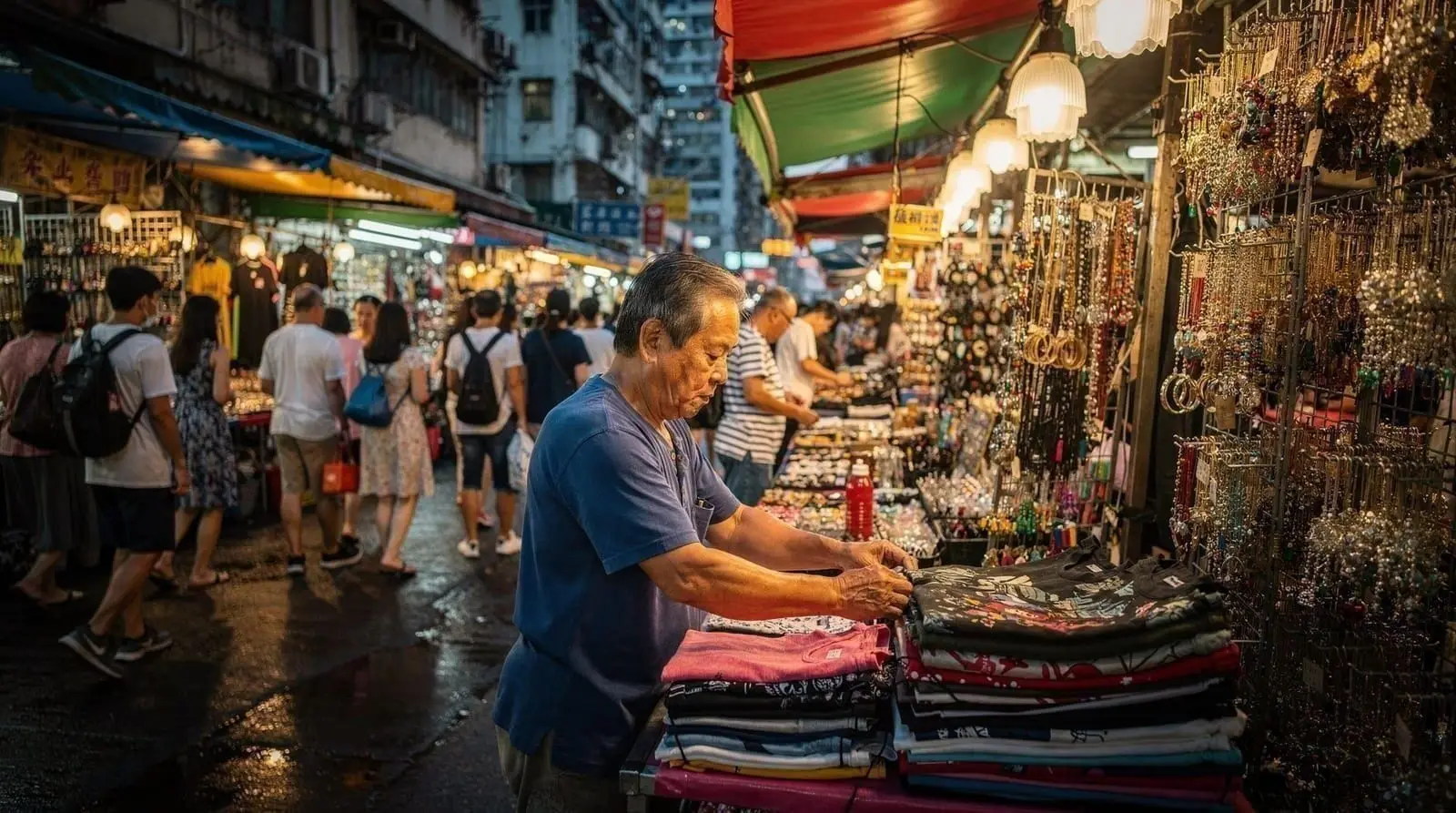
Hong Kong markets guide: where to shop, barter, and browse
What are the best markets in Hong Kong and where are they?
Temple Street Night Market (Jordan, nightly from 4 pm) is the most atmospheric. Ladies' Market (Tung Choi Street, Mong Kok) is the busiest daytime market. For unusual local markets: Goldfish Market and Flower Market in Mong Kok. Stanley Market on Hong Kong Island is touristy but has good linen and artwork.
Hong Kong’s market culture is a collision of function and spectacle — these are places where locals buy household goods, electronics, pets, and produce, alongside tourists hunting for souvenirs. The markets span multiple formats: night markets with food stalls and fortune tellers, specialized single-category markets for flowers and goldfish, outdoor day markets in covered lane-ways, and the beach-town market at Stanley on Hong Kong Island. This guide covers the most worthwhile, with honest notes on what is actually a bargain and what is overpriced tourist bait.
| Where | Temple Street/Mong Kok (Kowloon), Stanley (Hong Kong Island) |
| Cost | Free to browse; goods from HKD 15–2,000 |
| Time needed | 1–3 hours per market cluster |
| Getting there | MTR (Jordan, Mong Kok, Prince Edward) or bus to Stanley |
| Best time | Weekday evenings (Temple St); weekday mornings (Ladies’ Market) |
Temple Street Night Market
Temple Street Night Market in Jordan/Yau Ma Tei (Kowloon) is Hong Kong’s most atmospheric market. From around 4 pm until midnight, the street fills with stalls selling clothing, electronics accessories, watches, jade, souvenirs, and food. Cantonese opera singers sometimes perform in the open space near the Tin Hau temple halfway along.
What to buy: The market is most worthwhile for electronics accessories (phone cases, charging cables, earbuds — check quality carefully), wristwatches (replica and genuine Hong Kong-made), printed T-shirts, small jade items, and souvenir goods.
What to avoid: Anything you would assume to be a major branded product (watches with Swiss branding, luxury handbags, sports brand clothing) is counterfeit — the quality ranges from poor to passable. Do not expect authenticity.
Bargaining: Expected and practised. Start at 40–50% of the asking price for souvenir items; you will usually land at 60–70% of the first quote. Electronics accessories are often non-negotiable or negotiate only slightly. Be friendly; aggressive haggling is unusual here compared to mainland China markets.
Food stalls: The section near the temple and extending toward Kansu Street has seafood restaurants with tanks of live shellfish and fish at the entrance. These range from good value to tourist traps — the places on the lane off Temple Street proper (Reclamation Street side streets) are more local than the ones directly on the main drag. Look for where locals are eating.
Access: Jordan MTR (Exit A, walk north on Jordan Road then turn right onto Temple Street), or Yau Ma Tei MTR (Exit C, walk south). The market begins around Nanking Street and extends to Kansu Street — roughly 500 metres of stalls.
Hours: Stalls open from approximately 4 pm; best atmosphere from 7–10 pm.
Temple Street and Kowloon night markets guided walking tourMong Kok’s markets run into each other with no obvious order: a private walking tour of the Kowloon street markets gives them a sequence, which matters more here than in any other district.
Ladies’ Market (Tung Choi Street, Mong Kok)
Despite the name, Ladies’ Market sells clothing and accessories for everyone, across roughly 100 stalls along Tung Choi Street between Argyle Street and Dundas Street. It is Hong Kong’s most crowded market on weekend afternoons — the street is barely wide enough to walk comfortably through the stalls.
What to buy: Casual clothing at very low prices (T-shirts from HKD 50, dresses from HKD 80), bags, costume jewellery, phone accessories, cheap shoes. The quality reflects the price — these are disposables rather than lasting purchases.
Bargaining: Practised but less enthusiastically than Temple Street. Offer 60–70% of asking price on clothing.
Hours: Daily, approximately 12 noon to 11:30 pm. Peak crowds 2–8 pm on weekends.
Access: Mong Kok MTR (Exit E2), walk straight ahead. The stalls begin almost immediately.
Honest note: Ladies’ Market is primarily of interest to visitors who want to browse cheap clothing. It is not a place for authentic Hong Kong culture — it is a commercial market serving budget shoppers. That said, the sensory density of the narrow lane jammed with colour and merchandise is a genuine Hong Kong urban experience.
Mong Kok Flower Market (Flower Market Road)
The Mong Kok Flower Market along Flower Market Road (Fa Yuen Street MTR area, Prince Edward) is a proper wholesale and retail market selling cut flowers, potted plants, orchids, and seasonal decorations. It is particularly active in the run-up to Chinese New Year (January–February), when it sells kumquat trees and peach blossom branches.
For visitors: The market is genuine and functional — a proper working flower market, not a tourist attraction. Prices are wholesale-level. Orchid plants (Phalaenopsis) cost HKD 30–80 depending on size and variety. Cut roses are HKD 15–30 per stem. The sheer density and fragrance of the market make it a worthwhile 20–30 minute walk even if you are not buying anything.
Access: Prince Edward MTR (Exit B1), turn left on Prince Edward Road West and then onto Flower Market Road. A 2-minute walk.
Hours: Daily, approximately 7 am to 7 pm. Most active in the morning.
Goldfish Market (Tung Choi Street, Mong Kok — north section)
The northern section of Tung Choi Street (above Boundary Street, distinct from the Ladies’ Market section) is entirely dedicated to tropical fish and aquarium supplies. Hundreds of shops and stalls display plastic bags filled with goldfish, koi, and tropical species hanging from hooks, alongside aquarium tanks, supplies, and ornaments.
This market exists because keeping fish is considered auspicious in Hong Kong (Cantonese custom ties fish and prosperity), and the Goldfish Market is where serious hobbyists and casual buyers come. As a visitor, it is genuinely unusual — you are unlikely to see anything like it outside of a specialist pet district in East Asia.
Access: Prince Edward MTR (Exit B1). Walk south along Tung Choi Street — the fish shops begin around Bute Street and extend toward Boundary Street.
Hours: Daily, approximately 10 am to 8 pm.
Bird Garden and Bird Street (Yuen Po Street Bird Garden, Mong Kok)
A short walk from the Flower Market, the Yuen Po Street Bird Garden is a small park filled with songbird stalls. Cantonese men bring their caged songbirds here to socialise with other birds — the birds learn songs from each other. The stalls sell elaborate wooden bird cages (quality hand-made cages cost HKD 300–2,000), live grasshoppers and mealworms as bird food, and porcelain food dishes.
Again: primarily a functional market serving local hobbyists, not staged for tourists. Worth 20 minutes.
Access: Prince Edward MTR (Exit B1), follow signs. Adjacent to Flower Market.
Stanley Market
Stanley Market is located on the southern coast of Hong Kong Island in the former colonial fishing village of Stanley (赤柱). The market itself is a long covered lane and adjacent streets selling silk items, linen, paintings and prints, clothing, and tourist souvenirs.
Honest assessment: Stanley Market has an inflated reputation. Prices are not particularly low — you can often find similar items more cheaply in Mong Kok or online. The appeal is the setting: Stanley village is pleasant, the beach and waterfront are attractive, and the surrounding restaurants and bars make it a decent half-day destination. The market is a component of a Stanley outing rather than the main reason to go.
What is actually worth buying here: Custom-made linen clothing (several shops will alter or custom-stitch items quickly), original Hong Kong-themed paintings and prints (some local artists display here), silk products (check for “pure silk” labels and feel the weight).
Access: Bus 6 or 260 from Central (Exchange Square); takes 30–40 minutes. No MTR access — the bus ride through Tai Tam Country Park is part of the experience.
Hours: Daily, approximately 10 am to 7 pm.
Jade Market, Yau Ma Tei
The Jade Market at the corner of Kansu Street and Battery Street (beneath the Gascoigne Road overpass) is Hong Kong’s dedicated jade trading market — approximately 400 stalls selling jade jewellery, pendants, carvings, and loose stones.
Buyer’s caution: Jade is one of the most complicated gemstones to evaluate. “A-grade” natural untreated jade commands very high prices; “B-grade” (bleached and resin-filled) and “C-grade” (dyed) are significantly cheaper and less valuable. Without specialist knowledge, distinguishing between them by sight is nearly impossible. If you are interested in jade as an investment or heirloom, buy from reputable jewellers (Tse Sui Luen, Chow Tai Fook) with certificates, not market stalls. If you are buying for appearance at a price you are happy with, the market is fine.
Access: Yau Ma Tei MTR (Exit C), short walk along Kansu Street.
Hours: Daily 10 am to 5:30 pm (roughly).
Apliu Street and Sham Shui Po (electronics and fabric)
Sham Shui Po, in western Kowloon, has two adjacent specialist markets that rarely appear on tourist itineraries but are genuinely worthwhile for anyone who has already browsed Shenzhen’s own market scene. Apliu Street is Hong Kong’s electronics and secondhand-goods market — stalls of used phones, cables, tools, camera parts, and genuinely odd surplus electronics spread along the street and under a section of elevated road. Compare it mentally with Shenzhen’s Huaqiangbei electronics market: Huaqiangbei is vastly larger and more wholesale-oriented, while Apliu Street is smaller, retail-facing, and stronger on secondhand and vintage electronics than new components.
A few streets over, the Yen Chow Street fabric market (“Pang Jai”) sells fabric remnants, buttons, zips, and haberdashery at wholesale-adjacent prices, serving Hong Kong’s shrinking but still-active garment trade.
Access: Sham Shui Po MTR (Exit A2 for Apliu Street). Hours: Apliu Street stalls run roughly midday to 10 pm; fabric stalls keep more conventional daytime hours.
Hong Kong markets vs Shenzhen markets: what’s actually different
Visitors doing both cities often ask whether Hong Kong’s markets are worth the time given Shenzhen’s own wholesale scale.
| Hong Kong markets | Shenzhen markets | |
|---|---|---|
| Scale | Smaller, retail-facing | Vastly larger, wholesale-heavy (Huaqiangbei) |
| Bargaining culture | Polite, moderate discounts | More aggressive, larger discounts possible |
| Best for | Atmosphere, night markets, specialty goods (jade, fish, birds) | Electronics volume, factory-direct pricing |
| Currency/payment | HKD cash preferred at stalls | WeChat Pay/Alipay dominant, see the payment guide |
| Signature market | Temple Street Night Market | Dongmen pedestrian street |
The honest takeaway: go to Hong Kong’s markets for atmosphere and specialty categories (jade, goldfish, flowers, night-market food), and go to Shenzhen’s Huaqiangbei for genuine electronics volume and prices. Neither replaces the other.
Walking tours through the markets
Several good walking tours cover the Kowloon market districts — Temple Street, Mong Kok markets, and surrounding areas — with local guides who can explain the cultural context:
Kowloon markets and culture walking tourThese are particularly useful if you want context beyond shopping — understanding why goldfish markets exist, the cultural role of jade, the history of Temple Street’s fortune tellers.
Combining markets with Hong Kong in 2 days
If you are structuring a 2-day visit, dedicate a morning or afternoon to the Mong Kok cluster (Flower Market, Goldfish Market, Bird Garden, and then Ladies’ Market as it opens at noon) — all within 15 minutes’ walking distance of each other. Follow with Temple Street Night Market in the evening in nearby Jordan. See Hong Kong in 2 days for the full sequence.
For visitors with children, the Goldfish Market and Bird Garden are genuinely engaging for kids without being physically demanding — pair with the Hong Kong with kids guide.
Practical tips
- Bargaining is normal and expected at stalls; do not be embarrassed to negotiate
- Most market stalls accept cash only (HKD); larger shops in covered market buildings may accept Octopus or credit cards
- Keep bags closed and be aware of your surroundings in crowded market lanes
- The MTR is the fastest and most reliable transport between market areas — Octopus card for convenience
- Temple Street is significantly better on weekday evenings; Ladies’ Market is best weekday mornings before the crowds arrive
Frequently asked questions about Hong Kong markets
Is it safe to bargain hard at Hong Kong markets?
Yes, bargaining is normal and expected, but the culture is more restrained than at many mainland Chinese markets. A friendly, unhurried approach gets better results than aggressive haggling — stall owners often simply hold firm or walk away from pushy negotiation rather than escalate.
Can I pay with WeChat Pay or Alipay at Hong Kong markets?
Rarely at market stalls — most operate cash-only in HKD. Some larger covered market buildings and shops near markets accept Octopus or credit cards, but do not count on mobile China payment apps working reliably at stalls; carry HKD cash instead.
Top-rated things to do in Hong Kong
Verified deep-linked GetYourGuide tours. Book through these links and we earn a small commission at no cost to you.