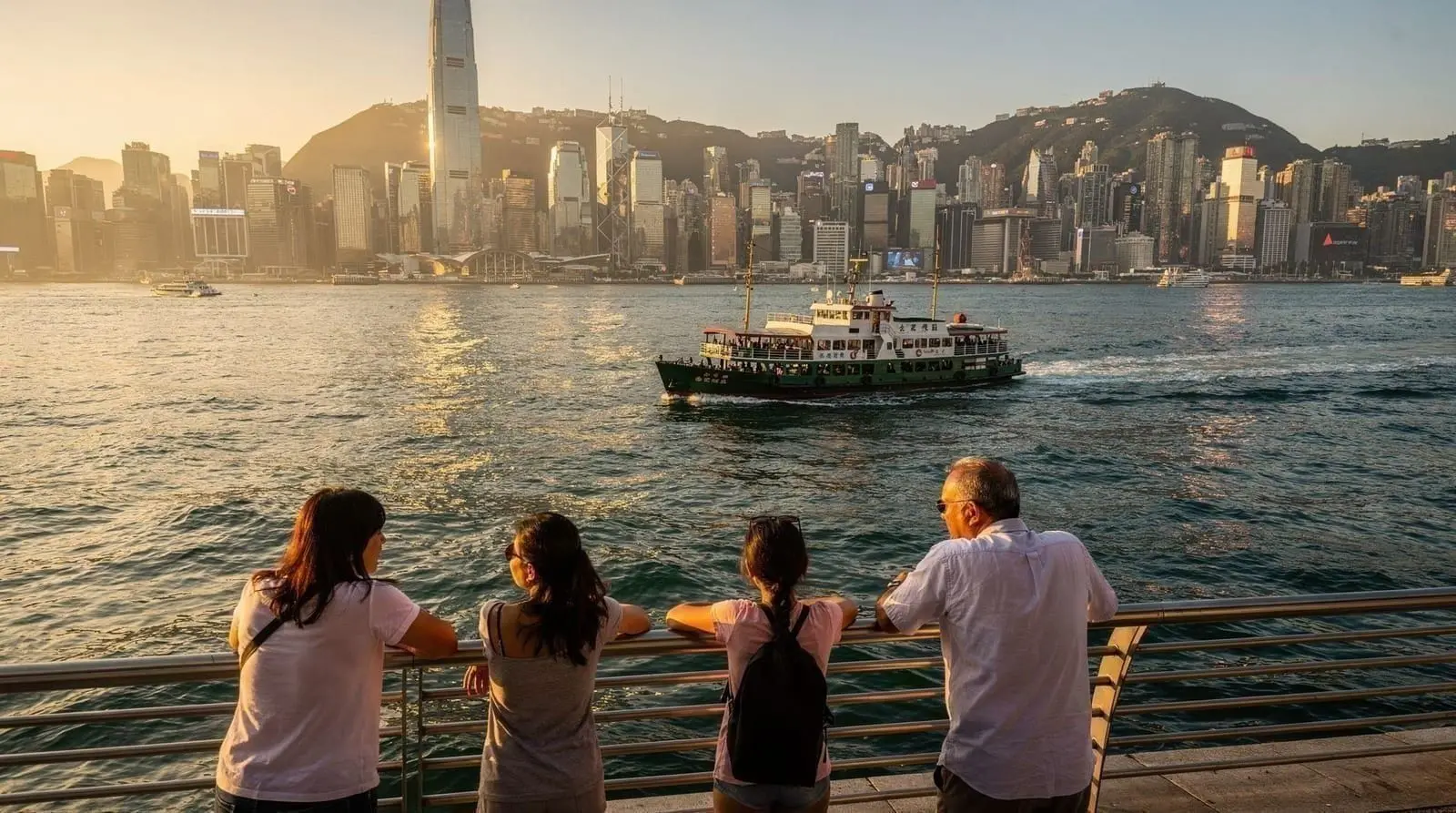
Hong Kong hits differently from the first morning. You’re riding a double-decker tram through Central, skyscrapers on your left, colonial facades on your right, the harbor glittering two blocks ahead — and then someone hands you a plate of cheung fun that costs HKD 28 (USD 3.60) and tastes better than anything you’ve eaten in months.
| Where | Hong Kong Island, Kowloon, New Territories, outlying islands |
| Cost | HKD 1,000–1,500/day comfortable mid-range budget |
| Time needed | 3–5 days for the essentials; 7 days with Lantau and islands |
| Getting there | HSR 14–24 min from Shenzhen Futian; Airport Express from HKG |
| Best time | October–December for dry, mild weather |
That contrast — world-class everything at street-food prices, mountain trails ten minutes from the financial district, a metropolis of 7.4 million people operating on quiet efficiency — is what makes Hong Kong earn repeat visits.
Why Hong Kong still tops every Asia shortlist
The city packs an unusual density of genuinely excellent things into a small footprint. Hong Kong Island holds the skyline, the tram (cheapest ride in town at HKD 3), the Peak, and the concentrated restaurant wealth of Wan Chai and Causeway Bay. Cross Victoria Harbour on the Star Ferry for HKD 4.40 and you’re in Kowloon — grittier, more authentically Cantonese, home to the Temple Street night market and some of the city’s best roast meats.
Then there are the other 250-odd islands, the UNESCO-listed geopark, the world-heritage fishing villages on Lantau, and a hiking trail network that puts cities twice Hong Kong’s size to shame. Dragon’s Back trail on Hong Kong Island is arguably the best urban hike in Asia — 8.5 km with panoramic South China Sea views, 45 minutes by MTR from Central.
For travelers coming from Shenzhen via the high-speed rail (14 minutes, Futian to West Kowloon), Hong Kong is the obvious first or last night of a Pearl River Delta loop. It’s also the natural gateway for the Macau day trip and for the Hong Kong–Macau 4-day itinerary.
Getting here and getting around
From Shenzhen: High-speed rail from Shenzhen Futian station to Hong Kong West Kowloon takes 14–24 minutes (from HKD 110 / USD 14). Tickets on the MTR Hong Kong app or at station counters. Alternatively, cross by land at Lo Wu, Lok Ma Chau/Futian, or Huanggang — each paired with MTR East Rail or Shenzhen Metro connections.
From mainland China broadly: The West Kowloon terminus of the Guangzhou–Shenzhen–Hong Kong Express Rail Link handles all immigration in the station itself. Clean, fast, no taxi queue at the other end.
Within Hong Kong: The MTR is the spine. An Octopus card (available at any MTR station or 7-Eleven, HKD 150 initial load + HKD 50 refundable deposit) covers metro, buses, trams, light rail, ferries, and even McDonald’s and Circle-K. Single rides range from HKD 4.50 (short hop) to HKD 16 (cross-island). Do not bother with single-journey tickets — Octopus saves time and 15–20% on fares.
Taxis: Red taxis cover urban areas (flag fall HKD 27, roughly USD 3.50). Uber also operates legally in Hong Kong as of 2026, which helps when taxi demand spikes on rainy evenings.
The tram (ding ding): Runs east–west along Hong Kong Island’s northern shore from Kennedy Town to Shau Kei Wan. Flat fare HKD 3 with Octopus. Slow but charming, and a good orientation ride on arrival.
The harbor and the Peak: managing expectations
Victoria Harbour at night is not hype. The Symphony of Lights laser show (nightly 8 pm, free from the Tsim Sha Tsui waterfront promenade) is genuinely spectacular and genuinely free. Book a harbor cruise for the elevated view — or do it from the upper deck of the Star Ferry for HKD 4.40.
Watch the Symphony of Lights from the water on an evening cruiseVictoria Peak requires managing the tourist-trap element around it rather than avoiding it altogether. The tram ride up is legitimately dramatic — a 27-degree incline with the city dropping away below you. The Sky Terrace 428 observation deck (the glass viewing platform) costs HKD 100–130 and is genuinely worth it for 360-degree views. What to skip: the overpriced souvenir mall at the top. Walk instead to the circular Peak Trail (3.5 km, free) for views the terrace doesn’t give you.
The tram itself regularly has 30–60 minute queues on weekends and holidays. Buy a combo tram + Sky Terrace ticket in advance to use the skip-line channel.
Book the Peak Tram + Sky Terrace 428 combo to skip the queueNeighborhoods worth knowing
Central and Sheung Wan form the colonial and financial core of Hong Kong Island. Here you’ll find the Escalator (the world’s longest covered outdoor escalator, 800 metres, free), the heritage-listed PMQ design market, and the dense restaurant wealth of SoHo (South of Hollywood Road). Lan Kwai Fong is the bar district — expensive by Hong Kong standards, fun on a Friday.
Wan Chai sits east of Central and was once the seedy sailor-bar district immortalised in fiction. In 2026 it’s a working neighborhood with Hong Kong’s best morning wet market on Cross Street, exceptional Cantonese roast restaurants, and the Hong Kong Convention Centre on the harbor. Lockhart Road still has bars; they’re not particularly dodgy anymore.
Causeway Bay is the main shopping district on the Island side — Times Square mall, SOGO department store, and the dense blocks of independent boutiques and restaurants around Jardine’s Crescent. The Noon Day Gun (British colonial ceremony, fires a 3-inch gun at noon daily) is free and takes 10 minutes to watch.
Mong Kok and Sham Shui Po in Kowloon are where Hong Kong’s working-class intensity is most concentrated. Mong Kok has a justified reputation for street market chaos; Sham Shui Po is better — electronics streets, cheap fabric, the Apliu Street flea market for second-hand tech. Excellent Cantonese congee at Sang Kee (CNY 45–70 / USD 6–9 a bowl).
Tsim Sha Tsui occupies the southern tip of Kowloon — harbor views, the Cultural Centre, the Art Museum, and the start of Nathan Road. The waterfront promenade here is where you stand for Symphony of Lights.
What to eat and what to spend
Hong Kong’s food culture is one of the densest concentrations of cooking talent anywhere on earth. The city has 15,000-odd restaurants for 7.4 million people. Start with the essentials:
Dim sum: Morning yum cha (tea + dim sum) is the city’s defining meal. Tim Ho Wan (multiple locations, original in Sham Shui Po) holds a Michelin star and charges HKD 20–60 per basket — the cheapest Michelin-starred meal in the world in practical terms. Lin Heung Tea House (Wellington Street, Central) is the atmospheric old-guard option: no English menu, no concessions to tourists, the real thing. Budget HKD 150–250 (USD 19–32) per person for a full dim sum breakfast.
Roast meats (siu mei): Hanging ducks, glazed pork, bright red char siu in every neighborhood. Yung Kee (Wellington Street) is the tourist-known option; cheaper and equally good at Sun Sin Kee (Wan Chai) or any neighborhood roast meat shop. A plate of char siu on rice costs HKD 55–80 (USD 7–10).
Wonton noodles: Mak’s Noodle (Wellington Street, Central) is the reference standard — HKD 60–90 per bowl, pork and shrimp wontons in a delicate broth, thin egg noodles. Queue at lunch; no reservations.
Egg tarts: Both the flaky Portuguese-style (from Macau influence) and the Hong Kong-style shortcrust version. Tai Cheong Bakery (Lyndhurst Terrace) is the pilgrimage option; HKD 9 each.
Budget reality: Street-level cha chaan teng (Hong Kong-style cafes) serve a full breakfast with milk tea for HKD 45–65 (USD 6–8). Dinner at a mid-range restaurant runs HKD 200–400 per person with drinks. Hotel breakfast is outrageously overpriced; skip it.
Shopping: where to go, what to avoid
Hong Kong’s traditional shopping advantage — tax-free electronics and luxury goods — has narrowed as prices equalised globally and online retail matured. That said:
Electronics in Wan Chai: Wan Chai Computer Centre and surrounding streets for cameras, components, and second-hand gear. Prices are not dramatically lower than home, but the selection of older/specialist equipment is unmatched. Bargaining sometimes works for cash transactions, not always.
Jade and antiques: Hollywood Road in Sheung Wan, particularly the upper section near Man Mo Temple. Reputable dealers, tourist-grade fakes, and genuine antiques exist side by side. Educate yourself before spending serious money.
Custom tailoring: Sam’s Tailor in Tsim Sha Tsui (Burlington Arcade, Nathan Road) is the famous name — reliable quality, two to three fittings, a suit from HKD 3,500 (USD 450) upward. Call ahead; they take walk-ins but are often busy.
Temple Street Night Market (Kowloon): Cheap watches, phone accessories, tourist trinkets. Fun for atmosphere; not for serious purchases. Bargain everything to 40–60% of the opening price.
Join a Kowloon markets walking tour to understand what you’re seeingDay trips from Hong Kong
The Shenzhen and Hong Kong 5-day itinerary covers the most natural day trip — Shenzhen via high-speed rail for electronics, OCT-LOFT contemporary art, and food that costs half the Hong Kong price.
For Macau: the TurboJET ferry (50–55 minutes, HKD 170–230 one way) runs from the Shun Tak Centre in Sheung Wan or from the airport ferry terminal. The HZMB shuttle bus (HKD 65) is slower but scenic. One day is sufficient for the historic peninsula; two days if you want to explore Cotai.
Lantau Island — Big Buddha, Tai O fishing village, and the Ngong Ping 360 cable car — is a solid full day without leaving Hong Kong territory. See the Lantau Island destination guide.
The outlying islands of Lamma and Cheung Chau are 40–50 minutes by ferry from Central Pier and offer a complete change of pace: car-free, seafood restaurants on the waterfront, hiking trails. Lamma in particular has a relaxed expat-and-local mix, with Yung Shue Wan village as the main hub.
For travelers with a China visa already sorted, Hong Kong is also the easiest gateway into Guangzhou — the West Kowloon HSR terminus handles Mainland immigration inside the station itself, no separate border crossing required, making a Guangzhou day trip realistically achievable even on a short Hong Kong stay. See the Guangzhou destination guide for what a single day there looks like, and note that this route still requires a valid mainland China visa or transit exemption — Hong Kong’s own visa-free entry does not extend across the border.
Practical notes for 2026
Internet: Hong Kong has no internet restrictions — Google, WhatsApp, Instagram work normally. You do not need a VPN here. If you’re also visiting Shenzhen or Guangzhou on the same trip, get a travel eSIM before crossing into mainland China; don’t rely on VPNs on that side.
Money: HKD only in Hong Kong. CNY is not accepted. Major credit cards work at restaurants, hotels, and larger shops; carry HKD cash for wet markets, street food, trams, and smaller dai pai dong restaurants. Most ATMs dispense HKD directly from foreign cards.
Water: Tap water is WHO-compliant and safe to drink directly. This is not the case in Shenzhen or Guangzhou.
Typhoon signals: Between June and October, watch the Hong Kong Observatory app. Signal 1 is advisory. Signal 3 means strong winds; most things stay open. Signal 8 means everything closes and you should not be outdoors. The system is well-communicated; alerts come via hotel TV and phone emergency alerts.
Tipping: 10% service charge is added at most restaurants and included in the bill. You are not expected to add more. Tips for taxi drivers: rounding up to the nearest dollar is common. No tipping at dai pai dongs or cha chaan tengs.
Language: English and Cantonese are both official languages, and English proficiency is genuinely high across hospitality, retail, and transport — a real difference from mainland Shenzhen or Guangzhou. Street signage, MTR announcements, and restaurant menus are almost universally bilingual, which makes Hong Kong a considerably easier city to navigate solo than its mainland neighbors.
Safety and health: Standard travel precautions apply; violent crime is rare and the main practical risk is pickpocketing in dense crowds (Mong Kok markets, MTR rush hour). Pharmacies (Watsons, Mannings) are widespread for basic medication, and hospital care is of a high international standard, though travel insurance is still worth having given private hospital costs.
Combining Hong Kong with the wider Greater Bay Area
Hong Kong rarely stands alone on a Pearl River Delta trip. The most common pairing is with Shenzhen via the 14-minute HSR crossing — see the Shenzhen and Hong Kong 5-day itinerary for a structured split of nights and activities between the two. Travelers building a longer loop often add Guangzhou and Macau, covered together in the Hong Kong and Macau 4-day itinerary and the more ambitious Pearl River Delta grand loop, which treats Hong Kong as one stop among several rather than the sole destination.
For visitors uncertain whether to base themselves in Hong Kong or Shenzhen for a multi-city trip, the Shenzhen vs. Hong Kong comparison guide breaks down cost, pace, and English-language ease between the two — useful context before booking accommodation on either side of the border.
Hong Kong Island vs. Kowloon: where to base yourself
| Hong Kong Island | Kowloon | |
|---|---|---|
| Character | Colonial, financial, the Peak, the tram | Grittier, more authentically Cantonese, night markets |
| Hotel prices | 15–30% higher for equivalent standard | Better value for the same quality |
| Best for | First-time visitors, shopping, skyline views | Food, markets, budget-conscious travelers |
| Full guide | Hong Kong Island and Central | Kowloon, Tsim Sha Tsui |
Neither side is objectively “better” — most repeat visitors end up splitting nights between both, since the harbor crossing by Star Ferry or MTR takes minutes. If pressed to choose one, first-timers usually get more immediate payoff from Hong Kong Island (the Peak, the tram, the skyline), while those prioritizing food and markets lean Kowloon.
Frequently asked questions about Hong Kong
Is Hong Kong safe for tourists in 2026?
Yes. Hong Kong consistently ranks among Asia’s safest cities for visitors. Violent crime rates are very low. The main practical concern for tourists is pickpocketing in crowded areas like the Mong Kok street markets and on the MTR during rush hour — standard precautions apply. Solo female travelers report feeling generally comfortable. The political tensions of 2019–2020 have settled into a different normal; the street protests that characterized that period are not a 2026 reality.
How many days do I need in Hong Kong?
Three days covers the non-negotiables: Victoria Peak, the Star Ferry harbor crossing, a dim sum breakfast, the Kowloon markets, and a harbor night cruise. Five days lets you add Lantau Island, Dragon’s Back hike, and a proper day in the Wan Chai/Sheung Wan food neighborhoods. Seven days is comfortable if you want the outlying islands and a day trip to Macau.
What’s the best way to get from Hong Kong Airport to the city?
The Airport Express MTR train is the definitive answer: 24 minutes to Hong Kong station (Central), 28 minutes to Kowloon station in Tsim Sha Tsui, HKD 115 single / HKD 205 return. Runs every 10 minutes from 5:50 am to 12:48 am. Taxi from the airport to Central costs roughly HKD 350–420 (USD 45–54) and takes 30–45 minutes depending on traffic — not worth it unless you’re with heavy luggage going to a non-MTR-adjacent hotel.
Do I need to exchange currency before arriving?
No. ATMs at the airport dispense HKD directly from foreign debit cards. Exchange rate at ATMs is close to mid-market; airport money changers charge higher spreads. If you want to exchange cash, the money changers on Chungking Mansions’ ground floor (Tsim Sha Tsui) historically offer better rates than airport counters but are busier. Avoid the booths that advertise “0% commission” — they recoup on the rate spread.
Can I use my phone freely in Hong Kong?
Yes. Hong Kong has no internet restrictions whatsoever. Google, WhatsApp, Instagram, and YouTube work normally. If your home carrier has a travel add-on that includes Hong Kong, that works fine. Alternatively, a local SIM from 3HK or SmarTone costs HKD 68–100 for 3–7 days of data. Note that if you’re also crossing into Shenzhen or Guangzhou, you’ll need a different eSIM or data plan for mainland China access — and you’ll need it set up before you cross the border.
What’s the cheapest Michelin-starred meal in the world?
Tim Ho Wan dim sum restaurant. Original location: Kwong Wa Street in Sham Shui Po, Kowloon (MTR: Sham Shui Po station). HKD 18–52 per basket, one Michelin star since 2010. Arrive before 10 am to avoid queuing. The baked BBQ pork buns (char siu bao) and shrimp rice noodle rolls are the signatures. Note that Tim Ho Wan now has many franchise locations globally; the Hong Kong locations are the original, with noticeably tighter quality control than the international franchises.
Is the Star Ferry really worth it?
Yes, at HKD 4.40 (lower deck) or HKD 5.60 (upper deck), the 8-minute crossing between Tsim Sha Tsui and Central is arguably the best value view in any city on earth. The Star Ferry has been running this route since 1888. Skip the dedicated harbor cruise boats if your primary goal is the crossing experience — save those for the Symphony of Lights viewing or a sunset drink on the water.
How do I get to Macau from Hong Kong?
Two options: TurboJET ferry (HKD 170–230 each way, 50–55 minutes, departing from Shun Tak Centre in Sheung Wan or from the airport ferry terminal at HKIA) or HZMB shuttle bus (HKD 65 each way, 40–45 minutes on the bridge, from the Hong Kong Port on Lantau). Ferries run more frequently during peak hours; the HZMB bus is cheaper and often faster off-peak. Both require you to clear immigration at the Macau end. Note that Macau casinos run free shuttle buses from the ferry terminal and HZMB port — useful if your hotel is in Cotai.