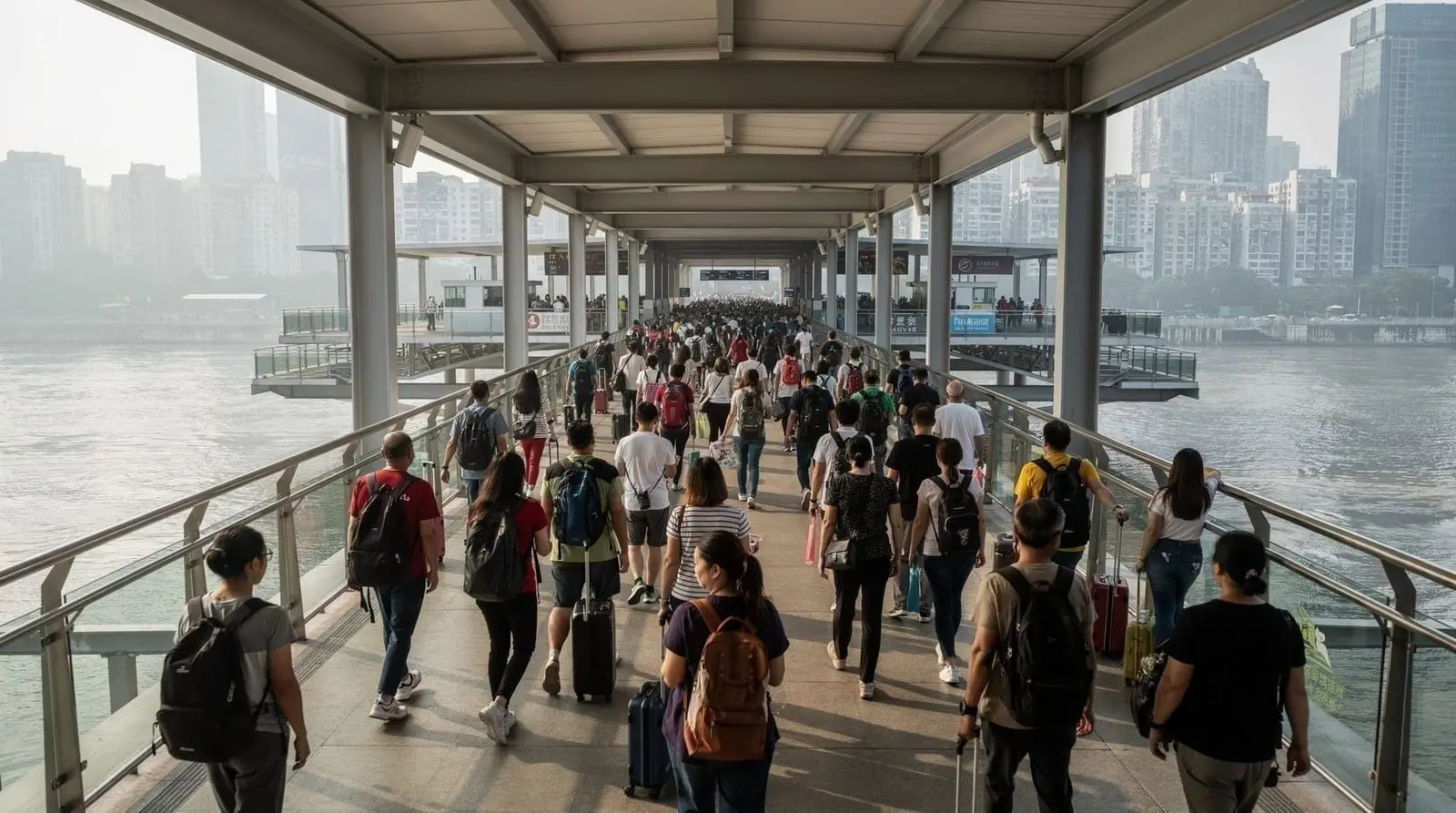
Hong Kong–Shenzhen border crossings and day trips: 2026 complete guide
What is the fastest way to cross between Hong Kong and Shenzhen in 2026?
The high-speed rail from Hong Kong West Kowloon to Futian Shenzhen takes 14 minutes (CNY 90 / HKD 105). For foot crossings, Lok Ma Chau–Huanggang is the most spacious; Lo Wu is busiest. Shenzhen Bay Port is best for the west of Shenzhen. All open 06:00–23:00 except Huanggang (24 hours).
Few borders in the world are as busy and as functionally invisible as the one between Hong Kong and Shenzhen. Around 500,000 crossings happen every day. Most are commuters — Shenzhen residents working in Hong Kong, Hong Kongers using mainland hospitals or shopping malls, logistics staff, students. For travellers, the border is simply an exercise in passport queue management: there are six checkpoints to choose from, each serving different parts of the two cities.
This guide explains every crossing option, the visa situations on both sides, what to do for a day on either side of the border, and the honest truth about what the journey actually involves.
| Fastest option | HSR, West Kowloon ↔ Futian, 14 min |
| Cheapest option | Lok Ma Chau/Futian MTR crossing |
| 6 crossings | Lo Wu, Lok Ma Chau/Futian, Shenzhen Bay, Man Kam To, Sha Tau Kok, HSR |
| Cost | HKD 105–128 HSR one-way, or MTR/metro fares only |
| Best time | Avoid weekday lunchtimes and Friday evenings |
The six crossing points
1. Lo Wu (罗湖 / 羅湖)
The original and busiest crossing. On the Shenzhen side: Luohu district with its shopping mall directly at the port exit. On the Hong Kong side: Lo Wu MTR station at the northern end of the East Rail Line.
Hours: 06:30–00:00 (midnight) Best for: Luohu market shoppers, East Kowloon / New Territories travellers in Hong Kong Honest note: This is the most chaotic crossing — the volume of people means long queues at peak times (weekday lunchtimes, weekend evenings, and before major Chinese holidays). Avoid if you have a time-sensitive connection.
2. Lok Ma Chau / Futian (落馬洲/皇崗 · 福田)
Actually two checkpoints in very close proximity:
- Lok Ma Chau MTR connects to the Futian Kou’an (福田口岸) checkpoint in Shenzhen’s Futian district. Open 06:30–23:30.
- Huanggang / Lok Ma Chau Road is a 24-hour crossing, primarily used by vehicles and logistics, with a pedestrian corridor.
Best for: Futian CBD, Huaqiangbei, and direct metro access throughout Shenzhen. This is the most practical crossing for most visitors as it drops you in Shenzhen’s commercial heart.
3. Shenzhen Bay Port (深圳湾口岸 / 深圳灣口岸)
A joint immigration facility on the HZMB corridor — both Hong Kong and Shenzhen immigration are processed on the Shenzhen side. Transport in and out is exclusively by shuttle bus from the Hong Kong side (from Sheung Shui and Mong Kok Coach Terminus).
Hours: 06:30–24:00 Best for: Nanshan/Shekou district of Shenzhen; travellers using the HZMB bridge to Zhuhai or Macau; Shenzhen Bay Park access. Honest note: The bus-only approach means you need to factor in the cross-border bus timetable. Less spontaneous than MTR crossings.
4. Man Kam To (文錦渡)
A smaller road crossing primarily for Hong Kong residents crossing by car or coach. Limited pedestrian corridor. Not practical for most visitors.
5. Sha Tau Kok (沙頭角)
Restricted crossing — requires a Closed Area Permit from Hong Kong authorities. Not available to most visitors.
6. High-Speed Rail (West Kowloon ↔ Futian / Shenzhen North ↔ Guangzhou South)
Not a physical border checkpoint in the conventional sense, but the most seamless option: Hong Kong West Kowloon → Futian: 14 minutes, HKD 105 (adult). West Kowloon → Shenzhen North: 23 minutes, HKD 128. Trains run approximately every 30 minutes throughout the day.
Immigration is handled at both West Kowloon and the Shenzhen stations. The experience is close to international air travel: check-in desks, passport scan, security, then boarding the train. No standing-in-a-queue-at-a-booth experience.
Hours: ~07:00–23:00 (check current timetable; last trains vary by season)
Which crossing to use
Going to Futian CBD / Shenzhen commercial districts: HSR to Futian station, or Lok Ma Chau MTR crossing
Going to Luohu / Dongmen: Lo Wu crossing (MTR)
Going to Nanshan / Shekou / Shenzhen Bay: Shenzhen Bay Port shuttle bus
Going to Shenzhen North (for connections to Guangzhou, Dongguan): HSR from West Kowloon to Shenzhen North
Coming from Zhuhai or Macau to Hong Kong: HZMB shuttle to Shenzhen Bay Port, then bus to MTR
Visa requirements
Entering Hong Kong from Shenzhen
Most Western passports (UK, US, EU, Australia, Canada, etc.) receive 14 days visa-free entry to Hong Kong on an e-Channel or arrival. No pre-registration required. Note: the 14-day allowance is for a single stay; you can re-enter after a genuine departure.
Entering Shenzhen / mainland China from Hong Kong
Required for most nationalities:
- Standard Chinese tourist visa (L visa): 30-day single or 90-day multiple entry, applied at Chinese embassy or consulate abroad. Processing 4–7 working days.
- 144-hour (6-day) visa-free transit: Available for 53 qualifying nationalities passing through designated airports. Does not apply at land border crossings — you must enter via Shenzhen Bao’an Airport.
- Shenzhen Special Economic Zone visa on arrival: Available at certain crossings (Lo Wu, Futian, Huanggang) for select nationalities; 5 days, Shenzhen only. Check current eligibility — this scheme has been subject to policy changes.
- Greater Bay Area visa policy (2026): Expanded visitor arrangements for GBA cities are under development. Check the latest rules from China’s National Immigration Administration before travelling.
Practical advice: Most visitors from Western countries who visit China regularly get a 10-year multiple-entry visa. If you are making a one-off trip to the region, applying for a 30-day single-entry tourist visa before departure is the safest option.
A day trip from Hong Kong to Shenzhen
Shenzhen is genuinely worth a day from Hong Kong — and not just for electronics shopping, which is the most common reason HK day-trippers cross. Here is an honest itinerary for a full day:
Option A: Tech, food, and city exploration
- 09:00: HSR West Kowloon → Futian (14 min)
- 09:30: Breakfast at Futian market street (Cantonese breakfast, CNY 20)
- 10:30: Metro to Huaqiangbei electronics market (Line 1, 15 min)
- 12:30: Lunch in Huaqiangbei area (Chaoshan beef noodles, CNY 40–60)
- 14:00: OCT-LOFT creative district (30 min taxi) or Dafen Oil Painting Village (Line 3)
- 17:00: Return by HSR or Lok Ma Chau MTR Hong Kong → Shenzhen day tour: tech, culture, and massage
Option B: Ancient villages and Dapeng coast A different kind of Shenzhen day — see pre-modern Guangdong before heading to the coast.
- 08:00: Lok Ma Chau MTR crossing
- 09:00: Taxi to Kengzi Hakka Walled Village (40 min, CNY 100)
- 11:00: Drive southeast to Dapeng Ancient Town (40 min, CNY 80)
- 12:30: Seafood lunch at Jiaochangwei (mantis shrimp, CNY 100–150 for two)
- 14:30: Beach at Xichong (30 min taxi, CNY 25)
- 17:00: Return from Dapeng bus to Shenzhen North HSR or Lo Wu MTR
A day trip from Shenzhen to Hong Kong
Hong Kong in a day (from Shenzhen base):
- 07:30: HSR Futian → West Kowloon (14 min)
- 08:00: Airport Express to Hong Kong station; deposit bags at hotel concierge or baggage storage (HKD 50–80/item)
- 09:00: MTR to Central → Peak Tram to Victoria Peak
- 11:30: Star Ferry from Central Pier to Tsim Sha Tsui
- 12:30: Dim sum lunch in Tsim Sha Tsui (Tim Ho Wan: 1-hour queue, or Din Tai Fung: faster, HKD 150–250/person)
- 14:30: Kowloon markets walk (Temple Street area, Jade Market)
- 17:00: Harbour sunset from the Tsim Sha Tsui promenade
- 19:00: Symphony of Lights (free, nightly 20:00 from Tsim Sha Tsui East)
- 21:00: Return HSR to Shenzhen Star Ferry harbour cruise at sunset — Hong Kong
For a full Hong Kong guide, see Hong Kong travel guide and the specific Kowloon travel guide and Hong Kong Island and Central district guide pages.
Practical logistics
Peak crossing times to avoid:
- Weekday lunchtimes (11:30–13:30): Mainland workers crossing HK → SZ
- Friday evenings (17:00–20:00): HK residents heading to Shenzhen for the weekend
- Before Golden Week, Chinese New Year: massive queues, multiple hours in extreme cases
e-Channel / Smart Customs: Hong Kong residents and eligible visa holders can use automated e-Channel kiosks; significantly faster than manned desks. Foreign visitors can enrol on their first visit for future use.
Currency: HKD in Hong Kong; CNY in Shenzhen. ATMs on both sides of every crossing. Credit cards less useful on the Shenzhen side for small purchases — WeChat Pay or Alipay with a foreign card linked is the practical solution.
Internet: Hong Kong: unrestricted internet. Shenzhen: mainland China firewall (Google, WhatsApp, Instagram blocked). Install a VPN before crossing if you need these services on the mainland side.
Health: No special health requirements for crossing in 2026.
Bags: Checked by X-ray at both sides. Standard security rules; no limitations on the HK side. On the mainland side, avoid carrying large amounts of undeclared foreign currency (over USD 5,000 equivalent).
See the day trips from Shenzhen guide for the full range of PRD day-trip options and the Shenzhen in 3 days itinerary for a multi-day framework.
Border crossing experiences: what to actually expect
The conceptual framework of the HK-Shenzhen border is straightforward — passport control, customs, the physical boundary. The actual experience varies by crossing.
Lo Wu experience: You exit the MTR East Rail at Lo Wu station and follow a covered walkway to a large immigration hall. The hall has 30+ counters; at peak times all are staffed but all queued. After Hong Kong immigration (exit stamp in your passport), you cross a short footbridge into the Shenzhen Luohu Port building. Chinese immigration here has separate queues for PRC citizens (automated e-gate), Other Documents (Macau/HK residents), and Foreigners. The foreigner queue is usually shorter than the PRC queue but unpredictably staffed. After customs (bag X-ray), you emerge into the Luohu shopping mall, which immediately presents you with perfume shops, clothing, and restaurants.
Lok Ma Chau MTR experience: Cleaner and less commercial than Lo Wu. The Lok Ma Chau MTR station has direct link corridors to the Futian Port immigration hall — a large, modern facility opened 2007. The Futian side has excellent connections to Shenzhen Metro Lines 2 and 11.
HSR experience (recommended): The high-speed rail through-train experience is unlike a typical border crossing. You arrive at Hong Kong West Kowloon station (a subterranean station designed by Aedas Architects), go through departure procedures at the station, board the train, travel 14 minutes, and arrive at Futian or Shenzhen North — where you exit through arrival procedures on the Chinese side. The whole process from passport check to boarding typically takes 20–30 minutes on the Hong Kong side; arrival procedures in Shenzhen add 10–15 minutes. Total elapsed time from West Kowloon platform to Futian street level: about 30–45 minutes.
Budgeting a border day trip
A rough per-person cost for a day-trip crossing in either direction, beyond the crossing itself: HSR return HKD 188–256 (or MTR/metro fares of a few HKD/CNY for a land crossing), lunch and dinner CNY 60–150 combined on the Shenzhen side or HKD 200–350 on the Hong Kong side, local transport (metro/MTR) CNY 20–40 or HKD 40–60, and any attraction entries on top. A frugal tech-and-food day in Shenzhen from Hong Kong can be done for under CNY 300 excluding the crossing; a Hong Kong day from Shenzhen with Victoria Peak included runs closer to HKD 500–700.
Neither direction requires significant pre-planning spend — most of the cost is discretionary (food, attractions) rather than fixed transport cost. Currency is the one area where visitors on a tight budget lose money unnecessarily: exchanging HKD to CNY (or vice versa) at airport kiosks or hotel desks carries poor rates compared to withdrawing directly from an ATM on arrival, so factor a bank withdrawal into your plan rather than pre-buying currency at a premium.
What the crossing looks like for families with children
The crossings are generally manageable for families. Key practical notes:
Each person (including infants) must have their own passport and go through their own immigration lane. Young children’s passports expire every 5 years (UK) or 5 years (US, under 16), so double-check expiry before planning the trip.
The HSR crossing is the most family-friendly: consistent escalators and lifts throughout, no crowds on the platform, no luggage restrictions. Lo Wu can be challenging with strollers on busy weekend evenings — the old infrastructure has narrower corridors.
Strollers fold for the security X-ray at all crossings but do not need to be checked in.
The border after dark
All crossings except Huanggang close at midnight. The last HSR train from West Kowloon to Shenzhen runs around 22:30; the last from Futian back to HK around the same time — check the current timetable.
If you are crossing late (22:00+), the Futian/Lok Ma Chau MTR route has trains until 23:30. Huanggang is the 24-hour option for emergencies but requires a taxi in Shenzhen as the surroundings are not pedestrian-friendly at night.
Late-night crossing queues are surprisingly short — the peak crowd has passed and only travellers who genuinely need to cross that late are there.
Logistics of arriving into Shenzhen from HK at different entry points
After Lo Wu: You are in Luohu district. Metro Lines 1 and 4 are directly accessible. Luohu commercial city (Dongmen shopping) is walkable. Taxis available at the exit.
After Futian/Lok Ma Chau MTR: You are in Futian district — Shenzhen’s financial CBD. Metro Lines 2 and 11 accessible from the port. Within 20 minutes on metro you can reach Nanshan (Line 1/11), OCT (Line 1), or Shenzhen North (Line 4) for onward HSR.
After Shenzhen Bay Port: You are in Nanshan district. Bus connections to multiple Shenzhen metro stations. This is the most useful crossing for visitors staying in Shekou, Nanshan, or heading directly to the Shenzhen Bay Park.
After HSR Futian/Shenzhen North: Directly on the Shenzhen metro network. Futian station connects to Lines 2 and 11; Shenzhen North to Lines 4 and 6, and the national HSR network for onward travel to Guangzhou, Dongguan, or further.
Common mistakes and how to avoid them
Assuming your China visa allows multiple entries when it doesn’t: If you have a single-entry Chinese visa and cross into Hong Kong for the day, your single entry has been used. You will not be able to re-enter mainland China without a new visa. Check your visa stamp carefully — it will say M (multiple) or S (single).
Arriving at a crossing that doesn’t serve your destination well: Crossing at Lo Wu when you want to be in Nanshan/Shekou means a 45-minute Shenzhen metro ride. The Shenzhen Bay Port bus is 15 minutes from Shekou.
Trying to use Google Maps on the Shenzhen side: Once across, Google Maps stops working (mainland firewall). Have alternative navigation ready — Baidu Maps (limited English but functional), Apple Maps (works well on the mainland), or Gaode (高德地图, international version available).
Forgetting to have CNY before crossing: ATMs are available on the Shenzhen side of all crossings, but queues form at peak times. Bring CNY for immediate needs (taxi from the port) or have Alipay/WeChat Pay ready.
See WeChat Pay and Alipay for foreigners: complete 2026 guide for mobile payment setup and eSIM and VPN in China: how to access the internet in 2026 for internet access on the mainland side.
Two more day-trip angles worth knowing
Beyond the tech-and-food or ancient-villages options above, two other framings suit specific traveller types:
Shopping-focused day (from Hong Kong): Cross at Lo Wu, spend the morning at the Luohu Commercial City mall directly at the port exit (clothing, accessories, tailoring — expect to bargain hard), then take the metro to Huaqiangbei for electronics in the afternoon. Return via Lo Wu or the HSR from Futian.
Nature-and-coast day (from Hong Kong): For visitors who have already done Shenzhen’s urban core, cross via Shenzhen Bay Port and head to Shenzhen Bay and the mangrove nature reserve for a walk along the boardwalk with views back toward Hong Kong’s New Territories — a genuinely different pace from the tech-district itineraries above.
Hong Kong to Shenzhen tech tour with visa supportHow the two directions compare in practice
Crossing from Hong Kong into Shenzhen and crossing the other way are not symmetric experiences. Heading into Shenzhen, the main friction point is visa eligibility — Western passport holders without a valid Chinese visa need a VOA-capable crossing or must have arranged one in advance, and Futian (the fastest crossing) does not issue VOAs, which occasionally sends day-trippers to the slower Lo Wu instead. Heading into Hong Kong, the process is simpler for almost everyone: most Western passports get a straightforward visa-free stay, and the paperwork burden essentially disappears. If your day trip plan depends on tight timing, build the extra VOA/visa buffer into the Hong Kong-to-Shenzhen direction, not the return leg.
Frequently asked questions about Hong Kong–Shenzhen border crossings
Is the HSR the only fast option from Hong Kong to Shenzhen?
The HSR (14–23 min) is the fastest. The MTR Lo Wu and Lok Ma Chau/Futian crossings take 40–50 minutes total including the cross-border formalities, which is still fast. The Shenzhen Bay Port shuttle bus takes longer (45–60 min) but serves western Shenzhen.
Can I cross the border multiple times in one day?
Yes. There are no restrictions on the frequency of crossings. Some visitors do an early crossing to Shenzhen, return to Hong Kong for the afternoon, and re-cross in the evening without issue.
Do I need to declare currency when crossing?
Yes, for amounts over CNY 20,000 (or USD 5,000 / HKD 40,000 equivalent) entering mainland China. Hong Kong imposes no currency declaration requirement. Keep receipts for large purchases to declare if asked.
What happens if I overstay my visa in Shenzhen?
Overstaying a Chinese visa results in fines (CNY 500 per day, up to CNY 10,000 maximum) and potentially a ban on future China entry. Take visa expiry dates seriously, especially if you are using a Shenzhen-specific visa on arrival (typically valid 5 days only).
Is the Huanggang crossing genuinely open 24 hours?
Yes — Huanggang (皇岗口岸) is the only 24-hour land crossing between Hong Kong and Shenzhen. It is primarily used by vehicles and has a pedestrian corridor, but it is less convenient for MTR connection than Lo Wu or Lok Ma Chau. Its main use case is late-night or early-morning crossings when other checkpoints are closed.
How long does the queue typically take at Lo Wu?
Off-peak (10:00–11:30, 14:00–17:00 on weekdays): 15–25 minutes. Peak (weekend evenings, pre-holiday): 1–3 hours. The Futian/Lok Ma Chau MTR crossing is generally faster and serves the same Futian district. The HSR is fastest of all.
Is it worth doing a day trip in both directions on the same trip?
Yes, if you have enough days — many visitors do a Hong Kong-to-Shenzhen day and a Shenzhen-to-Hong Kong day on separate dates rather than trying to combine both directions in one exhausting day. Each direction has its own rhythm and highlights, and splitting them avoids the fatigue of two full immigration processes in a single day.
Do children need their own crossing documents?
Yes — every traveller, including infants, needs their own passport and clears immigration in their own lane alongside the accompanying adult. There is no shared family document for either the Hong Kong or Shenzhen side.
Top-rated things to do in Shenzhen
Verified deep-linked GetYourGuide tours. Book through these links and we earn a small commission at no cost to you.