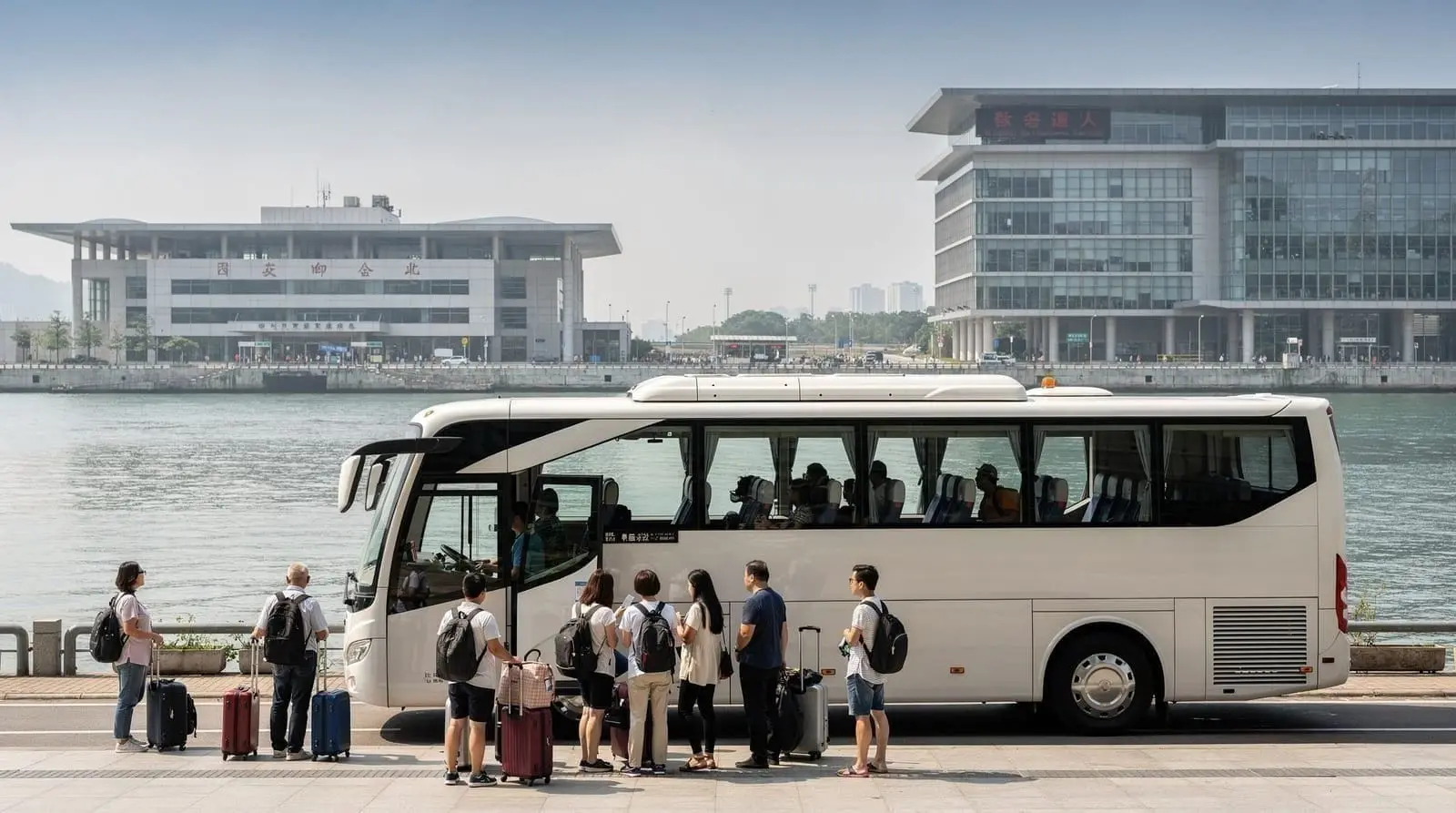
Hong Kong to Shenzhen border crossings: the practical guide
Which border crossing is best for Hong Kong to Shenzhen?
Futian/Lok Ma Chau is the fastest and most modern for most travellers — it connects directly to Hong Kong MTR Lines 4 and 10 and is typically the least crowded. Lo Wu is better if you are coming from Kowloon or need a direct MTR-to-MTR connection on the Shenzhen Line 1. Huanggang is the only 24-hour crossing. Shekou (ferry) is best if your destination is Shenzhen's western Nanshan district.
Crossing between Hong Kong and Shenzhen is routine — tens of thousands of people do it every day. But the experience varies considerably depending on which of the four crossings you use, what time you arrive, and whether you know where to queue. A smart choice of crossing can mean a 15-minute process or a 90-minute slog through weekend crowds.
This guide covers all four crossing points in practical detail: how to get to them, what to expect on both sides, the best and worst times to cross, and how to navigate the immigration process itself.
| Fastest crossing | Futian/Lok Ma Chau — MTR Line 10 direct |
| Busiest crossing | Lo Wu — avoid weekend mornings |
| Only 24-hour crossing | Huanggang |
| Cost | MTR/metro fares only, no crossing fee |
| Best time | Weekday afternoons, 14:00–18:00 |
What to know before you cross
You are crossing an international border
Even though Shenzhen and Hong Kong feel geographically close, you are moving between two separate customs territories. Both sides have full immigration and customs procedures. You need a valid travel document — passport for most international visitors, Home Return Permit or two-way permit for mainland Chinese nationals.
Visa requirements
International visitors need an appropriate entry permission for mainland China. For most Western nationalities, the 240-hour visa-free transit policy applies if you entered China by air; if you are crossing overland from Hong Kong, you will need a pre-issued L-visa or use the Shenzhen SEZ visa on arrival available at Lo Wu, Huanggang, and Shekou. Futian does not issue VOAs.
Hong Kong is visa-free for around 170 nationalities. Most travellers from Western countries do not need a Hong Kong visa.
The customs reset when you cross
Each time you cross in either direction, both countries log your entry. If you are on a 240-hour visa-free transit in mainland China and you cross to Hong Kong — even briefly — your mainland China stay effectively pauses. When you re-enter mainland China, your 240-hour clock resets to zero. This can actually be advantageous for longer trips: a day in Hong Kong gives you fresh 10 days in Shenzhen. But if you are counting days carefully, plan for it.
Payment for MTR fares
The Hong Kong MTR accepts Octopus cards, credit/debit cards (tap to pay), and the MTR app. The Shenzhen Metro accepts WeChat Pay, Alipay, and the Shenzhen Tong transit card (available at station service centres). Set up WeChat Pay or Alipay for foreigners before you travel — it makes the Shenzhen side significantly easier. Alternatively, purchase a Shenzhen Tong card at any Shenzhen Metro station.
Connectivity across the border
Mobile connectivity is a genuine practical concern, not just a convenience issue, since navigation apps behave differently on each side. Hong Kong has no internet restrictions — Google Maps, WhatsApp, and Instagram all work normally. The moment you cross into mainland Shenzhen, the Great Firewall applies, and Google services, WhatsApp, and most Western social media stop working unless you have a VPN installed and active before crossing (VPN apps generally cannot be downloaded once you are already on the mainland side, since app stores serving VPNs are themselves blocked there).
See the eSIM and VPN guide for China for how to prepare a working setup before you leave home. Roaming on a Hong Kong SIM inside Shenzhen is possible with some carriers but often expensive; a dedicated China eSIM or physical SIM bought locally is usually the more economical option for a multi-day stay.
Crossing 1: Futian/Lok Ma Chau — fastest for most travellers
Futian checkpoint (深圳福田口岸 on the Shenzhen side, Lok Ma Chau on the Hong Kong side) is the most modern of the land crossings and is widely considered the best choice for international travellers visiting central Shenzhen or the Futian CBD.
Getting there from Hong Kong
From Hong Kong Island or Kowloon: Take the MTR to Hung Hom, then the East Rail Line (Line 10) to Lok Ma Chau station. The station is directly connected to the Hong Kong side of the crossing via a covered walkway. Journey time from Hung Hom: approximately 45 minutes. From Mongkok: about 35 minutes.
Alternatively, board the West Rail Line (Line 9) to Kam Sheung Road, then change to the East Rail Line northbound to Lok Ma Chau.
The crossing itself
On the Hong Kong side, you clear Hong Kong departure immigration, pass through a short connecting corridor, and enter the Futian checkpoint building on the mainland side. This is one of the few crossings where both immigration halls are in the same building complex — the process feels continuous and the walking distance is short.
Shenzhen immigration at Futian tends to move efficiently. The hall is spacious, staffed well, and the e-gate technology for compatible passports (Chinese nationals, Hong Kong permanent residents, some other passports) processes fast. International visitors on manual counters still tend to clear in 10–20 minutes during off-peak hours.
The Shenzhen Metro connection is excellent: Futian Port station is directly below the checkpoint on Metro Lines 2 and 11. From there, Line 2 east reaches the Futian CBD in 2 stops, and Line 11 connects to Longhua and the high-speed rail hub at Shenzhen North.
Note: Futian does not issue Shenzhen VOAs. If you need a visa on arrival, use Lo Wu, Huanggang, or Shekou instead.
Operating hours
07:00–23:00 daily.
Best and worst times
Futian is busy but rarely overwhelming outside peak windows. Avoid: Saturday and Sunday mornings 08:00–12:00, and public holidays (particularly Golden Week in early October and the Chinese New Year period). Best: weekday afternoons 14:00–18:00. Evening crossings after 20:00 are typically quick.
Crossing 2: Lo Wu/Luohu — best MTR-to-MTR connection
Lo Wu (Hong Kong) / Luohu (深圳罗湖, Shenzhen) is the oldest, busiest, and most famous crossing. It handles more pedestrian crossings than any other point and is located where the East Rail Line terminates at the border — which makes it the natural choice if you are arriving from anywhere along that line without changing trains.
Getting there from Hong Kong
The East Rail Line (Line 10) from Hung Hom terminates at Lo Wu station, which is directly attached to the crossing. From Kowloon Tong (interchange hub): 40 minutes. From Hung Hom: approximately 55 minutes.
Unlike Lok Ma Chau/Futian, the Lo Wu crossing does not require any bus or extra connection — you exit the Hong Kong MTR and walk directly into the immigration hall. This seamless connection makes it the default for many regular commuters.
The crossing itself
The Lo Wu crossing building is substantial — it handles enormous volumes — but the layout can feel dated compared to Futian. There are many immigration lanes on both sides, and during off-peak hours the queue moves steadily. During peak times (see below), Lo Wu can be significantly slower than Futian.
The VOA counter is available at Lo Wu for eligible nationalities. This is one of the main reasons international travellers still prefer it — combined with the direct MTR connection, it means you can cross from central Hong Kong to mainland Shenzhen without a pre-issued visa in a single uninterrupted journey.
On the Shenzhen side, Luohu station on Metro Line 1 is immediately adjacent to the crossing exit. Line 1 (the oldest Shenzhen Metro line) runs east-west across central Shenzhen, connecting Luohu to Futian CBD (about 15 minutes), Chegongmiao, and on to Window of the World in Nanshan (about 40 minutes).
Operating hours
06:30–00:00 daily. Not 24 hours — Huanggang handles that.
Best and worst times
Lo Wu is the most prone to long queues of all four crossings. Weekend mornings are consistently the worst: 08:00–12:00 on Saturdays and Sundays can produce 60–90 minute waits. If your travel is flexible, crossing Lo Wu on a weekday afternoon is dramatically better. The crossing is also heavily used during Hong Kong and mainland public holidays. Best time: weekday 14:00–19:00.
Crossing 3: Huanggang — the 24-hour crossing
Huanggang (皇岗口岸) is the only crossing between Hong Kong and Shenzhen that operates around the clock. This makes it invaluable for early morning departures, late evening arrivals, and travellers with unusual schedules.
Getting there from Hong Kong
Huanggang is not directly served by the MTR on the Hong Kong side. Access is primarily via cross-boundary coaches, which depart from multiple points in Kowloon and the New Territories (including Mongkok, Jordan, and Tuen Mun). Coach journey times vary by pickup point: 30–60 minutes from central Kowloon. A taxi from central Kowloon costs roughly HKD 200–280.
On weekdays and during business hours, the coaches run frequently. Late at night (after 23:00), frequency drops but services continue.
The crossing itself
Huanggang is primarily used by cross-boundary vehicles and coaches rather than pedestrians, which gives it a different character from Lo Wu and Futian. There is a dedicated pedestrian crossing section, but the facilities feel more utilitarian. The immigration process for pedestrians is efficient, particularly at off-peak hours.
The VOA is available at Huanggang at all hours. For travellers who need a VOA and arrive in Hong Kong on a late evening flight, Huanggang is the practical option: you can cross at midnight, obtain your VOA, and arrive in Shenzhen in the early hours.
On the Shenzhen side, Metro Line 7 serves Huanggang station. Line 7 connects to Futian CBD (Huanggang Checkpoint station, about 10 minutes) and onwards to Chegongmiao interchange. From Chegongmiao, you can transfer to Line 1 for west/east access across the city.
Operating hours
24 hours, 7 days a week.
Best and worst times
Because Huanggang is 24/7 and less popular with pedestrian tourists, queues outside standard business hours are almost nonexistent. Mid-morning on weekdays can see heavy coach and vehicle traffic. Best: any time from 22:00 to 07:00 for virtually zero queues.
Crossing 4: Shekou ferry terminal — for western Shenzhen
Shekou (蛇口) is a ferry crossing rather than a land border, and it is the right choice for a specific set of travellers: those heading to Shenzhen’s western Nanshan district (the tech and creative hub, home to OCT Loft, Window of the World, and Tencent’s headquarters) or those connecting via the Hong Kong–Zhuhai–Macau Bridge.
Getting there from Hong Kong
Ferries depart from the China Ferry Terminal in Tsim Sha Tsui (Kowloon) and from Hung Hom pier. The journey time is approximately 30–50 minutes depending on sea conditions and specific route. Ferry schedules vary by season and demand; check current timetables with the ferry operator before travelling.
The HZMB (Hong Kong–Zhuhai–Macau Bridge) Hong Kong port also has ferry connections to Shekou. If you are arriving from Macau or Zhuhai via the HZMB, you can continue by ferry to Shekou rather than returning through central Hong Kong — a useful option for the Pearl River Delta grand loop. See the HZMB bridge guide for HZMB details.
The crossing itself
Immigration at Shekou International Cruise Terminal is generally smooth. The VOA is available here for eligible nationalities, applied for at the terminal immigration hall.
On the Shenzhen side, the Shekou terminal is served by Metro Line 2, with Sea World station directly adjacent. Line 2 runs east across Nanshan and Futian, connecting to major interchange stations including Chegongmiao (for Line 1) and Futian (for Lines 2 and 11).
Arriving at Shekou means you are already in the western Nanshan district — walking distance from Sea World (a popular waterfront area), close to OCT Harbour, and about 20–30 minutes by metro from Window of the World.
Operating hours
Ferry schedules typically run from around 07:30 to 21:30, but this varies. Check specific operators for current departure times.
Best and worst times
The ferry is less subject to the land-crossing queue dynamics. Busy ferry departures (Friday and Sunday evenings, public holidays) can sell out — booking online in advance is recommended for peak dates.
Crossing comparison at a glance
| Lo Wu | Futian | Huanggang | Shekou | |
|---|---|---|---|---|
| Type | Land | Land | Land | Ferry |
| Hours | 06:30–00:00 | 07:00–23:00 | 24 hours | ~07:30–21:30 |
| Hong Kong access | East Rail (MTR Line 10) direct | East Rail to Lok Ma Chau (MTR Line 10) | Cross-boundary coach / taxi | Ferry from Tsim Sha Tsui / Hung Hom |
| Shenzhen Metro | Line 1 (Luohu station) | Lines 2 & 11 (Futian Port station) | Line 7 (Huanggang station) | Line 2 (Sea World station) |
| VOA available | Yes | No | Yes | Yes |
| Typical crowd level | Highest | Moderate | Low–moderate | Low |
| Best for | Central/eastern Shenzhen via direct MTR | Futian CBD, fastest off-peak | Late/early arrivals | Nanshan, Zhuhai connections |
Peak times and how to avoid long queues
Queue dynamics at Hong Kong–Shenzhen border crossings follow predictable patterns.
Worst times across all crossings:
- Saturday and Sunday mornings, 08:00–12:00 (the worst window)
- Friday evenings, 17:00–21:00 (outbound from Shenzhen to HK)
- Hong Kong public holidays and long weekends
- Mainland Chinese public holidays (particularly Golden Week in October, Chinese New Year, Labour Day)
Best times:
- Weekday afternoons, 14:00–17:00 (consistently the least congested window)
- Weekday mornings before 08:30
- Evenings after 20:00 at most crossings (after 22:00 at Huanggang for near-zero queues)
The best real-time tool for queue monitoring is the Hong Kong Immigration Department’s website or app, which shows waiting times at each crossing updated in near-real time.
Crossing during Golden Week and Chinese New Year
The two periods that genuinely change the crossing calculus are Chinese Golden Week (early October) and Chinese New Year (late January to mid-February, date varies by year). During these windows, cross-border traffic can multiply several times over, and even Futian — normally the calmest crossing — sees sustained queues of an hour or more across most of the day, not just the usual peak windows.
What actually changes: Immigration halls run at full staffing, but the sheer volume of people, not process inefficiency, is the bottleneck. Huanggang, being 24-hour and less popular with pedestrian day-trippers, becomes relatively more attractive during these periods precisely because everyone else avoids it in favour of Lo Wu and Futian. The HSR is also affected — trains sell out days in advance, so book Golden Week or Chinese New Year HSR tickets as early as the booking window allows (typically 15–30 days ahead via 12306).
Practical adjustments during peak holidays: cross very early (before 07:30) or very late (after 21:00); avoid Saturday and Sunday entirely if your schedule allows a weekday crossing instead; and build in at least an extra hour of buffer beyond the usual estimate for any land crossing. If your itinerary includes a hard deadline (a flight, a pre-booked tour), use the HSR rather than a land crossing during these periods — it is the most resistant to holiday congestion because immigration is processed in the same controlled flow as regular ticketed train boarding.
Document checklist for crossing
For international visitors entering mainland China:
- Passport (minimum 6 months validity, at least 1 blank visa page)
- Valid Chinese visa or qualification for 240-hour transit/Shenzhen VOA
- Accommodation address in Shenzhen for the arrival card
- Onward ticket (if using 240-hour transit policy)
For international visitors entering Hong Kong:
- Passport (minimum 1 month validity beyond your stay is sufficient for most, but 6 months is standard practice)
- No visa required for ~170 nationalities
Do not carry: large amounts of undeclared cash above the customs declaration threshold (CNY 20,000 or equivalent per person). Commercial goods in quantities that could trigger customs duty. Certain restricted items (fresh fruit, meat, plants) are subject to agricultural controls at both crossings.
Getting to Shenzhen destinations from the border
Once you have cleared Shenzhen immigration, the Shenzhen metro connects the border areas to the rest of the city efficiently and cheaply. Metro fares range from CNY 2 to CNY 12 depending on distance.
From Luohu (Lo Wu): Line 1 west reaches Futian in about 15 minutes, Chegongmiao in 20, and Window of the World in 40 minutes.
From Futian Port (Futian/Lok Ma Chau): Lines 2 and 11 give direct access to the Futian CBD and Longhua respectively.
From Huanggang: Line 7 south reaches Futian interchange in about 10 minutes.
From Sea World (Shekou): Line 2 east reaches OCT and Window of the World area quickly, continuing to Futian in about 25 minutes.
The 3-day Shenzhen itinerary and Shenzhen destinations overview can help you plan where to go once you are through.
If you would rather not navigate it yourself
For a first crossing, or if you are travelling with a lot of luggage, mobility considerations, or simply want the visa-support and logistics handled, several operators run guided crossings that manage the paperwork and immigration process end to end:
Hong Kong to Shenzhen private day tour with border crossing supportThis is particularly useful for nationalities that need standard Chinese visa support rather than qualifying for the 240-hour transit or VOA schemes — the guide handles the checkpoint procedure and any required paperwork, removing the main source of uncertainty for a first-time crossing.
What happens if you pick the wrong crossing for your destination
A common planning mistake is choosing a crossing based on which one “sounds most convenient” rather than where you are actually headed. Crossing at Lo Wu when your destination is Nanshan or Shekou means a 40-minute metro ride across the city on Line 1, when the Shekou ferry or Shenzhen Bay Port would have dropped you within 15 minutes of the same destination. Before choosing, decide your first Shenzhen stop — Futian CBD, Nanshan/Shekou, or Luohu/Dongmen — and pick the crossing that serves it directly rather than the one that seems fastest from your current Hong Kong location.
Frequently asked questions about Hong Kong–Shenzhen border crossings
Do I need to book a specific time slot to cross?
No. None of the four crossings require advance booking or a time slot for individual pedestrian crossings. You can show up at any time during operating hours. The only exception is the Shekou ferry, where you buy a ticket for a specific departure and popular slots can sell out — book the ferry in advance for peak travel dates.
Can I take the Hong Kong MTR all the way to the border?
Yes, to two crossings. The East Rail Line (MTR Line 10) has two terminals: Lo Wu station (for the Lo Wu crossing) and Lok Ma Chau station (for the Futian/Lok Ma Chau crossing). Both stations are directly connected to the crossing buildings. Huanggang and Shekou are not served by the Hong Kong MTR.
Is there a crossing near Hong Kong Airport?
Not directly. The closest option from Hong Kong Airport is the HZMB, which connects HK Airport to Zhuhai and Macau (not Shenzhen directly — see the HZMB guide). For Shenzhen from the airport, take the Airport Express to Hong Kong station, transfer to the East Rail Line at Hung Hom or Kowloon Tong, and then continue to Lo Wu or Lok Ma Chau. Alternatively, a cross-boundary coach from the airport terminal serves Shenzhen destinations directly.
How long does the crossing actually take?
Off-peak (weekday afternoon): 20–40 minutes door-to-door through both sides of immigration. Peak (weekend morning at Lo Wu): can be 60–120 minutes. Futian is generally faster than Lo Wu even at busy periods due to better immigration infrastructure.
Do I need to fill in a paper form?
On the mainland China side, you complete a paper arrival/departure card (a small double-sided form in English and Chinese). Fill in your passport details, accommodation address, and arrival date. These are available at the crossing. Hong Kong arrival cards are no longer required for most visitors — Hong Kong replaced paper cards with electronic registration in 2023 for most nationality groups.
Can I bring food across the border?
Fresh produce is restricted in both directions. Mainland China restricts certain fresh fruits, meats, and soil-covered plants. Hong Kong restricts certain meat products from mainland China. For tourist quantities of packaged snacks or drinks in your personal luggage, there are no practical restrictions. Do not carry large commercial quantities of food.
What if I have oversized luggage or am travelling with a bicycle?
Lo Wu and Futian have lifts and are accessible with wheeled luggage. Larger items (bicycles, large boxes) are theoretically permitted through land crossings but may attract customs attention. The Shekou ferry has specific rules on bicycle transport — check with the ferry operator. For very large items, consider whether cross-boundary coach services (which have luggage holds) are more practical.
Is the Shenzhen and Hong Kong 5-day itinerary manageable with multiple crossings?
Yes. Crossing between Shenzhen and Hong Kong is fast enough that a multi-day itinerary with one or two crossings is entirely practical. Plan crossings on weekday mornings or afternoons to avoid queues, and remember that each crossing into mainland China counts as a new entry (resetting your 240-hour window if applicable). The Shenzhen vs Hong Kong guide is useful for deciding how to split your time between the two.
Which crossing should first-time visitors use?
Futian/Lok Ma Chau, for the combination of speed, modern facilities, and a direct MTR connection on both sides. It lacks a visa-on-arrival counter, so if you need a VOA, use Lo Wu or Huanggang instead — both offer VOA and still connect reasonably well to central Shenzhen.
Can I use a Hong Kong Octopus card on the Shenzhen side, or vice versa?
No. Octopus works only within the Hong Kong transport network (MTR, buses, ferries); it is not accepted on the Shenzhen Metro. On the Shenzhen side, set up WeChat Pay or Alipay (see the payment guide for foreigners) or buy a Shenzhen Tong card at any metro station customer service counter.
Top-rated things to do in Shenzhen
Verified deep-linked GetYourGuide tours. Book through these links and we earn a small commission at no cost to you.