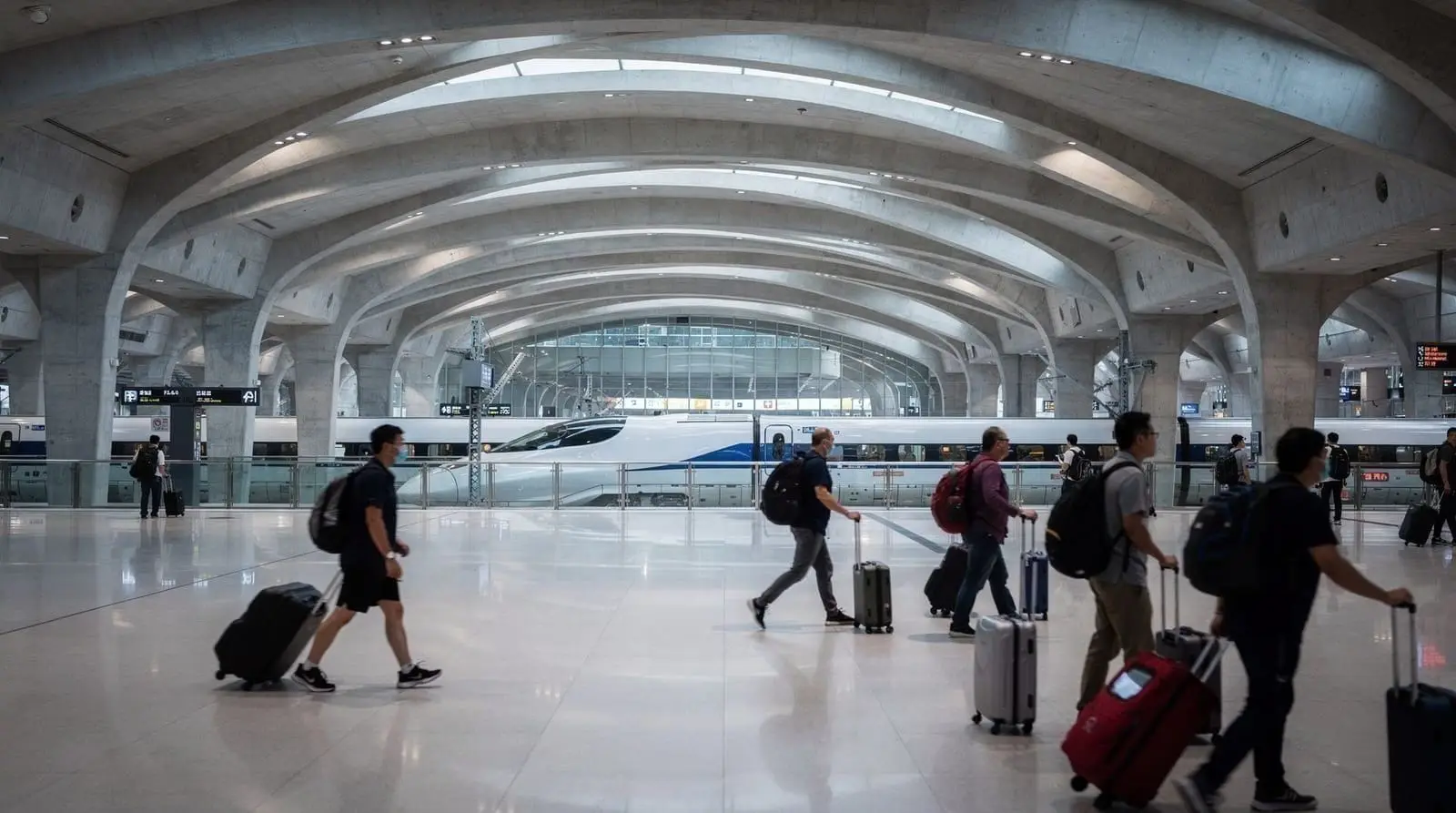
Greater Bay Area high-speed rail: the complete guide
How long is the high-speed train from Hong Kong to Shenzhen?
14–24 minutes from Hong Kong West Kowloon to Shenzhen Futian, or 18–30 minutes to Shenzhen North. Around 140 trains run daily in each direction.
The Guangzhou–Shenzhen–Hong Kong High-Speed Railway (广深港高铁) is one of the most important pieces of infrastructure in the Greater Bay Area. It connects three of southern China’s largest cities in under an hour — a journey that once took three hours by conventional rail or road. For travellers doing anything beyond a single-city visit, understanding how this line works will reshape your itinerary options considerably.
This guide covers every station on the line, realistic journey times and fares, how to book tickets, what the co-location immigration arrangement at West Kowloon means in practice, and how to combine HSR travel with other modes to build a smooth multi-city trip.
| Fastest route | Hong Kong West Kowloon → Shenzhen Futian, 14 min |
| Key stations | West Kowloon, Shenzhen Futian, Shenzhen North, Guangzhou South |
| Booking | MTR app (HK side), 12306 or Trip.com (mainland) |
| Immigration | Co-located at West Kowloon — no border stop mid-journey |
| Buffer time | Arrive 45+ min before departure for check-in and immigration |
The route and key stations
The Hong Kong section of the line opened in September 2018, connecting Hong Kong to the national high-speed rail network for the first time. The line runs from Hong Kong West Kowloon northward under the harbour to the border, then surfaces into Shenzhen and continues up through the Pearl River Delta to Guangzhou.
The four stations travellers use most:
Hong Kong West Kowloon (HKW) The Hong Kong terminus, located in West Kowloon — a 15-minute walk from the Tsim Sha Tsui entertainment district and well connected to the MTR (Austin station and Elements mall are directly above). This is where all cross-border HSR trains start or terminate in Hong Kong.
Shenzhen Futian (福田) Shenzhen’s CBD station, located underground directly beneath Futian district. It is the closest station to the Futian border crossing and a short walk from the Civic Centre and major shopping malls. For travellers heading to Futian or Luohu, this is usually the better arrival station. Futian is also on the Shenzhen metro network (Lines 2 and 11).
Shenzhen North (深圳北) Shenzhen’s main high-speed rail hub, located in the Longhua district north of central Shenzhen. It handles not just Hong Kong trains but the full national HSR network — connections to Beijing, Shanghai, Chengdu, and dozens of other cities all route through here. The station is enormous. From Shenzhen North, metro Line 4 connects to the city centre and the Futian border crossing. If you are continuing onward to anywhere in mainland China beyond the GBA, this is your departure point.
Guangzhou South (广州南) Guangzhou’s main HSR station, a large modern terminal in the Panyu district about 20 kilometres south of Guangzhou city centre. From here, metro Line 7 and Line 2 connect to Guangzhou’s various districts (allow 30–40 minutes to the historic Shamian Island area). Guangzhou South is also the hub for HSR connections westward toward Guilin, Kunming, and other destinations.
Journey times and fares (2026)
All services are high-speed — there are no slow trains on this corridor.
| Route | Journey time | Approximate fare | Daily trains |
|---|---|---|---|
| HK West Kowloon → Shenzhen Futian | 14–24 min | USD 14–40 | ~140 |
| HK West Kowloon → Shenzhen North | 18–30 min | USD 18–45 | ~140 |
| HK West Kowloon → Guangzhou South | 47–60 min | CNY 185–215 (~USD 27–32) | ~50 pairs |
The fare range reflects the tiered pricing between second class (standard) and first class. Second class is comfortable — the seats are wide and well-cushioned with generous legroom. First class adds more recline and slightly more space. Business class (available on some trains) includes a wider lie-flat seat and sometimes a meal; it is hard to justify on a 20-minute hop to Shenzhen but can make a Guangzhou journey more pleasant.
Fares to Shenzhen are quoted in Hong Kong dollars when purchased through the MTR booking system; they convert to approximately HKD 110–350 depending on class and departure time. Fares to Guangzhou are quoted in CNY (Chinese yuan) on the mainland booking platforms.
How immigration works: the co-location arrangement
This is the detail that surprises most first-time users. When you board a cross-border HSR train at Hong Kong West Kowloon, you do not stop at the border for immigration checks. Instead, immigration for both Hong Kong departure and mainland China arrival is handled at West Kowloon station before you board.
This is known as the co-location arrangement. A designated zone inside West Kowloon station — physically and legally treated as mainland China for immigration purposes — handles the full clearance process. You queue, present your passport, have your biometrics checked (if required), and receive your entry/exit stamps all before you step onto the train. When you arrive at Shenzhen Futian or Shenzhen North, you walk straight off the platform without any further checks.
In practice:
- Arrive at West Kowloon at least 45 minutes before departure (longer during busy periods)
- Check in at the counter or self-service kiosk (ticket required — see booking section below)
- Pass through Hong Kong immigration (departure)
- Enter the co-location zone and pass through mainland Chinese immigration (entry)
- Proceed to the platform and board
The co-location zone is a one-way system: once you enter it, you cannot re-enter Hong Kong without clearing immigration again. Do not enter the immigration zone until you are definitely travelling.
For the return journey from Shenzhen Futian or Shenzhen North, you clear both Chinese departure and Hong Kong arrival immigration at the Shenzhen station before boarding the train to Hong Kong. Same logic in reverse.
This arrangement is enormously convenient — it eliminates the time spent on a separate border crossing and makes the HSR the fastest city-centre-to-city-centre option between Hong Kong and Shenzhen by a significant margin.
What documents you need
- Your passport: the one registered when you booked the ticket. Even if you have a Hong Kong ID card, cross-border HSR requires your travel document, not your ID.
- Your ticket: either physical (printed) or the booking reference on your phone. You will need the ticket for check-in and again at the platform gate.
- A valid Chinese visa: if you are not a Hong Kong permanent resident or a passport holder from a visa-exempt nationality. Nationals of many countries can enter China without a visa for 30–90 days depending on reciprocal agreements as of 2026 — check the visa guide or the visa tool for your specific nationality.
Do not book a ticket before confirming your visa status. You will be turned away at immigration if you do not have the correct documentation.
How to book HSR tickets
MTR app (Hong Kong) The easiest option for buying Hong Kong–Shenzhen or Hong Kong–Guangzhou tickets. The MTR mobile app handles booking in English, accepts international credit cards and PayPal, and delivers e-tickets to your phone. You can book up to 30 days in advance.
At West Kowloon station Ticket counters and self-service machines are available at the station. Counters accept cash (HKD) and cards; machines accept cards, Octopus, and Alipay. Same-day tickets are usually available outside of holiday peaks.
12306 (mainland Chinese railway platform) The official mainland booking platform (12306.cn or its app) has the widest inventory and the best prices for longer journeys, but the English interface is limited and it requires a Chinese payment method or a mainland-compatible Alipay account. Worth using if you are buying tickets for inter-city journeys within mainland China (e.g., Guangzhou to other cities), less practical for the Hong Kong end of the journey.
Third-party platforms Trip.com (formerly Ctrip) and similar platforms sell HSR tickets with an English interface and accept international cards. They charge a small service fee but save the hassle of navigating 12306 as a foreign visitor. Useful for booking further in advance or for complex multi-leg journeys.
Booking window: tickets open 30 days before departure on mainland platforms; the MTR app opens bookings at 30 days for the Hong Kong side. During Chinese public holidays, popular departure times sell out quickly — book as early as possible.
Comparing HSR with other Hong Kong–Shenzhen options
The Shenzhen metro connects to Hong Kong through two border crossings: Luohu/Lo Wu (metro Line 1 on the Shenzhen side, East Rail Line on the HK side) and Futian/Lok Ma Chau (metro Line 4 on the Shenzhen side, East Rail MTR on the HK side). These are slower — allow 90–120 minutes from Kowloon to Luohu — but also cheaper (around HKD 40 total) and more flexible for luggage. For a detailed breakdown of all border options, see the Hong Kong–Shenzhen border crossings guide.
For Hong Kong to Guangzhou, the HSR is the clear winner over everything else. The old intercity coaches take 2.5–3 hours in traffic; the conventional rail (via Hung Hom to Guangzhou East) has been eclipsed entirely by the HSR’s 47–60 minute journey time.
Taxis and private cars are subject to cross-boundary plate restrictions and are not practical for individual travellers going between HK and Shenzhen or Guangzhou.
Key tourist routes on the HSR
Shenzhen day trip from Hong Kong Many Hong Kong visitors do Shenzhen as a day trip. The HSR makes this faster than ever: depart West Kowloon at 08:30, arrive Futian by 09:00, spend the day, return by 22:00. With Shenzhen’s metro network connecting you to Nanshan shopping, OCT Loft, and other areas, a day trip is genuinely viable. The Shenzhen in 3 days itinerary treats Shenzhen as a main destination, but the HSR is the obvious entry/exit point if you are based in Hong Kong.
Guangzhou add-on Guangzhou South to West Kowloon in under an hour makes Guangzhou an easy day trip or overnight extension from either Shenzhen or Hong Kong. Guangzhou’s Cantonese food scene, the old Shamian Island colonial quarter, and the Chen Clan Academy are all worth the trip. If you are doing the Pearl River Delta grand loop, Guangzhou is likely already on your list.
Onward connections from Shenzhen North If you are travelling deeper into China — to Guilin, Chengdu, Chongqing, Wuhan, or anywhere on the national network — Shenzhen North is the connection point. You can arrive from Hong Kong at Futian and take the metro one stop north to Shenzhen North to board a national HSR train. The Shenzhen metro guide covers the Line 4 connection between Futian and the stations serving Shenzhen North.
Practical tips for using the HSR
Arrive with buffer time. Immigration co-location adds steps that the gate-to-gate journey time does not reflect. The 14-minute journey time is train travel only; door-to-door from Tsim Sha Tsui hotel to Futian station exit is realistically 75–90 minutes including check-in and immigration.
Real-time schedules. The MTR app shows live train availability and timing. You can also check the arrivals/departures board at the station. Trains are almost always on time — Chinese HSR punctuality is exceptionally high.
Mobile payment in Shenzhen. Once you arrive, WeChat Pay and Alipay are the primary payment methods across Shenzhen. International cards work in most major hotels and some restaurants but are not universally accepted. Set up a linked foreign card on Alipay or WeChat Pay before you travel — the WeChat Pay and Alipay for foreigners guide explains the current setup process.
VPN and connectivity. Google Maps, WhatsApp, and most Western apps are blocked in mainland China. Download an offline map (Maps.me or Apple Maps offline) before crossing and set up a VPN on your phone before entering mainland China — you cannot download or activate VPN apps from inside the country. The eSIM and VPN guide has current recommendations.
Luggage. HSR carriages have overhead racks and a luggage area at the end of each carriage. There are no strict size limits for carry-on luggage, but large checked-style suitcases can be awkward on busy trains. You cannot check luggage separately on Chinese HSR.
Station food. West Kowloon station has a good selection of cafes and fast food in the departure area. Shenzhen Futian station has less on the platform level but is directly connected to mall food courts. Shenzhen North has a wider range of food vendors in the main concourse.
Using HSR with the HZMB bridge
If you are doing a multi-city loop that includes Macau or Zhuhai as well as Shenzhen and Hong Kong, consider combining HSR with the HZMB bridge shuttle. A common sequence: fly into HKIA → HZMB shuttle to Macau → day(s) in Macau → cross to Zhuhai → coach or train north to Guangzhou or Shenzhen → return to Hong Kong via HSR from Futian or North. This loop uses both major cross-boundary transport systems and avoids doubling back.
First-time HSR checklist for foreign visitors
If this is your first time using mainland Chinese high-speed rail, a short checklist removes most of the friction:
- Book before you travel, using the MTR app for the Hong Kong side or Trip.com for mainland-only legs — both accept international cards and have English interfaces.
- Confirm your visa or transit eligibility before booking, since the co-location immigration at West Kowloon checks this before you board, not at a separate border post.
- Arrive with real buffer time — 45 minutes minimum at West Kowloon, 20–30 minutes at mainland-only stations like Shenzhen North or Guangzhou South.
- Have your passport (not just a Hong Kong ID card) ready, along with the same document used at booking.
- Set up mobile payment before you need it — WeChat Pay or Alipay with a linked foreign card covers everything from station food to onward metro connections once you arrive.
- Download offline maps and set up connectivity before crossing into mainland China, since Google Maps and most Western apps stop working immediately behind the firewall.
Following this checklist once means every subsequent HSR trip during your stay — whether to Guangzhou, Dongguan, or back to Hong Kong — is simply a matter of booking and showing up. Most first-time users report that the whole system feels intimidating for about one journey and completely routine by the second.
Using the HSR to build a multi-day trip beyond Shenzhen
The HSR’s real value shows up once you start stacking destinations. A traveller with 5–6 days based in Shenzhen can realistically fit in Guangzhou (30 min), Dongguan (35–45 min), and Foshan (60–75 min via Guangzhou South) — all without ever renting a car or booking an internal flight. The day trips from Shenzhen guide ranks all of these by time and interest if you’re deciding which to prioritise.
Timing your HSR-based day trips around the region’s weather also matters more than it might seem — see the best time to visit Shenzhen guide for the months when walking around Guangzhou’s Xiguan district or Foshan’s Zumiao temple grounds is genuinely comfortable versus oppressively hot and humid.
Frequently asked questions about the Greater Bay Area HSR
Do I need a Chinese visa to take the HSR from Hong Kong to Shenzhen?
Yes, unless your nationality is exempt from Chinese visa requirements or you qualify under the 240-hour transit exemption. The co-location process at West Kowloon means you pass through mainland Chinese immigration before boarding — your visa status is checked there, not at a physical border. Check the China visa guide and visa tool for your passport.
Can I buy HSR tickets on the day of travel?
Yes, for most trains. The Hong Kong–Shenzhen corridor has around 140 daily services in each direction, so last-minute availability is usually fine outside of public holidays. For Golden Week and Lunar New Year, book 2–3 weeks in advance. Guangzhou trains are busier and worth booking earlier.
Is there a difference between travelling via Futian or Shenzhen North?
Futian is better if you are heading to Futian CBD, Luohu, or anywhere in central/eastern Shenzhen — it is more central. Shenzhen North is better if you need to connect to the national rail network or if you are staying in Longhua or Baoan districts. Both stations are on the Shenzhen metro — Lines 2 and 11 at Futian, Line 4 at stations near Shenzhen North.
What happens if I miss my train?
Unused tickets can usually be changed or refunded at the counter, subject to a fee (typically 5–30% depending on how close to departure you cancel). If you miss your specific train, go to the ticket counter immediately — staff can sometimes accommodate you on the next available service if there are seats, sometimes without an additional fee, but this is at the discretion of station staff.
Are the trains crowded?
Business and first class carriages are usually comfortable. Second class on the Hong Kong–Shenzhen corridor can be busy during morning and evening commute hours (07:00–09:00 and 17:00–20:00 on weekdays). If you want a guaranteed window seat or simply a less compressed journey, book first class — the fare premium on a 20-minute ride is modest.
Can I bring food onto the train?
Yes. There is no restriction on bringing food. The onboard trolley service sells snacks and hot drinks on longer journeys (mainly Guangzhou-bound trains). For a 14-minute Shenzhen hop, the trolley may not even come through your carriage.
Is the co-location immigration at West Kowloon confusing?
Not really — the signage is clear and the staff are accustomed to foreign travellers. The queue can be slow during peak periods. If you have Global Entry, APEC Business Travel Card, or similar fast-track credentials, check whether expedited lanes are available; as of 2026, Hong Kong immigration has e-gate options for many passport nationalities.
Can I use the HSR to visit both Guangzhou and Foshan in one day from Shenzhen?
Yes. Shenzhen North to Guangzhou South is 30 minutes, and Guangzhou South to Foshan West adds another 10–15 minutes. A day combining both is entirely realistic — see the Foshan kung-fu and Lingnan culture guide for how the two cities pair together.
Does the HSR reach Dongguan as well?
Yes, via a separate branch — Shenzhen North to Dongguan West takes 35–45 minutes. Dongguan isn’t on the direct Hong Kong–Guangzhou line covered in most of this guide, but it’s reachable on the same broader HSR network. Full details in the Dongguan travel guide.
Top-rated things to do in Shenzhen
Verified deep-linked GetYourGuide tours. Book through these links and we earn a small commission at no cost to you.