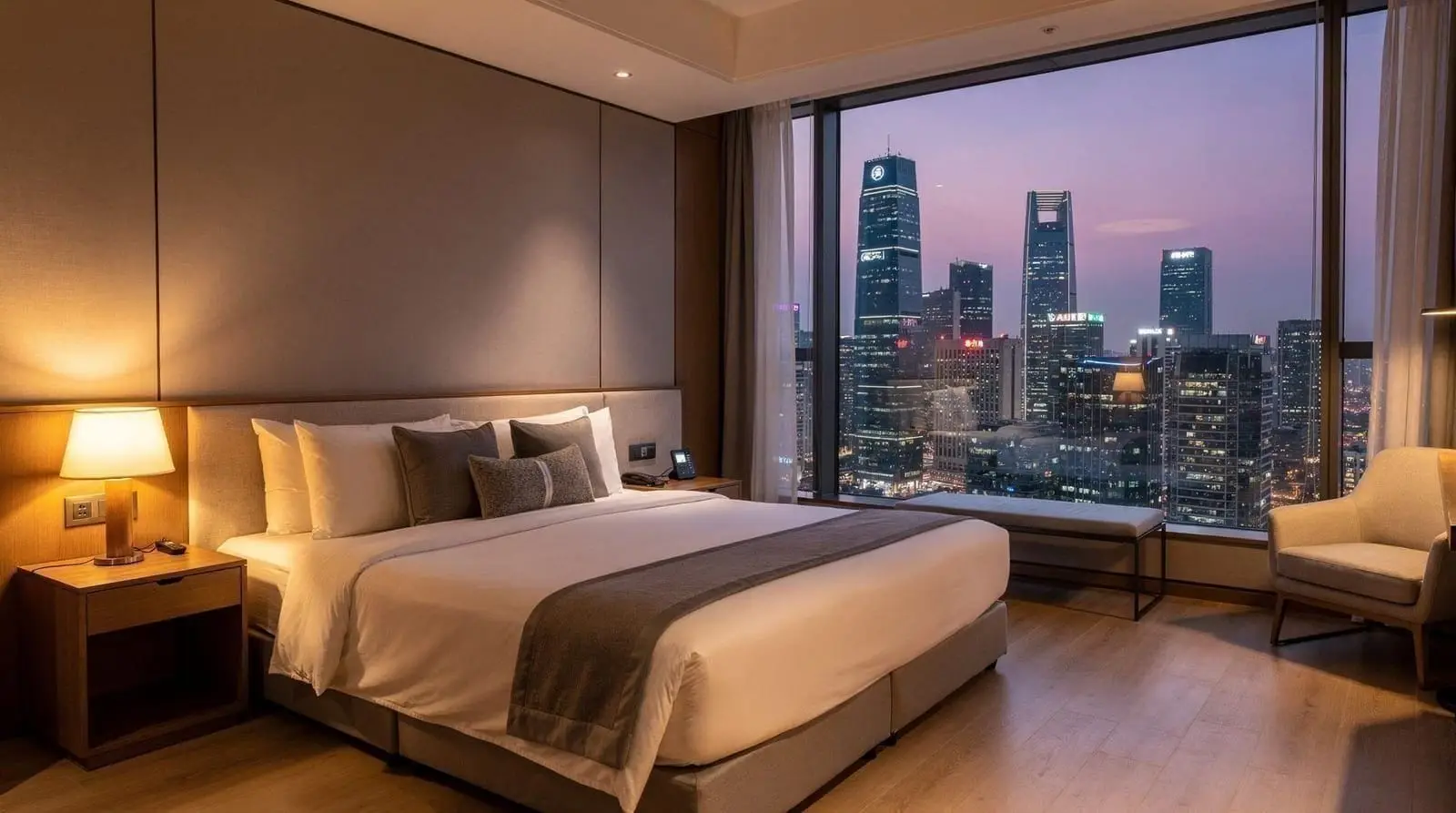
Where to stay in Shenzhen: best areas and hotels by budget
Where should I stay in Shenzhen?
Futian CBD is the best all-round base: central metro access, proximity to the high-speed rail link to Hong Kong, and most of the city's top hotels. Nanshan/Shekou suits visitors focused on the western tech corridor and bay parks. Luohu is the budget option with direct border access to Hong Kong but dated infrastructure.
Choosing where to stay in Shenzhen is more consequential than in many cities because the distances are real. Shenzhen is large — 1,997 square kilometres, roughly the same land area as Hong Kong — and the metro, while excellent, means that staying on the wrong side of the city for your itinerary can cost you 40 minutes each way on every excursion.
The good news: the hotel choice has never been better. Shenzhen’s hotel stock was largely built in the 2000s and 2010s, meaning even mid-range options are relatively modern by Asian standards. The bad news: pricing has become less predictable post-pandemic, and the gap between rack rates and online prices is significant — always compare on Ctrip, Booking.com, and the hotel’s direct website before booking.
| Best all-round base | Futian CBD |
| Best for tech/bay views | Nanshan/Shekou |
| Best for budget + HK border | Luohu |
| Typical mid-range price | CNY 300–700/night |
| Book ahead for | Golden Week (Oct) and Chinese New Year |
The four main areas: a quick comparison
| Area | Best for | Price range | Metro access |
|---|---|---|---|
| Futian CBD | Most visitors; central location; business | CNY 350–1,500+ | Lines 1, 2, 3, 4, 7, 11 |
| Nanshan/Shekou | Bay views; expats; tech campus visits; OCT | CNY 300–1,200 | Lines 1, 2, 5, 9 |
| Luohu | Budget; direct HK border access; shopping | CNY 200–600 | Lines 1, 3 |
| Qianhai | New development; modern; less tourist infrastructure | CNY 300–800 | Lines 1, 5 |
Futian CBD: best overall base
Futian is Shenzhen’s central business district and the closest thing the city has to a conventional tourist hub. The Civic Centre, Lianhuashan Park, and the Ping An Finance Centre observation deck are all here. The Futian high-speed rail station connects directly to Hong Kong West Kowloon in 14 minutes.
Why choose Futian: the metro network is most dense here, with Lines 1, 2, 3, 4, 7, and 11 intersecting in the district. You can reach the theme parks in Nanshan in 25 minutes, the border at Luohu in 15 minutes, and the high-speed rail to Hong Kong in 5 minutes from most Futian hotels. The Coco Park and Mixc malls, the CITIC Bank Financial City area, and the Civic Centre are all within walking distance of the central hotels.
Hotels at different price points:
Luxury (CNY 900–1,500/night, USD 130–220):
- InterContinental Shenzhen — in the Ping An Finance Centre tower itself (floors 98–105). Rooms have views to match the building. Breakfast is worth adding. The Sunday brunch is one of the better hotel brunches in the city.
- Four Seasons Hotel Shenzhen — on the Fuhua Road spine, consistently rated best hotel in the city for service. CNY 1,200–1,800 per night for standard rooms.
- JW Marriott Hotel Shenzhen — strong business hotel with efficient check-in, reliable wi-fi, and a central location. Slightly less expensive than the Four Seasons.
Mid-range (CNY 400–700/night, USD 58–100):
- Crowne Plaza Shenzhen Longzhu — good value in this price tier, comfortable rooms, central Futian location
- Sheraton Shenzhen Futian Hotel — reliable business-hotel comfort; breakfast buffet included in many packages; easy metro access
- Novotel Shenzhen Futian — solid international standard at the lower end of the mid-range bracket. Good location near Futian Station.
Budget (CNY 200–400/night, USD 29–58): Budget options in Futian are thinner — the district has tilted toward business and upscale over the past decade. For budget accommodation with metro access, consider the Luohu or Huaqiang areas (see below).
Nanshan and Shekou: best for the western corridor
Nanshan is Shenzhen’s technology district — Tencent, DJI, Huawei (Shenzhen R&D campus), and dozens of tech companies are based here. The expat community is concentrated in Nanshan, particularly in the Shekou and Houhai sub-areas. The bay park along the southern coast is one of the city’s best outdoor spaces.
If your visit focuses on Window of the World, Splendid China, OCT-LOFT, or the bay waterfront, Nanshan is your base. The international restaurant scene in Shekou is the best in Shenzhen for Western food, Indian food, and Southeast Asian cuisine.
The Nanshan and Shekou guide covers the neighbourhood in more detail.
Recommended hotels:
Luxury (CNY 800–1,400/night):
- Marriott Hotel Shenzhen (Sea World/Shekou waterfront) — the best-positioned luxury hotel in Nanshan; the bay views from upper floors are excellent; direct access to Sea World’s restaurants and the bay park
- Hilton Shenzhen Shekou Nanhai — another waterfront option; strong pool and gym; popular with business travellers and families
Mid-range (CNY 300–600/night):
- Holiday Inn Shenzhen OCT — directly beside OCT-LOFT Creative Park; good value, easy access to the theme parks on foot
- Ibis Shenzhen Gaoxin — budget-friendly international chain hotel in the tech park area of Nanshan; functional, clean, well-priced
Serviced apartments and long-stay: Shekou has a strong serviced apartment market catering to the expat community. Options like Somerset Shekou or various local serviced apartment buildings offer studio and 1-bedroom units at monthly rates — useful if you are planning a 2-week+ stay.
Luohu: budget option with direct Hong Kong connection
Luohu is the original commercial heart of Shenzhen and the district containing the Lo Wu border crossing — the busiest land crossing between Shenzhen and Hong Kong. If you are crossing frequently to Hong Kong or based primarily in Hong Kong and doing Shenzhen day trips, Luohu is convenient.
The honest caveats: much of Luohu’s hotel stock is older, the neighbourhood is more chaotic and less tourist-friendly than Futian, and the famous Luohu Commercial City mall (directly attached to the border crossing) is a source of counterfeit goods and aggressive selling that many visitors find unpleasant. That said, the budget accommodation prices here are genuinely lower.
Recommended hotels:
Mid-range (CNY 300–500/night):
- Shenzhen Shangri-La Hotel — the district’s best hotel; adjacent to Luohu Station; consistent service; excellent breakfast. The address is attached to the Luohu shopping complex but the hotel itself is quiet.
- Hilton Shenzhen — slightly dated compared to newer city properties but reliable and well-located for the border.
Budget (CNY 180–350/night):
- Ibis Shenzhen Luohu — basic and clean; the price is right; primarily serves business travellers transiting the border.
- Various local Hanting Express and 7Days hotel chain locations near Dongmen: functional, no frills, CNY 180–250 per night.
Qianhai: the newest option, still finding its feet
Qianhai appears in the comparison table above but deserves its own note, since it is the least understood of the four areas. It is Shenzhen’s newest large-scale development zone, built from reclaimed land west of Nanshan, with striking modern architecture and considerably lower hotel density than the other three areas.
The appeal is genuine novelty and lower prices, but the honest caveat is thinner tourist infrastructure — fewer restaurants outside hotel compounds, fewer English-speaking staff, and a metro network (Lines 1 and 5) that is efficient but leaves you further from the established sightseeing clusters in Futian and Nanshan. Qianhai suits business travellers with meetings in the district, or budget-conscious visitors happy to rely on Didi for most journeys, more than first-time sightseers.
Matching your base to your itinerary
If Window of the World and Splendid China are the priority, Nanshan cuts your commute to nearly zero. If you are building a trip around the Ping An Finance Centre observation deck, Huaqiangbei electronics shopping, or day trips using the high-speed rail, Futian keeps everything within 15–25 minutes.
Families following the Shenzhen with kids guide generally do best in Futian or Nanshan, both of which put major attractions within a manageable stroller-friendly commute — Luohu’s older infrastructure and busier streets are less ideal with young children in tow. If your trip is a short one built around day trips from Shenzhen to Guangzhou or Zhuhai, Futian’s rail connections make it the most efficient base regardless of your in-city interests.
Short stays vs longer stays
For a stay of three nights or fewer, prioritise proximity to your main planned activities over price — the time saved on commuting matters more than a modest nightly saving. For a week or longer, the calculation shifts: a serviced apartment in Futian or Nanshan often works out cheaper per night than a hotel once you factor in the convenience of a kitchenette for breakfast and laundry, and many buildings offer discounted weekly or monthly rates that hotels do not match.
If your trip spans multiple Greater Bay Area cities, as in the Pearl River Delta grand loop itinerary, consider a shorter Shenzhen stay bookended by nights in Guangzhou or Hong Kong rather than commuting back to a single fixed base each day.
Where not to stay
Baoan district: this is the area around Shenzhen Bao’an International Airport in the northwest of the city. Unless you have an early flight or specific business in the airport area, staying here puts you 45–60 minutes from the tourist sights even by express metro. The hotel-to-airport transfer is convenient but everything else is not.
Longgang district: the eastern residential and industrial zone. Dafen Oil Painting Village is here, but there is no other tourist concentration. Metro connections to Futian are decent (30–35 minutes) but staying in Longgang adds unnecessary commuting time.
Anonymous border-area budget guesthouses: around both the Luohu and Futian/Lok Ma Chau border crossings there are very cheap guesthouses (CNY 100–150/night) that cater to cross-border traders. They are functional but uncomfortable by international standards, and the immediate neighbourhood environment can be disorienting for first-time visitors.
Practical hotel-booking notes for Shenzhen
Book well ahead for October Golden Week and Chinese New Year: hotel prices in Shenzhen spike to 2–3x normal rates during national holidays. Book 6–8 weeks ahead for Golden Week (October 1–7), 8–12 weeks ahead for Chinese New Year (mid-February 2026).
Compare platforms: Ctrip (Trip.com) often has lower prices for Chinese-managed hotels than international booking platforms. Agoda is also competitive. Check the hotel’s own website for direct-book rates, which sometimes undercut platforms.
Check check-in requirements: all mainland China hotels require passport registration at check-in. This is a legal requirement, not optional. Have your passport handy (not packed in a bag). Most international hotels process this smoothly; some budget hotels have more bureaucratic check-in procedures.
Wi-Fi and the Great Firewall: almost all Shenzhen hotels offer free Wi-Fi, but the connection is subject to the Great Firewall — Google, WhatsApp, Instagram, and most Western services are blocked. Use a travel eSIM for unrestricted internet access. See the Shenzhen planning guide for eSIM recommendations.
Mobile payment: all hotels accept the standard payment methods (credit card, WeChat Pay, Alipay). The major international hotel brands accept Visa and Mastercard. Budget hotels occasionally cash-only but this is increasingly rare.
Book a private Shenzhen day tour with local guideA note on Airbnb and serviced apartments
Airbnb operates in mainland China but with considerably fewer listings than in most international cities, due to regulatory pressure. Short-term rentals in residential buildings are technically legal but exist in a grey area — some hosts have required guests to register with local police (a standard procedure for any foreigner staying in private accommodation in China). For straightforward visits of under 2 weeks, hotels are simpler.
Serviced apartments (酒店式公寓) are a better option than Airbnb for stays of a week or more. These operate as licensed accommodation businesses with proper registration procedures and are widely available in Futian and Nanshan.
Frequently asked questions about where to stay in Shenzhen
Should I stay in Shenzhen or Hong Kong for a PRD trip?
For a trip focused on Shenzhen, stay in Shenzhen — the accommodation is significantly cheaper than Hong Kong (good Shenzhen hotels cost 30–50% of equivalent Hong Kong properties), and the metro gets you everywhere. For a PRD trip that includes multiple nights each in both cities, split your stay: Hong Kong for the first and last nights (airport connections), Shenzhen for the middle nights.
The Shenzhen and Hong Kong 5-day itinerary covers this split in detail.
Is Futian CBD safe at night?
Yes, very safe. Shenzhen consistently ranks among the safest large cities in China. Futian CBD at night is populated with office workers, diners, and shoppers until 22:00–23:00. Standard urban common sense (don’t display expensive items conspicuously) applies as anywhere.
Are Shenzhen hotel prices negotiable?
In international chain hotels, prices are set and rarely negotiable at the desk. In local and independent hotels, particularly for multi-night stays, it is worth asking about a weekly rate. The bigger opportunity is in booking platform selection — the gap between Ctrip pricing and Booking.com on the same hotel can be 15–25%.
Do Shenzhen hotels provide airport transfers?
Major hotels offer car service to and from Bao’an Airport (CNY 150–250 for a private car). Alternatively, Metro Line 11 connects the airport directly to the Futian and Longhua districts — it is 40–50 minutes to Futian CBD and costs CNY 12–14. Most hotels in Futian and Nanshan are within a 5–10 minute walk or taxi from a Line 11 station.
Is Qianhai worth staying in for a first visit?
Generally no. Qianhai has striking modern architecture and lower prices, but the tourist infrastructure — restaurants, English-speaking staff, proximity to sights — is thinner than Futian or Nanshan. It suits business travellers or longer-stay visitors comfortable relying on Didi, more than first-time sightseers who want to walk to attractions.
Should I book a serviced apartment instead of a hotel?
For stays of a week or longer, often yes — serviced apartments in Futian or Nanshan frequently work out cheaper per night once you factor in a kitchenette and laundry, and many offer discounted weekly rates. For shorter stays, a hotel is simpler and the price difference is smaller.
Top-rated things to do in Shenzhen
Verified deep-linked GetYourGuide tours. Book through these links and we earn a small commission at no cost to you.