First time in Shenzhen: what to actually expect
Shenzhen sits on every “emerging destination” list, but most of what’s written about it is either breathless tech-utopia coverage or brief day-trip notes from Hong Kong. Neither is particularly useful if you’re arriving for a few days and want to actually understand the city. This guide is about what the place is genuinely like — the texture of it, the friction points, and the things that will pleasantly surprise you.
| Where | Guangdong province, bordering Hong Kong |
| Time needed | 3 days minimum, 5 with a Hong Kong or Guangzhou add-on |
| Getting there | SZX airport (Metro Line 11) or land border from Hong Kong |
| Payments | WeChat Pay/Alipay linked to a foreign card, plus some cash |
| Best time | October–early December or March–April |
For what to bring specifically, pair this with the what to pack for Shenzhen guide, and check the 2026 visa and payment update before you go, since entry rules change.
The city that built itself in 40 years
The single most disorienting thing about Shenzhen is that it has almost no history you can see. Where most major cities accumulate centuries of visual texture — old buildings, layered street patterns, monuments — Shenzhen has a skyline of towers, wide boulevards, and underground malls. This is not a flaw; it is just a fact that shapes how you experience the place. You are not here for antiquity. You are here for a city that was a cluster of fishing villages in 1979 and is now home to 18 million people and some of the world’s most forward-thinking manufacturing and technology companies.
Once you accept this, Shenzhen becomes genuinely interesting. The energy is mercantile and ambitious. People are working on things. The food scene, which reflects the migration patterns of workers from every province of China, is diverse in a way that most Chinese cities are not. The infrastructure is excellent and relatively legible. And it is, by the standards of cities its size, remarkably affordable.
Getting from the airport or border to where you’re staying
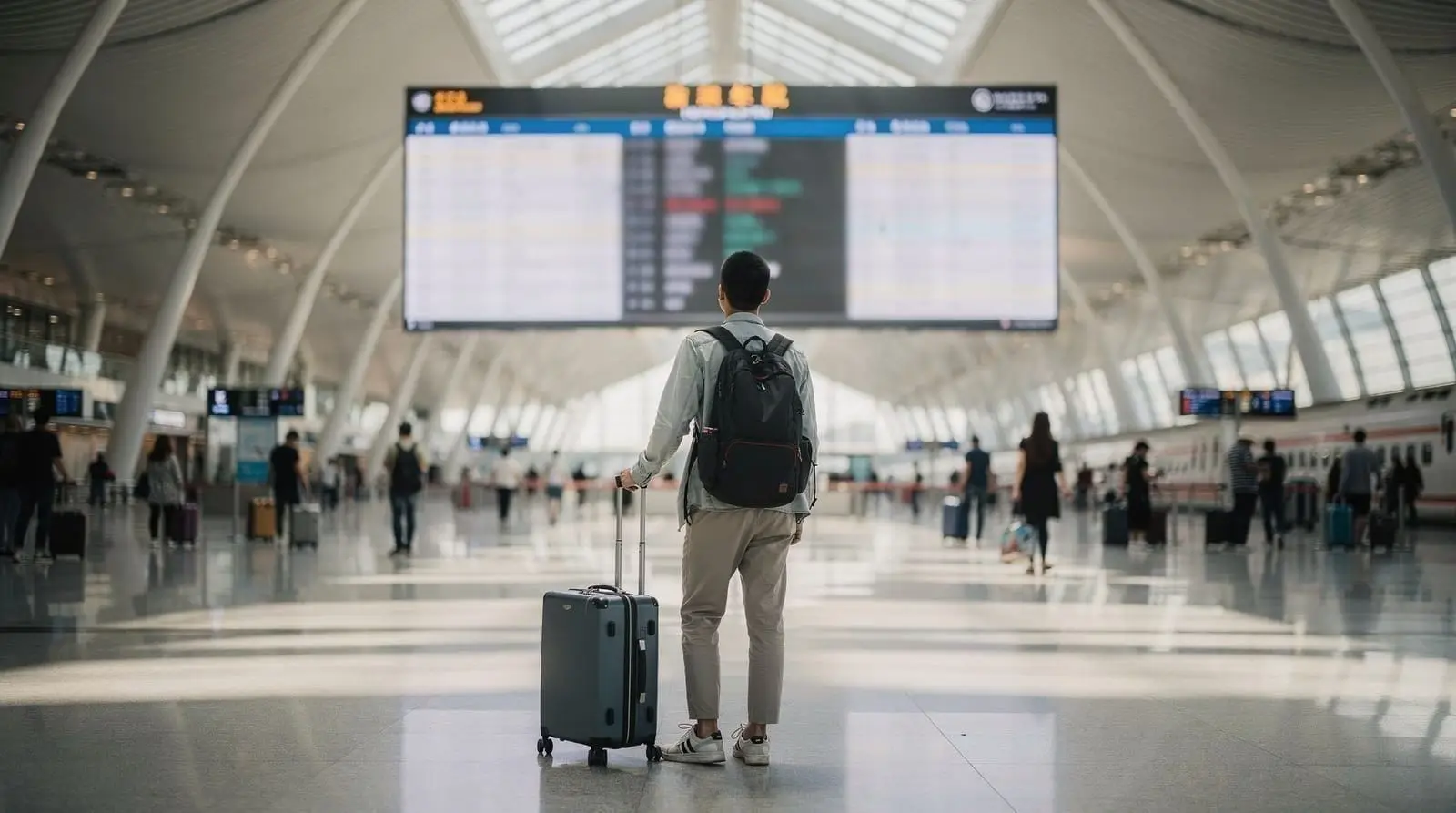
Most international arrivals come through Shenzhen Bao’an Airport (SZX). Terminal 3 is the main international terminal — it’s connected to the city by Metro Line 11 (Airport Express), which gets you to Futian CBD in about 35 minutes and costs around CNY 18 (~USD 2.50). Taxis are also metered and honest; the fare to Futian CBD is roughly CNY 80–100 (~USD 11–14). The DiDi app (Chinese equivalent of Uber) works well and usually offers slightly cheaper rates than street taxis.
If you are arriving from Hong Kong via one of the land border crossings, you emerge directly into the Shenzhen metro network at Futian or Lo Wu stations. Metro Line 4 runs from Futian checkpoint deep into the city; Lo Wu connects to Line 1. Both are clean, air-conditioned, well-signed in English, and cheap — CNY 2–12 for most inner-city trips.
See Shenzhen’s neighbourhoods guide and the fuller best neighbourhoods in Shenzhen breakdown for accommodation advice by district, and the Shenzhen metro guide for how the transit map fits together once you’re settled in.
The payments problem (and the solution)
Shenzhen runs almost entirely on WeChat Pay and Alipay. Cash is accepted at larger establishments but is often genuinely inconvenient — smaller restaurants sometimes cannot make change for large notes, and many transit machines now prefer QR codes.
The practical fix for foreign visitors in 2026: link your Visa or Mastercard to either WeChat Pay or Alipay before you leave home. Both apps now support international cards directly, with reasonable daily limits. Download the app, create an account (requires a phone number), add your card, and test a small transaction before you board your flight. This takes 15–20 minutes and solves the payment problem almost entirely.
Carry around CNY 500 in cash anyway. Small wet markets, a few government-operated venues, and the odd street vendor will only take physical money.
For connectivity: Mainland China blocks Google, WhatsApp, Instagram, and most Western social media. The options are:
- Use an international eSIM or roaming plan that routes traffic via Hong Kong — many work fine on the mainland and sidestep the firewall without a separate VPN.
- Install a reputable VPN before you enter China. Once inside the firewall, you cannot download VPN apps from the App Store or Play Store.
- Accept the restrictions and use mainland alternatives: Baidu Maps (or Apple Maps, which works), WeChat for messaging.
The four neighbourhoods a first-timer should know
Futian is the official CBD — gleaming towers, Shenzhen Convention and Exhibition Centre, Shenzhen Museum (free, excellent), and easy metro access to everything. Good hotel mid-range choices include the Futian Shangri-La and the Kerry Hotel. Not the most atmospheric area, but supremely convenient.
Nanshan and Shekou is where the tech companies live (Tencent, DJI, Huawei nearby) and where expats and professionals tend to congregate. Sea World in Shekou has a cluster of international restaurants and bars around a decommissioned cruise ship. The vibe is relaxed, international-facing, and easier on first-timers than the more chaotic districts.
Luohu and Dongmen is the oldest commercial heart of Shenzhen — close to the Lo Wu border crossing, dense with markets, and home to a genuinely chaotic, photogenic street-food scene around Dongmen Pedestrian Street. Not polished; very alive.
Huaqiangbei is the electronics district — a square kilometre of malls selling everything from finished gadgets to individual circuit components. Equal parts fascinating and overwhelming. Read the Huaqiangbei guide before you go, especially the section on what you can and cannot buy safely.
What to eat and where
Shenzhen’s food scene is internally diverse because of its migrant population. You will find:
- Cantonese dim sum: Shenzhen is in Guangdong province, so the yum cha tradition is strong. Crystal Jade (multiple locations), Jing’s Restaurant in Luohu, and the older teahouses around Dongmen do a good standard at CNY 60–120 (~USD 8–17) per person.
- Chaoshan food: From the Chaozhou/Shantou region — hand-rolled oyster omelettes, fish balls, Teochew congee. The strip along Hongling Zhonglu in Luohu has reliable Chaoshan spots.
- Hakka cuisine: Earthier, meatier — pork belly braised with preserved vegetables (mei cai kou rou) is the signature. Hakka restaurants cluster in Longhua district but appear across the city.
- Hunan and Sichuan: Aggressively spicy food brought by migrant workers from inland provinces. If you want mala hot pot, Shenzhen has better options than you might expect.
Budget for food: a proper sit-down lunch at a local restaurant costs CNY 40–80 (~USD 6–11). Dinner at a mid-range restaurant runs CNY 100–200 (~USD 14–28) per person. Street food is CNY 5–20 per item.
For a curated eating route, see the weekend eating through Shenzhen guide.
The tourist traps to avoid
This is an honest planner, so:
Huaqiangbei counterfeit goods: If a vendor pressures you into a back room or back floor to show you “special inventory,” it is almost certainly counterfeit electronics or fake branded goods. These purchases are legally risky (seized at customs) and often don’t work. Buying legitimate electronics at marked prices from major retailers (stores like RT-Mart or Gome on the ground floor) is fine.
Border-area touts: Around Lo Wu and Luohu, touts approach foreign-looking visitors to offer “copy watch tours,” “factory outlet” visits, or unofficial currency exchange. All of these are either scams or bad-value grey-market operations. Walk past.
Unofficial taxis: Green and red licensed taxis are metered and generally honest. Any vehicle without the yellow roof lamp and meter is unofficial — the fare is negotiated, and the outcome is reliably bad for the visitor. Use DiDi instead. For a fuller list of what to watch for across the city, see the Shenzhen tourist traps guide.
“Art students”: A long-running Shenzhen classic — young people approach you (usually in Nanshan or near tourist sites) claiming to be art students who want to practice English and invite you to see their gallery exhibition. The gallery exists; the ending involves high-pressure sales of overpriced student artwork. Politely decline.
Join a full-day guided Shenzhen city walk — a good way to orient yourself on a first visit, with a local who can field the questions that trip up first-timers.
Getting around day to day
The Shenzhen Metro is the backbone. 14 lines, 300+ stations, English signage throughout, clean and air-conditioned. Fares are CNY 2–12 depending on distance. The Shenzhen Tong card (reloadable transit card, similar to HK’s Octopus) speeds up boarding — buy one at any station service desk for CNY 50 (CNY 30 deposit + CNY 20 credit).
DiDi works well for point-to-point trips that the metro doesn’t cover cleanly. The app interface can be set to English. Prices are usually 15–25% cheaper than metered taxis.
Cycling: Shenzhen has a decent public bike-share network (Hello Bike, Meituan Bike) for flat areas. Requires WeChat Pay or Alipay to unlock. Good for Futian Bay, Shenzhen Bay Park, and the OCT/Nanshan area.
Is Shenzhen safe for a first-time visitor?
Yes, comfortably. Violent crime is rare and street harassment is uncommon even for solo travellers. The friction points for first-timers are logistical rather than safety-related — payment apps, the language barrier away from tourist zones, and knowing which invitations to decline (see the tourist traps above). The is Shenzhen safe guide covers this in more depth, including scams specific to the border areas and what to do if you lose your passport.
A first-day checklist
If you land in the morning, a realistic first day looks like: clear immigration and take the Airport Express or a taxi to your hotel, get WeChat Pay or Alipay working with a test transaction, have a simple lunch near your hotel to get comfortable ordering, then spend the afternoon walking one neighbourhood rather than trying to see the whole city. Futian’s Civic Centre area or Nanshan’s OCT-LOFT are both manageable, low-stakes first walks. Save Huaqiangbei and the theme parks for day two once you’re oriented.
Realistic time budget
A focused first visit to Shenzhen needs at minimum 3 days to feel unhurried. Day 1: arrival, neighbourhood orientation, evening food exploration. Day 2: a specific site (Huaqiangbei or one of the parks). Day 3: a half-day excursion (Hong Kong via Futian border, or Dapeng Peninsula) + departure.
If you have 5 days, add a day in Hong Kong for contrast and a day for a Guangzhou or Macau excursion. The Shenzhen and Hong Kong 5-day itinerary maps this out in detail.
Frequently asked questions for first-time visitors
How easy is it to navigate Shenzhen without speaking Chinese?
The metro is well signed in English. Major hotels have English-speaking staff. Restaurants in tourist and expat areas often have picture menus or English menus. Away from those zones, a translation app (Google Translate works offline with downloaded Chinese language packs, or use Baidu Translate) covers most situations.
Is Shenzhen worth visiting if I’ve already done Hong Kong?
Yes — they are different in almost every meaningful way. Hong Kong is colonial-era layered with global finance culture; Shenzhen is aggressively new, industrial-curious, and mainland Chinese in character. Spending two or three days in Shenzhen after Hong Kong gives you a much more complete picture of the Pearl River Delta.
Is it safe to drink tap water in Shenzhen?
No. Tap water in Shenzhen is not safe for direct drinking. All hotels provide bottled water; convenience stores (FamilyMart, 7-Eleven, local chains) sell 500ml bottles for CNY 2–4.
What is the best time of year to visit?
October through early December and March through April are the most comfortable — temperatures 18–26°C, low humidity, good air quality. June through September is hot (32–36°C), extremely humid, and typhoon-prone. January–February (Chinese New Year) brings domestic travel crowds and many restaurant and shop closures.
Can I visit both Shenzhen and Hong Kong on the same trip?
Yes, and it is one of the most natural combinations in Asia. The border crossing by metro takes under an hour door-to-door. See the 5-day Shenzhen and Hong Kong itinerary for a structured plan.
Do I need a China visa to visit Shenzhen?
It depends on your nationality and route — many visitors qualify for the Greater Bay Area or 240-hour visa-free transit if entering and exiting through approved ports, while others need a standard visa. Rules are updated periodically, so check the China visa and 240-hour transit guide and the 2026 visa and payment update before booking flights.
Top-rated things to do in Shenzhen
Verified deep-linked GetYourGuide tours. Book through these links and we earn a small commission at no cost to you.