Zhuhai occupies the western side of the Pearl River estuary, directly across from Hong Kong and adjacent to Macau. Among the Pearl River Delta’s major cities, it has the most livable reputation — lower density than Guangzhou, a genuine coastal character, and air quality that consistently registers better than its neighbors. It was one of China’s original four Special Economic Zones (established 1980), and unlike Shenzhen — which exploded into a megacity — Zhuhai developed at a more measured pace that preserved some of its natural coastal landscape.
Two things bring most international visitors here: Chimelong Ocean Kingdom on Hengqin Island, which holds multiple Guinness World Records and is Asia’s most-visited theme park in 2026; and the Hong Kong–Zhuhai–Macau Bridge (HZMB), which connects the three cities across 55 kilometers of open sea and has transformed travel patterns in the western Pearl River Delta since it opened in 2018.
Zhuhai is most naturally visited as part of a Pearl River Delta Grand Loop that also includes Guangzhou and Macau, or as a standalone 1–2 night coastal retreat from Shenzhen or Hong Kong.
| Where | Western Pearl River estuary, adjacent to Macau |
| Cost | Chimelong day ticket ¥369–499 ($51–70); hotels ¥350–700 ($49–98)/night |
| Time needed | 1–2 days |
| Getting there | HZMB shuttle from Hong Kong (40 min) or HSR from Guangzhou (70 min) |
| Best time | October–December, March–April |
Getting to Zhuhai
From Hong Kong via HZMB: The bridge shuttle buses run 24 hours, departing from the HZMB Hong Kong Passenger Clearance Building (accessible by bus or taxi from multiple HK districts). Journey to Zhuhai Gongbei port: approximately 40 minutes. Shuttle bus fare: around HK$65 ($8.30) one-way, purchased at the terminal. You clear both Hong Kong exit and Mainland China entry immigration at the respective border facilities. Western passport holders need a valid Chinese tourist visa before boarding.
Book a private limo transfer across HZMB (Hong Kong–Zhuhai–Macau)From Guangzhou: The Guangzhou–Zhuhai intercity rail (not high-speed) runs from Guangzhou South to Zhuhai station in about 70 minutes, with trains every 30–60 minutes (¥50–80 / $7–11). From Zhuhai station, a Didi to Chimelong takes 30 minutes (¥50–80 / $7–11); metro Line 1 runs to Gongbei border in 40 minutes.
From Shenzhen: No direct HSR. Options: bus from Shenzhen coach terminals (2–2.5 hours, ¥90–120 / $13–17), or HSR via Guangzhou (total 2.5–3 hours). The bus is usually the most convenient direct route.
From Macau: The HZMB connects Zhuhai Gongbei to the Macau HZMB port (Cotai Frontier Post) in about 20 minutes by shuttle (MOP35–45 / $4.40–$5.60). Ferries also run between Macau and Jiuzhou Port in central Zhuhai (30 minutes, ¥55–80 / $7.70–$11, multiple daily departures). The Macau guide covers departure points.
Chimelong Ocean Kingdom: what to know before you go
Chimelong Ocean Kingdom (长隆海洋王国) on Hengqin Island opened in 2014 and holds the world record for largest aquarium by water volume (48.75 million liters). It is Asia’s most-attended theme park in 2026 by combined capacity and genuinely earns that status. The centerpiece is the Whale Shark Aquarium — a 12.9-meter-tall panoramic acrylic panel containing four whale sharks alongside thousands of marine animals — and the scale of the facility exceeds all other aquariums in Asia.
Park highlights:
- Whale Shark Aquarium: arrive at opening to see it with manageable crowds. Budget 45 minutes.
- Aqua Express: a roller coaster that runs through aquarium tunnels. Queue early morning.
- Polar Ocean World: beluga whales and walruses. Welfare standards are above average for China but below European norms — manage expectations accordingly.
- Ocean Kingdom Parade: daily at approximately 16:00, impressive production values.
- Sky Wheel: a 168-meter Ferris wheel offering the best aerial views over Hengqin Island.
Chimelong Spaceship (长隆航天科技主题乐园), an adjacent high-tech science fiction theme park opened in 2024, targets older audiences with drone shows, immersive technology environments, and space-themed rides. It’s a separate park with a separate ticket, worth considering if you’re staying two days in Zhuhai and have exhausted Ocean Kingdom.
Book Chimelong Spaceship (all-day sci-fi adventure park, separate ticket)Practical Chimelong logistics:
-
One-day tickets: ¥369–499 ($51–70) adults, ¥269–399 ($37–56) children under 1.4 m. Book online for the lower rate and guaranteed entry.
-
Opening hours: typically 10:00–21:00; extended on weekends and public holidays.
-
Queues: the Whale Shark Aquarium queue reaches 60–90 minutes by midday on weekends. Being at the gates when they open at 10:00 is the single most effective tactic.
-
Dining inside the park: mediocre and overpriced (¥60–120 / $8–17 for a basic meal). Pack snacks or eat a substantial meal before arrival. Better seafood awaits in Zhuhai for dinner.
-
Getting there from city center: Didi to Chimelong (Hengqin) runs ¥30–50 ($4.20–$7). At park closing time (21:00), taxis are scarce — arrange a Didi pickup from within the app while still inside, before the crowds exit.
Hengqin Island and the Guangdong-Macao Cooperation Zone
Hengqin Island was largely undeveloped until 2009, when it was designated as a new area for Zhuhai. In 2021 it became the Hengqin Guangdong-Macao Deep Cooperation Zone — a unique arrangement where most of the island operates under Macau-adjacent regulations, with different tax treatment and less restrictive internet access than standard Mainland China.
For visitors, Hengqin’s practical attractions beyond Chimelong:
- New Yuanming Palace (圆明新园): A 1:1 recreation of Beijing’s Old Summer Palace, destroyed by British and French forces in 1860. The reconstruction is detailed and historically engaged, if contested in concept. Entry ¥150 ($21); the grounds take 2–3 hours.
- Meili Beach (美丽湾): The most accessible beach near Zhuhai proper.
Water clarity varies by season (best October–January); facilities are adequate for a half-day visit. Adjacent coastal resorts include the Novotel and Sheraton on Hengqin’s southern shore.
- Border crossing to Macau: The Hengqin port connects to the Lotus Bridge crossing into the Cotai area of Macau. Journey time: 15 minutes by taxi to the Cotai Strip. Significantly less congested than the Gongbei–Macau crossing during peak periods.
Zhuhai city and the coastal promenade
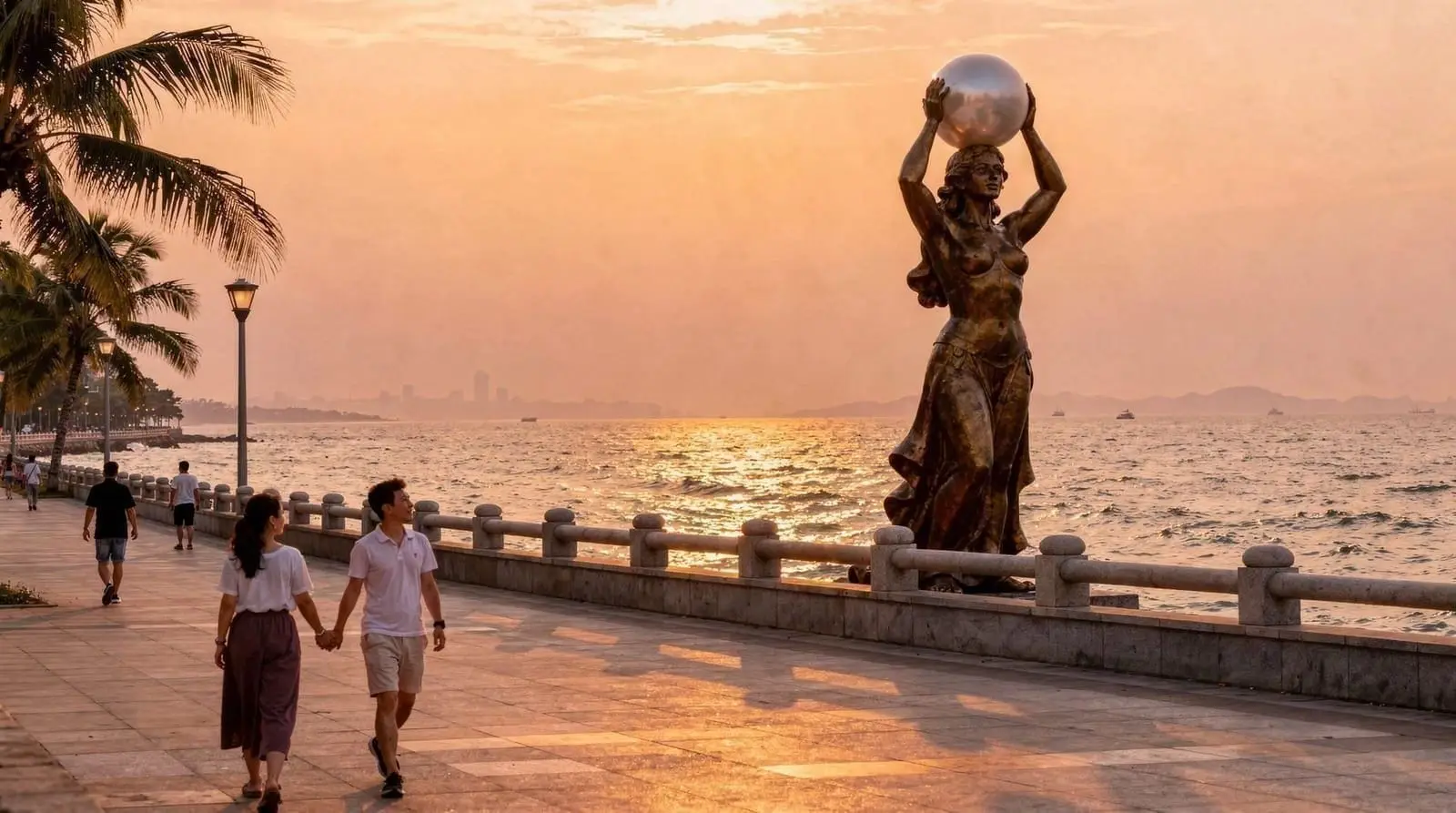
Central Zhuhai — the Gongbei, Xiangzhou, and Jida neighborhoods — is pleasant and undemanding for a half-day. The coastal promenade runs along Qinglu Middle Road and Haibin Road for several kilometers, with the Pearl River estuary visible to the east. The Fisher Girl Statue (珠海渔女), a 1982 bronze sculpture of a Cantonese fisherwoman holding a pearl aloft, stands in the water here and has become Zhuhai’s civic symbol.
Yuanming New Summer Palace area: The stretch from Jida east to Zhuhai Port has a small cluster of heritage buildings and waterfront walkways. Pleasant for a 30-minute stroll with coffee from one of the cafes on Jida Fishing Port Road.
Zhuhai Museum: A free local history museum covering Zhuhai’s development from fishing village to SEZ, with particular focus on the HZMB construction period. Small but competent; 45 minutes.
Gongbei border area: The streets immediately inside the Gongbei border crossing (Mainland side) are commercial and chaotic — duty-free shops, currency exchange, and restaurants targeting cross-border shoppers. Useful orientation point rather than destination in itself.
Seafood in Zhuhai
Zhuhai’s position at the Pearl River estuary means particularly good fresh fish, crab, and shellfish at prices meaningfully lower than coastal cities further north or Hong Kong.
The Jida District (吉大, near Jida Fishing Port) concentrates the best seafood restaurants. The standard experience: select your fish or shellfish live from tanks at the entrance, choose your preparation (steamed, poached in chili oil, stir-fried with ginger and scallion), and pay by weight. Budget ¥150–300 ($21–42) for two people with two fish dishes and vegetables.
Aopo fishing village in Daya Bay (accessible by Didi, 30 minutes from central Zhuhai): Smaller-scale seafood village restaurants with more genuine fishing community atmosphere and prices 20–30% lower than the Jida tourist area. Worth the trip if you’re willing to navigate without English menus (point at tanks and hold up fingers for quantity).
Shunde cuisine influence: Several Zhuhai restaurants serve the Shunde-style freshwater fish and milk-curd dishes that make Foshan’s Shunde district famous. The Guangzhou–Shenzhen foodie itinerary covers Shunde food in more depth.
Combining Zhuhai with Macau
The most logical reason to stay in Zhuhai rather than Macau is cost: mid-range hotels in Zhuhai run ¥350–700 ($49–98) per night, versus HK$800–2,500 ($102–320) for equivalent Macau properties. Zhuhai provides affordable hotel stock for Macau’s overflow during peak periods (Macau Grand Prix in November, Chinese New Year, National Day Golden Week).
The Gongbei–Macau border crossing is one of the busiest land border crossings in the world. Waits of 45–90 minutes are common on Friday evenings and weekends. The Hengqin–Cotai crossing is considerably less congested and is the preferred option if you’re coming from Chimelong area already. See Macau and Cotai Strip for complete Macau guidance.
For a multi-city route: Guangzhou by HSR (70 minutes) provides the best connection northward; the Pearl River Delta Grand Loop itinerary routes Zhuhai as the southwestern pivot of the circuit.
Practical information
Accommodation: Zhuhai Marriott Hotel Hengqin (near Chimelong, ¥900–1,500 / $125–209) is the most convenient for a Chimelong visit. Central Zhuhai options: Sofitel Zhuhai (¥800–1,200 / $112–168), Crowne Plaza (¥600–900 / $84–125), and budget business hotels near Gongbei starting at ¥250–400 ($35–56).
Connectivity: The Great Firewall applies fully in Zhuhai (unlike the partial relaxation in the Hengqin Cooperation Zone). Install your VPN before crossing into Mainland China. See eSIM and VPN for the Greater Bay Area for current options.
WeChat Pay: Link an international Visa or Mastercard to WeChat Pay before arriving. Carries the entire small-payment burden (transport, restaurants, markets, entrance tickets).
Frequently asked questions about Zhuhai
Do I need a China visa to visit Zhuhai from Hong Kong?
Yes, most Western passport holders need a Chinese tourist visa (L visa) to enter Zhuhai. China’s 240-hour transit exemption requires transit between two international cities, which a Zhuhai visit from Hong Kong typically doesn’t qualify for. There is no Zhuhai-specific visa-on-arrival for most Western nationalities. See our China visa guide for 2026 rules.
How far is Zhuhai from Macau?
The Gongbei border crossing in central Zhuhai is directly adjacent to the Macau border gate — a 5-minute walk through immigration. The Hengqin crossing connects to Cotai in Macau, minutes by taxi. By HZMB shuttle bus, Zhuhai’s port is about 20 minutes from the Macau HZMB port. The two cities are effectively one combined urban area sharing infrastructure.
Is Chimelong Ocean Kingdom worth the high ticket price?
For families with children, it’s among the best theme park experiences in Asia; the Whale Shark Aquarium is unlike anything else outside Japan. For adults without children, the value depends on interest in marine life and rides. The alternative of spending the day in Guangzhou exploring the old city and eating excellent food may be a stronger choice. Book tickets online in advance to save ¥50–80 ($7–11) vs. gate prices.
What are the best beaches near Zhuhai?
Meili Beach on Hengqin Island is the best accessible option — less crowded than city beaches, with cleaner water than the Pearl River estuary. Shuangyuewan (Double Moon Bay) in Huizhou’s Huidong County, 50 km east, is dramatically beautiful but a longer trip. Water quality across all area beaches is best October–January.
Can I day trip to Zhuhai from Hong Kong?
Yes. The HZMB makes it a 40-minute journey. A practical day: morning HZMB shuttle to Zhuhai, day at Chimelong Ocean Kingdom or Hengqin, return evening via HZMB. Book return Hong Kong shuttle tickets in advance at the Zhuhai port terminal; weekends sell out. Alternatively, add a Macau component: cross to Macau on the same day, spend several hours, return to Hong Kong by ferry.
What is the food like in Zhuhai?
Zhuhai’s cuisine is Pearl River Delta Cantonese with a coastal seafood emphasis. Fresh fish, crab, and shellfish from the estuary are the main draw, at prices meaningfully lower than Hong Kong or Guangzhou’s tourist areas. Shunde-influenced soft and dairy-inflected Cantonese dishes are also well represented. The food is excellent value and quality by any regional standard.
Zhuhai’s city character and why it matters
Among the Pearl River Delta’s original four Special Economic Zones (the others being Shenzhen, Shantou, and Xiamen), Zhuhai is the most overlooked by international travelers. Shenzhen’s explosive growth captured most of the narrative. Zhuhai had a different trajectory: more modest in economic scale, more oriented toward its coastal geography, and shaped significantly by its position adjacent to Macau rather than Hong Kong.
The result is a city that feels less anxious than Shenzhen, less overwhelming than Guangzhou, and less high-stakes than Macau. The coastal promenade works. The streets have trees. The housing blocks don’t loom at quite the same density. This is a minor achievement in a regional context where urban livability has been systematically sacrificed for development speed, but it’s real.
For the growing category of travelers who have done Shenzhen and Hong Kong and want to understand the broader PRD context, Zhuhai offers an intelligible counterpoint: the SEZ model applied at smaller scale, with a coastline intact, and with the most geographically proximate relationship to Macau’s Portuguese colonial heritage of any mainland city.
The HZMB: understanding the bridge that changed the western PRD
The Hong Kong–Zhuhai–Macau Bridge (HZMB), opened October 2018, is 55 km long — the world’s longest sea-crossing bridge-tunnel system. It consists of bridge sections, an artificial island mid-sea, and an undersea tunnel through the Pearl River shipping channel. The engineering scale is significant: 420,000 tons of steel were used in construction, more than 60 Eiffel Towers.
For travelers, the bridge’s practical effect has been to make the western PRD (Zhuhai, Macau, Zhongshan, Jiangmen) accessible from Hong Kong in under an hour without going through Shenzhen or Guangzhou. Before the HZMB, the equivalent journey by existing transport took 3–4 hours. This has restructured which part of the PRD Hong Kong visitors engage with, and Zhuhai’s visitor numbers from Hong Kong have grown substantially as a result.
Using the HZMB: Shuttle buses depart every 10–20 minutes from the HZMB Hong Kong Passenger Clearance Building, a facility on reclaimed land in the western approach to the bridge (bus access from Tung Chung, Hong Kong Station, and various Kowloon and NT pickup points). Hong Kong clearance happens at the building before boarding. At the Zhuhai end, Mainland clearance occurs at the Zhuhai Gongbei facility. Private vehicles are not permitted to cross — you must use the designated shuttle bus or a registered cross-boundary vehicle.
Cost: approximately HK$65 ($8.30) one-way. The 40-minute crossing is smooth; the bridge views over open South China Sea and the sight of the tunnel entrance mid-span are genuinely impressive.
Zhuhai’s art and design scene
Zhuhai has quietly developed a small but interesting contemporary creative scene, partly as an overflow from Guangzhou’s art community and partly through Hengqin Island’s deliberate positioning as a cultural-creative zone within the cooperation framework with Macau.
Zhuhai Planning Exhibition Hall (珠海市城乡规划展览馆) in Jida District: A free-entry exhibition documenting Zhuhai’s urban development from fishing village to SEZ, with models, historical photographs, and planning documents from the 1980 to present. Unusually honest about the process and trade-offs involved. 60–90 minutes.
Hengqin Creative Valley (横琴创意谷): Within the Cooperation Zone, a collection of converted industrial buildings now housing design studios, animation companies, and cultural businesses. The complex has an accessible public ground floor with cafes and occasional market events. A walk through gives a sense of how the Cooperation Zone’s cultural ambitions are materializing at ground level.
Macau-Zhuhai art crossings: Macau’s strong gallery scene (particularly the Tap Seac Gallery and Edificio Ritz contemporary art space) is 20 minutes from Zhuhai Gongbei by taxi. Several artists maintain studios in both cities, using Zhuhai’s lower cost base and Macau’s international connectivity. The Macau Peninsula guide covers the Macau art scene in more detail.
Recommended 2-day Zhuhai itinerary
A comfortable two-day structure combining the main areas:
Day 1 — Chimelong and Hengqin
Morning: Arrive from Hong Kong via HZMB or Guangzhou via HSR. Check into hotel near Chimelong (Zhuhai Marriott Hotel Hengqin is most convenient).
10:00: Enter Chimelong Ocean Kingdom at opening. Whale Shark Aquarium immediately — the queue builds to 60 minutes by noon. Morning: aquarium sections; afternoon: rides and shows.
Evening: Return to city center (Didi, 30 minutes). Jida District seafood dinner at a mid-range restaurant (¥150–250 / $21–35 for two people).
Day 2 — City and coast
Morning: Zhuhai coastal promenade walk, Fisher Girl Statue, Zhuhai Museum.
Midday: Cross to Macau via Gongbei border (10-minute walk through immigration) for lunch and 3 hours of Macau’s historic center (Macau Peninsula).
Afternoon: Return to Zhuhai, then Didi to Hengqin for New Yuanming Palace (90 minutes) or Meili Beach (afternoon swim, October–March).
Evening: Departure to Hong Kong via HZMB or onwards to Guangzhou or Shenzhen by HSR.
For a shorter version (day trip from Hong Kong): Day 1 only, return via HZMB in the evening. For the complete PRD loop, see Pearl River Delta Grand Loop.