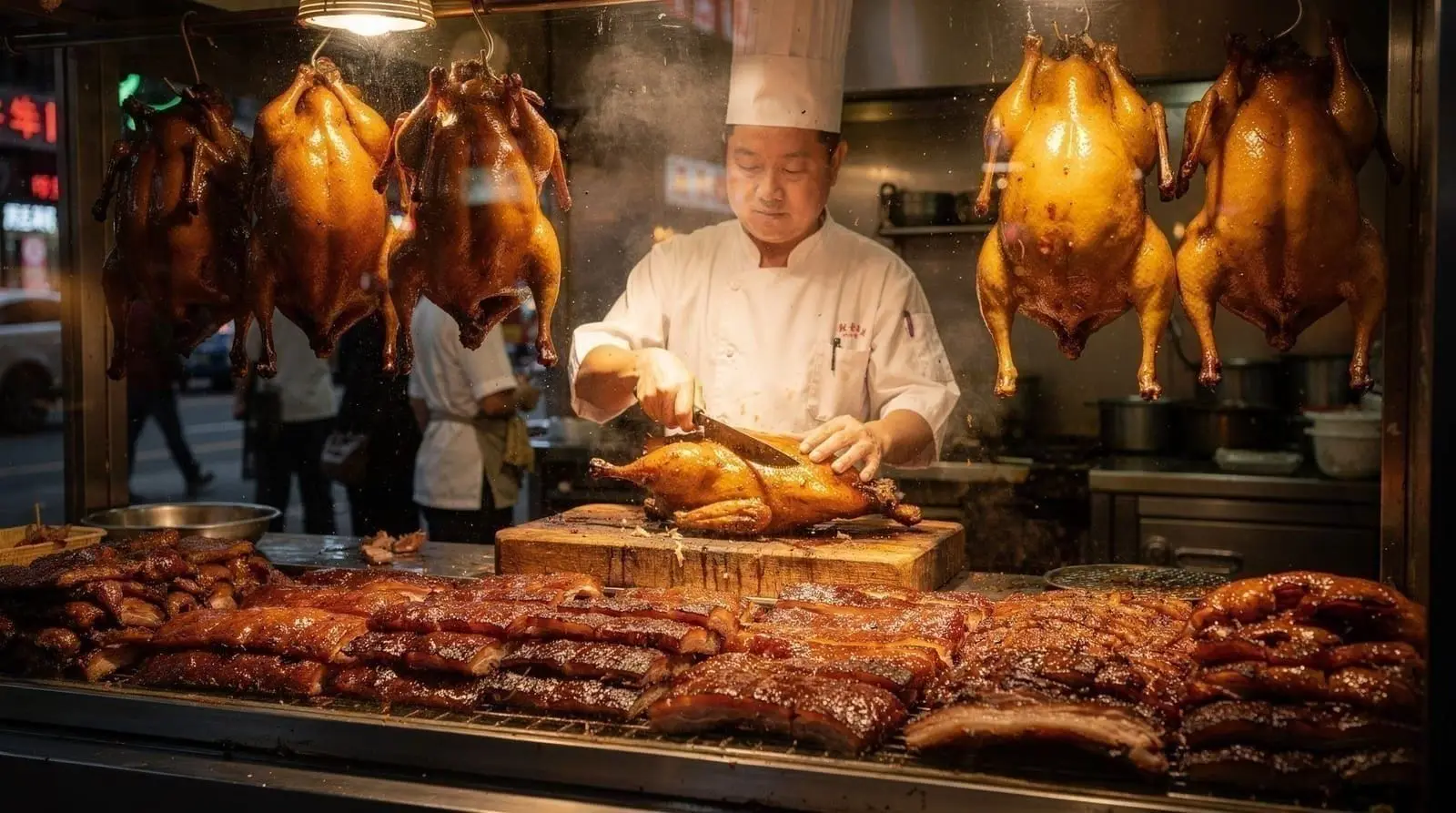
Guangzhou and Shenzhen foodie tour: 4 days of serious eating
Guangdong Province is the most food-obsessed region in a country whose food culture is the deepest and most varied on earth. Cantonese cuisine is the international face of Chinese cooking — the dim sum, the roast duck, the seafood preparations that have spread to Chinatowns worldwide. But the authentic versions in Guangzhou bear the same relationship to the export versions that Neapolitan pizza bears to frozen supermarket pizza. This four-day itinerary is structured around meals.
| Where | Guangzhou (2 days) → Shenzhen (2 days) |
| Cost | ¥2,500–4,000/US$350–560 per person, food-focused |
| Time needed | 4 days |
| Getting there | HSR between Guangzhou and Shenzhen, 33–45 minutes |
| Best time | Any season; dim sum and street food are year-round, but avoid Chinese New Year when many family-run shops close |
The plan covers two days in Guangzhou (the provincial capital, 130 km north of Shenzhen), one day in transit and Shenzhen, and a final day doing Shenzhen’s migrant food scene — which is arguably the most diverse food landscape in China, given that the city’s 18 million people arrive from every province.
The food philosophy
Eat where locals eat. This sounds obvious but requires resisting the gravitational pull of hotel breakfast buffets, international food courts, and restaurants with photo menus in English. The actual quality hierarchy in Guangdong cuisine often runs: tea house dim sum → neighbourhood roast meat rice → specialist noodle shop → large Cantonese banquet restaurant. The most expensive option is not the best.
Practical note on paying for food: most independent restaurants in Guangzhou and Shenzhen require mobile payment (WeChat Pay or Alipay). Set up WeChat Pay with a foreign Visa/Mastercard via the international version of the app before you arrive. Cash (CNY) is a universal fallback. The WeChat Pay and Alipay for foreigners guide walks through the setup step by step — do this before you land, since some verification steps need a stable connection.
Day 1: arriving in Guangzhou — morning tea and the old city
Getting to Guangzhou
From Hong Kong: West Kowloon HSR to Guangzhou South (广州南, approximately 50 minutes, ~HK$230–280/US$30–36 second class). From Shenzhen: HSR from Shenzhen North to Guangzhou South (33 minutes, ¥80/US$11). Guangzhou South is a vast interchange hub in the southern suburbs — take Metro Line 2 north toward the city centre.
Base in Yuexiu district for access to the historic food streets. The White Swan Boutique Hotel on Shamian Island (from ¥780/US$108/night) puts you in a former colonial enclave on the Pearl River with excellent access to the Xiguan food district. Budget: Ibis Guangzhou Renmin Zhonglu (from ¥280/US$39/night).
Morning tea (yum cha) — the right way
Dim sum (飲茶, yum cha — “drink tea”) in Guangzhou is a morning ritual, not a restaurant option. The best establishments open at 06:30 and peak between 08:00 and 10:00. Tao Tao Ju (陶陶居, 20 Dishifu Road, Liwan District) has been operating since 1880 and is the most historically significant tea house still open. Arrive by 08:30; the weekend queue can be 30 minutes. Order the full spread: har gow (crystal shrimp dumplings, ¥28/US$4), siu mai (pork and shrimp, ¥26/US$3.5), cheung fun (rice noodle rolls, ¥22–30/US$3–4), egg tarts (¥18/US$2.5), turnip cake (¥20/US$3). Budget ¥100–160/US$14–22 per person for a proper morning tea.
Lianxianglou (蓮香樓, 67 Dishifu Road) is a second excellent option — slightly less famous, slightly shorter queues, equally old-school.
Guangzhou morning tea and Cantonese opera food tour with local guideAfternoon — Xiguan old quarter and roast meats
The Xiguan (西關) area in Liwan district is Guangzhou’s most intact historic residential quarter — qilou (arcade) buildings from the Republican era, narrow lanes, and the densest concentration of food shops in the city. The wholesale dried seafood and medicinal herb markets on Qingyuan Alley operate Monday–Saturday from 08:00–17:00.
Lunch: roast meat rice (燒臘飯) from a neighbourhood 燒臘 shop in Xiguan. Char siu (BBQ pork), roast duck and siu yuk (crispy belly pork) are ordered by weight, served over rice with ginger-scallion sauce. Budget ¥35–55/US$5–7.5 per person. The best shops are identifiable by the hanging carcasses in the window and the queue outside.
Chen Clan Academy (陳家祠, 7 Zhongshan 7th Road) — an 1894 ancestral hall complex now housing Guangdong Folk Art Museum (¥15/US$2, free for under-18s). The architecture is the exhibit: elaborate Shiwan ceramic roof ridges, carved wooden screens and clan hall proportions that communicate the scale of Qing-dynasty merchant wealth. Allow 60–90 minutes.
Evening — Pearl River night cruise and dinner
The Pearl River (珠江) divides Guangzhou. The north bank has the Canton Tower (广州塔, 600 m, the world’s 4th tallest structure) and the new Tianhe CBD. The south bank has Haizhu island and traditional residential neighborhoods.
A night cruise gives you both banks from the water. The Xinghai Concert Hall departure pier on the north bank has commercial cruise operators (¥100–180/US$14–25 for 60–90 minutes, snacks included on higher-tier tickets).
Guangzhou Pearl River night cruise with city highlights commentaryDinner after the cruise: Guangzhou Restaurant (广州酒家, 2 Wenchang South Road) — a 1935 institution serving formal Cantonese cuisine. The double-boiled soups (老火靚湯), the steamed fish in superior soy sauce and the deep-fried taro duck are the non-negotiable dishes. Dinner for two: ¥280–400/US$39–56.
Day 1 budget: ¥600–900/US$84–125 per person.
Day 2: Guangzhou deep-dive — Temple of the Six Banyan Trees and Cantonese food obsession
Morning — Temple of the Six Banyan Trees and breakfast noodles
Start early (07:00) at a cheung fun (腸粉) specialist near your hotel. Cheung fun is steamed rice noodle sheets with your choice of filling (shrimp, beef, char siu, preserved egg): ¥18–28/US$2.5–4. Yi Ji Lao Lao (怡記榔榔) near Haizhu Square does the Cantonese heartland version with minimal tourist overlay.
The Temple of the Six Banyan Trees (六榕寺, 57 Liurong Road) is a working Buddhist temple with a Flower Pagoda (57 m, Song dynasty, visible from 500 m away) that is one of the city’s oldest structures. Entry: ¥10/US$1.4. The morning incense ritual (08:00–09:00) is the most atmospheric time to visit.
Midday — Tianhe and Cantonese barbecue
Tianhe (Tianhe, the modern CBD north of the old city) has the city’s best concentration of medium-tier Cantonese restaurants. Metro Line 3 to Tianhe Station.
Xiao Bao Guang (小包光) in the lanes east of Tianhe is a Cantonese BBQ lunch specialist: goose (潮州鹵水鵝) is the signature — thinly sliced braised whole goose in a five-spice master stock, served with a ginger-rice wine vinegar dip. This is a Chaoshan (Teochew) preparation that has been adopted by the whole province. Budget ¥55–80/US$7.5–11 for the goose per person; add rice noodles and vegetable dishes.
The Guangzhou food tour circuit around Tianhe includes: wonton noodle soup (¥25–35/US$3.5–5), rice roll workshops (some dim sum restaurants offer a 30-minute rolling demo for ¥60–80/US$8–11 per person), and the egg tart comparison tour — Cantonese style (puffy shortcrust) vs Portuguese-influenced tart (flakier pastry).
Guangzhou food tour with eat-like-a-local guidance and rice roll workshopAfternoon — Canton Tower and Haizhu island
Walk or metro to the Canton Tower (广州塔, Line 3/APM, Canton Tower station). The observation deck at 433–450 m offers views over the entire Pearl River Delta on clear days. Skip the commercial Bubble Tram ride (¥100/US$14 for a Ferris wheel attached to the tower top — more gimmick than view). The standard observation deck is ¥150/US$21 and worth it in clear conditions.
The Haizhu Wetland Park (海珠湿地公园, Line 3, Lijiao station, free) on Haizhu island is a 1,100-hectare urban wetland with egrets, kingfishers and orchid farms — a useful decompression from the food intensity of the day.
Dinner: Guangzhou Restaurant, Tianhe branch or Fook Lam Moon Guangzhou for a higher-end Cantonese experience (HK$300–500/US$39–64 per person). More affordable: the basement of Grandview Mall (正佳广场, Tianhe) has an excellent regional food court with Guangzhou-style roast meats, hand-pulled noodles and Chaoshan seafood.
Day 2 budget: ¥700–1,000/US$98–140 per person.
Day 3: HSR to Shenzhen — Chaoshan beef and migrant food night market
Morning — Guangzhou South to Shenzhen
Check out and take Metro Line 2 to Guangzhou South (广州南) station. HSR to Shenzhen North (深圳北, 33 minutes, ¥80/US$11) or Futian (深圳福田, 45 minutes, ¥90/US$12.5). The Guangzhou South waiting hall is itself a spectacle — a 10-storey atrium handling 200,000 passengers per day.
Late morning — check-in and Shenzhen Chaoshan beef noodles
In Shenzhen, drop luggage at your hotel (mid-range Shenzhen option: Shenzhen Marriott Nanshan from ¥650/US$90, or W Shenzhen in Nanshan for a higher tier from ¥1,200/US$167).
The Chaoshan beef noodle shops around Luohu and Futian serve some of the best beef in China. The Chaoshan (Teochew) tradition specifies: freshly slaughtered beef (morning slaughter only), served within 4 hours, in clear broth, with specific cuts at specific temperatures. San He Chaoshan Beef (三合潮汕牛肉) near Huaqiangbei Road is reliable. Order the mixed platter: tendon (筋腱), brisket (胸肉), tripe (牛百葉) in clear broth, plus a bowl of meatballs made fresh that morning. Budget ¥55–80/US$7.5–11 per person.
Afternoon — Dongmen and Hakka specialties
Dongmen pedestrian street and the surrounding Luohu area reflect the Hakka migrant legacy that forms the backbone of Shenzhen’s oldest residential population. Stuffed tofu (客家釀豆腐) from Hakka-specialist restaurants in Luohu is the signature dish: firm tofu stuffed with a pork-and-shrimp paste, pan-fried and served in a clay pot sauce. Budget ¥30–50/US$4.2–7.
The Dongmen wet market (东门老街菜市场) behind the pedestrian zone operates from 06:00–18:00 and is a working food market, not a tourist construct: live seafood tanks, specialty herbs, Sichuan pickles alongside local fresh produce. Walk through even if you are not buying.
Evening — Shenzhen’s migrant food street
The areas around Huaqiangbei and the workers’ districts of Longgang have concentrated migrant food streets where every provincial cuisine in China can be found within 200 metres. The most accessible for visitors: the night food street behind Dongmen metro station (Laojie station, Line 1), operating 18:00–01:00. Specials to seek: Xinjiang lamb skewers (新疆羊肉串, ¥5–8/US$0.7–1 per stick), Sichuan malatang (¥35–55/US$5–7.5 for a custom bowl), Yunnan crossing-the-bridge noodles (过桥米线, ¥35–45/US$5–6.5), and Hunan steamed fish head with pickled chilies (剁椒鱼头, ¥65–90/US$9–12.5).
Budget ¥100–180/US$14–25 for a full evening of street food sampling.
Day 3 budget: ¥600–850/US$84–119 per person.
Day 4: Shekou seafood and departure
Morning — Shekou wet market and seafood breakfast
The Shekou Wet Market (蛇口水产市场, 20 minutes by metro, Line 2, Sea World station) opens at 06:00 with live fish, crabs, clams and oysters from the Pearl River estuary and South China Sea. Several adjacent restaurants open at 07:00 and will cook market purchases for a nominal fee (¥15–25/US$2–3.5 per dish on top of the purchase price).
For a simpler option: the adjacent congee shops (粥鋪) serve century egg and pork congee, preserved egg and lean meat congee, and seafood congee from ¥25–40/US$3.5–5.5. This is the Cantonese breakfast as it was eaten before dim sum restaurants existed.
Late morning/afternoon — Shenzhen final food stops
The Nanshan district around OCT has developed a serious independent coffee and small-batch food producer scene since 2022. Laboutique Coffee on Keyuan Road and Manner Coffee’s Nanshan flagship both offer Yunnan single-origin pour-overs. For a final Shenzhen food moment: the egg waffles (雞蛋仔) from street stalls near Coastal City mall (Line 2, Coastal City station) are the Cantonese street snack that has somehow not been replicated at scale outside the region — crispy-edged, custard-centred, eaten fresh for ¥15–22/US$2–3.
Departure options: Shenzhen Bao’an Airport (SZX, Line 11 Airport Express, 45 minutes from downtown); Hong Kong International Airport via Futian Checkpoint and Airport Express (60–90 minutes total); or HSR back to Guangzhou Baiyun Airport (CAN) via Guangzhou South.
Day 4 budget: ¥250–400/US$35–56 per person.
Total 4-day food-focused budget: ¥2,500–4,000/US$350–560 per person (excluding accommodation and transit). Food costs per day average ¥200–350/US$28–49 — high by Chinese standards but modest by international foodie travel standards.
Guangzhou food vs Shenzhen food: what’s actually different
| Guangzhou | Shenzhen | |
|---|---|---|
| Core tradition | Cantonese, centuries deep | Migrant mix — every province represented |
| Signature meal | Morning dim sum (yum cha) | Chaoshan beef noodles, Hakka stuffed tofu |
| Best value | Neighbourhood roast meat rice | Street food and night markets |
| Splurge option | Formal Cantonese banquet restaurant | Higher-end hotel Cantonese dining |
| Payment culture | WeChat Pay dominant, some cash-only old shops | WeChat Pay/Alipay near-universal |
Guangzhou rewards patience and tradition-seeking — the best meals are at institutions that have not changed their menu in decades. Shenzhen rewards curiosity about China’s internal migration — the city’s food scene exists because 18 million people arrived from every province and brought their home cooking with them. Neither is “better”; they answer different questions about the country. For a deeper single-city dive into either, see the Guangzhou Cantonese food guide or the Shenzhen dim sum guide.
If you have a fifth day to add
Extend the Guangzhou half by a day rather than the Shenzhen half — Guangzhou’s food culture is deeper and rewards more time. The Guangzhou in 2 days guide adds Shamian Island’s colonial-era streets and a second dim sum sitting at a different historic teahouse, which is a genuinely different experience from Tao Tao Ju. On the Shenzhen side, an extra day is better spent on Shenzhen’s Chaoshan cuisine specialists or the Hakka food scene in Luohu rather than repeating the same night-market circuit.
Food travel tips for this route
- The best dim sum is always at breakfast or brunch (07:00–12:00). Evening dim sum exists but is a pale version.
- Avoid restaurants with photo menus at the entrance and tour-group signage in multiple languages — these are not where locals eat.
- Shellfish and live seafood are best ordered at market price (按斤, by the jin/500g). Always confirm the price before ordering.
- Both cities have zero tolerance for counterfeit food safety; the hygiene standard at busy street food stalls is generally high. The wet market stalls that look alarming are usually the cleanest because turnover is so high.
For deeper context on the Guangzhou and Shenzhen food scenes, read the city destination guides. The Shenzhen food and drink guide has restaurant listings by district.
Frequently asked questions about the Guangzhou and Shenzhen foodie route
Do I need to speak Mandarin or Cantonese to eat well on this route?
No, but it helps enormously at the least touristy stalls. A translation app with offline Chinese packs (Google Translate or Pleco) covers most menus, and pointing at what other diners are eating works everywhere. The best dim sum houses and wet markets have staff used to foreign visitors even without shared language.
Is four days too much food for one trip?
Pace yourself by treating lunch as the lightest meal of the day and skipping hotel breakfast entirely in favour of the planned morning stop. Most travellers find the intensity manageable if they walk between meals — this itinerary already builds in enough walking (Xiguan, Tianhe, Dongmen) that appetite is rarely the problem.
Top-rated things to do in Shenzhen
Verified deep-linked GetYourGuide tours. Book through these links and we earn a small commission at no cost to you.