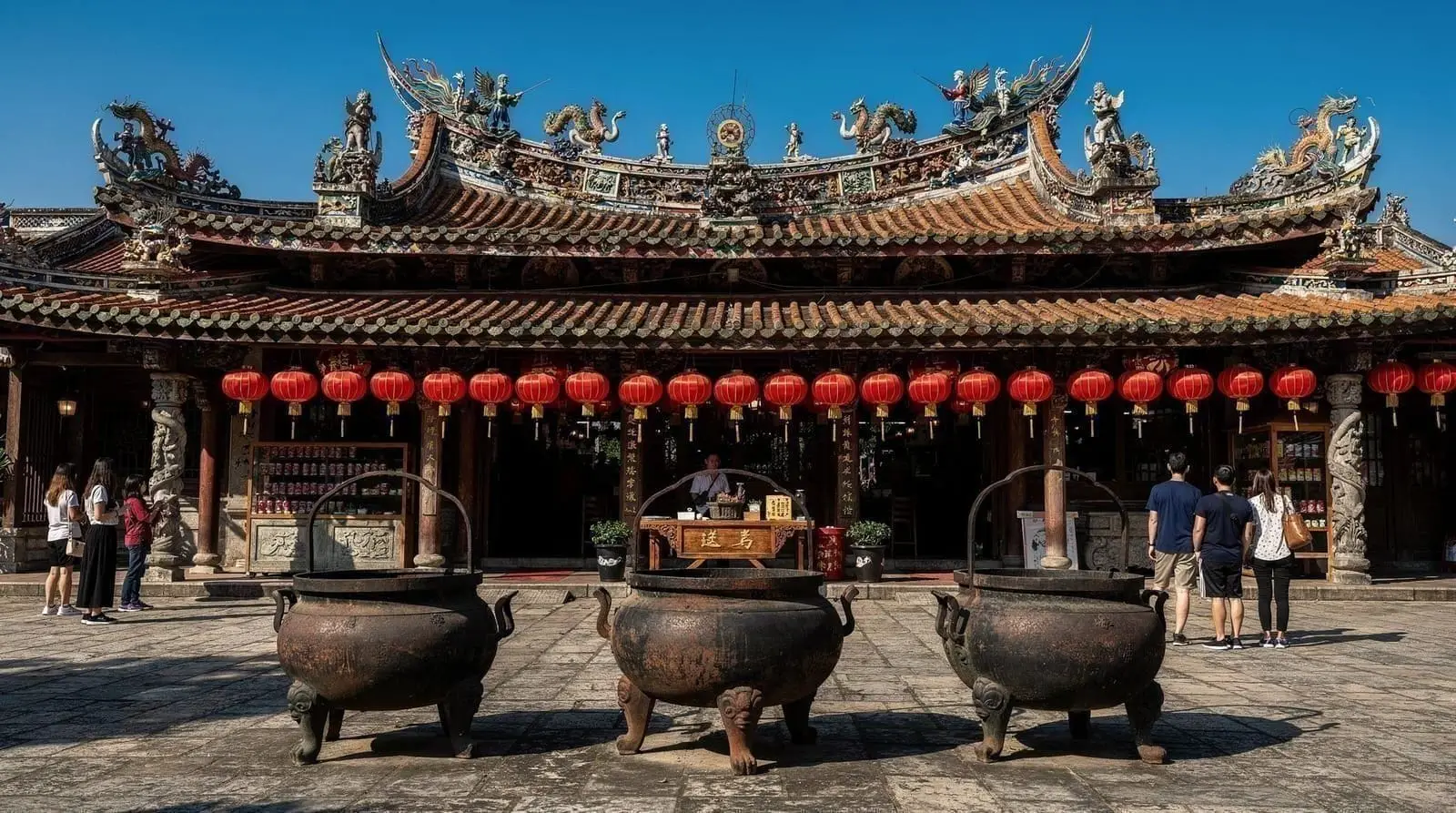
Foshan (“Buddha Mountain”) sits immediately southwest of Guangzhou, connected by metro in under 35 minutes. For centuries it was one of the four great commercial towns of China, renowned for Cantonese opera, martial arts, and two craft traditions — ceramics and silk — that supplied both the domestic market and the global trade flowing through Canton.
| Where | Immediately southwest of Guangzhou, Pearl River Delta |
| Cost | Zumiao ¥20; Nanfeng Kiln ¥25; Shunde meal ¥60–250/person |
| Time needed | 1 day, or a half-day combined with Guangzhou |
| Getting there | Metro 35–45 min from downtown Guangzhou; HSR + metro ~90 min from Shenzhen |
| Best time | October–April; weekdays for a quieter Zumiao |
The city’s most famous export is cultural: Bruce Lee was born in the United States but his father was Foshan-born, and Foshan is the hometown and cultural center of the Wing Chun style of kung fu that Lee studied under Ip Man (叶问). Ip Man himself lived and taught in Foshan until 1949, and the city has developed this heritage into one of the more sincere tourist-to-culture connections in Guangdong Province — a contrast to heritage sites that perform history without engaging it.
The pottery heritage is equally significant: Shiwan ceramics (石湾陶瓷), produced in Foshan’s Shiwan district since at least the Song dynasty (960–1279 CE), supplied glazed building ceramics to temples and government buildings across southern China. The dragon-backed ceramic ridge ornaments on Guangdong’s ancestral halls — including the Chen Clan Academy in Guangzhou — were made in Shiwan. The kilns are still firing.
Getting to Foshan
From Guangzhou: Take Guangzhou Metro Line 1 west to Xilang station (or Changshou Road, depending on your starting point in Guangzhou), then transfer to the Guangfo Metro (Foshan Metro Line 1). The full journey from downtown Guangzhou to Zumiao station in Foshan takes 35–45 minutes and costs ¥7–10 ($0.98–$1.40). No separate transit tickets needed — a Yangcheng Tong card or WeChat Pay metro works across both networks seamlessly. This is the same metro network, extended.
From Shenzhen: HSR from Shenzhen North to Guangzhou South (35 minutes), then metro across to Foshan (40 minutes). Total: approximately 90 minutes. Tickets for the HSR portion: ¥75–120 ($10–17).
From Hong Kong: HSR from West Kowloon to Guangzhou South (55 minutes), then metro to Foshan (40 minutes). Total: 1 hour 45 minutes. A full day is feasible; start early and aim to arrive at Zumiao before 10 a.m.
Within Foshan, Didi is reliable. The main sites — Zumiao, Ip Man Memorial Hall, Nanfeng Kiln, and the Shunde food area — are spread across 3–15 km and best connected by taxi between sites.
Zumiao Ancestral Temple
The Zumiao Ancestral Temple (祖庙, Zu Miao) is Foshan’s centerpiece and one of the finest examples of Lingnan religious architecture surviving in the Pearl River Delta. The original structure dates to the Northern Song dynasty (around 1078 CE); what stands today is largely a Ming and Qing reconstruction with accumulated additions, including some of the most spectacular ceramic ridge work in southern China — compare it to what you may have seen at the Chen Clan Academy in Guangzhou, and note that the Shiwan ceramics artisans responsible for both knew each other’s work.
The main hall honors Beidizhen — the deity of the northern heavens, patron of water management and ironworking — which explains why Foshan’s commercial and industrial community built their primary civic temple here. The bronze statue of Beidizhen (2.5 tons, cast 1452) is the largest free-standing bronze statue in pre-20th-century Guangdong.
The complex also contains:
- The Foshan Cantonese Opera Art Museum: exhibition on Yue opera history, with performance costumes and stage props. Small but informative.
- Huang Feihong Memorial Hall: commemorating the real martial artist who became a folk hero in 20th-century Cantonese cinema (played by Jet Li in the 1990s film series). The exhibition mixes history and legend without always clearly distinguishing them; the artifacts are genuine.
- Ancestral temple gardens: courtyards and planted areas that function as local recreational space alongside the temple proper. Mornings see elderly residents doing exercises here before tourist hours begin.
Entry to the full complex: ¥20 ($2.80). Open daily 8:30–18:00. The temple forecourt becomes crowded with worshipers on the 1st and 15th of each lunar month — those dates offer religious atmosphere but are difficult for photography.
Book a private Foshan kung fu, lion dance, and Bruce Lee heritage day tourMetro: Guangfo Line 1 to Zumiao station, exit A.
Ip Man and Wing Chun heritage
The Ip Man Martial Arts Cultural Park (叶问堂) and the Ip Man Memorial Hall (叶问纪念馆) are five minutes by taxi from Zumiao. The Memorial Hall occupies the preserved house where Ip Man grew up in the Sangji district, with exhibitions covering his life in Foshan (1893–1949), his departure to Hong Kong after the Communist victory, and his teaching of Wing Chun there — students included Bruce Lee from 1954.
The Wing Chun lineage Ip Man represents is one of several Wing Chun traditions but became the most globally prominent through Lee and through the Donnie Yen film adaptations (2008–2019). The Foshan experience allows engagement with the actual historical context rather than the cinematic mythology. The video archive of Ip Man’s late-life demonstrations (filmed in Hong Kong in the 1960s–1970s) is more interesting than the biographical text panels.
Lion dance workshops: Foshan is also the origin of the southern-style lion dance tradition used in Cantonese celebrations worldwide. The Foshan Lion Dance Association (佛山醒狮协会) near Zumiao offers demonstration performances (scheduled on weekends, ¥30 / $4.20 per person) and brief participatory workshops. Worth arranging before arrival.
Book a Guangzhou–Foshan culture tour with kung fu and Lingnan heritageActive Wing Chun training: Several Foshan schools accept walk-in visitors and short-term students. The Ip Man Martial Arts Association (叶问拳术研究会) on Songfeng Road offers demonstration sessions on weekday mornings; email inquiry in advance is advisable. A 2-hour introductory session runs ¥200–400 ($28–56) including instruction.
Nanfeng Ancient Kiln and Shiwan ceramics
The Nanfeng Ancient Kiln (南风古灶) in Shiwan district has been continuously firing ceramics since 1506, making it the longest continuously operating kiln in China — 519 years as of 2025. The dragon kiln (龙窑, long yao) — a 32-meter-long ascending tunnel kiln built into the hillside — is fired with brushwood and produces Shiwan’s characteristic glazed ware: mottled earth tones, jade greens, and the lively unglazed red clay figures for which Shiwan is internationally known.
The complex is part museum, part working pottery facility. Visitors can watch potters throw and glaze in the adjacent studios. Scheduled kiln firings (twice monthly) can be observed from the terrace above. The attached Shiwan pottery market sells both workshop-made ceramics and imports; authentic Shiwan pieces bear a workshop mark on the base.
Entry ¥25 ($3.50). Open daily 9:00–17:30. Allow 90 minutes. From Zumiao, taxi takes 15 minutes and costs ¥20–30 ($2.80–$4.20).
Foshan Qinghui Garden entry and foodie map (Lingnan garden visit included)Foshan Ceramics District: The streets around Shiwan town center have showrooms and wholesale outlets for Shiwan pottery at retail. Decorative pieces from ¥50–500 ($7–70) for workshop production; artist-signed pieces are higher. The Nanzhuang Ceramics City (南庄陶瓷城), 12 km from Shiwan, is the major wholesale market for architectural and decorative ceramics in southern China — worth seeing for scale even without purchasing. Several hundred showrooms across multiple warehouse buildings.
Shunde cuisine: Foshan’s food highlight
Shunde district — now administratively part of Foshan city — is widely recognized as having one of the most refined Cantonese cooking traditions in China. UNESCO designated Shunde a “City of Gastronomy” in 2014. The cuisine shares Cantonese cooking’s emphasis on freshness and subtle flavor amplification, but with a distinctive use of freshwater fish (from the Pearl River delta channels), dairy (unusual in Chinese regional cooking — milk curd desserts originated here), and extreme attention to texture.
What to eat in Shunde:
- Shunde fish congee (顺德鱼生): raw freshwater fish thin-sliced and added to boiling congee tableside. Clean, delicate, unlike other fish preparations in China. ¥30–60 ($4.20–$8.40) per person.
- Twice-cooked milk (双皮奶, shuang pi nai): a steamed milk curd dessert served in a ceramic bowl. The surface skin is lifted, the curd mixed with egg white and sugar, then replaced and re-steamed.
Originated in Shunde in the 19th century. ¥10–20 ($1.40–$2.80) per bowl.
- Daliang stir-fried milk (大良炒鲜奶): silken barely-set egg-milk custard with shrimp and pine nuts. Another Shunde original dating from the early 20th century. ¥35–55 ($4.90–$7.70).
- Braised pork belly with taro: the Shunde version differs from Hakka versions by using freshwater taro varieties and a lighter braising stock. ¥60–100 ($8.40–$14) per serving.
For dedicated Shunde food: the town of Daliang (大良, Shunde’s administrative seat), 25 minutes from Foshan city center by Didi (¥40–60 / $5.60–$8.40), has a cluster of traditional restaurants on Qinghui Garden Road. Qinghui Yuan Restaurant attached to the Qinghui Garden scenic area is institutional-quality. Budget ¥150–250 ($21–35) per person for a full Shunde meal with multiple courses.
Book a Guangzhou–Shunde foodie day trip with lunch guideThe Guangzhou–Shenzhen foodie 4-day itinerary allocates a full Shunde day for the most thorough coverage.
Combining Foshan with Guangzhou and the broader PRD
Foshan is most naturally combined with Guangzhou as a half-day addition. The typical approach: spend the morning in Guangzhou’s Xiguan/Chen Clan Academy area, then metro to Foshan after lunch (35 minutes), visit Zumiao and Ip Man Memorial Hall in the afternoon, return to Guangzhou for dinner. Total elapsed time: 8–9 hours.
An alternative structure for a dedicated Foshan day: arrive by 9 a.m. at Zumiao (before the crowds), explore until 11 a.m., lunch at a Shunde restaurant in Chancheng District, Nanfeng Kiln from 13:30 to 15:30, Ip Man Memorial Hall until 17:00, then metro back to Guangzhou or HSR to Shenzhen for the evening.
Shunde extension: If you want to focus on food, skip the Foshan city sites and go directly from Guangzhou to Daliang by intercity rail (Guangzhou South to Shunde station, 45 minutes). Spend the day eating and exploring Qinghui Garden before returning.
Day trip from Shenzhen: The Shenzhen weekend 48-hour itinerary includes a Foshan option on day two via HSR to Guangzhou and metro connection.
For the full PRD circuit, see Pearl River Delta Grand Loop.
Practical information
Language: Cantonese is the primary local language in Foshan, with Mandarin for formal contexts. English is limited outside international hotels. Restaurant menus often have photographs; the WeChat translation camera function (point at Chinese text) works reliably for menu items.
Accommodation: Most visitors combine Foshan as a day trip from Guangzhou, where hotel options are broader. If staying in Foshan, the area near Zumiao Metro station has mid-range options from ¥280–500 ($39–70) per night. The InterContinental Foshan (¥800–1,400 / $112–196) is the most reliable international-brand option.
Connectivity: Full Great Firewall applies — same as Guangzhou. Install your VPN before crossing from Hong Kong. See the eSIM and VPN in China guide for setup before you arrive, and the WeChat Pay and Alipay for foreigners guide since most Foshan transactions, from metro fares to Shunde restaurant bills, run through mobile payment rather than cash or card.
Weather: Subtropical, with hot humid summers (June–September) and mild, dry winters (December–February). October–April is the most comfortable window for walking the Zumiao complex and Qinghui Garden; midsummer heat and humidity make the outdoor ceramics district considerably less pleasant, though the temple halls themselves are shaded.
Safety: Foshan is safe for tourists by international standards, with the same ordinary city-travel caution appropriate anywhere in the Pearl River Delta. The main practical friction is the language barrier away from Zumiao and the metro stations — Cantonese and Mandarin dominate, with limited English signage — rather than any safety concern specific to Foshan.
Honest note on tourist-facing pricing: The area immediately around Zumiao has souvenir stalls that price aggressively toward tourist trade. The same Shiwan ceramic figurines available at ¥80 near the temple entrance are ¥30–40 in the Nanfeng Kiln complex or Shiwan district proper, 15 minutes by taxi. Walk a block off the main temple approach for more honest prices. The lion dance team soliciting photographs at the Zumiao entrance is not associated with the temple and will ask for a substantial fee; the temple itself does not require any supplementary payment.
Qinghui Garden and Lingnan garden design
Qinghui Garden (清晖园) in Daliang (Shunde district, 25 minutes south of Foshan city center by Didi) is one of the four famous Lingnan gardens — alongside Ke Yuan in Dongguan, Yu Yin Shan Fang in Panyu, and Liang Yuan in Liwan. The garden was built in 1797 and expanded through successive generations of the Long family, reaching its current form of 21,800 square meters in the Qing dynasty.
Lingnan garden design differs from the more famous Suzhou gardens in several key ways: the spaces are more integrated with the surrounding residence (the garden was always a working aristocratic home rather than a retreat villa), the planting emphasizes tropical and subtropical species rather than pines and bamboo, and the ceramic and stone ornament is more elaborate — reflecting the proximity to Shiwan’s ceramics industry. Entry ¥15 ($2.10). Open daily 8:00–17:30. Allow 60–90 minutes.
The restaurants along Qinghui Garden Road outside the gate serve Shunde cuisine at prices calibrated for the local lunch crowd (¥60–120 / $8.40–$17 per person) rather than for tourists. This is where to eat if you want Shunde food in context.
The Lingnan folk art museum scene
Foshan has a cluster of folk art museums and workshops that most visitors miss in favor of the major sites:
Foshan Folk Art Research Society (佛山民间艺术研究社), a short walk from Zumiao, produces and sells Foshan-origin paper-cutting art (剪纸, jian zhi), a UNESCO-recognized intangible cultural heritage. The cutting is precise to a level that looks machine-made to untrained eyes — it isn’t. Workshop demonstrations run weekday mornings; ask at the gate. Pieces range from ¥30–300 ($4.20–$42) depending on complexity.
Foshan straw weaving (佛山草编): A traditional Lingnan craft using dried water hyacinth (风信子茎) woven into baskets, hats, and household objects. Several workshops in Xiqiao Mountain district still produce this commercially. Less prominent than ceramics or paper-cutting but interesting as a material culture document.
Nanhai Art Museum (南海博物馆) in the Guicheng area (Line 2, Guicheng metro station): Covers the history of the Nanhai area — now part of Foshan — from ancient times through the Republican era. Stronger on the pre-modern crafts and trade history than on contemporary material. Free entry. Closed Mondays.
Xiqiao Mountain: a nature extension
Xiqiao Mountain (西樵山), about 35 minutes by Didi from central Foshan (¥60–90 / $8.40–$13), is a national geological park built around an extinct volcano — one of the few genuinely hilly, forested landscapes accessible from the flat Pearl River Delta plain. The site combines nature with Lingnan cultural sites: several Ming and Qing-era academy buildings, Buddhist and Daoist temples tucked into the hillside, and the straw-weaving workshops mentioned above in the surrounding villages. A giant modern statue of Guanyin (observation platform included) sits near the summit.
Entry ¥60 ($8.40), which includes the shuttle bus between sites — the mountain area is too large to walk comfortably in a single visit. Allow half a day if combining two or three of the temple/academy sites with a walk to a viewpoint. Xiqiao works best as an alternative to the ceramics and Ip Man circuit for travelers who’ve already done a Foshan city day and want a second, quieter visit, or as a nature counterpoint on a longer Guangdong trip that’s otherwise all cities and temples.
Weekday mornings are noticeably quieter than weekend afternoons, when the shuttle queues can run 20–30 minutes at the busiest stops. Sturdy shoes are worth packing even though the shuttle covers most of the distance, since several of the temple and academy sites require short uphill walks on uneven stone steps, and the summit viewpoint area involves a final stretch that isn’t shuttle-accessible.
Foshan’s role in Cantonese opera history
Foshan (specifically the Zumiao area in Chancheng District) is recognized as the birthplace and historical center of Cantonese opera (粤剧, Yue opera). The first permanent opera guild (琼花会馆, Qionghua Huiguan) in Guangdong Province was established here in the Ming dynasty, and Foshan performers and troupes defined the stylistic conventions that subsequently spread across the Pearl River Delta.
The Cantonese opera tradition that Hong Kong has maintained since the 1950s (when many Foshan performers relocated) traces back to the Zumiao district’s performance culture. The elaborate costumes, high-pitched falsetto vocals accompanied by plucked strings and percussion, and the symbolic gesture vocabulary of Yue opera were codified here.
The Foshan Cantonese Opera Art Museum inside the Zumiao complex gives the historical overview. For live performance: the Foshan Grand Theater (佛山大剧院), a 2012 building by the Pearl River, hosts both Cantonese opera touring productions and contemporary performance. Tickets ¥80–280 ($11–39). Check schedule at the official Foshan Grand Theater site or through WeChat mini-programs for upcoming productions. For smaller, more traditional performances, the opera rehearsal space at the Foshan Ancestral Temple (within the Zumiao complex) occasionally has open rehearsals on weekend mornings — ask the ticket desk.
Getting the most out of a single day in Foshan
A realistic single-day Foshan itinerary from Guangzhou:
08:30 — Metro from downtown Guangzhou (Changshou Road station, Line 1) to Zumiao station (Guangfo Line 1). Total: 35–40 minutes.
09:00–11:00 — Zumiao Ancestral Temple complex. Arrive when it opens to have the main hall relatively uncrowded. Focus on the ceramic ridge work, the Beidizhen bronze statue, and the Cantonese Opera Art Museum.
11:00–11:30 — Walk or Didi to the Ip Man Memorial Hall (5 minutes). 30-minute visit.
12:00 — Lunch. Choose between a local Foshan restaurant in Chancheng District (¥60–100 / $8.40–$14 per person for a set meal) or Didi to Daliang for dedicated Shunde cuisine at Qinghui Garden Road (25 min, ¥40–60 / $5.60–$8.40).
13:30–15:30 — Nanfeng Ancient Kiln (Didi from lunch location, ¥20–40 / $2.80–$5.60, 15–25 minutes). Allow 90 minutes at the kiln complex.
15:30–17:00 — Free time: Foshan Folk Art Research Society for paper-cutting, or browse the Shiwan ceramics district showrooms.
17:00 — Metro back to Guangzhou (35–40 minutes). Arrive in Guangzhou for dinner in Tianhe or the old city.
This schedule is full but not frantic. Cutting the Daliang food detour (eating in Chancheng instead) saves 60–90 minutes if you want more time at the kiln or folk art workshops. The Greater Bay Area 2-week itinerary allocates a full day to Foshan if you want the Shunde food and Qinghui Garden without rushing. From Foshan, onward connections include Zhuhai by intercity rail (70 minutes) for the HZMB crossing to Macau.
Foshan vs. a half-day-only visit: what to prioritize
Not every visitor has a full day. If you’re deciding what to keep and what to cut:
| Priority | Half-day (4–5 hrs) | Full day (8–9 hrs) |
|---|---|---|
| Must-see | Zumiao Temple + Ip Man Memorial Hall | Same, plus Nanfeng Kiln |
| Food | Quick Chancheng lunch (¥60–100) | Dedicated Daliang/Shunde detour (¥150–250) |
| Craft | Skip | Folk Art Research Society or Qinghui Garden |
| Realistic pace | Tight but doable | Comfortable |
If Wing Chun and martial arts heritage is the primary draw, prioritize Zumiao and the Ip Man Memorial Hall over the ceramics sites — they’re 5 minutes apart and self-contained. If food is the primary draw, skip the city sites entirely and go straight to Daliang, as the Shunde extension above describes. Combine either approach with the Guangzhou destination guide and the Guangzhou in 2 days itinerary if Foshan is one stop on a longer Guangzhou-based trip, or with the Guangzhou Cantonese food guide if you’re building a food-focused route across both cities.