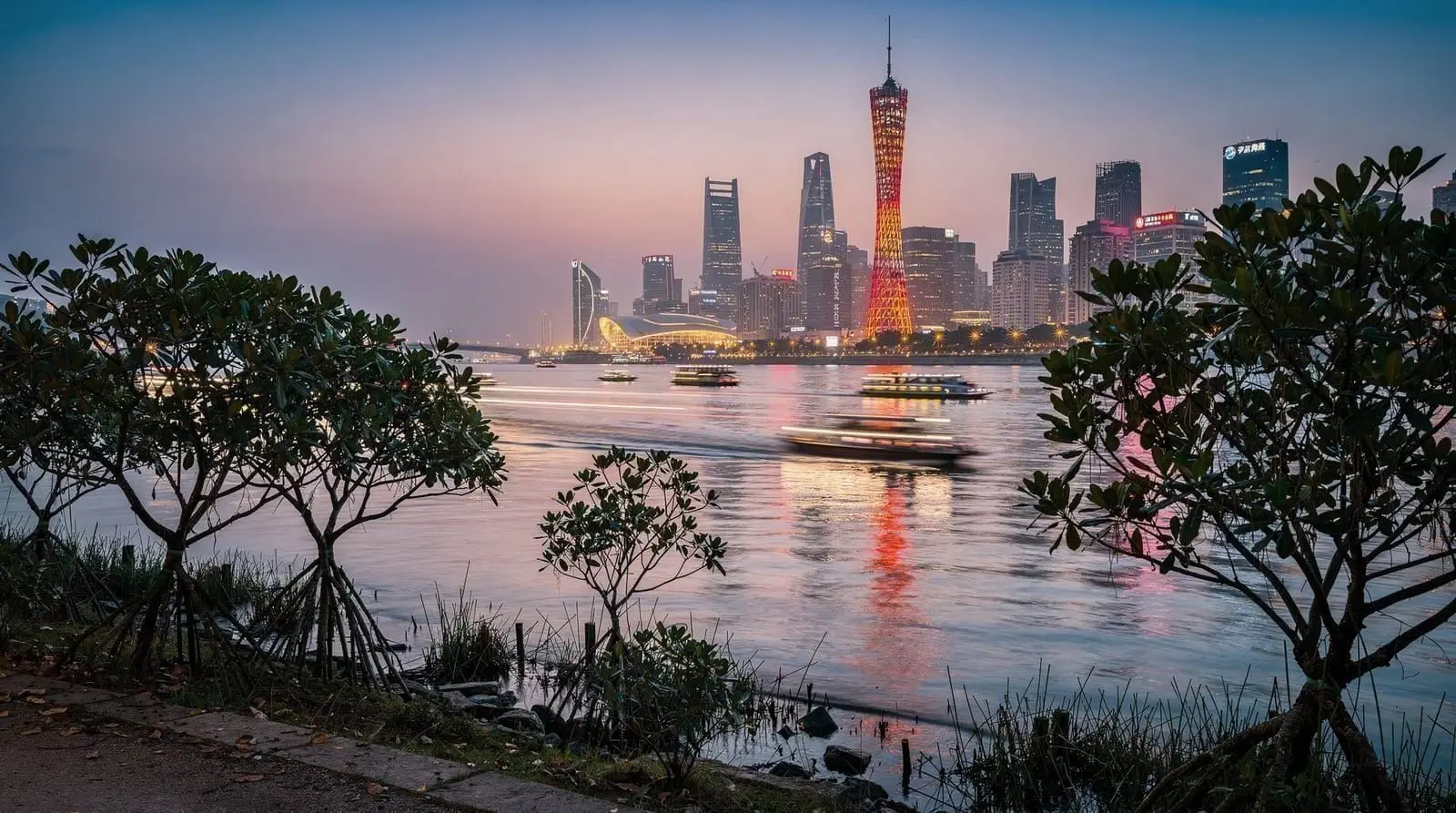
Guangzhou is one of the oldest continuously inhabited cities in southern China, and for most of its history the rest of the world called it Canton. That name still echoes everywhere: Cantonese cuisine, the Canton Fair, the Canton Tower. As the capital of Guangdong Province and anchor of the western Pearl River Delta, it sits at the heart of the Greater Bay Area — only 35 minutes from Shenzhen North by HSR and 55 minutes from Hong Kong West Kowloon.
| Where | Guangdong Province capital, western Pearl River Delta |
| Cost | Comfortable day ¥300–500/person; accommodation ¥350–1,100/night |
| Time needed | 1–2 days minimum |
| Getting there | HSR 35 min from Shenzhen North, 55 min from Hong Kong West Kowloon |
| Best time | October–November, or March–April |
What sets Guangzhou apart from its neighbors is age and authenticity. While Shenzhen was built from scratch since 1980 and Hong Kong was shaped by colonial trade, Guangzhou has been a merchant city for over 2,000 years. You feel it in the tea houses that open at 6 a.m. for yum cha, in the Qing-era shophouses of Xiguan, and in the market stalls selling medicinal herbs alongside live seafood. Come hungry.
Getting to Guangzhou from Shenzhen and Hong Kong
From Shenzhen, the fastest route is HSR from Shenzhen North station to Guangzhou South — roughly 35 minutes, tickets from ¥75 (about $10). Trains run every 10–20 minutes most of the day; buy through the 12306 app or at the station. Tickets often sell out on weekend mornings, so booking the previous evening is worthwhile.
From Hong Kong, the Guangzhou–Shenzhen–Hong Kong Express Rail Link departs West Kowloon station and reaches Guangzhou South in 55 minutes (from HK$260 / $33 one-way). This crosses into Mainland China at the co-located immigration checkpoint in West Kowloon — clear both HK and Mainland immigration before boarding. From Macau, the HZMB to Zhuhai and then an intercity rail from Zhuhai to Guangzhou South takes about 2 hours total.
Guangzhou South station is in Panyu district, 25–35 km from the city center. Metro Line 2 and Line 7 connect to the urban core; allow 35–45 minutes to reach Yuexiu or Tianhe by metro. A taxi or Didi from Guangzhou South to the Chen Clan Academy area runs ¥50–80 ($7–11) and takes 30–40 minutes depending on traffic.
Within Guangzhou, the metro network (12+ lines) covers almost everywhere you’ll want to go. A single ride costs ¥2–9 ($0.30–$1.25). Didi works reliably for taxis and ride-hailing; always confirm your pickup point on the map since drivers may not speak English. See our Greater Bay Area transport overview for cross-city logistics.
The old city: Yuexiu and Xiguan
The heart of historic Guangzhou divides into two adjoining areas worth exploring together. The full guide to this neighborhood is at Yuexiu and the old city.
Yuexiu District holds the cultural institutions: the Guangzhou Museum inside the 1380 Zhenhai Tower, the Chen Clan Academy (陈家祠, Chenjia Ci), and Yuexiu Park itself — 860,000 square meters with the iconic Five Rams Statue (symbol of the city) and trails through banyan forest where elderly residents practice tai chi before 8 a.m.
The Chen Clan Academy (1888) is the unmissable architectural showpiece of the city. Built by 72 Cantonese clans as a combined ancestral hall and exam preparation center, it’s now a museum of Lingnan folk arts. The ceramic ridge ornaments, wood carvings, and stone reliefs are among the finest Qing-era craft in southern China. Entry is ¥20 ($2.80) standard — one of the best-value tickets in any Chinese city. Allow 90 minutes.
Book a guided Chen Clan Academy tour (2 hours, English-speaking guide)Xiguan (西关) is the old merchant quarter west of the city center, a tangle of qilou arcade shophouses, traditional tea houses, and antique shops. Enning Road (恩宁路) was restored without being emptied — pharmacies, barber shops, and rice-roll stalls coexist with independent cafes. Shamian Island sits at Xiguan’s southern edge: a small sandbank that served as Guangzhou’s foreign concession from 1859, lined with restored French and British colonial villas now housing boutique hotels and coffee shops. It’s calm and photogenic.
Join a Xiguan walking tour with local guideThe Xiguan lanes are also where Guangzhou’s antique trade concentrates. Wende Road (文德路) specializes in books and art; Dishifu Road has shops dealing in Cantonese furniture, jade, and folk handicrafts. Prices are negotiable and quality varies — treat anything “antique” as decorative unless you have specialist knowledge.
A first day here is mostly a problem of distance, since the sights sit far apart: a city highlights tour with a dim sum lunch links them in one run and puts the meal where it belongs, in the middle of the morning’s walking.
Canton Tower and the new city
Canton Tower (广州塔) opened in 2010 and remains the defining symbol of modern Guangzhou at 600 meters. The observation deck at 433 m costs ¥180 ($25) for the indoor SkyView, ¥120 ($17) for the outdoor skydeck. Buy timed tickets online at weekends to avoid queues.
Canton Tower SkyView deck with local guideThe tower sits in Haizhu District beside the Pearl River. Cross the Haixin Bridge to Ersha Island for a quieter afternoon: the Guangdong Museum of Art and the Xinghai Concert Hall both face the river. Zhujiang New Town (Pearl River New Town), immediately north of the tower across the river, is Guangzhou’s modern CBD, with the Guangzhou Opera House designed by Zaha Hadid (2010), the Guangdong Museum by Rocco Yim, and tower clusters designed by international architects. The Tianhe guide covers the modern city in detail.
Guangzhou from above: The Canton Tower is the most accessible vantage point, but several hotel rooftop bars provide free viewing. The Mandarin Oriental Guangzhou (Zhujiang New Town, Level 8 bar) offers unobstructed views of the tower from the opposite bank, at cocktail prices of ¥90–140 ($13–20).
Cantonese food: where to eat
This is why many people make the journey. Guangzhou is to Cantonese cuisine what Lyon is to French cooking — not the glitziest city, but the one the professionals take most seriously.
Dim sum (yum cha) is a morning affair. The classic experience is at a traditional tea house before 10 a.m.: trolley carts, bamboo steamers, and tables packed with multi-generational families. Lian Xiang Lou (莲香楼) on Dishifu Road has been operating since 1889; expect queues by 7:30 a.m. on weekends. Budget ¥80–150 ($11–21) per person including tea. Taotaoju (陶陶居, founded 1880), also in Liwan District, serves reliable har gow and siu mai in a restored 1880s interior. Pan Xi Restaurant (泮溪酒家) near Liwan Lake, opened 1947 in a garden setting of pavilions over water, seats 1,000+ and remains a professional kitchen despite the scale.
For the full dim sum guide, see Guangzhou’s food culture.
White-cut chicken (bai zhan ji) here is a religious experience: the bird raised slowly, the skin gelatinous, the dipping sauce of ginger-scallion oil applied at the last moment. Guangzhouers argue about the best version the way Parisians argue about croissants.
Shunde cuisine from neighboring Foshan district — freshwater fish, dairy-influenced textures, extreme attention to delicacy — is also well represented in Guangzhou. Ask for Shunde-style at restaurants in Liwan and Haizhu.
Late-night options: The area around Beijing Road and Haizhu Square has stalls open past midnight. Factory-district Canteens in Tianhe serve rice dishes at ¥15–25 ($2.10–$3.50) around the clock. Guangzhou rewards 10 p.m. eating: the city doesn’t get quiet early.
Food tour option: A guided food walk through the old city, covering rice-noodle workshops, dim sum houses, and Qingping herb market, contextualizes what you’re tasting more effectively than solo exploration. The Guangzhou food tour with local guide runs 3–4 hours.
Pearl River cruise
The Pearl River at night, with Canton Tower reflected in the water and the illuminated bridges overhead, is genuinely spectacular. Standard tourist cruises (1–1.5 hours, ¥100–180 / $14–25) depart from Tianzi Wharf near Shamian or from Xidi Pier near the Convention Center. Multiple operators run similar routes.
Book a Pearl River 1-hour night cruise (flexible departure pier)Avoid the dinner cruise add-ons at the premium pier — the food is mediocre and overpriced compared to eating at a restaurant first and doing the boat separately. The basic boat gets the same views. The 20:00 departure typically offers the most complete set of illuminated bridges.
For a daytime river perspective, the Lychee Bay waterway (荔枝湾涌) in Liwan District is a quieter canal experience — stone bridges, restored shophouse reflections, and dragon boat sightings. Free to walk; boat rides available at ¥40–60 ($5.60–$8.40) for a 30-minute tour.
Guangzhou’s wider cultural life
Beyond the showpiece attractions, Guangzhou sustains a serious cultural life that’s easy to tap into:
Cantonese opera (粤剧, Yue opera) performs at the Guangzhou Cantonese Opera Arts Center (广州粤剧艺术中心) and at the historic Nanfang Theater (南方剧场) in Liwan. Tickets start at ¥50 ($7); evening performances run 7:30–9:30 p.m. most weekends. Understanding the story is optional — the elaborate costumes, falsetto vocals, and percussion-led orchestra are a complete sensory experience.
The Guangdong Museum (广东省博物馆) in Zhujiang New Town has an outstanding collection of Guangdong trade ceramics and Lingnan natural history. Free with passport registration. Closed Mondays.
Yuexiu Park and temple culture: The Temple of the Six Banyan Trees (六榕寺, Liu Rong Si), one block from the Chen Clan Academy, has a Song-dynasty pagoda still standing. Entry ¥5 ($0.70). The Guangxiao Temple (光孝寺) nearby is the oldest Buddhist temple in Guangzhou (established Eastern Han dynasty, before the city itself was founded as Canton). Both draw genuine worshipers rather than tourists.
Practical tips and honest warnings
WeChat Pay and Alipay are essentially mandatory for small purchases. Foreigners can now link an international Visa or Mastercard to WeChat Pay — do this before crossing from Hong Kong. Carry ¥200–300 ($28–42) cash for wet markets and older tea houses.
VPN: Guangzhou is fully behind China’s Great Firewall. Google Maps, WhatsApp, and Instagram don’t work without a VPN installed before crossing the border. See eSIM, VPN, and connectivity for the Greater Bay Area for 2026-verified options, and the WeChat Pay and Alipay for foreigners guide for the payment side of the same setup, since the two matter equally once you cross into the mainland.
Language: Cantonese is Guangzhou’s home language, with Mandarin as the official and business default. This differs from Shenzhen, where Mandarin dominates due to the city’s migrant population, and from Hong Kong, where Cantonese and English coexist. Restaurant staff outside international hotels rarely speak English fluently; photo-menu apps and pointing work better than attempted conversation.
Tourist traps to know: The jade market in Liwan has persistent touts offering “wholesale” prices that aren’t. “Tea ceremony” invitations from friendly strangers in Yuexiu Park are a well-documented scam (you’ll receive a bill of ¥500+). The Qingping market area near Shamian has souvenir shops with tourist-inflated prices — cross a block north for the same goods at local prices.
Weather and packing: Guangzhou is subtropical with hot, humid, rainy summers and mild winters. A light rain jacket or umbrella is useful year-round given the unpredictable shower pattern, especially during the Qingming rains in early April and the broader May–September wet season. Sunscreen matters even on overcast days given the latitude. Layering works better than heavy jackets even in the coolest winter weeks, since indoor heating is uncommon and the temperature swing between outdoor cool and indoor mall air conditioning (aggressive year-round) is often the bigger factor in comfort.
Comfortable walking shoes matter more than weather-specific gear — the old city’s stone-paved lanes and the distances between metro exits and destinations add up faster than they appear on a map, and a full day of dim sum, walking, and a night cruise easily covers 12,000–15,000 steps, so plan a mid-afternoon coffee break rather than pushing straight through.
Accommodation: Mid-range options near the historic center include the White Swan Hotel on Shamian Island (from ¥1,100 / $153 per night) and the Guangzhou Marriott Hotel Tianhe (from ¥900 / $125). Budget travelers near the old city: clusters of mid-range Chinese business hotels on Zhuhai Road and Liwan Lake Road at ¥280–450 ($39–63). For modern Guangzhou, Tianhe has the concentration of international brand hotels.
Getting around: Metro is the primary tool. A Yangcheng Tong card (¥20 deposit, rechargeable at any station machine) or WeChat Pay metro QR covers all lines including the Guangfo cross-city connection to Foshan.
Day trip options from Guangzhou
Guangzhou’s HSR and metro connections make it a natural base for the western Pearl River Delta:
- Foshan (30 min by metro): Lingnan folk art, Wing Chun kung fu heritage, Zumiao Temple, excellent Shunde cuisine.
- Yuexiu and the old city: The full guide to Xiguan, Shamian, Chen Clan Academy, and dim sum institutions.
- Zhuhai (70 min by HSR): Chimelong Ocean Kingdom, Hengqin Island, and the HZMB crossing to Macau.
- Dongguan (30 min by HSR): Halfway to Shenzhen, with Songshan Lake and Huawei campus curiosity.
- Zhaoqing (1.5 hours by HSR): Song-dynasty city walls and Seven Star Crags lake scenery.
- Kaiping (2 hours by HSR + bus): UNESCO-listed diaolou watchtower villages from the 1920s–1930s.
For the complete PRD loop including Guangzhou, see Pearl River Delta Grand Loop. For a food-focused itinerary pairing Guangzhou with Shenzhen, see Guangzhou–Shenzhen foodie 4 days.
Frequently asked questions about Guangzhou
Do I need a visa to visit Guangzhou from Hong Kong?
Most Western passport holders entering China from Hong Kong need a standard Chinese tourist visa (L visa), though the 240-hour (10-day) transit exemption applies if you’re transiting between two international cities and Guangzhou is a stop along the way. Guangzhou is not covered by the Shenzhen-specific visa-on-arrival available to some nationalities at certain Guangdong crossings. Check current rules in our China visa and 240-hour transit guide.
How do I get from Guangzhou to Shenzhen?
The fastest option is HSR from Guangzhou South to Shenzhen North (35 minutes, ¥75–120 / $10–17) or Shenzhen Futian (40 minutes). Trains run every 15–30 minutes. Long-distance bus from Guangzhou Tianhe Coach Terminal to Shenzhen Luohu takes 1.5–2 hours (¥55–70 / $8–10) — fine if you’re not on a schedule. See Shenzhen for arrival orientation.
What is Guangzhou best known for?
Guangzhou is the origin city of Cantonese cuisine, dim sum culture, and the Cantonese diaspora that spread Chinese cooking worldwide. It hosts the biannual Canton Fair (April and October), one of the world’s largest trade exhibitions. The city blends Qing-era Lingnan shophouses in Xiguan with world-class contemporary architecture in Zhujiang New Town.
Is Guangzhou safe for tourists?
Guangzhou is generally safe. The main risks are petty theft in crowded markets and the social scams described above. Metro, Didi, and official taxis are reliable. Avoid unmarked vehicles near train stations. The city’s international presence — from the Canton Fair trade community and African trading community in Yuexiu’s Xiaobei area — means some English-language signage in business districts.
How much does a day in Guangzhou cost?
A comfortable day including metro, Chen Clan Academy, dim sum lunch, riverside walk, and Pearl River cruise costs roughly ¥300–500 ($42–70) per person. Accommodation adds ¥350–1,100 ($49–153) depending on category. Guangzhou is meaningfully cheaper than Hong Kong and slightly cheaper than Shenzhen for food and accommodation.
When is the Canton Fair and should I plan around it?
The Canton Fair runs in April and October, drawing hundreds of thousands of trade visitors. Hotels multiply in price and availability collapses. If visiting for tourism, avoid those two months or book accommodation months in advance at significant premium.
What is the best way to experience dim sum in Guangzhou?
Go on a weekday morning before 9 a.m. to a traditional tea house (Lian Xiang Lou, Taotaoju, Pan Xi). Arrive hungry. Order a pot of pu-erh or chrysanthemum tea first; the waiter stamps your bill per item. Budget ¥80–150 ($11–21) per person. Allow 90 minutes. The Guangzhou morning tea food tour with a local guide covers multiple establishments in a structured tasting.
Can I do Guangzhou as a day trip from Hong Kong?
Yes, easily. HSR from West Kowloon to Guangzhou South takes 55 minutes. A practical day: Chen Clan Academy, dim sum lunch in Xiguan, Shamian Island, and return before dinner. Buy return tickets in advance on weekends. The Greater Bay Area 2-week itinerary includes Guangzhou in context as part of a longer loop.
Guangzhou’s seasonal character
The city operates year-round but with significant seasonal variation in comfort and experience:
October and November are the consensus best months. Temperatures drop to 18–26°C with low humidity and frequent clear days. The autumn colors are subtle by northern Chinese standards (Guangzhou is subtropical and trees don’t fully change), but the combination of comfortable walking conditions and fewer rainy days makes this the period when everything is most enjoyable. The Guangdong Museum of Art typically schedules its major exhibitions for autumn.
March and April offer a second pleasant window before summer heat. Spring in Guangzhou means plum blossoms in February (Yuexiu Park plum garden), azaleas in March, and wisteria in April on the Chen Clan Academy courtyard walls. The spring rains (清明 Qingming season, early April) bring overcast days that flatten photography but reduce both temperature and crowds.
December through February is Guangzhou’s mild winter: temperatures 8–18°C, requiring a light jacket in the evenings. The city remains fully functional — unlike northern Chinese cities where winter creates outdoor activity shutdowns. Tea houses are at their coziest in cool weather. The Chinese New Year flower markets (late January to early February, depending on lunar calendar) are one of Guangzhou’s most spectacular seasonal events.
May through September: Subtropical summer. Temperatures regularly exceed 33°C with high humidity. Typhoon season runs May through September; direct typhoon impacts are less frequent than coastal Hong Kong but tropical rain events can strand outdoor plans. Air conditioning is aggressive in malls and restaurants. Schedule morning outdoor activities (markets, parks, temple walks) before 10 a.m. and plan indoor activities (museums, tea houses, malls) for the afternoon.
Guangzhou for families
Guangzhou is workable with children but requires more planning than Shenzhen or Hong Kong, since fewer attractions are purpose-built for families. Yuexiu Park’s open lawns and the Five Rams Statue photo-op work well for younger children, and the Guangzhou Zoo (广州动物园), a short metro ride from the old city, has giant pandas and a reasonably maintained enclosure standard. The Canton Tower’s outdoor skydeck is a genuine thrill for older children comfortable with heights, though the ticket price adds up quickly for a family group.
Dim sum itself is naturally child-friendly — the trolley-cart format lets kids point at what looks appealing rather than navigating a menu, and tea houses are used to boisterous multi-generational tables. The main friction point for families is the metro during rush hour (extremely crowded 08:00–09:30 and 18:00–19:30) and the general lack of English signage away from major tourist sites, so a translation app and a hotel business card with the address in Chinese are worth having at all times.
Guangzhou’s African trading community
One of the more distinctive features of modern Guangzhou is the concentration of West and Central African traders in the Yuexiu and Baiyun district neighborhoods north of the city center. The Xiaobei area (小北) around Dengfeng Road and Xiaobei Road has been the informal center of this community since the 1990s, when Chinese manufacturers began working directly with African importers rather than through Hong Kong intermediaries.
At its peak in the 2010s, the African population in Guangzhou was estimated at 200,000–400,000 — the largest African community in Asia. Post-COVID emigration and visa policy changes have reduced that figure, but the neighborhood retains its character: West African and Congolese restaurants, mosques, fabric and goods wholesale markets, and money transfer offices alongside the standard Guangzhou commercial streetscape.
The food in the Xiaobei area is legitimately interesting if you’re curious about diaspora cooking: Senegalese tieboudienne (fish rice), Nigerian pepper soup, Congolese pondu (cassava leaves) coexist with Cantonese and Hunanese restaurants on the same blocks. This is not a managed cultural attraction — it’s a working trading community neighborhood. Approach it as such.
Guangzhou for longer stays: the university district and hidden neighborhoods
For visitors staying more than 3–4 days, Guangzhou reveals layers that short visits miss:
Tianhe’s university district (华南师范大学, South China Normal University; 中山大学, Sun Yat-sen University) south of Zhujiang New Town has the bookshop culture, cheap Cantonese restaurants, and street life that university neighborhoods everywhere provide at their best. The Zhongshan University campus itself (founded by Sun Yat-sen in 1924) is open to visitors and has a colonial-era library building and tree-lined campus lanes. Free entry; takes 45 minutes to walk.
Haizhu wetlands (海珠湿地公园): South of the city center in Haizhu District, 1,100 hectares of remaining urban wetland around Hohai Lake. Herons, kingfishers, and migratory ducks in autumn. Free entry from the north gate near Pazhou Convention Center. An unexpected and genuinely rural experience within 25 minutes of Canton Tower.
Yuexiu night market on Beijing Road (pedestrian section, 50 shops): The historical commercial spine of Guangzhou’s old city, with night market stalls from 19:00 to 23:00 selling street snacks (fish balls, turnip cake, maltose cookies) alongside the tourist souvenir shops. The eastern portion of Beijing Road has archaeological excavations visible through glass panels in the pavement — Han-dynasty road layers and Song-dynasty stone paving exposed beneath modern footfall. Genuinely unusual urban archaeology.
How Guangzhou compares to other Greater Bay Area cities
The practical differences between Guangzhou and its GBA neighbors matter for itinerary planning:
Guangzhou vs. Shenzhen: Guangzhou is older, culturally richer in traditional Cantonese heritage, and more complex to navigate. Shenzhen is newer, faster, more English-friendly, better for technology tourism, and has better international transport connections (border crossings to Hong Kong every 10 minutes). For food specifically, Guangzhou is the clear choice. For tech, innovation, and modern China spectacle, Shenzhen is the choice.
Guangzhou vs. Hong Kong: Hong Kong is more expensive, more English-friendly, politically distinct, and free of the Great Firewall. Guangzhou offers more immersive mainland Chinese culture experience, considerably lower prices, and authentically traditional Cantonese food culture (Hong Kong’s Cantonese food is excellent but adapted for a different economic context). The two cities are complementary rather than substitutes.
Guangzhou vs. Macau: Macau is smaller, Portuguese-heritage flavored, focused on gaming and colonial architecture. Guangzhou is the mainland counterpoint — immense, historically deep, culinarily dominant. The HZMB connection makes combining both in one trip easy.
For choosing between them, the Shenzhen vs. Hong Kong comparison guide and the Greater Bay Area 2-week itinerary both address this question with specific routing recommendations.
A realistic 2-day Guangzhou itinerary
For visitors with two days rather than one, here’s how to split the city without rushing:
| Morning | Afternoon | Evening | |
|---|---|---|---|
| Day 1 | Chen Clan Academy, then walk into Xiguan | Shamian Island, Lychee Bay canal walk | Dim sum-style dinner or Beijing Road night market |
| Day 2 | Yuexiu Park and Temple of the Six Banyan Trees | Zhujiang New Town, Guangdong Museum | Canton Tower + Pearl River night cruise |
If you only have one day, compress Day 1’s morning and Day 2’s evening into a single circuit: Chen Clan Academy, Xiguan lunch, Shamian Island, then Canton Tower and the night cruise. This is the route covered in the Guangzhou in 2 days guide, which breaks the same structure down hour by hour with transit times between stops.
Markets beyond Qingping
Guangzhou’s market culture extends well past the well-known Qingping herb and seafood market near Shamian. Yide Road (一德路), a few minutes’ walk east of Qingping, is the wholesale hub for dried seafood, Chinese New Year decorations, and toys — less visually dramatic than the herb stalls but a genuine working wholesale street rather than a tourist stop.
Haiyin Cloth Wholesale Market near the Guangzhou Cantonese Opera Arts Center supplies fabric to much of Guangdong’s garment trade; individual buyers are welcome but minimum cuts apply at most stalls (usually a full bolt). Sanyuanli flower and plant market, in Baiyun District, is at its most spectacular in the weeks before Chinese New Year, when the flower-market tradition described above reaches its peak scale.
None of these markets are curated for tourists, which is precisely their appeal — go with modest expectations of English signage and a willingness to simply look rather than transact, and treat any unsolicited “good price for you, friend” approach with the same skepticism as the jade-market touts mentioned above.