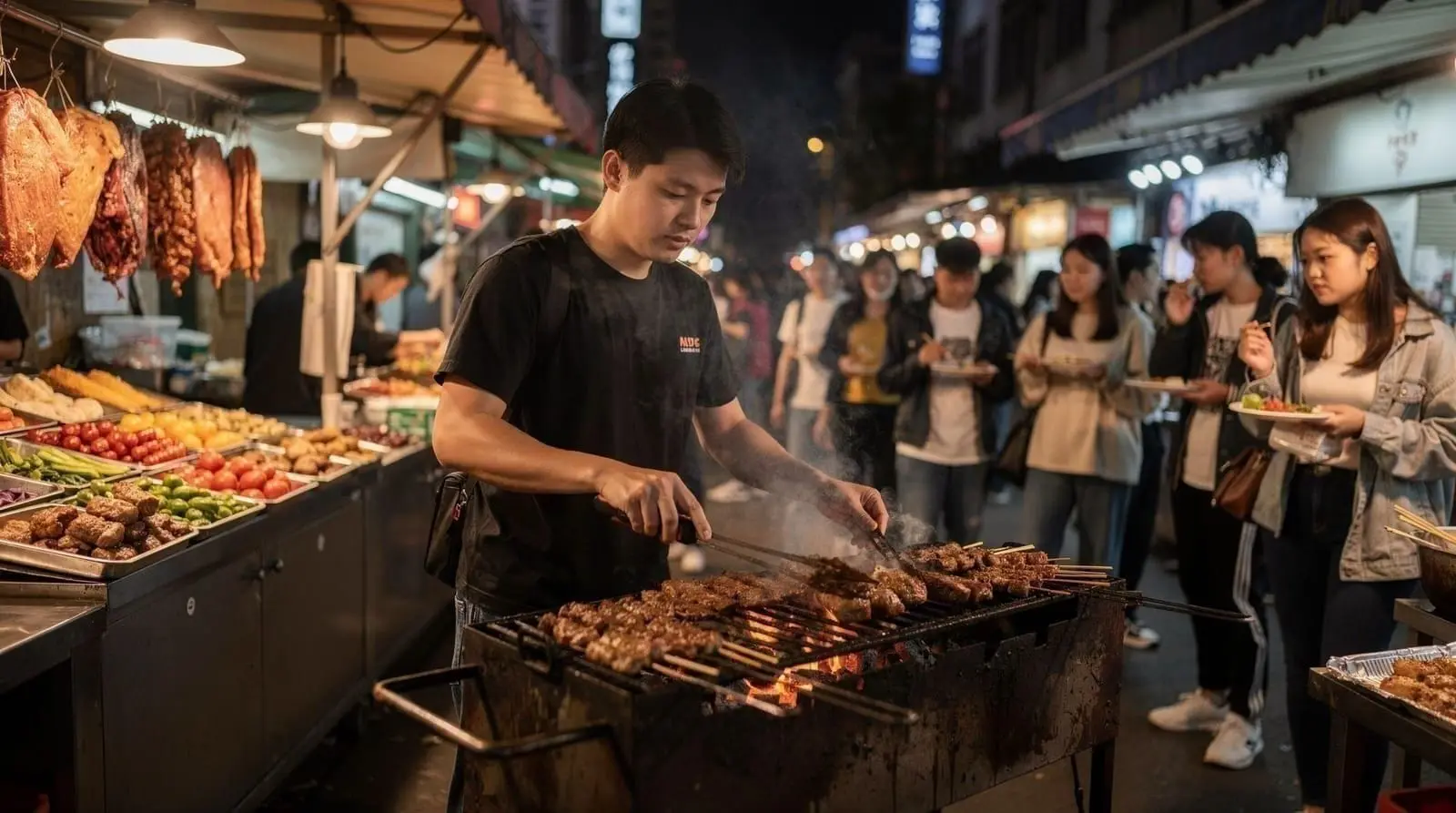
Dongmen street food guide — eating through Shenzhen's oldest market
What should I eat at Dongmen in Shenzhen?
Dongmen Pedestrian Street in Luohu is Shenzhen's busiest street food zone. Top picks are stinky tofu, hand-pounded beef meatball noodles, oyster omelette, and grilled skewers. Budget CNY 30–60 (~USD 4–9) for a full street food crawl. Metro Line 1 to Laojie Station.
Dongmen Pedestrian Street (东门步行街) is the oldest commercial zone in Shenzhen and one of the few places in the city that predates the Special Economic Zone era. The market here was trading before Shenzhen became a city — a wet market that evolved into a clothing and electronics bazaar surrounded by food stalls, and later into the street food destination locals bring visitors to when they want to show off the city’s chaotic energy.
It’s not elegant. The alleys behind the main pedestrian street smell of cooking fat and fermented tofu. There are fluorescent lights, plastic stools, and vendors shouting. It’s also genuinely delicious if you know what to order and what to skip.
| Where | Dongmen Pedestrian Street, Luohu (Metro Line 1, Laojie Station) |
| Best time | Weekday evenings 5–10pm; weekends busier |
| Cost | CNY 120–150 (~USD 17–22) for a full food crawl |
| Don’t miss | Stinky tofu, oyster omelette, hand-pounded beef meatball noodles |
| Payment | WeChat Pay/Alipay everywhere; cash also works |
The history of Dongmen — Shenzhen before the boom
Understanding what Dongmen was helps explain what it is. The area around today’s pedestrian street was the original Shenzhen Xu (深圳墟) — a market town that served the surrounding Hakka and Cantonese villages for centuries before the SEZ. “Shenzhen” as a place name long predates Shenzhen the city; it referred to this river-side market settlement where villagers traded produce, fish, and dry goods.
The pre-SEZ market town Shenzhen Xu was a functioning market town when the SEZ was designated in 1980. Unlike the flat farmland to the west where Futian now stands, the Dongmen area had density: narrow streets, a wet market, a riverside trading zone, and a small but established commercial ecology. Early SEZ workers and administrators concentrated here partly because existing housing and food infrastructure was already in place. The first generation of Shenzhen migrants ate in Dongmen’s canteens and morning markets.
1980s transformation Through the 1980s, Dongmen evolved rapidly. The clothing trade arrived first — garment workers from Guangdong, Fujian, and Zhejiang set up stalls selling fabric and finished clothing in the covered markets that still line the back alleys today. Food vendors expanded around the clothing market, feeding the shoppers and stall operators. By the late 1980s, the area had the basic character it still has: clothing and accessories at the front, food and snacks threading through the alleys.
The pedestrianization era In the 1990s, Shenzhen pedestrianized the main commercial axis — creating the Dongmen Pedestrian Street that functions today — and renovated the surrounding blocks into a mixed commercial and entertainment zone. This modernization preserved the commercial character while reducing some of the rawer market atmosphere. The back alleys, however, remained largely as they were: tighter, less renovated, and significantly more interesting for food.
What remains Today’s Dongmen is a palimpsest of its own history. The main pedestrian street is fully modern, lined with fashion brands and chain restaurants. One block behind it, the food alley ecosystem has continuity with the 1980s market — some of the families running stalls today have been in the same location for decades. Two blocks behind that, the wet market operates much as it has for generations. Dongmen is simultaneously Shenzhen’s most tourist-oriented food zone and its most historically continuous one.
Getting to Dongmen
Metro Line 1 to Laojie Station (老街站) puts you at the edge of the main pedestrian zone. From exit B, you’re on the street within two minutes. The area is walkable and compact — the food zone covers about six city blocks.
Alternatively, Line 3 to Dongmen Station gives a slightly different entry point into the northern end of the market. Line 1 is generally faster from Futian or Nanshan.
Hours: The main pedestrian street has vendors from around 10am, but the best street food energy builds from 5pm onward and peaks between 7pm and 10pm. Weekend evenings are the most vibrant but most crowded. If you want to eat without elbow-to-elbow crowds, come on a weekday evening.
Morning in Dongmen: the wet market and breakfast stalls
The evening food crawl gets all the attention, but Dongmen’s morning character is equally interesting and dramatically less crowded. Between 6am and 10am, a different food economy operates.
The wet market The covered wet market running off the pedestrian zone’s side alleys is most active in the early morning. By 7am, fishmongers have laid out overnight catches from Guangdong’s coast — live crabs in tanks, fresh shrimp in ice trays, whole fish still showing color. Vegetable vendors have set up next to them with early-season produce. The wet market operates daily until around 7pm but peaks before noon; the best selection of fresh seafood and produce is gone by 10am.
Walking through the wet market even without buying anything is worthwhile for context. You’ll see the raw materials of every Chaoshan and Cantonese dish in the surrounding restaurants. The fish paste counter — where fresh fish paste is pounded or ground for fish balls — is near the center of most Luohu wet markets; watch the process if you haven’t seen it before.
Cantonese breakfast stalls Alongside the wet market, a cluster of Cantonese breakfast vendors operates through the morning:
- Congee stalls (粥店): Open from 6am, serving thick Cantonese-style jook (not the thin Chaoshan variety) with century egg and pork, fresh fish, or plain salted versions. CNY 10–18 per bowl.
- Cheung fun stalls (肠粉): Fresh rice noodle rolls made to order, with shrimp, beef, or char siu filling. The stalls with the longest queues before 9am are the reliable ones. CNY 8–15 for a plate.
- You tiao (油条) vendors: Deep-fried dough sticks, eaten with congee or dipped in soy milk. CNY 3–5 for two sticks.
- Dim sum canteens: Several ground-floor Cantonese canteen-style operations near Laojie Station serve trolley dim sum through the morning — less refined than the teahouses in Futian but cheaper (CNY 40–60 per person) and genuinely local. These are the places where Luohu residents eat on weekend mornings.
For a more focused guide to dim sum options in Luohu and beyond, see the Shenzhen dim sum guide. Arriving before 8am for the wet market and breakfast stalls also means you’ll have Dongmen’s usually-crowded main pedestrian street almost to yourself, which makes for a much easier walk-through of the clothing market stalls before the afternoon shopping crowds build.
The essential Dongmen street food
Stinky tofu (臭豆腐)
The Dongmen stinky tofu vendors are some of the most debated in Shenzhen. The dish — fermented tofu deep-fried until crisp-exterior and custardy-interior, served with sweet chili sauce and pickled vegetables — has a sulfurous, powerful smell that hits you from 20 meters away.
If you’ve never tried it: the smell is deceiving. The taste is much milder than the aroma suggests — nutty, savory, with a crispy shell and soft center. The best versions in Dongmen come from the vendors along the eastern alleys behind the main pedestrian street, where the tofu ferments on-site in clay pots rather than arriving pre-processed.
Standard price: CNY 10–15 for six pieces. Avoid any vendor charging CNY 20+ for “premium” versions — the quality differential doesn’t exist.
Oyster omelette (蚝烙)
Multiple vendors along the south end of the pedestrian zone serve the Chaoshan oyster omelette. The quality varies significantly between stalls. Look for vendors using small, live oysters from an iced cooler rather than pre-shucked oysters from a plastic bag — the difference in flavor is stark.
A good oyster omelette has a crispy outer ring from the sweet potato starch, a softer center, and oysters that are plump and barely cooked. Overcooked oysters shrink to tough pellets. Price: CNY 25–38 for a single-serving omelette.
Hand-pounded beef meatball noodles (手打牛肉丸面)
Several Chaoshan noodle shops occupy the alley market directly south of Laojie Station. The hand-pounded beef meatballs here are made fresh each morning — you’ll see vendors working wooden mallets in open kitchens before lunchtime. A bowl of flat rice noodles with mixed beef meatballs and tendon in clear broth: CNY 20–28.
The tell for quality: the meatball should have a firm, bouncy texture that yields cleanly when bitten, not a soft, spongy give. Frozen meatballs crumble; fresh ones snap.
Grilled skewers (烧烤串)
From around 6pm, barbecue smoke fills the alleys near Xinhua Road as skewer vendors fire up their charcoal grills. Chicken thigh, pork belly, lamb, shrimp, enoki mushrooms in foil, corn, and dozens of vegetable options arrive on bamboo skewers dusted with cumin and chili.
The best cluster of skewer vendors is on the small streets two blocks east of the main pedestrian zone — look for the smoke. Prices are typically CNY 3–8 per skewer. A satisfying serving of 8–12 skewers costs CNY 30–50.
Note on hygiene: Stick to vendors with visible live coals (not electric heating), where skewers are cooked to order rather than sitting under heat lamps. The busy ones with queues are usually the safest bet.
Claypot rice (煲仔饭)
Small claypot rice stalls operate throughout Dongmen’s back alleys, particularly in cooler months (October to March). Washed rice cooks directly in a small clay pot over charcoal, absorbing sauce as it goes, with toppings — preserved sausage, salted fish and pork, or chicken — placed on top to steam. The crust at the bottom (饭焦, fàn jiāo) is the most prized part — scrape it from the pot and eat it as crackers or mix it into the dish.
One pot serves one person: CNY 22–38. Order at least 20 minutes before you want to eat — they can’t be rushed.
Cold sesame noodles and Chongqing noodles
The Dongmen area has absorbed migrants from across China, and the noodle options reflect that. Walk the side streets and you’ll find Chongqing-style spicy noodles (重庆小面), cold sesame noodles (凉面), and hand-pulled Lanzhou beef noodles (兰州拉面) within 200 meters of each other.
For spice-seekers: the Chongqing small noodle stalls near the north end of the market are the real deal — thin noodles with chili oil, Sichuan pepper, preserved vegetables, and peanuts, adjusted to heat level on request. CNY 15–22 per bowl.
Afternoon eating: noodles and rice shops around Dongmen
The 12pm–4pm afternoon window in Dongmen is less dramatic than evening street food but has its own reliable options — air-conditioned restaurants, proper sit-down noodle shops, and the rice box (饭盒) culture that feeds Luohu’s working population.
Cantonese rice box shops (粤式快餐) On the residential streets immediately north and west of the main pedestrian zone, a dense cluster of Cantonese fast-food rice shops offers lunch plates at CNY 18–30 — two or three dishes over white rice, self-selected from a steam table or ordered from a short menu. These places feed construction workers, office staff, and market vendors. The food is plain, hearty, and representative of what most Shenzhen residents eat daily rather than what appears in restaurant guides. Steamed fish, braised tofu, stir-fried water spinach, and barbecued pork are the typical anchor dishes.
Lanzhou beef noodles Several Halal Lanzhou-style beef noodle shops operate on the side streets near Dongmen, open through lunch and into the afternoon. The characteristic hand-pulled noodle in a clear beef bone broth with a slice of braised beef and a few strands of cilantro is one of China’s most widely replicated northern dishes, and the Dongmen versions are reliably good. CNY 14–22 per bowl, with noodle width specified to order (hair-thin to flat-wide, typically five options). Recommended for a quick, substantial afternoon meal.
Chaoshan beef noodle shops at lunch The Chaoshan noodle shops that operate as breakfast stalls restart for a lunch service around 11am. By noon they’re serving the most complex version of the menu — mixing meatballs with tendon slices, brisket, and offal options alongside the standard bowl. Queues from the morning have cleared; this is often the most comfortable time to try the dish. CNY 22–35 for a full mixed bowl.
Sit-down Cantonese restaurants for afternoon dim sum A handful of ground-floor Cantonese restaurants near Laojie Station continue dim sum service until 2–3pm. These aren’t the best dim sum in Shenzhen — for that, see the dim sum guide — but they’re convenient if you’re already in the Dongmen area and want a sit-down eating break with tea. Budget CNY 50–80 per person.
What to skip at Dongmen
Overpriced “tourist” claypot: Some vendors near the main pedestrian street entrance post English-language signs and charge CNY 60–80 for claypot rice that neighborhood restaurants sell for CNY 22–35. The food is not different; you’re paying for proximity to the tourist zone.
Pre-packaged snacks sold as “local specialty”: Vacuum-sealed “Shenzhen specialties” (深圳特产) sold in gift-pack format in the pedestrian zone are almost all factory-produced industrial snacks. Buy them if you want a souvenir, not if you want food quality.
Sellers approaching you for “special deals”: Anyone who proactively approaches you to suggest a specific restaurant or stall in Dongmen is likely receiving a referral fee. Walk past and find your own entry point — the good stalls have queues.
Overpriced fresh juice: CNY 25–35 for a fresh juice at Dongmen entrance stalls is double what you’d pay a block away. Walk 100 meters inward before buying drinks.
Dongmen beyond food: shopping the side streets
The food is the main reason to visit Dongmen as a tourist, but the shopping ecosystem that exists alongside it is worth understanding — both because it tells you something about the area’s character and because it’s practically useful if you’re looking for specific items.
The clothing market Dongmen’s clothing market is a direct descendant of the 1980s garment trade. The covered market buildings between the main pedestrian street and the wet market contain hundreds of stalls selling everything from fast fashion to sportswear to traditional clothing. Quality ranges enormously. The wholesale floors (usually above street level) sell to retailers in minimum quantities; the ground-floor stalls sell individual items.
Tourist trap warning: the first stalls visible from the pedestrian street entrance often have the highest markups and lowest quality. Walk deeper into the market and prices drop noticeably. For clothing, it’s worth comparing several stalls before buying — identical items often vary by 30–50% in asking price between the first stall and the tenth.
Accessories and costume jewelry The south section of the market has a concentration of accessories stalls — bags, belts, hair accessories, sunglasses, phone cases. Quality control is variable; treat these as disposable fashion purchases rather than durable goods. CNY 20–80 for most items.
Haggling Haggling is expected in Dongmen’s stall market but not in its restaurants or chain stores. The standard approach: ask the price, offer 50–60% of the initial ask, let the vendor counter, and settle somewhere around 65–75% of the original price. Don’t feel obligated to buy after negotiating — walking away is also accepted and sometimes triggers a better offer. Friendly persistence works better than confrontational bargaining.
Electronics accessories A few stalls near the northern end of the market sell phone accessories, cables, and small electronics — cases, chargers, earphones. These are convenient but significantly cheaper at Huaqiangbei, Shenzhen’s dedicated electronics district. For anything more complex than a phone case, make the trip to Huaqiangbei instead.
Dongmen with kids
Dongmen is family-frequented by Shenzhen locals, which means it’s practical for family visits — but it helps to know the terrain in advance.
Kid-friendly food options Many of Dongmen’s most popular foods translate well to children:
- Stinky tofu: surprisingly popular with kids once they get past the smell. The texture is approachable and the flavor is mild.
- Grilled corn: vendors sell whole cobs brushed with seasoning, CNY 8–12. Universally appealing.
- Grilled sweet potato: charcoal-baked sweet potatoes from pushcart vendors, CNY 5–10.
- Fish ball skewers: mild, bouncy, not spicy. Reliably enjoyed by children across cultures.
- Mango sticky rice (from Southeast Asian stalls in the market): sweet, familiar, and usually found near the dessert vendor clusters.
Avoid taking young children to the stinky tofu vendor clusters — the smell is genuinely overwhelming at close range. Also steer clear of the spicy skewer vendors for smaller children; cumin-heavy Xinjiang-style lamb skewers are manageable, but the chili-heavy options are not.
Safety considerations The Dongmen crowds on weekend evenings can be very dense — the kind of density where a small child could be easily separated. Consider keeping children on shoulders or in carriers during peak hours (7pm–9pm on Saturdays). The main pedestrian street is wide enough to navigate comfortably, but the back alleys narrow significantly and crowds feel more intense.
During cooler months (October–March), the crowds thin somewhat and the outdoor food experience is more comfortable for families. Summer evenings can be uncomfortably hot and humid even after dark.
Practical logistics for families Strollers are technically manageable on the main pedestrian street but difficult in the back alleys. Baby carriers are more practical. Public restrooms exist in the main commercial buildings along the pedestrian street — look for the signs on building pillars. The nearest metro station (Laojie, Line 1) has elevators.
Dongmen as a food crawl — a suggested route
Early evening (6pm start): Exit Laojie Station from exit B. Walk south on the pedestrian street. Stop at the first cluster of oyster omelette vendors (look for the big wok on the right side of the alley, about 5 minutes’ walk from the metro exit). Eat one omelette (CNY 28).
Continue south toward the main clothing market area. Find the covered alley market behind the main pedestrian street — this is where the stinky tofu and meatball noodle stalls concentrate. Order a bowl of beef meatball noodles (CNY 22) and watch the stinky tofu being fried.
At 7pm, follow the smoke east toward Xinhua Road and find the skewer zone. Order 10 skewers (budget CNY 40) — mix protein and vegetables.
Finish at one of the claypot rice stalls for a hearty close (CNY 28–35). Total spend for a complete Dongmen food crawl: CNY 120–150 per person (~USD 17–22), plus drinks.
Dongmen beyond street food
The area around the market has a full ecosystem. Upstairs from many stalls are air-conditioned Cantonese and Chaoshan restaurants if you want a full sit-down meal after the street crawl. The wet market area (accessible from the pedestrian zone’s side alleys) operates until about 7pm selling fresh produce, live seafood, and spices — interesting to walk through even if you’re not buying.
For the daytime shopping dimension of Dongmen, the Shenzhen best shopping malls guide covers what to find here versus the malls. The nearby Luohu district guide has accommodation options in the area. And if you want to understand the broader Shenzhen food scene across multiple cuisine traditions, start with the Chaoshan cuisine guide.
Take a guided Dongmen and electronics market tour combining the food street with Shenzhen’s tech market scene — especially useful for first-time visitors who want a curated entry point to both Luohu’s chaotic energy.
Book a food-focused Shenzhen walking tour if you’d prefer a local guide to navigate the stalls, translate, and steer you toward the highest-quality vendors in the Dongmen area.
Seasonal specialties worth timing your visit around
Dongmen’s stall lineup shifts slightly through the year, and a handful of seasonal dishes are worth planning a trip around if you have flexible dates.
Autumn and winter (October–March): claypot rice season is at its best, with vendors using the cooler weather to justify longer charcoal cooking times and thicker sauces. This is also when Dongmen’s hot soup stalls — often overlooked in favour of the flashier grilled and fried options — come into their own, particularly the beef tendon and offal soups sold from small counters near the wet market.
Spring (March–April): fresh bamboo shoots and spring greens appear in the wet market and filter into the noodle shops as seasonal toppings. Look for restaurants advertising 春笋 (chūn sǔn, spring bamboo shoot) dishes on handwritten boards — these rotate off the menu once the season passes.
Summer (May–September): cold noodle dishes and iced sweet soups become more prominent at the dessert stalls near the market’s southern end, a practical response to the heat. This is also when mango sticky rice and other cooling desserts are most heavily promoted by vendors.
Chinese New Year period: some of Dongmen’s older family-run stalls close for several days to a week around the holiday (February 15–23, 2026) to return to their home provinces — a reminder that many vendors here are themselves part of Shenzhen’s migrant workforce, the same demographic the market has served since the 1980s. Check ahead if visiting during this window, and see the best time to visit Shenzhen guide for the fuller citywide picture during this period.
Dongmen versus Shenzhen’s other food destinations
Dongmen is Shenzhen’s most tourist-accessible street food zone, but it isn’t the only one, and knowing where it fits helps set expectations. If you’re specifically chasing Hakka cuisine, the Hakka-influenced dishes at Dongmen’s canteens are a decent introduction but not as deep as dedicated Hakka restaurants elsewhere in the city. If your interest is Chaoshan cuisine specifically, Dongmen’s oyster omelette and beef meatball noodle stalls are genuinely representative — this is one of the better places in Shenzhen to try both without seeking out a specialist restaurant.
For an evening that pairs street food with drinks, Dongmen itself has limited late-night bar culture compared to Shenzhen’s rooftop bars or the craft beer scene covered in the Shenzhen craft beer and bars guide — most visitors treat a Dongmen food crawl as a standalone evening and head to Shekou or OCT-LOFT afterward for drinks, rather than trying to combine both in Luohu.
Best season for a Dongmen visit: Dongmen works year-round since most eating happens under cover or in narrow alleys with some shelter, but the outdoor plastic-stool seating is far more pleasant October through April than during Shenzhen’s peak summer humidity. See the best time to visit Shenzhen guide for the fuller seasonal picture — a hot, humid July evening in Dongmen’s crowded alleys is a genuinely different experience from a crisp November one.
Getting there and away: Metro Line 1 to Laojie is the standard route covered above; the Shenzhen metro guide has the full network map if you’re coming from further afield like Nanshan or Futian. Weekday off-peak trains are quick and uncrowded; if you’re heading straight from a full day of sightseeing elsewhere in the city, factor in that Line 1 can get genuinely packed during the evening commute (5:30–7pm), which is exactly when you’ll want to arrive for the best food energy.
Frequently asked questions about Dongmen street food
Is Dongmen street food safe to eat?
Generally yes. The high-volume stalls with visible queues and fast turnover are the safest bet. Avoid pre-cooked food sitting under heat lamps. The health inspection standards are adequate in this area; the real risk is from lower-traffic stalls where food sits. Go where locals go.
What’s the best time to visit Dongmen for food?
Friday and Saturday evenings between 6:30pm and 9:30pm for maximum energy and full vendor selection. Weekday evenings are calmer but still have most food options. Sunday evenings are good but slightly less vibrant than Saturday. Daytime is mostly clothing shopping with limited food vendor activity.
Do Dongmen street food stalls accept WeChat Pay?
Most stalls now have WeChat Pay and Alipay QR codes. Cash (CNY notes) works everywhere. Foreign cards directly are rare. Set up WeChat Pay linked to a foreign Visa/Mastercard before arriving. Full setup instructions in the WeChat Pay and Alipay guide.
How spicy is the food at Dongmen?
Most Cantonese and Chaoshan dishes (oyster omelette, meatball noodles, dim sum) are mild. The Sichuan and Chongqing stalls can be very spicy — ask for 微辣 (wēi là, mildly spicy) if you want to ease in. Grilled skewers are usually medium spice by default.
Can I eat vegetarian at Dongmen?
Yes, with some navigation. Grilled vegetables, plain noodles with sesame sauce, tofu skewers, stinky tofu (vegetarian preparation), and claypot rice with vegetable toppings are all available. Most stalls use pork-based broths in noodle soups by default — specify 素 (sù, vegetarian) and most vendors will adapt.
Are there other Shenzhen tourist traps I should watch for beyond Dongmen’s pricing issues?
Yes — a handful of pricing and quality issues recur across Shenzhen’s tourist-facing food and shopping areas, not just Dongmen. See the Shenzhen tourist traps guide for the fuller list, including similar entrance-pricing patterns at other markets.
What’s the best season to do a Dongmen food crawl?
October through April, when the evening temperature makes standing at open-air stalls comfortable rather than sweaty. Summer (June–August) evenings are still busy and the food is unaffected, but the combination of heat, humidity, and dense crowds is significantly less pleasant than a cool autumn or spring night.
Top-rated things to do in Shenzhen
Verified deep-linked GetYourGuide tours. Book through these links and we earn a small commission at no cost to you.