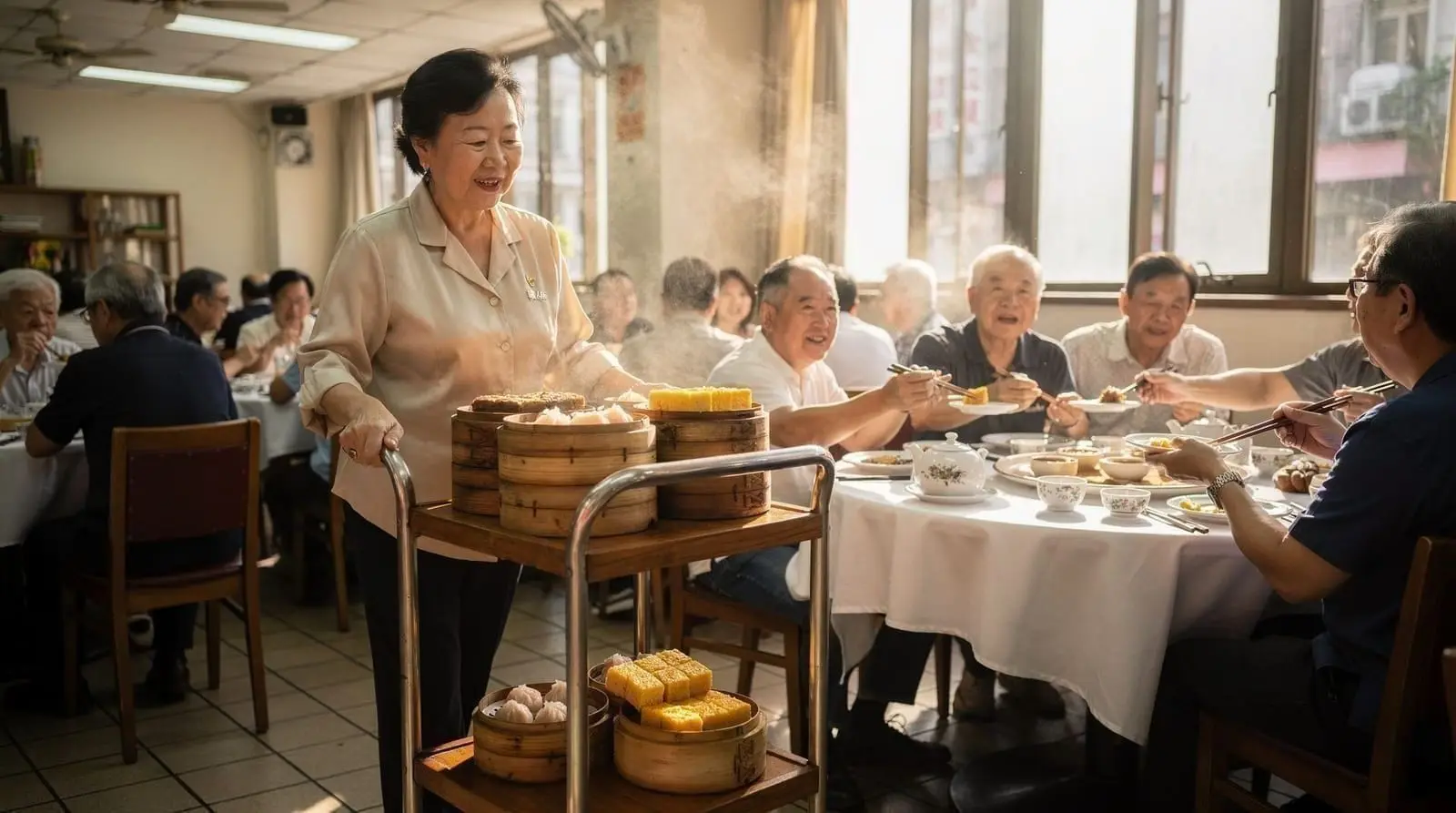
Hong Kong dim sum guide: where to eat, what to order, and how it works
Where is the best dim sum in Hong Kong and how much does it cost?
For quality without queue: Tim Ho Wan (HKD 50–80/head, Michelin star), Lin Heung Tea House (HKD 80–120, old-school trolley service), or Lung King Heen (Four Seasons, HKD 400+, highest-rated). Budget HKD 80–150 per person at a good neighbourhood dim sum house. Go before 11 am or after 1:30 pm to avoid peak queues.
Hong Kong is where yum cha — the Cantonese tea-drinking tradition from which dim sum emerges — is practised with a seriousness and consistency you will not find anywhere else in the world, including Guangzhou. The city has hundreds of dim sum restaurants operating across every price bracket, from Michelin-starred rooms to basement teahouses that have been serving the same dumplings for 50 years. This guide tells you what to order, where to go, how the ritual works, and what to expect as a foreign visitor.
| Where | Central, Sham Shui Po, Kennedy Town, and citywide |
| Cost | around HKD 80–150 per person, budget to mid-range |
| Best time | before 9 am or after 1:30 pm to avoid peak queues |
| Booking | not usually needed at neighbourhood spots; book ahead for Lung King Heen |
| Pairs with | a morning walk before, since the meal can run 2–3 hours |
What dim sum actually is
Dim sum (點心, literally “touch the heart”) refers to the individual dishes — small steamed, fried, or baked portions served in bamboo steamers or on small plates. Yum cha (飲茶, “drink tea”) is the broader cultural practice: going to a restaurant in the morning or at midday, drinking tea, and ordering continuously from a rotating cart or menu. The two terms are often used interchangeably in English.
The core principle: you come with people, you order many dishes shared among the table, you eat them in no particular sequence, and you leave around noon or 1 pm. It is social eating at its most relaxed.
Dim sum is fundamentally a breakfast and lunch tradition. Most restaurants stop serving at 3–4 pm. The morning sitting (7–10:30 am) is the traditional one — this is when elderly Cantonese men read newspapers over tea before work. The lunch sitting (11 am–2 pm) is busier and more varied in clientele.
What to order: the essential dishes
Har gow (蝦餃, shrimp dumplings): The benchmark of any dim sum kitchen. Translucent rice-flour skin, filling of whole prawns, sealed in a fan-fold crimp. The skin should be thin enough to see the pink shrimp through it, yet hold together when you pick it up. Usually 3 per order, HKD 30–60.
Siu mai (燒賣, pork and shrimp dumpling): Open-topped pleated dumplings, usually with a dot of fish roe or crab on top. The pork filling should be coarse-ground, not pasty. Order alongside har gow.
Char siu bao (叉燒包, BBQ pork bun): Two versions — steamed (fluffy white domed bun) and baked (golden, slightly sweet crust). Baked char siu bao from Tim Ho Wan is one of the most discussed single dim sum items in Hong Kong.
Cheung fun (腸粉, rice noodle rolls): Silky rice-flour noodles rolled around prawns, char siu, or beef, steamed and cut, served with soy sauce and sesame paste. Order the version with prawns (蝦腸粉).
Lo mai gai (糯米雞, sticky rice in lotus leaf): A pyramid of glutinous rice packed around chicken, mushroom, and Chinese sausage, steamed inside a lotus leaf. Substantial — one is usually enough for two people.
Turnip cake (蘿蔔糕, lo baak gou): Pan-fried savory cakes made from shredded turnip and rice flour. Crispy outside, soft inside, eaten with soy sauce. A Hong Kong dim sum staple less common in mainland China versions.
Taro dumpling (芋角, woo gok): Lacy fried pastry made from mashed taro, filled with pork and mushroom. The latticed shell is difficult to make and a mark of kitchen skill.
Egg tart (蛋撻, daan taat): A Hong Kong pastry hybrid — Portuguese-influenced custard in a butter-pastry shell, or sometimes puff pastry. The custard should be barely set, still wobbly. These come out of the oven periodically; ask when the next batch is ready.
Turnover puffs (咖哩魚蛋, curry fishballs): Less common in upper-tier restaurants but ubiquitous in cheaper places — fishballs in mildly spiced curry sauce. Good with rice.
The tea: what to order and how it works
You choose your tea first. This is not optional — the cover charge at most dim sum restaurants includes a pot of tea per person. Common choices:
- Bo lei / Pu’er (普洱): Earthy aged tea. The traditional choice for cutting through oil. Pairs well with fatty pork dishes.
- Jasmine (茉莉): Floral, mild. Good if you find pu’er too strong.
- Chrysanthemum (菊花): Sweet, floral, light. Popular with older patrons.
- Dragon Well / Long Jing (龍井): Green tea, delicate and grassy.
The tea pot is kept filled throughout — signal the server when you need more hot water by flipping the lid of the teapot to rest at an angle. This is the universal Hong Kong signal for “please refill.”
Tea etiquette: When someone refills your cup, tap two fingers on the table (a gesture of thanks originating from a Qing dynasty story about the Emperor incognito). This is widely practised and appreciated.
Where to eat dim sum in Hong Kong: by category
Budget and local: under HKD 120 per person
Lin Heung Tea House (林香茶室), 160–164 Wellington Street, Central: One of Hong Kong’s last genuine trolley-service dim sum restaurants. Servers push carts through the room; you flag down what you want. Noisy, packed with regulars, no English menu. Prices are excellent. This is what dim sum restaurants looked like across Hong Kong 30 years ago. The char siu bao, wu gok, and lo mai gai are reliable. Arrive before 9 am or after 1 pm. Cash only.
Yum Cha (multiple locations — Central, Mong Kok, Tsim Sha Tsui): Modern casual chain with creative takes on classic dim sum. English-friendly ordering via iPad. Good quality control. HKD 80–130 per person. Reasonable queues compared to the famous standalone houses.
City Hall Maxim’s Palace, City Hall Low Block, Central: A vast traditional dim sum hall, 1500 seats, famous for being very large and very old-school. Trolley service. Good for getting the classic experience without the intimidation factor of smaller local spots. HKD 80–120 per person.
Mid-range: HKD 150–280 per person
Tim Ho Wan, multiple locations (IFC Mall Central, Sham Shui Po, Mong Kok): The world-famous “cheapest Michelin-starred restaurant” that started in a tiny storefront and is now a chain with locations across Asia. The original Hong Kong locations maintain solid quality. The signature baked BBQ pork bun is essential. Queue at busy locations can reach 45 minutes; the IFC Mall location is generally shortest. HKD 100–150 per person.
One Dim Sum (一點心, Prince Edward): Known among food writers as one of the best value-per-quality dim sum in Hong Kong. The har gow and siu mai are particularly well-executed. Expect to queue on weekends. HKD 80–150 per person.
Luk Yu Tea House (陸羽茶室), 24–26 Stanley Street, Central: Opened in 1933, preserved in its original dark-wood and stained-glass interior, Luk Yu is a Hong Kong cultural monument. The food is not the cheapest and not the most innovative, but eating here is eating in a room that has looked the same since before the Second World War. Morning sittings only. HKD 150–200 per person.
High-end: HKD 300+
Lung King Heen (龍景軒), Four Seasons Hotel, 8 Finance Street, Central: The most decorated dim sum restaurant in Hong Kong — three Michelin stars, the first Chinese restaurant anywhere to receive three stars (2009). The harbour views from the fourth floor are spectacular. The har gow here is arguably the finest in Hong Kong: thinner skin, larger prawns, more precise crimping than anywhere else. Reservation essential (book weeks ahead). HKD 400–600 per person.
The Dim Sum Place and Summer Palace (Island Shangri-La): Both offer premium dim sum in hotel settings with service levels more attentive than most local restaurants. Good for a business meal or a special occasion.
A food tour for deeper exploration
If you want to explore Hong Kong’s food scene more systematically — including dim sum and other street food — guided food tours are good value:
Hong Kong street food tour with dim sum and wonton Hong Kong hidden gems food tour — dim sum and roast gooseThese tours typically cover 10–14 tasting stops across a neighbourhood, with a guide explaining Cantonese food culture. The tours that focus on Kowloon City, Sham Shui Po, or Kennedy Town tend to be more authentic than Central-based tours.
Ordering dim sum well takes local knowledge the menu does not supply: a private food tour with ten tastings alongside locals covers enough ground in one sitting to order confidently for the rest of the trip.
Neighbourhood dim sum: where to find local spots
Sham Shui Po (深水埗): One of Hong Kong’s oldest and least gentrified residential areas, northwest of Mong Kok. Multiple neighbourhood dim sum houses with very low prices and no tourist presence. Tim Ho Wan’s original (now closed) storefront was here.
Kennedy Town (堅尼地城): MTR Kennedy Town station, the western terminus of the Island Line extension. A genuine neighbourhood rather than a tourist district; the dim sum places here serve local residents. Less English spoken, good prices.
Wan Chai (灣仔): More mixed — some tourist-oriented restaurants, some local. The streets behind the Convention Centre toward Queen’s Road East have good neighbourhood options.
Causeway Bay (銅鑼灣): Dense with restaurants of all types. Dim sum quality varies widely; mid-range chains are reliable. Very busy on weekends.
From Shenzhen: Cantonese food comparison
Visitors coming from Shenzhen will notice similarities and differences between Shenzhen’s Cantonese food scene and Hong Kong’s. Shenzhen has excellent dim sum, but the Hong Kong version has a distinct character — slightly lighter flavours, more emphasis on delicate skins, the older-style trolley service now largely extinct in mainland Guangdong. If you enjoyed dim sum in Shenzhen’s Futian or Nanshan districts, Hong Kong will feel like a deeper version of the same tradition.
The Guangzhou Cantonese food guide offers a deeper comparison of the Guangdong dim sum tradition across the Greater Bay Area, including Guangzhou’s historic dim sum halls where the cuisine originated.
Hong Kong vs Guangzhou dim sum: quick comparison
| Hong Kong | Guangzhou | |
|---|---|---|
| Price | HKD 80–400+, higher overall | Lower for equivalent quality (CNY terms) |
| Service style | Mostly order-slip now, trolleys rare | Trolley service more common at historic halls |
| Best for | Michelin-tier execution, variety | Origin-city depth, historic institutions |
If you’re doing both cities on the same Greater Bay Area trip, expect Hong Kong to be pricier and more polished, and Guangzhou to feel more like the source tradition. Neither is objectively “better” — see Shenzhen vs Hong Kong for how the food scenes fit into a broader city comparison if you’re deciding where to spend more time. Shenzhen sits in between the two on price and formality, with a dim sum scene shaped more by migrant workers from across China than by a single unbroken local tradition — worth trying if you’re based there, but not a substitute for the historic halls of either Hong Kong or Guangzhou.
Practical tips
- Go on weekdays to avoid the worst queues at popular restaurants
- Arrive before 9 am or after 1:30 pm to miss the peak sitting
- Many local dim sum restaurants do not take reservations — queue in person
- “Do you have English menus?” — most mid-range and up restaurants do. At traditional places, point at others’ food or bring the Cantonese dish names with you
- Payment: most restaurants accept Octopus card and credit cards. Cash is still common at traditional teahouses.
- Tipping: not expected but rounding up (leaving HKD 20–30) is appreciated at local restaurants
Frequently asked questions about Hong Kong dim sum
What is the difference between dim sum and yum cha?
Yum cha (“drink tea”) is the ritual — going out for tea and ordering small dishes. Dim sum are the individual dishes themselves. In English-language conversation, both terms are used to refer to the whole experience.
Can you eat dim sum for dinner?
Most dim sum restaurants close by 4–5 pm. A few upscale hotel restaurants offer dim sum during dinner hours, but this is not the traditional practice. The experience is fundamentally a morning and early afternoon one.
Is dim sum expensive in Hong Kong?
Relative to the rest of Hong Kong’s restaurant scene, dim sum is very affordable. A satisfying meal at a neighbourhood teahouse costs HKD 80–130 per person. Even at a mid-range chain like Tim Ho Wan, two people can eat well for HKD 200–250 total.
Do I need to speak Cantonese?
No. Most restaurants popular with tourists have English menus or picture menus. At traditional places with Cantonese-only menus, photos on the menu are usually present. Pointing works. Learning the names of 3–4 dishes you want before going makes the experience smoother.
What tea should I order if I have no preference?
Pu’er (普洱) is the traditional pairing with dim sum — it cuts through the oil and complements the pork dishes. If you find it too strong, chrysanthemum or jasmine are milder and universally liked.
Is Hong Kong dim sum better than Guangzhou dim sum?
Different rather than strictly better. Hong Kong offers more refinement, variety, and Michelin-tier execution at the top end; Guangzhou offers the historic institutions where the tradition was standardised, generally at lower prices. See the Guangzhou Cantonese food guide if you’re comparing the two directly.
Can I get good dim sum near the Hong Kong–Shenzhen border?
Yes. Areas close to the border crossings, and Kowloon generally, have solid neighbourhood dim sum options without needing to travel into Central. If you’re day-tripping from Shenzhen, build dim sum into a Hong Kong from Shenzhen day trip itinerary rather than treating it as a separate excursion.
Top-rated things to do in Hong Kong
Verified deep-linked GetYourGuide tours. Book through these links and we earn a small commission at no cost to you.