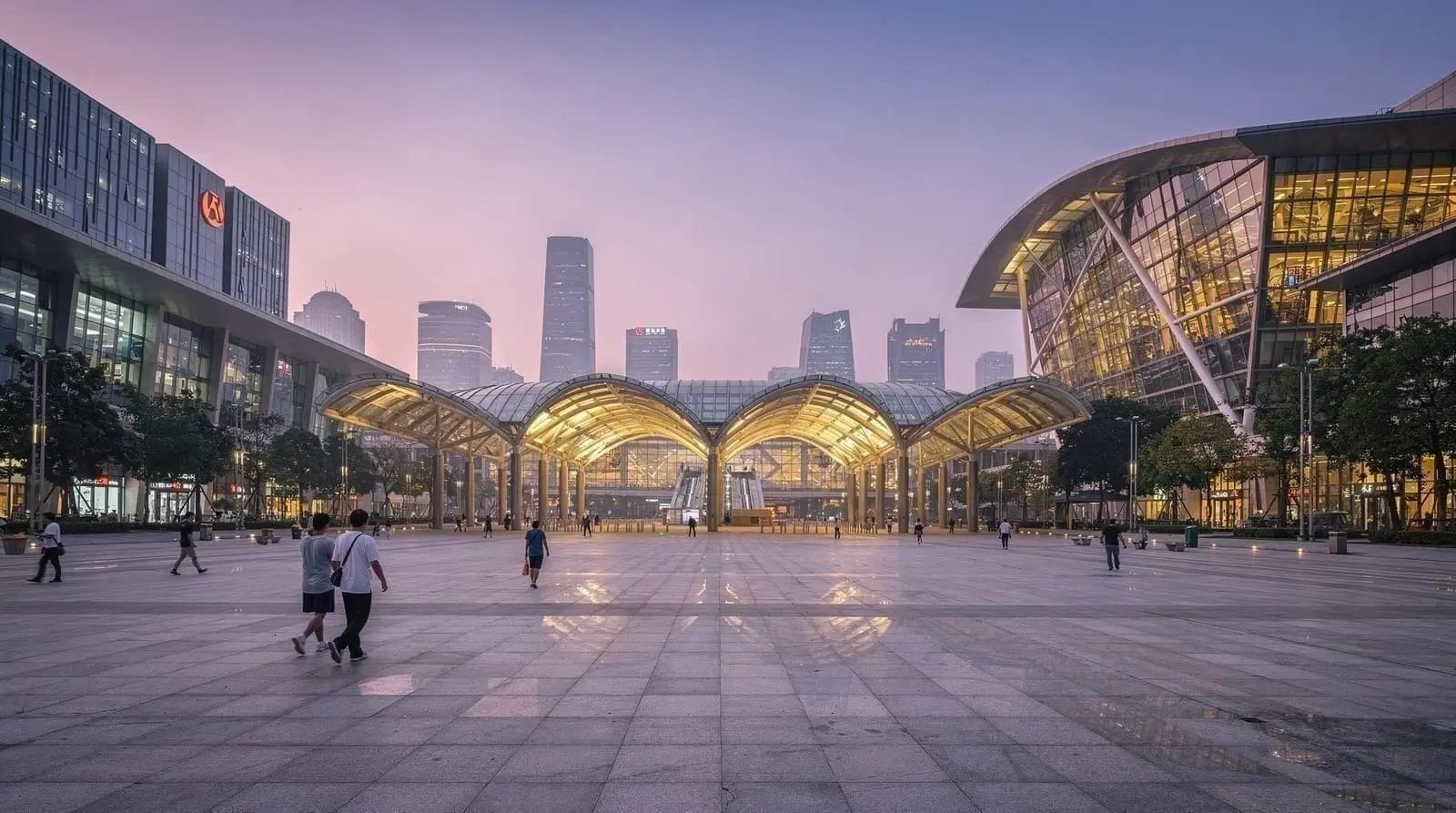
Futian is the part of Shenzhen that runs on time. Neat boulevards, landmark government architecture, gleaming malls, the city’s best-connected metro hub, and a high-speed rail station that puts Hong Kong 14 minutes away. If you’re visiting Shenzhen for the first time, Futian is almost certainly where you should base yourself — not because it’s the most interesting district, but because it is the most functional.
That functional excellence is not a small thing. In a city the size of Shenzhen, knowing you can get anywhere by metro in under 40 minutes, and can be in Hong Kong’s Central MTR station within 45 minutes of leaving your hotel, has real value when you’re planning days with multiple stops.
| Where | Central Shenzhen, Special Economic Zone core |
| Cost | Free parks and museums; Huaqiangbei purchases vary widely |
| Time needed | 1 full day for the district; 1–2 nights as a base |
| Getting there | Metro Lines 1, 2, 3, 4, 7, 10, 11; HSR to Hong Kong in 14 min |
| Best time | October–April for outdoor spaces; indoor sites year-round |
The heart of the Shenzhen Special Economic Zone
Futian sits at the geographic and administrative center of Shenzhen. The Civic Center — a massive public building with a sweeping curved green roof — anchors the CBD north of Shennan Boulevard, the city’s main east–west artery. South of the Civic Center, high-rise office towers house financial firms, law offices, and regional headquarters of tech companies that chose prestige address over the Nanshan campus density.
The district’s shape reflects its planning origins. Unlike older Chinese cities that grew organically, Futian was conceived as a grid from the 1990s onward. The streets are wide (often 6–8 lanes), the blocks are large, and the metro planning preceded the construction of most buildings. This gives Futian an efficient but occasionally impersonal quality — the opposite of Luohu’s chaotic energy or Shekou’s neighborhood feel.
The district borders Hong Kong at the Futian/Lok Ma Chau crossing. It is one of the two most efficient land border crossings between the two cities. The crossing is modern, well-signed in English, and handles meaningfully fewer travelers per hour than Lo Wu — average immigration processing time is 25–35 minutes off-peak, against 30–45 minutes at Lo Wu during similar conditions.
Getting around Futian
Futian is the most metro-dense district in Shenzhen. Metro Lines 1, 2, 3, 4, and 7 all run through it, with Lines 10 and 11 accessible via interchange at major hubs. Futian Station is the most important node — it handles both Shenzhen Metro Lines 3 and 4, and is a co-located stop on the Guangzhou–Shenzhen–Hong Kong high-speed rail (to Hong Kong West Kowloon: 14–18 minutes; HKD 85–170 depending on class).
Key intra-district journeys: Futian Station to Huaqiangbei (Lines 3/4, 2 stops, 5 minutes); Futian to Civic Center (10 minutes walk from Line 2 Civic Centre station); Futian to the border crossing (15 minutes by metro on Line 4).
Didi is widely available. Cross-district fares: Futian to Nanshan/Shekou, CNY 30–45 (~USD 4–7); to Luohu, CNY 15–25 (~USD 2–4); to the airport (Bao’an), CNY 80–120 (~USD 12–18).
Cycling within Futian is practical via the Meituan or Hellobike app bike-share systems. Dock-free bikes are widely scattered; expect to pay CNY 1.5–2 per 30 minutes. The area around Lianhuashan Park and Civic Center has dedicated cycling lanes. Avoid major roads during rush hours — six-lane Shennan Boulevard is not a comfortable cycling experience.
Huaqiangbei: the world’s largest electronics market
The Huaqiangbei area occupies northern Futian along Huaqiang Road North and South. The sheer scale makes description inadequate: SEG Plaza (华强广场) alone has 11 floors dedicated to electronics components, assembled products, and accessories. Huaqiang Electronics World (华强电子世界), Mingtong Digital Mall (明通数码城), Yuanwang Digital Mall (远望数码城), and a further dozen buildings create a contiguous commercial zone covering multiple city blocks.
What you can buy, and at what price:
- Phone accessories — USB-C cables (CNY 15–25), fast chargers (CNY 30–80), cases for virtually every current phone model (CNY 20–60). These are real bargains regardless of brand status.
- Consumer electronics — Earbuds, power banks, portable speakers. Quality varies dramatically; test before buying. A reputable brand like Xiaomi or Anker has official stores with fixed prices; unbranded alternatives at 40% less may or may not last 6 months.
- Drones — DJI has a flagship store near OCT (Nanshan), but Huaqiangbei dealers sell DJI products at prices competitive with or slightly below official retail.
The DJI Mini 4 Pro runs CNY 3,799 (~USD 558) officially; dealers offer CNY 3,500–3,600 for the same item.
- Electronic components — The upper floors of Huaqiang Electronics World sell individual components: capacitors, resistors, microcontrollers, LED strips, circuit boards. This is where hardware engineers and Makers come to source. It’s not primarily a tourist market, but it’s fascinating to observe.
- Cameras — Gray-market cameras exist here. Sony, Canon, and Nikon products sold below retail may be parallel imports (genuine goods from other markets) or refurbished. Warranty is the issue: parallel imports may not carry mainland China warranty. If that matters, buy from an official brand store.
Practical visiting notes: Go on a Tuesday or Wednesday morning. Weekends attract Shenzhen residents and day-trippers from Hong Kong, making the main floors genuinely crowded. The negotiation dynamic is also better on weekdays — sellers are less confident about finding another buyer and more willing to move on price.
Negotiation approach: For phone accessories and unbranded electronics, start at 40–50% of the opening price. Walk away when the seller doesn’t move below your target — they will often call you back. For branded products (DJI, Sony, Xiaomi), prices at official stores are fixed and dealers offer limited flexibility below retail.
Counterfeit risk: The upper floors of several buildings in the Huaqiangbei complex sell products that would constitute counterfeit branded goods in most import markets. A “Rolex” at CNY 300 is not a Rolex. Airpods at CNY 80 are not Apple products. The legal risk of importing such goods varies by destination country; customs confiscation at arrival is common. If you want genuine goods, stick to official stores or the clearly labeled genuine products on ground and lower floors.
Lianhuashan Park
Lianhuashan (Lotus Hill) Park is Futian’s most significant public space — 194 hectares of landscaped hillside with a prominent bronze statue of Deng Xiaoping at the summit, looking south over the CBD he authorized. The statue is large (6 meters), dramatically positioned, and surrounded by parkland that descends in terraces to the park’s southern gate.
The park itself is more naturalistic than many Chinese urban parks: actual mature trees (camphor, banyan, ficus), uneven grass hillsides, lotus ponds at the base, and walking paths that include some steep sections. Weekend afternoons at the south gate have consistent kite vendors and flying enthusiasts — the hilltop provides good updrafts. Bring or rent a kite if you’re visiting with children.
City views from the summit: decent during clear weather (October–November best); hazy June–September. The Ping An Finance Centre — Shenzhen’s tallest building at 599 meters — is visible to the east.
Metro: Lianhuashan Park station (Lines 2/11). Entry: free. Hours: 06:00–22:00. The park has multiple entrances; the south gate (closest to the metro) is the most used.
Honest note on crowds: On weekend mornings (09:00–11:30), the hilltop around the Deng Xiaoping statue is genuinely crowded with tourists and domestic visitors. If you want a more contemplative visit, come on a weekday morning or late afternoon.
Civic Center and the cultural district
Shenzhen Civic Center stands directly south of Lianhuashan Park on Shennan Boulevard. The building — designed by Lee, Timchula & Associates and completed in 2004 — has a distinctive split structure: two curved wings meeting in an open center, with a roof that rises to a sweeping peak over the central hall. It houses the municipal government offices and the main civic assembly spaces.
Adjacent buildings form a planned cultural cluster:
Shenzhen Concert Hall (深圳音乐厅): Home to the Shenzhen Symphony Orchestra. The concert hall has strong acoustics and hosts visiting international orchestras. Tickets: CNY 80–800 depending on performance; check the official schedule at szsymphony.com.
Shenzhen Library (深圳图书馆): One of the larger public libraries in southern China. English-language section is limited but the building’s reading rooms are open to visitors without a library card. Free. Hours: Tuesday–Sunday, 09:00–21:00.
Shenzhen Museum (深圳博物馆, Ancient History Branch): Covers Shenzhen’s history from prehistoric habitation through the founding of the Special Economic Zone. Good English labels. Free. Hours: Tuesday–Sunday, 10:00–18:00. Metro: Children’s Palace station (Line 2).
Urban Planning Exhibition Hall: Inside the Civic Center complex, a large exhibition with a 1:1000 scale model of the city as planned through 2030. Useful for understanding Shenzhen’s spatial organization before exploring it. Free. Hours: Tuesday–Sunday, 09:00–17:00.
Shenzhen Book City and literary culture
The Futian Culture District (文化中心 cluster north of Shennan) houses Shenzhen Book City (深圳书城中心城), one of the largest physical bookstores in China. The Futian branch spans six floors with over 200,000 titles. The fourth floor has an English-language section (primarily popular fiction, business books, and language learning materials). The children’s floors have good craft activity areas.
Adjacent to Book City is a cluster of independent cafes and small galleries that has developed into Futian’s modest creative zone — smaller than OCT-LOFT but pleasant for an afternoon. The Chengzhong area north of Book City has several independent coffee shops at CNY 25–45 per drink.
The Ping An Finance Centre and Shenzhen’s skyline
The Ping An Finance Centre at 599 meters is the fifth-tallest building in the world and the dominant feature of Futian’s skyline. The observation deck (floor 116) offers 360-degree views of Shenzhen, Hong Kong, and the Pearl River Delta on clear days.
Observation deck ticket: CNY 220 (~USD 32). Hours: 10:00–22:00. Metro: Chegongmiao station (Line 1/7), then 15-minute walk or short Didi. The observation experience is comparable to similar megastructure decks elsewhere in China and Southeast Asia — worthwhile on a clear autumn or winter day; not worth the price in haze.
Futian for families
Futian is one of the more family-friendly districts in Shenzhen thanks to its concentration of parks, museums, and predictable infrastructure. Lianhuashan Park’s gentle terraces and kite-flying tradition suit most ages, and the Shenzhen Museum’s Ancient History Branch has enough visual material (models, artifacts, dioramas) to hold children’s attention even without reading the Chinese-heavy panels closely. The Urban Planning Exhibition Hall’s giant scale model of the city is a genuine hit with kids curious about how a city this size actually works.
Shopping malls double as indoor entertainment on hot or rainy days — Mixc City (Gouwu Park) and the Coco Park complex both have children’s play areas, cinema, and food courts under one roof, useful when the outdoor heat or summer humidity makes Lianhuashan or the Civic Center plaza uncomfortable. See the Shenzhen with kids guide for a fuller district-by-district breakdown, and the Shenzhen best shopping malls guide if mall-hopping is part of the plan regardless of weather.
Stroller access is generally good on Futian’s wide, level pavements, though the elevated walkways around the HSR station and border crossing involve escalators and lifts rather than ramps at a few junctions — allow a little extra time if traveling with a pram, and confirm lift availability at the specific exit you plan to use since not every exit has one.
Where to eat in Futian
Futian’s restaurant scene encompasses every cuisine and price point. The challenge is finding the good options amid the undifferentiated mass of mall food courts.
Cantonese dim sum: Guangdong Shanzhen Restaurant (广东山珍海味大酒楼) near Civic Center serves traditional yum cha from 07:30. Weekday lunch: CNY 60–100 (~USD 9–15) per person. Order shrimp dumplings (虾饺, har gow), pork-stuffed rice rolls (肠粉, cheung fun), and the turnip cake (萝卜糕). Arrive by 08:30 on weekends or expect 30-minute waits.
Chaoshan beef hotpot: Multiple Niu Ba Ba (牛爸爸) locations operate in Futian. The format: paper-thin-sliced fresh beef, satay-based dipping sauce, clear bone broth, and various offcuts (tendons, tripe, brisket). CNY 120–200 (~USD 18–30) per person. Best ordered from a paper menu with pictures — staff speak limited English but are accustomed to pointing and gesturing.
Working lunch options: The basement food court of Mixc City (万象城) at Gouwu Park Metro station has 40+ stalls offering Cantonese noodles, roast meats, rice boxes, Sichuan fast food, and bubble tea. Budget CNY 25–50 per meal. Crowded 12:00–13:30 on weekdays.
Fine dining: Grand Hyatt Shenzhen’s Cantonese restaurant, Wan Tong (万通), serves refined Guangdong cuisine. Dinner for two: CNY 400–800 (~USD 59–118) with wine. Worth the price for a special occasion; booking 2–3 days ahead is advisable for weekend evenings.
Korean food: Futian has a concentrated Korean restaurant district near Shenzhen Futian International Hotel — a legacy of the South Korean business community that established itself in the district in the 2000s. Korean BBQ restaurants at CNY 100–180 per person, tteokbokki and bibimbap at CNY 35–60.
Budget noodles and rice: The side streets around Huaqiangbei have dozens of Cantonese-style fast food restaurants (快餐). Cha chaan teng-style menus: pork chop rice (猪扒饭), wonton noodle soup (云吞面), and milk tea (奶茶) at CNY 20–40 per meal.
Futian’s border crossing: complete guide
The Futian/Lok Ma Chau border crossing is the most modern and comfortable Shenzhen–Hong Kong land crossing. On the Shenzhen side: Futian Checkpoint metro station (Lines 4/10), directly connected by elevated walkway to the immigration hall. On the Hong Kong side: MTR Lok Ma Chau station (Tuen Ma Line), direct connection from immigration exit.
Operating hours: 06:30–22:30. Closed between 22:30 and 06:30 the following morning. For late-night crossings, Huanggang (24/7) is the alternative — it’s less convenient from central Futian but operates around the clock.
Immigration timing: Off-peak (14:00–18:00 weekdays): 20–30 minutes total. Rush hours (08:00–10:00 and 18:00–20:00 weekdays): 45–75 minutes. Weekend mornings (09:00–13:00) can reach 60–90 minutes in peak travel season.
HSR alternative (faster): The co-located immigration at Shenzhen Futian HSR station processes passport and immigration in approximately 10–15 minutes, then you board the train directly. This is the most efficient option for a Hong Kong day trip — no separate crossing, no connecting metro on the Hong Kong side. Cost: HKD 85–170 (CNY 77–154) vs. ~HKD 40–55 for MTR.
Accommodation in Futian
Futian has the widest range of accommodation in Shenzhen, from international luxury chains to budget business hotels.
Luxury (CNY 900–2,000+/night, ~USD 132–294):
- Grand Hyatt Shenzhen — signature property with excellent Cantonese restaurant; 15 minutes walk from Futian Station
- Intercontinental Shenzhen — well-located near Convention Center; strong for business travelers
- JW Marriott Hotel Shenzhen — newer property with rooftop pool; excellent metro access
Mid-range (CNY 400–900/night, ~USD 59–132):
- Holiday Inn Express Futian — reliable international standard; walking distance to Huaqiangbei
- Ibis Shenzhen Futian — compact rooms, good value, multiple locations
- Novotel Shenzhen Waterway (north Futian) — larger rooms, slightly outside the core CBD
Budget (CNY 200–400/night, ~USD 29–59):
- Business hotels near Huaqiangbei: Zhujiang Hotel, Wangfujing Hotel, and similar properties. Quality varies; read reviews from the past 3 months (management changes are common). Rooms tend to be small but functional.
- Youth hostels: Limited options in Futian specifically; better hostel concentration in Luohu.
Booking advice: Book mid-range and luxury hotels 2–3 weeks ahead for Golden Week (Oct 1–7) and Spring Festival (Feb). Budget hotels are generally available with 24–48 hours notice except during major trade fairs (Canton Fair overlap periods in spring and autumn draw business travelers citywide).
Connectivity and payments: WeChat Pay and Alipay cover essentially every transaction in Futian, from metro fares to street food. Set up your payment app and VPN before arrival — see the eSIM and VPN in China guide and the WeChat Pay and Alipay for foreigners guide for the practical steps. Carry a small amount of cash regardless; a handful of smaller Huaqiangbei stalls still prefer it.
Safety: Futian is as safe as any major Chinese CBD — petty crime against tourists is rare, and the district’s wide boulevards and heavy security presence around government buildings make it feel, if anything, more monitored than most. The practical risks are ordinary ones: heavy traffic crossing Shennan Boulevard outside marked crossings, and the general disorientation of navigating a grid with limited English signage away from the metro stations.
Honest assessment of Futian
Futian is the right base for the majority of Shenzhen visitors. The metro system makes the rest of the city accessible; the HSR makes Hong Kong day trips trivially easy; the accommodation range is the broadest in the city; and Huaqiangbei and Lianhuashan together provide a full, genuine day of activity.
As a district to explore for its own character, Futian is less interesting than Nanshan-Shekou (more livable, more personality) or Luohu (more authentic, more food). The CBD energy can feel sterile after the first day. Plan Futian as your operational hub while you explore the city’s more characterful corners — the OCT art district, the old streets of Luohu, or the beaches of Dapeng Peninsula.
The trap to avoid: spending your entire Shenzhen visit in Futian. The district is a gateway, not the destination.
Futian vs. Nanshan-Shekou vs. Luohu: choosing a base
First-time visitors often ask which district to actually book a hotel in. Here’s the honest comparison:
| Futian | Nanshan-Shekou | Luohu | |
|---|---|---|---|
| Character | Efficient, CBD, slightly sterile | Livable, coastal, more personality | Chaotic, authentic, food-forward |
| Metro connectivity | Best in the city | Good, less dense | Good, closer to Lo Wu crossing |
| HK crossing speed | Fastest (HSR, 14 min) | Ferry to HK via Shekou, ~40 min | Lo Wu, ~30–45 min immigration |
| Best for | First-timers, business travelers | Longer stays, families | Budget travelers, market shopping |
| See also | — | Nanshan-Shekou guide | Luohu guide |
For most first-time visitors, Futian’s HSR access and metro density outweigh its relative lack of character — you’ll spend evenings and mornings there but days exploring elsewhere anyway. See the where to stay in Shenzhen guide for a fuller breakdown across all districts.
Day trips and onward connections from Futian
- Hong Kong: 14 minutes by HSR. Recommended itinerary: Shenzhen and Hong Kong 5-day plan
- Guangzhou: Change at Shenzhen North for HSR to Guangzhou South, 25–30 minutes total. Full day trip realistic. See Guangzhou guide
- Nanshan and Shekou: Metro Lines 1/2, 20 minutes. Window of the World, SEA World, ferry terminal. See Nanshan-Shekou guide
- OCT-LOFT creative district: Metro 20 minutes via Line 1. See OCT guide
- Dapeng Peninsula: Metro + bus, approximately 90 minutes. See Dapeng guide
- Things to do in Shenzhen — full activity list across all districts
- 3-day Shenzhen itinerary — includes Futian on Day 1