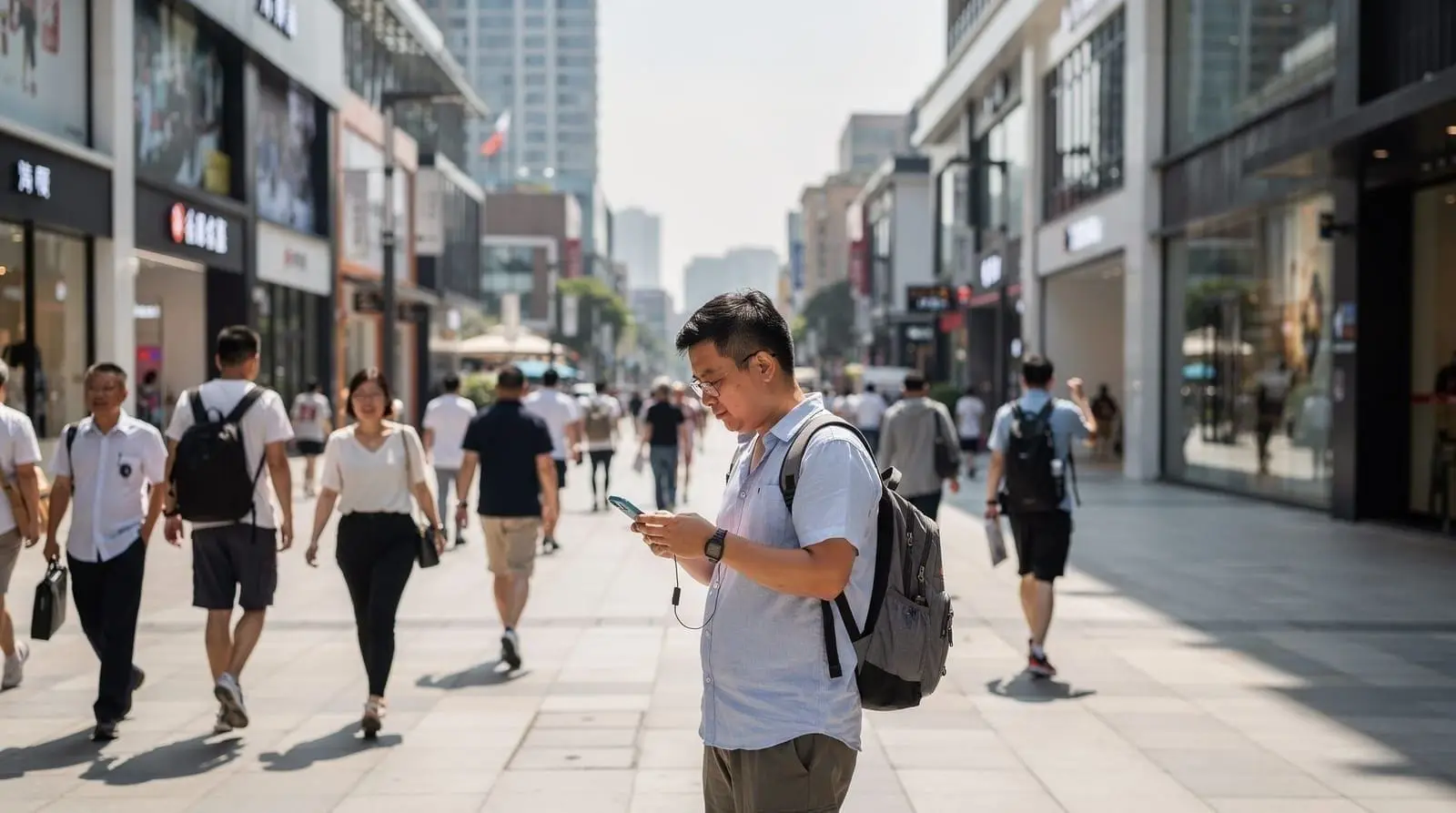
Is Shenzhen safe? an honest assessment for tourists
Is Shenzhen safe for tourists?
Yes, Shenzhen is among the safest major cities in China and Asia. Violent crime is rare; main risks are petty scams at tourist hotspots and taxi overcharging. Standard urban awareness is all that is needed.
Shenzhen is a safe city — that is the honest headline. Violent crime rates are low by the standards of any major global city, the police are generally responsive, and foreign tourists are well-treated. The risks that do exist are mostly in the category of scams and overcharging, which are predictable and avoidable once you know what to look for.
This guide gives a realistic picture: not a reassurance that everything is perfect, but a grounded assessment of what the actual risks are, who faces them, and how to handle them. For a related guide on specific scams, see Shenzhen tourist traps.
| Main risk | Scams and overcharging, not violent crime |
| Tap water | Not safe to drink — bottled or boiled only |
| Emergency | Police 110 / Ambulance 120 / Fire 119 |
| Best time (air quality) | Nov–Jan, drier and less hazy |
| VPN needed | Yes, for Google/WhatsApp/Instagram/X |
Overall safety level: how Shenzhen compares
By most international measures, Shenzhen is safer than Tokyo, Singapore, or Seoul is overstating it — but it is in the same conversation. Among the world’s large cities (Shenzhen has approximately 17 million residents), it has very low rates of violent crime, mugging, and street robbery. China’s overall homicide rate is lower than the United States, the United Kingdom, and most of South America. Shenzhen, as a prosperous first-tier city, sits at the safer end of the national spectrum.
By comparison:
- Versus Bangkok: Shenzhen is meaningfully safer on violent crime and street scams, though Bangkok has stronger English-language emergency services.
- Versus Tokyo: roughly comparable on petty crime; Tokyo is slightly easier to navigate alone due to stronger English-language support.
- Versus London or Paris: Shenzhen has lower rates of pickpocketing in tourist areas and significantly less street harassment.
The main risk category in Shenzhen is financial — scams, overcharging, and purchasing counterfeits — not physical. See the full breakdown below.
Violent crime
Street violence, mugging, and robbery directed at tourists are rare in Shenzhen. This is consistent across years of traveller reports and crime statistics. The combination of extensive CCTV coverage (Shenzhen has one of the highest camera densities of any city in the world), a visible police presence, and a generally prosperous population creates conditions where opportunistic street crime is uncommon.
That said, no city is crime-free. Practical baseline:
- Keep phones and valuables in front pockets or zipped bags in crowded transit stations (Luohu/Lo Wu border crossing is the busiest, densest environment you will encounter).
- The usual crowd-awareness that applies in any major city applies here — metro carriages during rush hour, busy street markets.
- Physical confrontation with strangers is genuinely unusual. If it occurs, the police (dial 110) respond quickly.
Petty theft and pickpocketing
Pickpocketing exists but is not especially prevalent compared to European tourist cities like Rome, Paris, or Barcelona. The highest-risk locations are crowded transit hubs — particularly Luohu border crossing on weekends, Shenzhen North Station during Golden Week, and packed metro carriages.
Standard precautions: use a bag worn across the body rather than a backpack in very crowded areas; keep a phone screen-down in a front pocket; do not leave bags unattended at café tables or on restaurant chairs. There is nothing Shenzhen-specific about any of this.
Scams: what you actually need to know
The most common issues tourists report are not violent — they are financial. The detailed guide is at Shenzhen tourist traps, but the short version:
Tea ceremony scam: someone approaches you on the street, strikes up a friendly conversation in English, and eventually invites you to a “traditional tea ceremony” or “local tea house.” The experience ends with an astronomically inflated bill. Politely decline all unsolicited street invitations to eat or drink with strangers, regardless of how friendly the approach seems. This scam is not unique to Shenzhen — it operates in Beijing, Shanghai, and Hong Kong as well — but it is the one that genuinely costs people money.
Electronics overcharging at Huaqiangbei: the world’s largest electronics market has official shops and less-official vendors. The less-official vendors sell counterfeit or defective goods at inflated prices. Stick to shops with fixed price tags; test products before paying; get a written receipt. Full detail in the tourist traps guide.
Unofficial taxis: a small number of drivers at airports, train stations, and border crossings offer rides without running the meter. These are not dangerous — they are overpriced. Use Didi (the standard ride-hailing app) or insist on the meter from any regular taxi. See the Shenzhen metro guide for transport options that sidestep this entirely.
Border-area touts: around the Luohu (Lo Wu) border crossing in particular, people approach arrivals offering “tours,” “exchange services,” or “cheap transfers.” These are not dangerous but are invariably a worse deal than arranging your own transport. Walk past without engaging; your metro station is right there.
Tap water safety
Do not drink tap water in Shenzhen. This is the one area where casual reassurance would be actively wrong. Shenzhen’s tap water is technically treated to municipal standards but is not safe to drink directly — the infrastructure, including ageing pipe networks in older areas, means contamination is a real risk. Bottled water is available everywhere (CNY 2–4 for 500 ml), and hotel rooms provide thermos flasks of boiled water. Brush your teeth with bottled water if you are cautious.
By contrast, tap water in Hong Kong and Macau is safe to drink directly — it meets international WHO standards.
Guangzhou follows the same rule as Shenzhen: bottled or boiled water only.
Air quality
Shenzhen’s air quality is moderate. The city is part of the Pearl River Delta industrial zone, and on still or humid days, haze (a mixture of particulate pollution and coastal humidity) can be noticeable. Air quality is better than Guangzhou and significantly better than Beijing.
Practical guidance:
- Check the AQI (Air Quality Index) before planning outdoor activities. Apps: AirVisual (IQAir), Plume Labs Air Report, or the Chinese national app 空气质量 (Kong Qi Zhi Liang).
- On poor air quality days (AQI above 100), limit strenuous outdoor activity or wear an N95 mask outdoors.
- November to January tends to have the best air quality (drier, more northerly winds). June to August (summer monsoon) can have higher humidity and moderate pollution.
People with asthma or respiratory conditions should check the forecast before planning outdoor days.
Health and vaccinations
No vaccinations are officially required to enter China, but the following are recommended by most travel medicine clinics:
- Hepatitis A and B: standard recommendations for Asia travel.
- Typhoid: recommended if you plan to eat at local street stalls or less formal restaurants.
- Routine vaccinations (measles/MMR, tetanus, diphtheria) should be up to date.
- Yellow fever: not required or recommended for Shenzhen specifically; only relevant if you are arriving from an at-risk country.
COVID-19 entry requirements: as of mid-2026, China does not require COVID vaccination or testing for tourist entry. Verify the current situation on your government’s travel advisory page before departure, as policies can change.
Healthcare for travellers
For serious medical issues, Shenzhen has several hospitals with international wards that have English-speaking staff:
- The University of Hong Kong-Shenzhen Hospital (Futian district) has an international medical centre with English consultation.
- Shenzhen People’s Hospital (Luohu district) has an international department.
- Shekou Hospital (Nanshan district) is convenient if you are based in the tech/Nanshan area.
Travel insurance with medical evacuation cover is strongly recommended. Chinese public hospitals accept payment (cash or UnionPay card); international health insurance is accepted at international wards of private or joint-venture hospitals. Always carry your insurance card and policy number.
Basic pharmacies (药店, yaodian) are ubiquitous — every neighbourhood has several — and stock common over-the-counter medications. Staff will not speak English in most neighbourhood pharmacies; show the medication name or use a translation app.
Emergency numbers (mainland China): Police 110 / Ambulance 120 / Fire 119.
Safe neighbourhoods vs. areas of caution
Shenzhen does not have an equivalent of “no-go zones” for tourists in the sense that some other major cities do. All the main visitor areas — Nanshan, Futian, Luohu, Shekou, OCT/Overseas Chinese Town — are safe at any hour.
A few contextual notes:
Luohu border crossing area: the district directly around the Luohu crossing has more touts and informal vendors than the rest of Shenzhen, simply because of the traffic flow. It is not unsafe — just noisier and more hustler-heavy than other areas. Stay aware, decline unsolicited approaches, and move briskly through if you do not need anything there.
Late night: the nightlife areas (Shekou bar strip, Futian clubs, OCT-LOFT) are generally safe late at night. There are no specific areas where walking alone after midnight carries meaningful risk for tourists, though standard urban night-time awareness applies (stick to lit streets, use Didi rather than flagging a taxi at 2 am).
Construction areas: Shenzhen is still rapidly building. Large construction zones can involve dust, uneven pavement, and sudden road closures. This is inconvenience, not danger, but worth noting for families with young children or anyone with mobility concerns.
Solo female travel
Solo female travellers consistently rate Shenzhen as comfortable. Street harassment is uncommon — substantially less so than many European or South American cities. Women travelling alone can use the metro, eat at restaurants, and explore neighbourhoods at normal urban hours without specific concern.
Practical notes for solo women:
- As everywhere, trust your instincts if a situation feels uncomfortable.
- Didi has an in-app emergency contact feature and trips are tracked in real time by the platform — it is generally considered safer than flagging random taxis.
- Bars and clubs in Shekou cater to an international crowd and are generally low-pressure; the standard drink-watching awareness applies.
In Hong Kong, the MTR (metro) has women-only carriages on some lines during peak hours — more a comfort option than a safety necessity.
LGBTQ+ safety
The situation is nuanced and worth addressing honestly. Same-sex relationships are not criminalised in China, and Shenzhen — as a young, international, forward-looking city — is more liberal in practice than many other Chinese cities. Public displays of affection between same-sex couples will attract some looks in more traditional areas; in the international districts (Shekou, OCT-LOFT, Futian) this is less pronounced.
There are LGBTQ+ friendly bars and spaces in Shenzhen, and the scene is active even if low-profile compared to Hong Kong. Hong Kong has historically had a more visible and legally protected LGBTQ+ community, though this has shifted somewhat in recent years.
For most tourist purposes, LGBTQ+ visitors to Shenzhen will not face safety concerns. Discretion in more conservative or rural areas (such as Dapeng) is advisable.
Traveling with valuables and electronics
Shenzhen’s status as an electronics manufacturing hub means many visitors carry cameras, drones, and gadgets purchased locally, particularly after a Huaqiangbei visit. There is no elevated theft risk specifically tied to carrying visible electronics compared to other major cities, but standard precautions apply: don’t leave bags with laptops or cameras unattended at café tables, and use hotel safes for anything you are not actively using.
Drones purchased at Huaqiangbei should not be flown near government buildings, military areas, or the airport without checking local regulations — enforcement of no-fly zones is active and can result in confiscation, which is a bureaucratic hassle rather than a safety issue, but worth avoiding.
Emergency contacts summary
- Police: 110 (mainland China)
- Ambulance: 120 (mainland China)
- Fire: 119 (mainland China)
- Hong Kong/Macau emergency: 999 (all services)
- Tourist police hotline: 12301 (mainland China, has English support)
Save these in your phone before you travel. If you lose your passport, contact your country’s consulate — most major nations have consulates in Guangzhou and embassies in Beijing; some have consular representation in Shenzhen or Shenzhen Bay.
Digital safety and internet access
This section covers a category of “safety” that is different in kind from crime but genuinely relevant to travellers: the Chinese internet environment.
Blocked services: the Great Firewall of China blocks a significant range of international services. This includes Google (Search, Maps, Gmail, Translate), WhatsApp, Instagram, Facebook, Twitter/X, and most Western news sites. These are not accessible without a VPN, regardless of your data plan or SIM card.
VPN: a working VPN allows you to access all of the above from China. The critical point is that VPN apps must be downloaded before you enter China — the App Store and Google Play Store versions available inside China do not include them. Install and test your VPN before travelling. Common options used by travellers include ExpressVPN, NordVPN, and Astrill; availability fluctuates and none can guarantee 100% reliability inside China. See the eSIM and VPN guide for current guidance.
What you CAN access without a VPN: WeChat, Didi, Alipay, Baidu Maps, and most local Chinese apps work natively. Apple Maps (surprisingly) has reasonable Shenzhen coverage and is not blocked. Microsoft Bing Maps is accessible. If you have a Taiwanese or Hong Kong SIM card with a data roaming plan, the GFW typically does not apply to roaming data — worth checking with your carrier.
Data connectivity: if you arrive with a mainland China SIM card (purchased locally), you are fully inside the GFW. A Hong Kong SIM with mainland roaming, or an international eSIM with mainland data from a non-Chinese provider, typically bypasses the GFW. This is the simplest approach for short visits — no VPN configuration required. The eSIM guide covers this in detail.
Payment safety: WeChat Pay and Alipay are the dominant payment systems in Shenzhen. Both now accept international Visa/Mastercard cards linked to a foreign account for tourist use. These apps are legitimate, widely used, and safe. The WeChat Pay and Alipay guide explains setup. Standard phishing awareness applies: do not scan QR codes from individuals rather than verified businesses; use QR codes displayed at official merchant points.
Data privacy: Chinese apps (WeChat, Didi, Alipay) operate under Chinese data law, which is different from GDPR or US consumer data protections. For most short-stay tourists this is an academic point. If you are concerned, use a secondary phone or SIM for China-specific apps and keep your primary device for VPN-protected international services.
Natural hazards and weather risks
Shenzhen’s climate creates a few safety considerations beyond the interpersonal.
Typhoons (June–September): the South China coast is in the western Pacific typhoon belt. Typhoons typically form in the Philippines Sea and track northwest; a direct hit on Shenzhen is relatively infrequent, but tropical storm conditions (heavy rain, strong wind, transport disruption) affect the Pearl River Delta several times per season. When a typhoon warning is issued, outdoor activities including beach visits should stop, and metro/transport services may be suspended. Check the Hong Kong Observatory (weather.gov.hk — accessible without VPN) for reliable typhoon tracking and signals. Hotels will advise guests during active warnings.
Heat: June to September temperatures regularly exceed 35°C with high humidity. Heat exhaustion is a genuine risk for unacclimatised visitors doing outdoor theme parks or sightseeing in midday heat. Practical mitigation: plan outdoor activities for 09:00–11:00 and 16:00–18:00; seek air-conditioned venues midday; drink more water than you think you need (at least 500 ml/hour in direct sun); wear loose, light-coloured clothing and apply sunscreen even on overcast days.
Air quality events: on still, humid days especially in summer, PM2.5 levels can temporarily spike due to regional industrial emissions. During AQI events above 150 (“Unhealthy”), limit strenuous outdoor time and wear an N95 mask outside. These events are short-lived — typically 1–3 days — and can be tracked in real time on AirVisual or the Chinese government’s air quality app.
Money and card safety
ATM fraud and card skimming are rare in Shenzhen compared to some destinations, but a few habits are worth keeping. Use ATMs attached to bank branches or inside shopping malls rather than free-standing street machines, and cover the keypad when entering your PIN. Since WeChat Pay and Alipay dominate daily transactions (see the WeChat Pay and Alipay guide), you will rarely need to carry large amounts of cash — this itself reduces street-theft exposure compared to cash-heavy destinations. Keep a backup of CNY 200–300 in cash for the rare vendor or small shop that has connectivity issues with the payment apps.
Border crossing safety
If your Shenzhen trip includes crossing into Hong Kong, Macau, or elsewhere in the Greater Bay Area, the crossings themselves are safe but can be crowded and disorienting on first use. The Hong Kong–Shenzhen border crossings guide covers which checkpoint suits your itinerary, and the China visa and 240-hour transit guide explains the visa-free transit rules that let many nationalities skip a visa application entirely for short Greater Bay Area loops.
Keep your passport and any home-return or entry permits in a single dedicated pocket during the crossing — the main practical risk at busy checkpoints like Luohu is a dropped or misplaced document in the queue, not theft.
Timing your trip around safety factors
Beyond the general year-round safety picture, timing affects a few specific risk factors. Typhoon season (roughly June–September) can disrupt transport and outdoor plans with little notice, so build flexibility into any fixed itinerary during those months. Air quality is typically best November through January. The best time to visit Shenzhen guide covers the full seasonal picture, including festival crowding that can affect crossing times at borders and stations during Golden Week and Lunar New Year.
Frequently asked questions about safety in Shenzhen
Is Shenzhen safe at night?
Yes, Shenzhen’s main tourist and nightlife areas are safe at night. Standard urban awareness — staying on lit streets, using Didi rather than unmarked taxis, keeping valuables secure — is sufficient. There are no areas where tourists should specifically avoid walking after dark within the central districts.
Is Shenzhen safe for solo travellers?
Yes, both male and female solo travellers report comfortable experiences in Shenzhen. The city is walkable in its main districts, the metro is safe, and the density of restaurants and convenience stores means you are rarely in an environment that feels isolated. Solo female travellers in particular describe it as less harassing than many Western European capitals.
Should I be worried about political situations affecting my safety as a tourist?
This is a legitimate question given that mainland China has a different political environment from most Western countries. For tourists visiting Shenzhen for leisure, the practical answer is no — tourists are not targeted by political enforcement. Standard guidance: do not photograph military installations or government buildings, stay away from any protests or demonstrations if they occur, and be aware that some online services (Google, WhatsApp, Instagram) are blocked and require a VPN to access. The eSIM and VPN guide covers this in detail.
Is it safe to eat street food in Shenzhen?
The risk is low but not zero. Cooked-to-order street food from busy stalls (high turnover = fresh ingredients) is generally fine. Avoid anything that has been sitting out at ambient temperature. The bigger food safety risk in Shenzhen is from raw vegetables washed in tap water; stick to cooked food at street level. Hotel restaurants and chain restaurants are low-risk.
What is the biggest safety risk in Shenzhen?
For the majority of tourists, it is financial rather than physical: being overcharged, buying counterfeit goods, or falling for a scam. The tea ceremony con and Huaqiangbei electronics trap are the two that actually cost visitors money with some regularity. Both are entirely avoidable with advance knowledge — see Shenzhen tourist traps for the full breakdown.
Is Shenzhen safe for families with children?
Yes — see the Shenzhen with kids guide for a full picture. The main child-specific note is water: never give children tap water in Shenzhen; use bottled water even for formula. Emergency services are responsive. Child-specific medical care is available at international hospital wards.
How does Shenzhen’s safety compare to Hong Kong and Macau?
All three cities — Shenzhen, Hong Kong, and Macau — are very safe by global standards. Hong Kong has the added advantage of fully English-language emergency services and clear legal protections familiar to Western visitors. Macau is small, casino-dominated, and safe. Shenzhen requires a bit more navigation (police and emergency services are primarily Mandarin-speaking) but is not less safe — just less English-accessible in an emergency.
Top-rated things to do in Shenzhen
Verified deep-linked GetYourGuide tours. Book through these links and we earn a small commission at no cost to you.