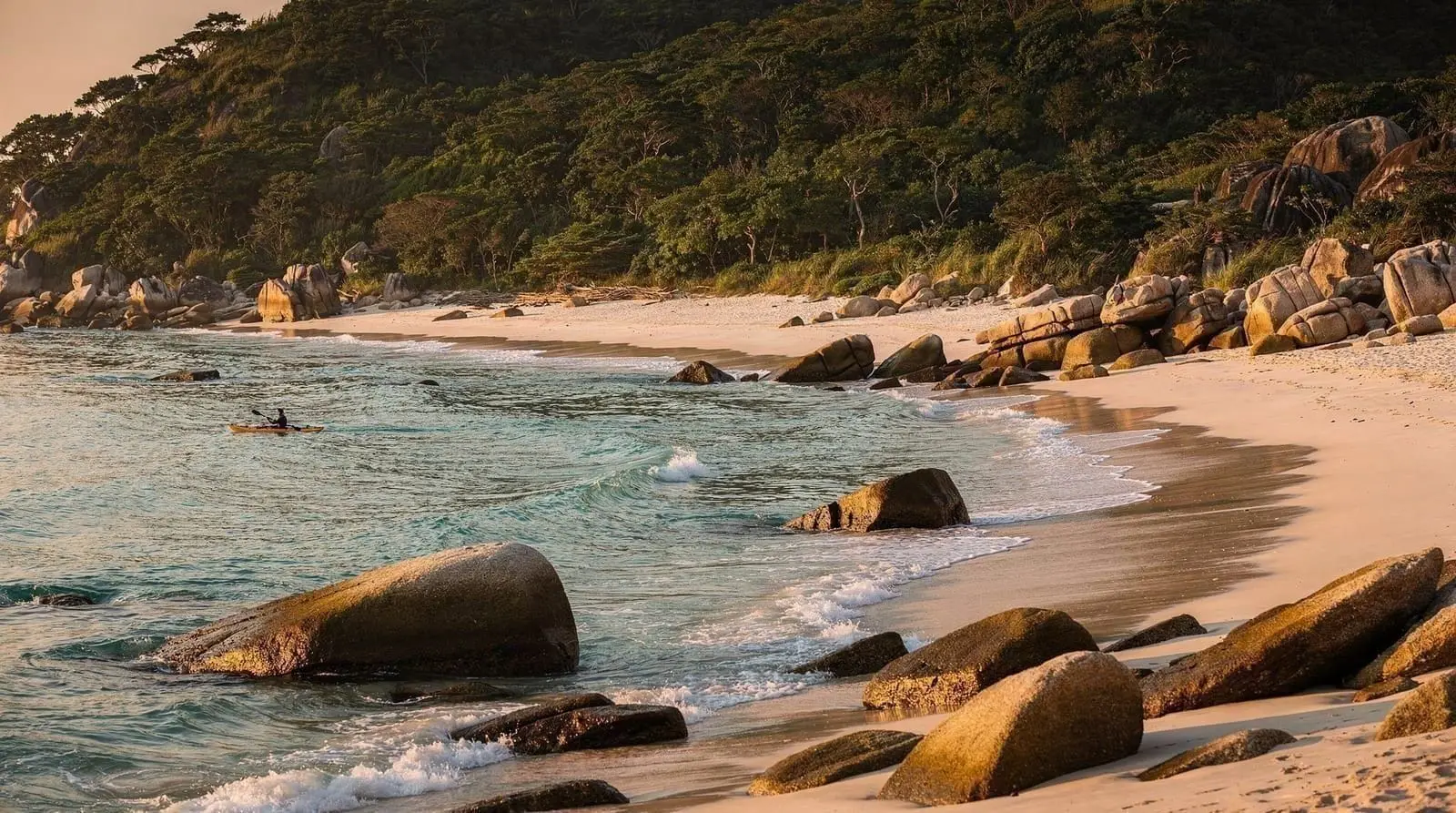
Ninety minutes east of Futian Station, the Shenzhen that most visitors see — the high-rises, the malls, the electronics markets, the convention hotels — gives way completely. The road narrows. The hills rise steeply to the left. The South China Sea appears on the right, and for the next hour of driving along the Dapeng Peninsula coast, there is nothing between you and the water except a guardrail and a view.
Dapeng Peninsula (大鹏半岛) is a protected ecological zone covering roughly 320 square kilometers in the southeastern corner of Shenzhen. National geological park protections and relatively low development pressure (the terrain is too rugged for easy construction) have left it with 50+ kilometers of coastline, a functioning fishing culture, and a historical center — the Dapeng Ancient Fortress — that is among the best-preserved Ming-dynasty military sites in Guangdong Province.
Most Shenzhen visitors never come here. A trip to Dapeng Peninsula often becomes the best day of a Shenzhen trip.
| Where | Southeast Shenzhen, Dapeng New District |
| Cost | Mostly free; beach entry CNY 20 peak season, seafood lunch CNY 100–175/person |
| Time needed | 1 full day minimum; overnight for the coastal hike or camping |
| Getting there | Metro Line 8 to Dapeng North + bus M557, ~90–100 min from Futian |
| Best time | October–November for warm sea and clear skies; avoid July–August |
Getting to Dapeng Peninsula
By metro and bus (recommended):
- Take Metro Line 8 eastbound to Dapeng North station (大鹏北). Journey time from Sungang (Line 3/8 interchange at central Luohu): approximately 65–75 minutes. From Futian Station, add 20 minutes for the interchange.
- At Dapeng North station, exit and take bus M557 toward Dapeng Ancient City. Journey: 30 minutes. The bus is air-conditioned; frequency is every 20–30 minutes.
- Total door-to-door from Futian: approximately 90–100 minutes.
Bus M557 continues from Dapeng Ancient City toward Xichong Beach (additional 40 minutes) and several other coastal points. Plan which sites you’re combining and check the current route map at the bus stop (the M557 route has been extended and altered in recent years).
By Didi:
- From Futian to Dapeng Ancient City: 60–70 minutes, CNY 100–130 (~USD 15–19)
- From Futian to Xichong Beach: 75–85 minutes, CNY 120–160 (~USD 18–24)
- Didi within the peninsula: CNY 30–80 depending on distance
By bicycle (for the peninsula road): Some travelers rent bicycles in Dapeng town and cycle between sites. The main coastal road from Dapeng to Nanao is approximately 25 km. Road quality is good but the terrain is hilly; allow 3–4 hours for the circuit. Bicycle rental at Dapeng bus station area: CNY 30–60/day from multiple vendors.
Dapeng Ancient City (Dapeng Ancient Fortress)
The Dapeng Suo Cheng (大鹏所城) is a Ming-dynasty military garrison founded in 1394 under the Hongwu Emperor’s coastal defense program. The fortress was designed to protect the Pearl River Delta coastline from Japanese pirate raids (wokou), which were endemic in the 14th and 15th centuries along China’s southeastern coast.
The walls enclose a roughly 1,000 × 900 meter area. Unlike many Chinese historical sites, Dapeng Ancient City is not a reconstruction — the current walls are the Ming-dynasty walls, restored and maintained rather than rebuilt from scratch. The south gate archway is original 14th-century masonry. The internal street layout follows the original military grid.
Inside the fortress:
- South gate and walls: The south gate is the best-preserved entry point. Walk the wall section adjacent to the south gate for views over the internal streets and the surrounding hills. Access to some wall sections: free; the main viewing platform charge CNY 10–20.
- Zhao Family Ancestral Hall (赵氏宗祠): A Hakka-style courtyard hall honoring the Zhao family, who produced several military commanders in the garrison’s early years. The hall has been restored; the ancestral tablets are still maintained. Free entry.
- Liu Family Ancestral Hall (刘氏宗祠): Similar structure on the opposite side of the fortress.
Slightly larger, with more elaborate carved wood panels. Free entry.
- Military temple (将军庙): A small temple dedicated to Tianhou (Mazu), the sea goddess patron of coastal communities, repurposed over centuries to honor locally revered military figures. Still used for worship by Hakka families in the fortress.
- Residential streets: Approximately 500 people still live inside the fortress walls. Old women hang laundry on Ming-dynasty walls. Children play in the same courtyard spaces where garrison soldiers once trained. The combination of 600-year-old architecture and daily life is the most interesting thing about Dapeng Ancient City.
Practical information: Entry to the fortress area: free. Some interior exhibition halls charge CNY 10–20. Audio guide: CNY 20 (~USD 3) at the main gate; English version available (functional if stiff). Allow 1.5–2 hours. Best on a weekday morning when the tour groups haven’t arrived.
Metro Line 8 to Dapeng North, then Bus M557 to “大鹏古城” stop. Hours: 08:00–18:00 (internal halls); the street area is accessible earlier.
Xichong Beach
Xichong Beach (西冲) is a 2 km arc of sandy beach on the peninsula’s south coast, facing open water rather than the enclosed bay. This matters for water quality: Xichong consistently rates among the cleanest swimming water in Shenzhen, with visibility of 3–5 meters — not tropical, but genuinely swimmable by the standards of a city on an industrial coast.
The beach is backed by forested hills (part of the geological park) with no hotel development along the shoreline. Infrastructure is minimal: a tourist service center with public toilets and basic changing facilities, a cluster of seafood restaurants and snack stalls at the north end, and a small parking area.
In season (May–October), the beach has lifeguards on duty 09:00–18:00. Red flag means no swimming; yellow flag means caution; the system is observed. In the October–November shoulder season, lifeguards are fewer or absent; the water is calmer and the beach is more peaceful.
Beach facilities:
- Public showers: CNY 5 per person
- Umbrella and chair rental (in season): CNY 30–50 for a set
- Sun loungers: CNY 20–40
- Beach volleyball courts: free, first-come
- Kayak rental (near the north end): CNY 60–100/hour
Entry fee: CNY 20 in peak season (May–October); free or CNY 5 off-peak. Not all visitors know the fee exists; pay at the booth near the bus drop-off point.
Getting there from Dapeng Ancient City: Bus M557 continues to Xichong from the ancient city. Additional travel time: 40 minutes. Total from Futian: approximately 135–145 minutes. Alternative: rent a bicycle at Dapeng Bus Station for the 12 km coastal ride (1–1.5 hours; hilly but rewarding).
Camping: Licensed campsites operate near Xichong and at adjacent Xiao’ao Beach (小澳海滩). Bring your own tent or rent from operators: CNY 80–150/night. The campsites have outdoor showers (cold water) and basic cooking facilities. Weekend camping in the summer months is popular — book sites through Ctrip or directly via Dapeng tourism bureau WeChat account. Weekday camping is quieter and often uncrowded.
Coastal hiking: Xichong to Dong’ao Bay
The coastal trail from Xichong Beach to Dong’ao Bay (东澳湾) covers approximately 6 km of clifftop and beach walking, offering South China Sea views throughout.
Difficulty: Moderate. The paths are maintained but not paved; several rocky scrambles at elevation transitions require using hands briefly. Total elevation gain: approximately 280 meters over the full route. Time: 2.5–3 hours one way.
Trailhead: 800 meters north of Xichong Beach main entrance. Look for signs reading “滨海栈道” (Coastal Boardwalk). If using navigation, the Google Maps pin for “西冲海岸线” is accurate.
What you’ll see: Open ocean panoramas from multiple clifftop viewpoints; small coves accessible on foot at certain tide levels; rock formations created by ancient volcanic activity (the geological park designation reflects this geological heritage); occasional fishing boats; and at the right time of year (October–November), occasional pods of Indo-Pacific humpback dolphins in the waters offshore.
What to bring:
- Water: 1.5–2 liters per person (no sources on trail)
- Sun protection (the trail is fully exposed)
- Trail shoes with grip (the rocky sections require proper footwear; sandals inadequate)
- A fully charged phone with Maps.me downloaded — the English-language signposting is inconsistent
- Snacks (4+ hours round trip including return)
Return options: Reverse the trail to Xichong (same route back) or continue to Dong’ao Bay and take a boat or bus back to Dapeng town. Confirm current boat availability before committing to this option.
Nanao Old Street and seafood
Nanao (南澳) is a fishing town on the peninsula’s western coast, approximately 20 km from Dapeng Ancient City via the main road. It has developed a weekend-destination character while retaining more genuine fishing-community character than most similar places near major Chinese cities.
Nanao Old Street (南澳老街) is a 200-meter commercial strip in the Qing-dynasty arcade style common throughout Guangdong — low covered walkways, ground-floor shops, upper-floor residences. The renovation level is light: the buildings have been stabilized and painted but not extensively rebuilt. On weekend afternoons, snack stalls, craft vendors, and an increasing number of young-person-oriented coffee shops operate.
The real attraction at Nanao is the seafood. The restaurants around Nanao Pier are the best in the peninsula for quality and value:
Typical order for two people:
- Live grouper or bream (石斑鱼/鲷鱼): CNY 50–80 per jin (0.5 kg) — ask the weight before they take it to the kitchen
- Mantis shrimp (皮皮虾): CNY 60–80 per jin, best October–April
- Razor clams (竹蛏) stir-fried with black bean sauce: CNY 35–50 per portion
- Steamed crab (螃蟹): CNY 80–150 per crab depending on size and season (autumn–winter is crab season)
- Vegetables: CNY 15–25 per dish
Total meal for two: CNY 200–350 (~USD 29–51). These prices are approximately 30–40% less than comparable seafood in Shekou or the Nanshan area.
Trap warning: Restaurants immediately at the pier entrance tourist strip inflate prices and sometimes add undisclosed service fees. Walk 5–10 minutes up the slope into the residential area above the pier — the restaurants in the neighborhood proper quote local prices and don’t provide English menus (use Google Translate camera mode for the menu).
Getting to Nanao: Bus M378 from Dapeng Ancient City (approximately 30 minutes); or Didi (CNY 35–55 from Dapeng, 25 minutes).
Dong’ao Island
Dong’ao Island (东澳岛) sits 15 minutes offshore from Xichong Beach by speedboat. The island has several small beaches, basic snorkeling (visibility 3–5 meters; better than the mainland coast due to lower sewage input), minimal infrastructure, and a complete absence of resort development.
Speedboat from Xichong pier: CNY 30–50 round trip per person; negotiable for group bookings. Boats run when weather permits, typically 09:00–17:00 in season. The last boat back normally leaves at 17:00 — if you miss it, you are sleeping on a camping platform or calling the coastguard. Don’t miss it.
The island has no accommodation (as of 2026 there are plans for limited eco-lodging; verify current status). Day visits only. The best snorkeling is on the island’s southeast coast, accessible by 10-minute walk from the main landing pier.
Baguang and Kuichong: the less-visited north
The northern section of Dapeng New District (Baguang/Kuichong area) is less traveled than the main peninsula. The coastline here is more dramatic — volcanic basalt formations, sea arches, and rocky headlands rather than sandy beaches. The Baguang Cultural Tourism Area has a short walking circuit of coastal rock formations.
Access is harder: buses from Kengzi station (Metro Line 14) or Longhua via multiple changes. Didi is more practical: CNY 60–90 from Dapeng Ancient City, 30 minutes.
Worth visiting for: geology enthusiasts, photographers, and travelers specifically seeking uncrowded coastal terrain. Not worth the transit complexity for casual visitors who have limited time on the peninsula.
Diving, snorkeling and water sports
Water quality on Dapeng’s open-water beaches is genuinely better than anywhere else accessible from central Shenzhen, though visitors coming from destinations like the Philippines or Indonesia should recalibrate expectations — visibility of 3–5 metres is good by Pearl River Delta standards, not tropical-reef standards. Snorkeling gear can be rented at Xichong Beach and on Dong’ao Island (CNY 30–50/set); bring your own mask if you’re particular about fit, since rental gear is basic. Stand-up paddleboarding and kayaking operators cluster at the north end of Xichong in season (May–October), charging CNY 60–120/hour depending on equipment.
Scuba diving is not well developed here — divers looking for a proper Guangdong dive trip typically go further afield to Weizhou Island or Hainan rather than Dapeng, which is better understood as a swimming-and-snorkeling coastline than a diving destination. Jet ski rentals occasionally appear at Xichong in peak season, unlicensed and inconsistently priced (CNY 150–300 for 15–20 minutes) — negotiate before boarding and confirm the operator carries basic insurance, since standards vary considerably between vendors.
Practical planning for Dapeng
Best itinerary for a single day:
- 08:00 — depart Futian by metro
- 09:30 — arrive Dapeng Ancient City; explore for 1.5 hours
- 11:00 — bus or Didi to Xichong Beach
- 11:45 — lunch at beach restaurant (grilled seafood, noodles)
- 13:00 — 2 hours at Xichong Beach (swimming, relaxing)
- 15:00 — optional: coastal hike trailhead for 1 hour (return to beach)
- 17:00 — Didi to Nanao for sunset and seafood dinner
- 19:00 — Didi back to Dapeng North Metro for return journey
- 21:00 — back in central Shenzhen
For an overnight stay: Base yourself at a Nanao guesthouse or Xichong beach guesthouse. Day 1: Ancient city, beach, coastal hike. Day 2: Dong’ao Island, Nanao seafood, return.
Accommodation on the peninsula:
- Xichong area guesthouses (民宿): CNY 200–500/night for private rooms; sea-view rooms at top of range
- Nanao guesthouses: CNY 180–400/night; more options but further from the best beaches
- Boutique guesthouses with sea views and design aesthetic: CNY 600–1,200/night; book 2–3 weeks ahead for October–November weekends
What to bring: Cash (CNY 300–500 recommended; card acceptance on the peninsula is less reliable than central Shenzhen). Printed or offline address of your accommodation. Bug repellent for the evening. Sunscreen year-round.
Book a Shenzhen cultural and scenic tour including historical heritage sites and drone experiencesDapeng by season
| Month | Sea temp | Conditions | Notes |
|---|---|---|---|
| Dec–Feb | ~18–20°C | Cool, dry, clear | Best hiking weather; too cold for most to swim |
| Mar–Apr | ~21–23°C | Mild, occasional rain | Good hiking and beach walks, cooler swimming |
| May–Jun | ~25–27°C | Warm, humid, rainy season starts | Swimming season opens; watch typhoon bulletins |
| Jul–Aug | ~28–30°C | Hot, peak typhoon risk | Busiest and priciest; check forecasts before committing |
| Sep | ~27°C | Typhoon risk tapering | Good value if weather cooperates |
| Oct–Nov | ~24–25°C | Clear skies, calm seas | The best overall window — warm water, manageable crowds |
Combining Dapeng with the rest of eastern Shenzhen
Dapeng pairs naturally with a broader eastern-Shenzhen loop. Yantian district sits 30–40 minutes west along the coastal road and makes a sensible overnight base if you’d rather not stay on the peninsula itself. Travellers building a longer trip often slot Dapeng into the Shenzhen in 3 days itinerary as the final day, or use it as the coastal counterweight to a tech-and-city-focused stay covered in the Shenzhen with kids guide if traveling with children who need a beach day after museums and malls.
For those extending into a full Pearl River Delta trip, the greater bay area two-week itinerary treats Dapeng as the natural “slow down” day between the tech districts and the historic Guangdong towns.
Onward connections
- Shenzhen main guide for city overview and transport logistics
- Yantian district — 30–40 minutes west along the coastal road; the adjacent eastern district
- Shenzhen in 3 days — Dapeng Peninsula as a Day 3 option
- Pearl River Delta grand loop — 10 days — Dapeng as a Shenzhen highlight
- Things to do in Shenzhen