Shenzhen Hakka food guide — mountain cuisine in a modern city
Where can I try Hakka food in Shenzhen?
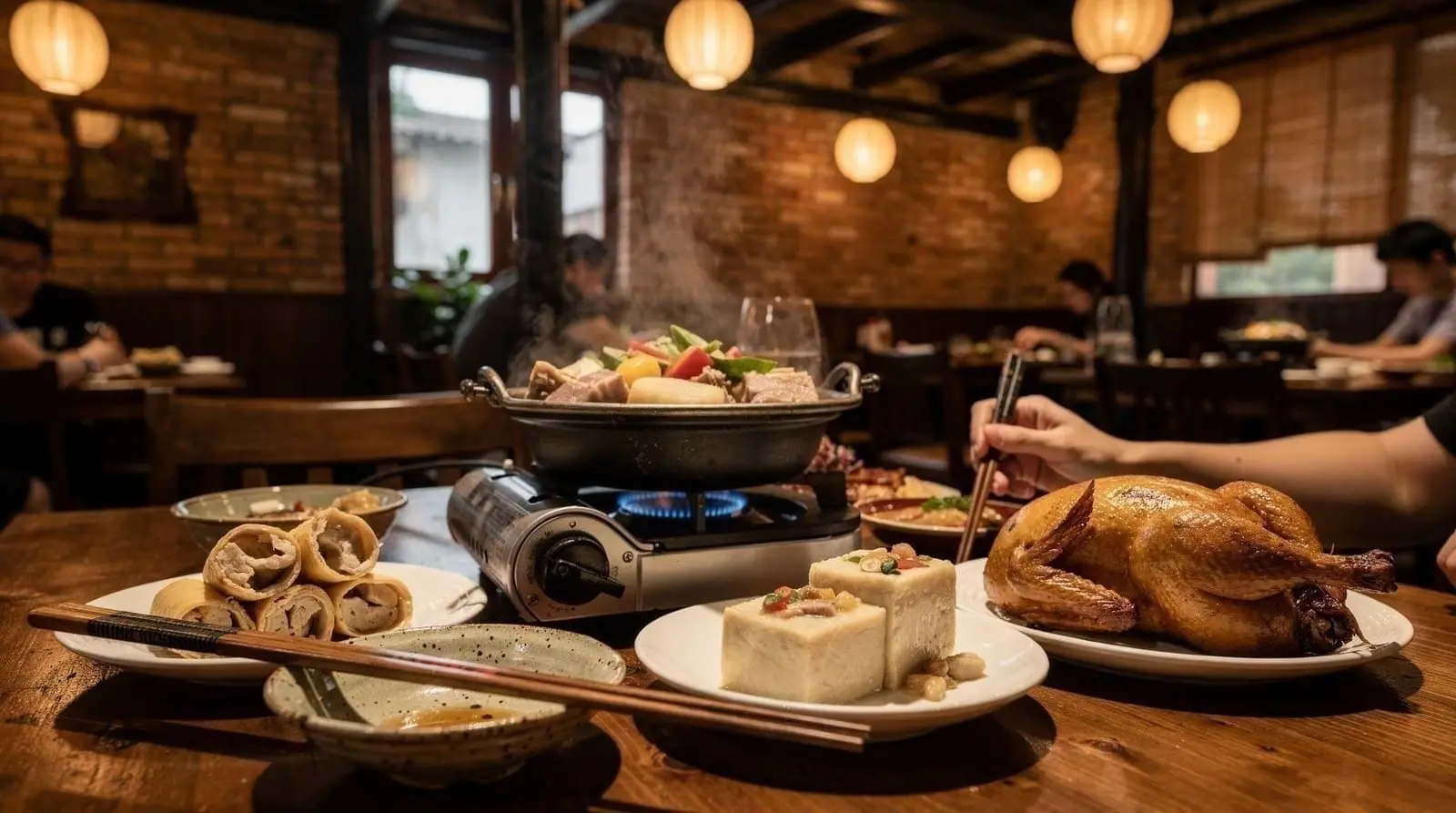
Hakka restaurants cluster in Longhua, Longgang, and parts of Luohu. Look for "客家" (Kèjiā) on the signboard. Salt-baked chicken, stuffed tofu, and braised pork with preserved mustard greens are the essential dishes. Budget CNY 50–90 (~USD 7–13) per person.
| Where | Longhua and Longgang for authentic spots; Futian and Nanshan for polished versions |
| Cost | Around CNY 50–100 per person |
| Time needed | A single meal, or a full day for the dedicated food route below |
| Getting there | Metro Line 4 (Longhua) or Line 3 (Longgang) |
| Best time | Lunch, 12–2pm, when restaurants are fullest and freshest |
Hakka cuisine is one of China’s great under-appreciated cooking traditions, and Shenzhen — built on what was historically Hakka land — remains one of the best cities outside a Hakka homeland village to eat it. Most visitors rush past it on the way to a Chaoshan congee stall or a dim sum teahouse, which is a genuine miss.
The Hakka people (客家, literally “guest families”) are Han Chinese who migrated southward from northern China over several centuries, settling in the mountain interiors of Fujian, Jiangxi, and Guangdong. Unlike coastal populations who could rely on fresh seafood, Hakka communities developed a cuisine built on preservation, slow cooking, and making the most of pork, tofu, and dried vegetables. The resulting food is heartier and more intensely flavored than Cantonese cooking, with fermented and preserved ingredients playing a central role.
The defining features of Hakka cooking
Salt and preservation: Before refrigeration, Hakka cooks preserved everything — vegetables, fish, meat — in salt. That tradition survives in dishes like salt-baked chicken and the use of salted mustard greens (mei cai) as a key ingredient.
Stuffed dishes: A technique unique to Hakka cuisine, probably developed to incorporate wheat-based preparations into a rice-eating culture. Tofu, eggplant, bitter melon, and peppers are hollowed or split and stuffed with pork mince mixture. Three of these stuffed items served together is a classic ordering pattern called “Hakka three stuffed” (客家三酿).
Rich braising: Pork belly is the flagship protein, braised low and slow in soy sauce, rice wine, and aromatics until nearly falling apart. The most famous version comes with preserved mustard greens (梅菜扣肉, méi cài kòu ròu) — the greens absorb the fat and become almost luscious alongside the tender pork.
Earthy fermented flavors: Fermented black bean sauce, fermented tofu (腐乳, fǔrǔ), and dried shrimp paste appear regularly in Hakka cooking. The fermented depth reads as umami-forward and slightly funky to Western palates — typically in a good way.
Hakka history and Shenzhen — the original inhabitants
Before there was a Shenzhen, there were Hakka villages. This is the fact that most modern travel guides to Shenzhen’s food scene omit: the land that became Shenzhen’s urban grid was historically Hakka territory, settled centuries before the Special Economic Zone arrived.
The pre-SEZ Hakka villages The area that is now Shenzhen was dotted with Hakka villages when the British Crown leased the New Territories (just across the border) in 1898. Families like the Tang, Liu, and Ye clans farmed rice paddies and fished in the Bei River. Village names that survive today — Caiwuwei (蔡屋围), Huangbeiling (黄贝岭), Shangsha (上沙) — were Hakka settlements. When the SEZ was established in 1980, some of these villages were demolished, others were swallowed into the urban fabric, and a handful became the “urban villages” (城中村) that remain as Shenzhen’s low-rent residential pockets.
Gankeng — a preserved Hakka community Gankeng Hakka Town (甘坑客家小镇) in Longhua is one of the better-preserved examples of a Hakka settlement in the Shenzhen area. It’s been developed as a tourist attraction — somewhat aggressively commercial — but the underlying architecture and community identity are genuine. The traditional Hakka courtyard houses (围屋, wéiwū) here follow the same defensive architecture as the famous roundhouses (土楼, tǔlóu) of Fujian, adapted for Guangdong’s terrain. Food within the attraction zone is overpriced and tourist-calibrated; eat in the surrounding streets instead. Metro: Gankeng Station (Metro Line 6), 10-minute walk.
Longgang’s Hakka old town Longgang district to the east of central Shenzhen has retained more Hakka character than other outer districts, partly because it developed later and was never fully overwritten by the SEZ’s initial urbanization wave. The Longgang Old Town area (龙岗老城) preserves some traditional street patterns, and the Hakka food culture here is genuinely community-embedded rather than tourist-facing. Longgang Station (Metro Line 3) is the access point.
The Hakka paradox in Shenzhen The Hakka people are simultaneously the original inhabitants of Shenzhen’s land and one of the less visible communities in the modern city’s cultural narrative. The city’s story emphasizes migration and economic transformation; the pre-existing Hakka identity doesn’t fit neatly into that arc. Eating Hakka food in Shenzhen is therefore one way to engage with the city’s deeper history — a tradition that predates the skyscrapers by several centuries.
Essential Hakka dishes to order in Shenzhen
Salt-baked chicken (盐焗鸡, yán jú jī) The most famous Hakka dish. A whole chicken wrapped in paper or salt crust and slow-cooked over gentle heat until the meat steams through from the salt crust’s residual heat. The result is intensely flavored skin, juicy meat, and a remarkable concentration of chicken flavor that regular roasting can’t replicate. Order half a chicken for two people (CNY 38–65). The Dongguan and Meizhou-style versions are both well-represented in Shenzhen.
Stuffed tofu (客家酿豆腐, kèjiā niàng dòufu) Cubes of firm tofu with a pocket of pork and shrimp mince, pan-fried then braised in a light sauce. The contrast between the crispy exterior, soft tofu, and savory filling is the point. This appears on virtually every Hakka menu and is often a starting point for people trying Hakka cuisine for the first time.
Braised pork with preserved mustard greens (梅菜扣肉) Pork belly cooked until it dissolves, layered with deeply savory preserved mustard greens that have been soaked and squeezed to reduce saltiness. Served in a deep bowl; you flip it upside down onto a plate to present the pork on top of the greens. Rich, fatty, and better the next day — many Hakka home cooks make this the day before eating. Typically CNY 45–75 per portion.
Hakka three stuffed (客家三酿) A combination platter of stuffed tofu, stuffed bitter melon, and stuffed eggplant — the Hakka trinity. Ordered together as a set and a reliable introduction to the stuffing technique across three different textures. CNY 55–80 for a set portion.
Pork belly with taro (芋头扣肉) Similar in technique to the preserved mustard green version but with taro slices replacing the greens. The taro absorbs the pork fat and becomes almost caramelized. Richer than the mei cai version.
Dried radish omelette (菜脯蛋) A humble but delicious side dish — shredded dried radish, which is salty and concentrated, scrambled with egg. Earthy and satisfying. CNY 15–25 per dish.
Hakka fermentation and preservation — the flavor fundamentals
Before you can fully appreciate Hakka cooking, you need to understand its pantry. The deep, complex flavors in Hakka food aren’t produced by elaborate wok technique or high-end ingredients — they come from preserved and fermented staples that have been part of Hakka mountain cooking for centuries.
Mei cai (梅菜) — preserved mustard greens The single most important preserved ingredient in Hakka cooking. Fresh mustard greens are salted, sun-dried, and pressed in clay jars over weeks until they develop an intense, savory concentration. Good mei cai is deep brown, almost black, and has a sweet-savory smell. Inferior versions are over-salted with no complexity. In the famous mei cai kou rou (braised pork with preserved greens), the mei cai absorbs the pork fat during cooking and becomes the most flavorful element of the dish. You’ll find mei cai sold in wet markets throughout Shenzhen; Hakka vendors in Longhua markets often sell home-dried versions that are superior to supermarket-packaged alternatives.
Fermented tofu (腐乳, fǔrǔ) Red or white fermented tofu — cubes of firm tofu inoculated with a mold culture, then cured in rice wine, salt, and spices. The result is a creamy, intensely savory condiment used as a flavoring in stir-fries, as a dipping sauce (particularly for hot pot), and as a table condiment. White fermented tofu (白腐乳) is milder; red fermented tofu (红腐乳) has a stronger color from red yeast rice and a sharper flavor. Hakka households typically have both. In Shenzhen’s Hakka restaurants, fermented tofu appears as a condiment alongside plain rice and as a key flavoring in braised dishes.
Dried shrimp (虾米, xiā mǐ) Tiny whole shrimp dried until concentrated and intensely savory — used in Hakka cooking as a background flavor rather than a primary ingredient. They appear in stir-fried vegetables, in the filling for stuffed dishes, and in rice porridge preparations. The quality varies significantly: the best dried shrimp retain some sweetness alongside the salt; cheaper versions taste harsh and one-dimensional. Hakka wet market stalls in Longhua and Longgang sell properly dried versions from Guangdong’s coast.
Salted fish (咸鱼, xián yú) Preserved fish is fundamental to Hakka cooking, serving as both a flavoring (chopped and added to pork fillings) and a standalone dish (steamed with pork or served alongside rice). The most prized variety is mak hei fish (马友鱼) salted and partially fermented — it has a strong, distinctive smell and an intense umami flavor. In Shenzhen’s Hakka restaurants, you’ll see salted fish steamed with minced pork patty (咸鱼蒸肉饼) as a classic home-style dish. CNY 30–45.
Glutinous rice wine (米酒, mǐ jiǔ) Hakka rice wine is used in cooking rather than drunk as a beverage — it appears in braising liquids for pork belly, as a marinade for chicken, and as the base for certain sweet preparations. The Hakka rice wine tradition differs from other Guangdong wine traditions in using specific wild yeasts. Some Longgang Hakka restaurants still produce their own table rice wine — ask if there’s self-brewed (自酿) rice wine available.
Hakka vs Cantonese vs Chaoshan: a quick comparison
| Tradition | Core technique | Signature dish | Where in Shenzhen |
|---|---|---|---|
| Hakka | Preservation, stuffing, slow braising | Salt-baked chicken, mei cai kou rou | Longhua, Longgang |
| Cantonese | Wok technique, steaming, roasting | Dim sum, roast goose | City-wide |
| Chaoshan | Cold marinating, thin congee | Marinated goose, raw crab | Luohu, Longhua |
Hakka food is the heartiest and least seafood-dependent of the three, reflecting its mountain-interior origins rather than the coastal access that shaped Cantonese and Chaoshan cooking. See the Chaoshan cuisine guide and dim sum guide for the other two traditions in depth.
Where to find Hakka food in Shenzhen
Longhua and Longgang — Hakka heartland
These outer districts north and east of the Shenzhen center were originally Hakka villages before urbanization. The Hakka food tradition runs deepest here.
Longhua Hakka Village Restaurant (龙华客家村) A cluster of restaurants along Minzhi Avenue in Longhua operates with semi-communal outdoor seating and a menu that hasn’t changed in decades. The salt-baked chicken is the reason to come. CNY 55–85 (~USD 8–12) per person. Metro: Minzhi Station (Line 4), 5-minute walk.
Longgang Old Street (龙岗老街) food area Longgang district’s old town area has a concentration of Hakka family restaurants that cater to the local residential community rather than tourists. Menus are handwritten in Chinese; prices are low (CNY 40–60 per person). The stuffed dishes here are particularly good. Metro: Longgang Station (Line 3), 10-minute walk.
Futian and Nanshan — modern Hakka restaurants
More polished Hakka restaurants have opened in Futian and Nanshan to serve the growing middle-class market that wants Hakka food in a cleaner environment.
Meizhou Dongpo (眉州东坡) — Futian Technically a Sichuan-Hakka crossover brand, but the Hakka dishes here are well-executed and accessible to visitors. The mei cai kou rou and stuffed tofu are reliable. Bilingual menu. CNY 80–120 (~USD 11–17) per person. Metro: Shimin Center Station (Lines 2/9).
Ke Jia Ren (客家人) A small chain with several Shenzhen branches serving mid-range Hakka in a heritage-decorated space. Popular with local families for weekend lunch. The three-stuffed platter and salt-baked chicken are the draws. CNY 70–100 (~USD 10–14) per person. Branches near Nanshan Station (Line 1).
Luohu — working-class Hakka stalls
In the older residential blocks behind Dongmen Commercial Street, small Hakka family restaurants and individual stall vendors serve lunch and dinner to the working community. This is the least polished experience and often the most authentic.
Market Row 28 (二十八号市场排) Not an official restaurant name but a cluster of stalls in the covered market behind Dongmen pedestrian street. Hakka rice boxes (客家饭盒) with two or three dishes over rice run CNY 20–30 — the city’s cheapest route into Hakka cooking. Metro: Laojie Station (Line 1), 8-minute walk.
Hakka desserts and drinks
Hakka cuisine’s sweet side is less celebrated than its savory cooking, but it’s worth exploring — particularly the tong sui tradition of sweet soups, the use of red yeast rice in both food and drink, and the range of root vegetable desserts that reflect the mountain pantry.
Tong sui (糖水) — sweet soups The Cantonese tong sui tradition overlaps with Hakka sweet soups but takes on a distinct character in Hakka restaurants:
- Red bean soup (红豆沙) — slow-cooked red beans in sweetened water, sometimes with dried tangerine peel. Simple and satisfying. CNY 10–18.
- Sesame soup (芝麻糊) — thick, black sesame paste thinned to a soup consistency. Deeply nutty. CNY 12–20.
- Taro and sago soup (芋圆西米露) — taro balls and pearled sago in coconut milk. Lighter and more refreshing than the other options. CNY 15–22.
- Peanut and pig’s trotter soup (花生猪脚汤) — savory-sweet, collagen-rich, served warm. CNY 20–35 per bowl.
Red yeast rice wine (红曲酒) A traditional Hakka fermented drink made with rice inoculated with red yeast (Monascus purpureus), which gives it a distinctive burgundy color and a mildly sweet, slightly tangy flavor with low alcohol content (typically 5–10% ABV). It’s primarily used in cooking but some Hakka restaurants serve it as a table drink. If you see 客家红曲酒 on a menu, try a small cup — it tastes nothing like rice wine from other traditions.
Sweet potato preparations Baked sweet potato (烤番薯) is a common street snack throughout Shenzhen’s Hakka zones — vendors with charcoal ovens sell them from pushcarts in Longhua and Longgang from autumn through winter. CNY 5–12 per potato depending on size. Inside restaurants, sweet potato taro balls (番薯芋圆) cooked in ginger sugar syrup are a standard Hakka dessert with an interesting bouncy, slightly chewy texture.
Grass jelly (仙草冻) Made from dried Platostoma palustre plants boiled into a stiff jelly, then cut into cubes and served cold with honey or sugar syrup. Hakka families in Guangdong have made grass jelly as a summer cooling food for generations. In Shenzhen, it’s sold at street stalls and dessert shops across Longhua and Longgang for CNY 8–15 per cup. The commercial version at chains is adequate; the home-made version at Hakka family restaurants has a darker color and more complex, slightly bitter flavor.
Hakka food and Shenzhen’s urban villages
Hakka food culture in Shenzhen survives disproportionately in the city’s “urban villages” (城中村) — the dense, low-rise residential pockets that were once independent villages before being absorbed into the expanding metropolis. These areas, often overlooked by visitors focused on the skyline and malls, are where the pre-SEZ Hakka land ownership patterns are most visible in the built environment: narrow “handshake buildings” packed close enough that neighbours can reach across the gap, built on what were once family rice paddies.
Walking through an urban village in Longhua or Longgang before or after a Hakka meal adds useful context — this is what the land looked like before Shenzhen’s transformation, and the ground-floor Hakka restaurants operating in these pockets are frequently run by families who trace their presence in the area back generations, long before the city’s factories or towers arrived.
Day trip: eating Hakka outside Shenzhen
The Hakka homeland in eastern Guangdong is accessible from Shenzhen by high-speed rail, and a day trip combining Hakka architecture with serious eating is entirely feasible.
Meizhou (梅州) — the Hakka capital Meizhou is considered the spiritual capital of Hakka culture, located about 3 hours from Shenzhen by high-speed rail (from Shenzhen North Station, frequent departures, CNY 100–150 each way). The city has the highest concentration of Hakka food culture anywhere in Guangdong:
- Meizhou salt-baked chicken is the benchmark version — the local breed of chicken is different from what you’ll find in Shenzhen, and the result has a distinctive flavor that Shenzhen restaurants can only approximate.
- Meizhou niang tofu is prepared with slight regional variation, often with a more assertive fermented tofu sauce than the Shenzhen versions.
- Ke jia xian wine (客家咸酒) is a savory rice-based fermented drink specific to Meizhou, not found outside the region.
The Meizhou day trip also allows you to see Hakka roundhouse-adjacent architecture in the surrounding countryside, giving context to the defensive building style that the Gankeng heritage site in Shenzhen attempts to replicate.
Dongguan Hakka food Dongguan is 40 minutes from Shenzhen by metro or high-speed train and has a significant Hakka community in its rural townships. The local version of salt-baked chicken uses a slightly different spice blend. Worth combining with a manufacturing district visit if you’re interested in Shenzhen’s broader Pearl River Delta context.
Practical logistics for Meizhou Book high-speed rail tickets from Shenzhen North Station (深圳北) in advance on the 12306 app or at station ticket windows. The ride is 2.5–3 hours; a day return is feasible if you leave Shenzhen by 8am. Take a taxi or DiDi in Meizhou — the food neighborhoods aren’t concentrated near the train station.
Hakka food for special diets
Vegetarians face a similar challenge here as with other Cantonese-region cuisines: the cuisine’s core dishes (salt-baked chicken, stuffed tofu with pork mince, mei cai kou rou) are built around meat. Plain stuffed tofu can sometimes be requested without the pork filling, and the dried radish omelette and vegetable-forward tong sui desserts are safe defaults, but a fully vegetarian Hakka meal requires clear communication with staff and lowered expectations on variety.
Those with shellfish allergies should be cautious with dishes described as containing dried shrimp (虾米), which appears as a background flavoring in many stuffed and stir-fried preparations even when not listed as a headline ingredient — ask specifically (“有虾米吗?” — does it contain dried shrimp?) if this is a concern.
How Hakka food fits Shenzhen’s food landscape
Shenzhen is sometimes reduced to “Cantonese food capital” in travel guides, but the reality is more textured. The city has distinct food communities from every major Chinese culinary tradition — Hakka, Chaoshan, Hunanese, Sichuanese, northern Chinese — coexisting in the same neighborhoods. Eating through these traditions is one of the most interesting things you can do as a visitor.
For contrast, the Chaoshan cuisine guide covers the Teochew coastal tradition with its cold marinating and delicate congee. The dim sum guide takes you into Cantonese morning tea culture. If you want to eat across multiple districts in one day, the Shenzhen in 3 days itinerary includes food routing by neighborhood.
The broader Shenzhen food and drink overview maps all the major cuisine traditions across the city, and Luohu and Longgang (covered in the general Shenzhen destination guide) are worth understanding as more than outer suburbs — they’re where some of the city’s most genuinely local food exists.
Building a Hakka food day in Shenzhen
A focused Hakka food day can be structured entirely on Metro Line 4 (Longhua line) with excursions east to Longgang on Line 3. This route takes you through the districts where Hakka food is most authentic and covers all the major dishes in a logical sequence.
8:30am — Metro to Minzhi Station (Line 4) Start the day by heading north from Futian or central Shenzhen to Minzhi Station on Line 4. This is the heart of Longhua’s Hakka residential community.
9:00am — Hakka breakfast: taro rice porridge Find one of the small Hakka breakfast stalls in the streets surrounding Minzhi Station. Hakka-style rice porridge (客家粥) is thicker than Chaoshan congee and served with dried radish omelette, salted fish, and a plate of peanuts. Budget CNY 20–30 for a full Hakka breakfast. Duration: 45 minutes.
10:30am — Walk the Longhua residential streets Before lunch, spend an hour walking through Longhua’s older residential blocks. The urban village texture here — tight alleyways, ground-floor food operations, wet market sections — gives context for the Hakka community that the tourist-facing restaurants can’t provide.
12:30pm — Lunch at Longhua Hakka Village Restaurant Order the salt-baked chicken 20 minutes in advance. Also order the Hakka three stuffed platter and a plate of dried radish omelette alongside rice. Budget CNY 65–85 per person for a full lunch. Duration: 90 minutes.
3:00pm — Metro east to Longgang (Line 3, transfer at Buji) Take Line 4 south to Buji Station, then Line 3 east to Longgang Station. This 40-minute transit is worth it for the contrast — Longgang’s old town area has a more preserved Hakka character than Longhua.
4:00pm — Explore Longgang Old Street Walk the Longgang Old Street food area. Look for the Hakka family restaurants that serve an afternoon crowd of local residents. This is a good time to try grass jelly (仙草冻) at a street stall as a late-afternoon refresher. CNY 8–12.
6:30pm — Dinner: braised pork and fermented specialties Choose one of Longgang’s Hakka family restaurants for an early dinner. Order mei cai kou rou, pork belly with taro, and a plate of steamed salted fish with minced pork. Finish with red bean sweet soup. Budget CNY 55–75 per person.
Join a food-focused Shenzhen tour to cover multiple cuisine traditions in one session with a guide who knows which restaurants to skip and which are worth the queue.
Frequently asked questions about Hakka food in Shenzhen
Is Hakka food spicy?
No, generally mild to moderately seasoned. Hakka cooking gets its intensity from preservation and slow braising rather than chili heat, unlike Sichuan or Hunan cuisine. The saltiness of preserved ingredients like mei cai and salted fish is the dominant flavor note, not spice.
Can I find Hakka food near central Shenzhen, or do I have to travel to Longhua?
Yes — Futian and Nanshan both have polished Hakka restaurants (Meizhou Dongpo, Ke Jia Ren) that are easy to reach and accessible for first-timers, though the Longhua and Longgang versions are more authentic and considerably cheaper. If time is limited, a central Futian or Nanshan restaurant is a reasonable substitute for the full trip out to the Hakka heartland districts.
Practical tips for eating Hakka food in Shenzhen
Best meal: Lunch (12–2pm) is when Hakka restaurants are fullest and the food freshest. Many Hakka spots are empty in the morning (they don’t do breakfast service) and sometimes sell out key dishes by 2pm.
Ordering style: Hakka meals are meant to be shared. Order one dish per person plus a vegetable side, plus rice. Start with the stuffed tofu (easier to parse), then add salt-baked chicken and pork belly if you want more.
Payment: Virtually all sit-down Hakka restaurants accept WeChat Pay and Alipay; foreign-card-linked versions work. Stall vendors in markets prefer cash. Carry CNY 100–200 per person. For payment setup details, see the WeChat Pay and Alipay guide.
Language: Even fewer Hakka restaurants have English menus than Cantonese or Chaoshan places. The Google Translate camera function (point at the menu) works well for Chinese characters; download the Chinese language pack offline before arriving.
Getting around: Metro Line 4 (Longhua line) and Line 3 (Longgang extension) cover the Hakka heartland districts efficiently. The Shenzhen metro guide has full line maps and fare information. Budget 45–60 minutes transit time from central Shenzhen to the outer Hakka districts.
Top-rated things to do in Shenzhen
Verified deep-linked GetYourGuide tours. Book through these links and we earn a small commission at no cost to you.