HZMB guide: crossing the Hong Kong–Zhuhai–Macau Bridge
How do I cross the HZMB from Hong Kong to Macau?
Take a shuttle bus from the Hong Kong Passenger Clearance Building (next to HK International Airport). Tickets cost HKD 65 for a standard single trip. Buses run 24/7, every 5 minutes at peak times.
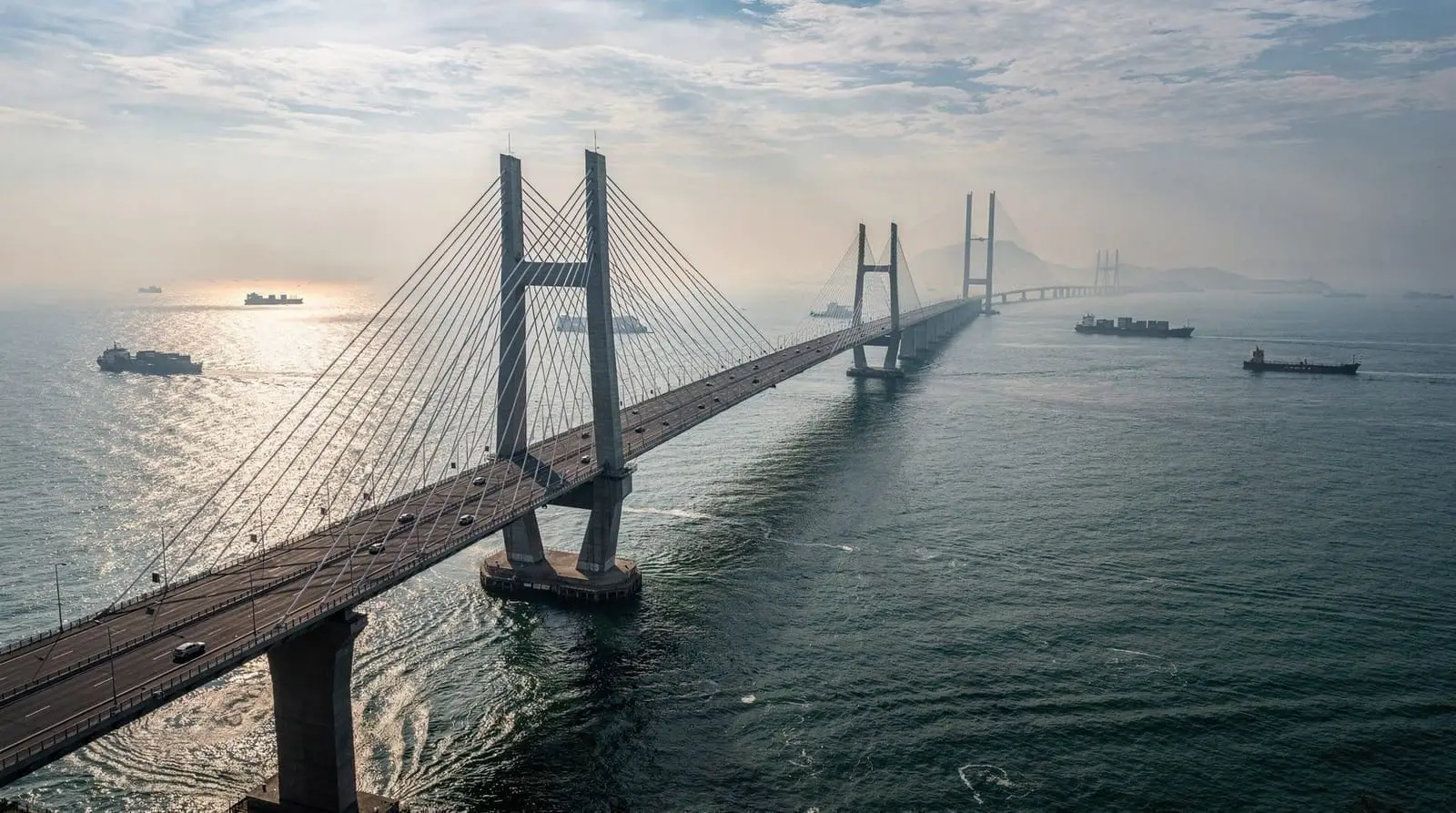
The Hong Kong–Zhuhai–Macau Bridge is one of the longest sea-crossing structures on the planet — 55 kilometres of six-lane expressway connecting Hong Kong’s Lantau Island with Zhuhai and Macau via a combination of bridge spans and an underwater tunnel. It opened in October 2018 after nine years of construction and immediately changed how travellers move around the western Pearl River Delta.
For independent travellers, the HZMB is primarily relevant as a way to get between Hong Kong and Macau (or Zhuhai) without taking a ferry. If you are doing any kind of Pearl River Delta grand loop, understanding how the bridge works is essential. This guide covers everything you need to know: shuttle buses, tickets, border formalities, luggage rules, and the unusual free shuttle offer that launched in 2026.
| Where | Hong Kong Passenger Clearance Building, Lantau Island |
| Cost | Around HKD 65 standard single fare |
| Time needed | Crossing plus border formalities |
| Getting there | Free shuttle from HKIA, or Bus B6 from Tung Chung MTR |
| Best time | Off-peak hours; avoid Golden Week and Lunar New Year |
What the bridge actually is (and why you don’t drive on it yourself)
Despite spanning six lanes, private cars from Hong Kong cannot simply drive onto the HZMB. The bridge operates under a cross-boundary quota system: only vehicles with specific cross-boundary plates (mainly Guangdong-registered or dual-plate vehicles) can use the bridge under their own power. For almost everyone visiting from abroad, that means using either a shuttle bus, a designated coach service, or a hired private vehicle.
The shuttle bus system — officially called the Hong Kong-Zhuhai-Macao Bridge Shuttle Bus — is the practical solution for foot passengers, and it works extremely well.
The bridge runs roughly west from Lantau across the Pearl River estuary. Partway across, an artificial island houses the entrance and exit of the 6.7-kilometre Zhuhai Submarine Tunnel, which takes traffic under the main shipping channel before emerging on the mainland side. When you are on the shuttle bus, you will barely notice the transition from bridge to tunnel — the bus just keeps moving.
The Hong Kong Passenger Clearance Building
The Hong Kong end of the bridge does not have a connection to Central or Kowloon by metro. The shuttle bus terminal is located at the Hong Kong Passenger Clearance Building (HKPCB), which sits on Lantau Island adjacent to Hong Kong International Airport (HKIA).
Getting there from central Hong Kong:
- From HKIA arrivals hall: a free shuttle runs between the airport and the HKPCB. Follow signs for “HZMB” inside the terminal. Journey time is about 10 minutes.
- From Hong Kong city (not via airport): take the Airport Express to the Airport station, then the free inter-terminal shuttle to the HKPCB. Check the current fare and journey time on the official Airport Express site.
- From Tung Chung: Bus B6 connects Tung Chung MTR to the HKPCB (check the current fare on the official New Lantao Bus website). This is the cheapest option from Lantau.
If you are arriving into Hong Kong and heading straight to Macau or Zhuhai, the HZMB connection from the airport is genuinely seamless — one of the most efficient multi-destination entry routes in Asia.
Shuttle bus tickets: prices and where to buy
The HZMB shuttle bus is operated by a consortium under the Hong Kong Zhuhai Macao Bridge (HK) Bus Co., Ltd. Fares as of 2026:
| Journey | Standard fare | Midnight surcharge (00:00–05:59) |
|---|---|---|
| Single (any direction) | HKD 65 | HKD 70 |
Concession fares for children, seniors and passengers with disabilities are set by the operator; check them on the official HZMB shuttle bus website.
Where to buy:
- At the ticket counters inside the HKPCB (accepts HKD cash, Octopus card, Alipay, WeChat Pay, and major credit cards)
- At vending machines inside the terminal (faster if you know what you need)
- Through authorised online platforms in advance (useful if you want to guarantee a seat during peak holiday periods, though walk-up availability is generally fine outside of Golden Week)
There is no advance booking requirement. The service is frequent enough that turning up and buying at the counter is the standard approach for most travellers.
Schedule and frequency
The HZMB shuttle operates 24 hours a day, 365 days a year. Frequency varies by time of day:
- 08:00–23:59: buses depart roughly every 5–10 minutes
- Overnight (to about 06:00): roughly every 30 minutes
In practice, daytime waits are short. During Chinese public holidays — particularly Golden Week in early October and the Spring Festival period — the terminal fills up and you may queue 30–45 minutes to board even with a ticket. Arrive early on those dates.
Traffic jams on the bridge are rare but can occur during severe weather or after accidents; the tunnel section is generally unaffected.
Border formalities: what to expect
The HZMB has a unique border-clearance setup. You clear immigration once per journey at each port of entry — there is no mid-bridge stop.
Outbound from Hong Kong:
- Check in at the HKPCB, buy your ticket
- Pass through Hong Kong Immigration (your passport is stamped on exit)
- Board the shuttle bus landside
Arriving in Macau:
- Bus arrives at the Macau Passenger Terminal (on the Macau Outer Harbour reclamation)
- Disembark and pass through Macau Immigration (your passport or Macau Entry Permit is checked on entry)
- Pick up your luggage (it travels in the bus hold — it is not separately screened at the midpoint)
Arriving in Zhuhai: The Zhuhai port of entry is the Zhuhai Passenger Terminal, adjacent to the Zhuhai end of the bridge. You clear Chinese customs and immigration here. Most nationalities visiting Zhuhai will need a Chinese visa in advance; check the visa requirements tool or the China visa and 240-hour transit guide before travelling.
If you are on the Greater Bay Area visa-on-arrival scheme, confirm that the Zhuhai HZMB port is a listed entry point under your nationality’s arrangement.
Luggage rules
This is where many travellers get caught out. The HZMB shuttle bus has strict luggage limits:
- Luggage limits (number of pieces, size, weight) are set by the operator: check them on the official HZMB shuttle bus website before you travel
- Carry-on is allowed in addition, within reason (standard cabin-bag size)
Oversized luggage may be refused boarding; check your bag against the operator’s limits before you get in the queue.
There is a luggage storage facility at the HKPCB if you need to deposit excess bags before crossing.
The 2026 free airport shuttle offer
From 2026, the Macau Tourism Board introduced a promotional free shuttle service running from Hong Kong International Airport directly to Macau using the HZMB. This is separate from the standard paid shuttle service and is specifically designed to encourage transit passengers to add Macau to their itinerary.
As of June 2026, the free shuttle runs on specific departure windows (check the Macau Tourism Board’s official website or the HKIA information boards for the current timetable). The service is available to passengers holding a valid boarding pass from a long-haul flight into HKIA within the same day — you cannot simply show up and claim the free bus without meeting the eligibility criteria.
If you qualify, this is an exceptional deal. Check the Macau Tourism Board’s official website for the current terms. It fits naturally into a Hong Kong–Macau 4-day itinerary if you are flying into Hong Kong.
Private limo transfers across the bridge
If the luggage limits are a problem, or if you are travelling in a group and want a door-to-door service without queuing for the bus, private transfer vehicles operate across the HZMB with cross-boundary plates.
Book a private limo transfer across the HZMBThese vehicles pick you up from your hotel or the airport and deliver you to your destination on the other side — Macau hotel, Zhuhai address, or elsewhere. They are significantly more expensive than the shuttle (typically HKD 400–900 per vehicle depending on distance and vehicle type) but bypass the luggage restrictions and queuing entirely. For groups of three or more, the per-person cost narrows considerably.
HZMB vs. ferry: which should you choose?
Before the bridge opened, the ferry between Hong Kong and Macau (operated from Sheung Wan and Kowloon) was the only fast option. Ferries still run and remain popular. Here is an honest comparison:
Choose the HZMB shuttle if:
- You are flying into or out of HKIA and the airport connection saves you a trip into the city
- You are staying on Lantau or in Tung Chung and the HKPCB is geographically convenient
- You want the experience of crossing the bridge (the views are genuinely impressive on a clear day)
- You are travelling overnight and the 24/7 service suits your schedule
Choose the ferry if:
- You are based in Central Hong Kong or Kowloon — the Sheung Wan or Tsim Sha Tsui ferry terminals are much more central than the HKPCB
- You value the harbour scenery and prefer a nautical crossing
- You have oversized luggage (ferries have more flexible baggage handling)
The ferry crossing from Sheung Wan takes about an hour (see the official TurboJET site for the current sailing schedule and fares). Neither option is dramatically faster city-to-city once you factor in getting to the terminal.
If the ferry suits your plans better, you can reserve a seat ahead of time: a ferry crossing between Hong Kong Island and Macau is the simplest way to skip the trip out to Lantau altogether. Travellers landing at HKIA who would rather not handle the shuttle with bags can also arrange a private transfer from the airport straight to their hotel in the city.
Building the rest of your trip around the crossing
The bridge is only a connector, so the best use of this guide is to slot the crossing into a wider plan. A few directions, depending on where your trip is centred.
If Hong Kong is your base, the Hong Kong in 2 days guide and the Hong Kong destination page show what to see before or after you head for the terminal. Families will want the Hong Kong with kids guide, and the Lantau Island destination page is useful since the HKPCB sits there. If you have time before an evening crossing, the Hong Kong Star Ferry guide and the Symphony of Lights guide cover easy ways to spend the hours.
If Macau is the goal, the Macau destination page gives the lay of the land, and the Macau day trip from Hong Kong guide shows how to fit it into a single day. The Macau food guide is worth reading before you arrive, and the Macau with kids guide helps if you are travelling with children.
If you are continuing on to the mainland, the Zhuhai destination page and the Greater Bay Area visa-on-arrival guide are the two pages to read first. For a plain-language account of someone else’s crossing, see the blog post on crossing the HZMB bridge, and for a wider view of how the region links up, read Greater Bay Area on the high-speed rail. Anyone weighing Shenzhen against Hong Kong as a base can compare them in Shenzhen vs Hong Kong, and the Hong Kong and Macau 4-day itinerary puts the bridge into a ready-made schedule.
Integrating the HZMB into a Pearl River Delta trip
The bridge fits naturally into a multi-city GBA itinerary. A common pattern:
- Arrive into HKIA, cross immediately to Macau (free shuttle or paid bus)
- Spend 1–2 nights in Macau
- Cross from Macau to Zhuhai (separate bus service within the HZMB system)
- Head north by train to Shenzhen (by coach, or high-speed rail via Guangzhou South)
- End the trip in Shenzhen with an easy metro ride to Luohu or Futian for the cross-border MTR to Hong Kong
This loop covers four cities — Hong Kong, Macau, Zhuhai, Shenzhen — without doubling back. See the full Pearl River Delta grand loop itinerary for a day-by-day breakdown.
The Shenzhen and Hong Kong 5-day itinerary uses the Hong Kong–Shenzhen border crossings rather than the HZMB, since Shenzhen and Hong Kong are directly linked by metro. The HZMB makes most sense when Macau or Zhuhai is in the picture.
Practical tips
Check the weather before crossing. In typhoon season (May–November), the bridge occasionally closes if a T8 or higher typhoon signal is hoisted in Hong Kong or Macau. This is rare but worth monitoring if you have a fixed onward connection.
Currency. The HZMB shuttle terminal accepts HKD, Macanese Patacas (MOP), and digital payments (Alipay, WeChat Pay, Octopus, credit cards). Mainland Chinese renminbi is not accepted at the Hong Kong terminal. You will need MOP or CNY on the Macau side. See the currency guide for current exchange advice.
Mobile data. Your Hong Kong SIM or e-SIM will not work in Macau or mainland China. If you are doing a multi-territory trip, a regional e-SIM covering HK + Macau + mainland is the most practical option. See the eSIM and VPN guide for recommendations.
Language. The HKPCB is very well signposted in English. On the Macau side, staff speak Cantonese, Mandarin, Portuguese, and usually English. At the Zhuhai terminal, English is less reliably available — have your destination address written in Chinese characters.
Toilets. There are adequate facilities at both terminals. The bus does not have an onboard toilet, but the crossing is manageable without one.
Seating and comfort. The shuttle buses are standard coach seating, air-conditioned, with overhead luggage racks for carry-on bags. There is no assigned seating on the standard service — board and take any available seat. The ride is smooth; the bridge deck and tunnel surfaces are both well maintained, and motion sickness is rarely an issue even for passengers who struggle on ferries.
Photography. Photography from inside the moving shuttle bus is permitted and the views — particularly crossing the main navigation span with its distinctive dolphin-shaped towers — are genuinely worth capturing. There is no dedicated photo stop; window seats on the upper deck (where the service uses double-deck vehicles) give the best vantage point.
HZMB vs. routing through Shenzhen
Travellers based in Shenzhen sometimes ask whether the HZMB is a faster way to reach Macau than going via Hong Kong or Zhuhai directly. In practice, if you are already in Shenzhen, the HZMB is rarely the most efficient route — it exists to connect Hong Kong (specifically HKIA and Lantau) with Macau and Zhuhai, not to serve Shenzhen directly.
From Shenzhen, the more direct paths to Macau are: cross to Zhuhai via one of the land border crossings or coach services and then take the short Zhuhai–Macau connection, or use high-speed rail toward Guangzhou South and change for a Zhuhai/Macau-bound service. The HZMB genuinely earns its place in your plans only when Hong Kong International Airport is part of the trip — arriving or departing through HKIA and wanting to reach Macau or Zhuhai without a detour into central Hong Kong.
If Macau is simply one stop on a wider Greater Bay Area loop that also includes Shenzhen, day trips from Shenzhen and the Pearl River Delta grand loop itinerary both map out how to sequence the cities so you are not backtracking across the bridge unnecessarily.
What to do on arrival in Macau or Zhuhai
Arriving via the HZMB Macau Passenger Terminal puts you within a short taxi or bus ride of the Macau Peninsula’s historic core. The Macau historic centre and Senado Square guide and the Macau tower guide both cover the main sights within 20–30 minutes of the terminal. If your itinerary continues to the Cotai Strip resorts, the Cotai Strip resorts guide is the natural next stop, a short bus ride from the terminal.
Arriving via the Zhuhai Passenger Terminal, the city’s own attractions and onward connections toward Guangzhou or Shenzhen are covered in the Zhuhai travel guide.
Frequently asked questions about the HZMB
Do I need to book a shuttle bus ticket in advance?
No. Walk-up tickets are available at the HKPCB counters and vending machines at almost any time. During peak holiday periods (Golden Week, Lunar New Year), there can be queues, so arriving early helps — but it is rarely necessary to pre-book unless you want a guaranteed seat on a specific departure window offered by a third-party operator.
Can I take a bicycle or scooter across the HZMB?
No. The shuttle bus service does not accept bicycles, scooters, or other personal mobility devices. The bridge itself does not have a pedestrian or cycle path.
Is the HZMB open during typhoons?
The bridge and shuttle service suspend operations when Hong Kong or Macau raises a Tropical Cyclone Warning Signal 8 or above. Lower-level signals (T1, T3) do not trigger closure. Ferries are also affected by typhoons, so this is a regional transport issue rather than something specific to the bridge.
How long does border clearance take?
Waiting times vary a lot with the time of day, weekends, school holidays and Golden Week. Build a generous buffer into your plans, especially at the Hong Kong end.
What visa do I need for Zhuhai?
Most nationalities require a standard Chinese tourist visa (L visa) to enter Zhuhai. Some nationalities qualify under the Greater Bay Area visa-on-arrival scheme. Check the visa tool and confirm which entry point (Zhuhai HZMB terminal) is covered under your nationality’s arrangement before travelling.
Can I use the HZMB to get between Macau and Zhuhai?
Yes. There is a separate shuttle service operating within the HZMB system connecting the Macau Passenger Terminal to the Zhuhai Passenger Terminal. It effectively makes Macau and Zhuhai a single integrated destination with an easy connection point. The Zhuhai destination guide has more on what to do once you arrive.
Is the bridge worth seeing for itself?
The crossing is genuinely scenic on a clear day — the Pearl River estuary is wide, and the view back toward Lantau and forward toward the Macau Tower on the horizon is impressive. It is not a reason in itself to make a trip, but if you are going to Macau or Zhuhai anyway, the bridge crossing is more interesting than a flight or ferry in terms of the views it offers.
Top-rated things to do in Shenzhen
Verified GetYourGuide and Viator tours. Book through these links and we earn a small commission at no cost to you.
GetYourGuide cards show our own photo of the destination, not the tour operator's pictures.