Shenzhen's tech scene for travellers: what to actually see
Shenzhen occupies an unusual space in travel writing — it gets called “the Silicon Valley of hardware” and “the city of the future” with regularity, but most articles about it either zoom in on Huaqiangbei electronics or remain at the level of breathless generalisation. This guide is about what a traveller can actually visit, experience, and understand in the city’s technology ecosystem without a business visa or insider connections.
| Where | Nanshan tech corridor + Huaqiangbei, Futian |
| Cost | Mostly free to browse; CNY 15–100 for rides/workshops |
| Time needed | A focused full day covers the highlights |
| Getting there | Metro Line 1 (Science Museum, Gaoxin Park, Hua Qiang Bei stations) |
| Best time | Weekdays, when the tech district runs at full capacity |
For the electronics-market half of this in more depth, see Huaqiangbei: the electronics district that resists description or the Huaqiangbei electronics market guide.
What makes Shenzhen’s tech scene distinctive
The important thing to understand: Shenzhen’s technology identity is primarily about manufacturing and hardware, not software. The software giants are mostly in Beijing (Baidu), Hangzhou (Alibaba), and partly Shenzhen (Tencent). What Shenzhen owns is the supply chain, the factory ecosystem, and the intersection between design and production.
When a tech company anywhere in the world wants to prototype a new physical product, they often come to Shenzhen because the component supply chain (Huaqiangbei), the PCB manufacturers (concentrated in Longhua and Baoan districts), and the factory production (Foxconn, BYD, and thousands of smaller manufacturers) are all within 50 kilometres. This is why Shenzhen is genuinely globally significant in tech — not because of the apps, but because of the physical things.
For travellers, this means the interesting stuff is tactile: you see things being made, you understand the physical manifestation of industries. It is a different kind of tech tourism than visiting a campus of glass buildings.
DJI: the flagship you can actually enter
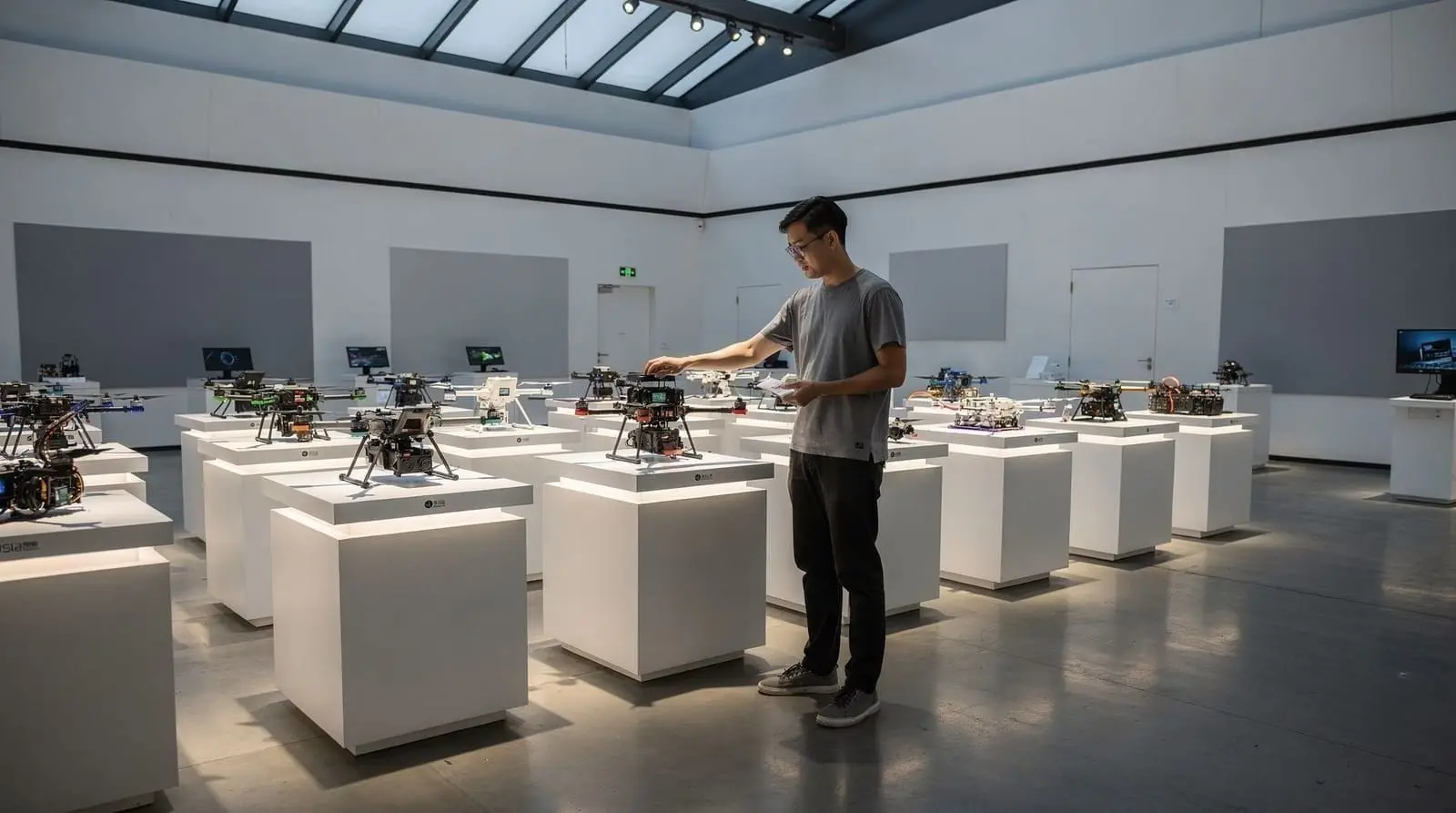
DJI makes the majority of the world’s consumer and professional drones and is headquartered in Shenzhen. Their main facilities are not open to the public, but the DJI flagship store near Huaqiangbei (DJI Sky City showroom concept opens 2025–2026, with the main store at Haixiu Rd, Nanshan) is. The showroom displays the full product line, demonstrates drones in a purpose-built indoor flight area, and lets you fly simulator units.
For drone buyers, the DJI store in Shenzhen offers legitimate products at Chinese domestic pricing, which can be 10–20% lower than European and North American retail (before any customs considerations). Ask the staff for a regional frequency compatibility check before purchasing — some models are region-locked for regulatory reasons.
DJI also operates Aeroscope and enterprise drone demonstrations; these are invitation-only. But the consumer showroom is open 10:00–19:00, 7 days a week.
Tencent’s Binhai Building: an architectural spectacle
Tencent — which operates WeChat, the app you need to pay for everything in Shenzhen — has its headquarters in Nanshan’s tech corridor. The Tencent Binhai Building (designed by NBBJ, a Seattle architecture firm) is a visually striking twin-tower structure connected by sky bridges at the upper floors. It is a private corporate campus and not open for general tours.
What you can do: walk the promenade along Shenzhen Bay between the Tencent campus area and Shenzhen Bay Park. The towers are visible and photogenic from the coastal path. Shenzhen Bay Park itself is excellent — 15km of seafront walking and cycling, pelicans on the mudflats in winter, the city skyline to one side and Hong Kong’s New Territories visible across the bay. See the Shenzhen Bay and mangrove nature guide for the best stretches to walk and when the pelicans are actually present.
BYD’s innovation park is similarly a private campus (in Pingshan district, east Shenzhen). BYD, which now makes more electric vehicles than any company in the world, does not offer factory tours to individual tourists. The nearest legitimate access point is the BYD Auto showroom in Futian or Nanshan — worth a visit if you’re curious about the product range and where Chinese EV design is heading.
Autonomous vehicles on public streets
This is where Shenzhen earns the “city of the future” label with actual justification. As of 2025–2026, Shenzhen operates one of the world’s highest concentrations of commercially deployed autonomous vehicles on public roads:
Robotaxis: Companies including WeRide, AutoX, and Baidu’s Apollo have robotaxi services operating in Shenzhen. You can hail them via specific apps (Baidu Maps has an Apollo taxi option; WeRide has its own app). The experience is genuinely novel — a production vehicle with no driver, navigating normal city traffic. Pricing is close to regular taxi rates.
Autonomous buses: Shenzhen operates AI-driven mini-buses on several fixed routes in Futian and Nanshan, some without human safety drivers in the cab. These are regular public transit, accessible with a WeChat Pay tap.
Delivery robots: On footpaths in Nanshan and the tech corridor, you will encounter autonomous food delivery robots navigating between restaurants and offices. These are from companies including Meituan (China’s dominant food delivery platform) and operate on dedicated sidewalk permits.
For the most concentrated autonomous vehicle density, spend time walking through the tech corridor in Nanshan district between Keyuan Road and the bay promenade. The Nanshan and Shekou destination guide has the fuller neighbourhood context if you want to combine this with food or nightlife afterward.
Book a guided tour focused on Shenzhen’s autonomous vehicles, drones, and AI infrastructureMaker spaces and hardware innovation hubs
Shenzhen has a globally recognised maker ecosystem, though access varies:
SZMTA (Shenzhen Maker Town) in Baoan: The city’s main maker hub, with open-access workshop days and community events. The website lists open house hours; these vary monthly. Best for hardware developers and serious makers.
HAX: The world’s first hardware accelerator, based in Nanshan. They run cohorts of hardware startups (not tourist accessible), but their monthly demo days are occasionally open to the public — check their event calendar at hax.co.
Chaihuo Maker Space: A community maker space in Nanshan district, more accessible than the corporate campuses. Runs workshops and open community days where travellers with maker interests can drop in. CNY 50–100 for drop-in day access.
OCT-LOFT innovation zone: More accessible and more design/art focused than pure maker spaces, but the intersection of industrial design, technology, and culture is visible here. Several tech design studios occupy the converted factory buildings. Free to walk around the public areas.
The honest framing: tech tourism in Shenzhen has limits
A common disappointment among tech-curious travellers: Shenzhen’s actual factories and campuses are not open to individual tourist visits. The Foxconn plants in Longhua where iPhones are assembled, the BYD battery factories, the Huawei research park — none of these accept individual visitors. Group manufacturing tours do exist through specific B2B tourism companies, but they require advance booking and are primarily aimed at business delegations.
What travellers can genuinely access: Huaqiangbei and its component supply chain (legitimate and detailed), the DJI flagship store, autonomous vehicle hailing, street-level observation of the city’s physical technology infrastructure, and the visual grammar of a city built around manufacturing at scale.
This is still more technology access than most cities in the world offer visitors. Adjust your expectations from “I’ll tour a smart factory” to “I’ll understand what makes this place globally significant” and the visit delivers.
Join a structured Shenzhen tech exploration tour — these cover DJI, Huaqiangbei, autonomous vehicles, and technology demonstration points in a single day, which is efficient if time is limited.
Practical details
- Best time: Weekdays, when the tech district operates at full capacity. Many businesses closed on public holidays.
- Getting there: Metro Line 1 to Science Museum Station or Gaoxin Park Station for the Nanshan tech corridor. Line 1 to Hua Qiang Bei for the electronics district.
- Transport in the district: The autonomous shuttle services within Shenzhen Bay Tech Park (深圳湾科技生态园) are accessible to members; the public road routes for robotaxis are broader.
- Budget: Autonomous taxi rides CNY 15–35. DJI store browsing: free. OCT-LOFT: free to walk. Maker space drop-in: CNY 50–100.
Pairing a tech day with the rest of your trip
A tech-focused day works well slotted into a longer Shenzhen itinerary rather than as the sole reason to visit. If you’re new to the city, read first time in Shenzhen first for the basics of getting around and paying for things, since navigating Nanshan’s tech corridor assumes you already have WeChat Pay or Alipay working. For where to stay to make this day trip easiest, both Nanshan and Futian work; see the best neighbourhoods in Shenzhen guide for the trade-offs, and factor the cost of any guided tour or robotaxi rides into your overall trip budget via the Shenzhen on a budget guide.
Frequently asked questions about Shenzhen’s tech scene
Can I visit Huawei or DJI headquarters?
Huawei’s Banxuegang campus is a private corporate facility and not open for tours. DJI’s flagship showroom (separate from HQ) is publicly accessible. Factory and campus tours in Shenzhen generally require corporate invitation or B2B tour booking.
Are the autonomous taxis safe?
Commercial robotaxi deployments in Shenzhen have strong safety records for the size of the programmes. The vehicles operate with extensive sensor suites (lidar, cameras, radar) and remote monitoring. As of 2026, the major operators have not reported significant safety incidents on the Shenzhen deployments.
What is the best one-day itinerary for tech-focused travellers?
Morning: Huaqiangbei component floors (SEG) and consumer electronics exploration. Lunch at nearby noodle shops. Afternoon: Nanshan tech corridor, DJI flagship, Shenzhen Bay promenade, robotaxi hailing. Evening: Shekou area for dinner and the Sea World atmosphere. Metro throughout.
Is Shenzhen’s tech scene better than visiting Hangzhou or Beijing?
Depends what you’re interested in. Shenzhen is unique for hardware manufacturing and supply chain. Beijing has Baidu, ByteDance, and AI research. Hangzhou has Alibaba and fintech. For physical tech tourism — things you can see and touch — Shenzhen is unmatched.
How do I get between the Nanshan tech corridor and Huaqiangbei efficiently?
The Shenzhen metro guide covers this route in detail, but the short version is Metro Line 1 connects both directly — about 25–35 minutes between the Nanshan tech stations and Hua Qiang Bei, making a single-day itinerary covering both entirely realistic.
Top-rated things to do in Shenzhen
Verified deep-linked GetYourGuide tours. Book through these links and we earn a small commission at no cost to you.