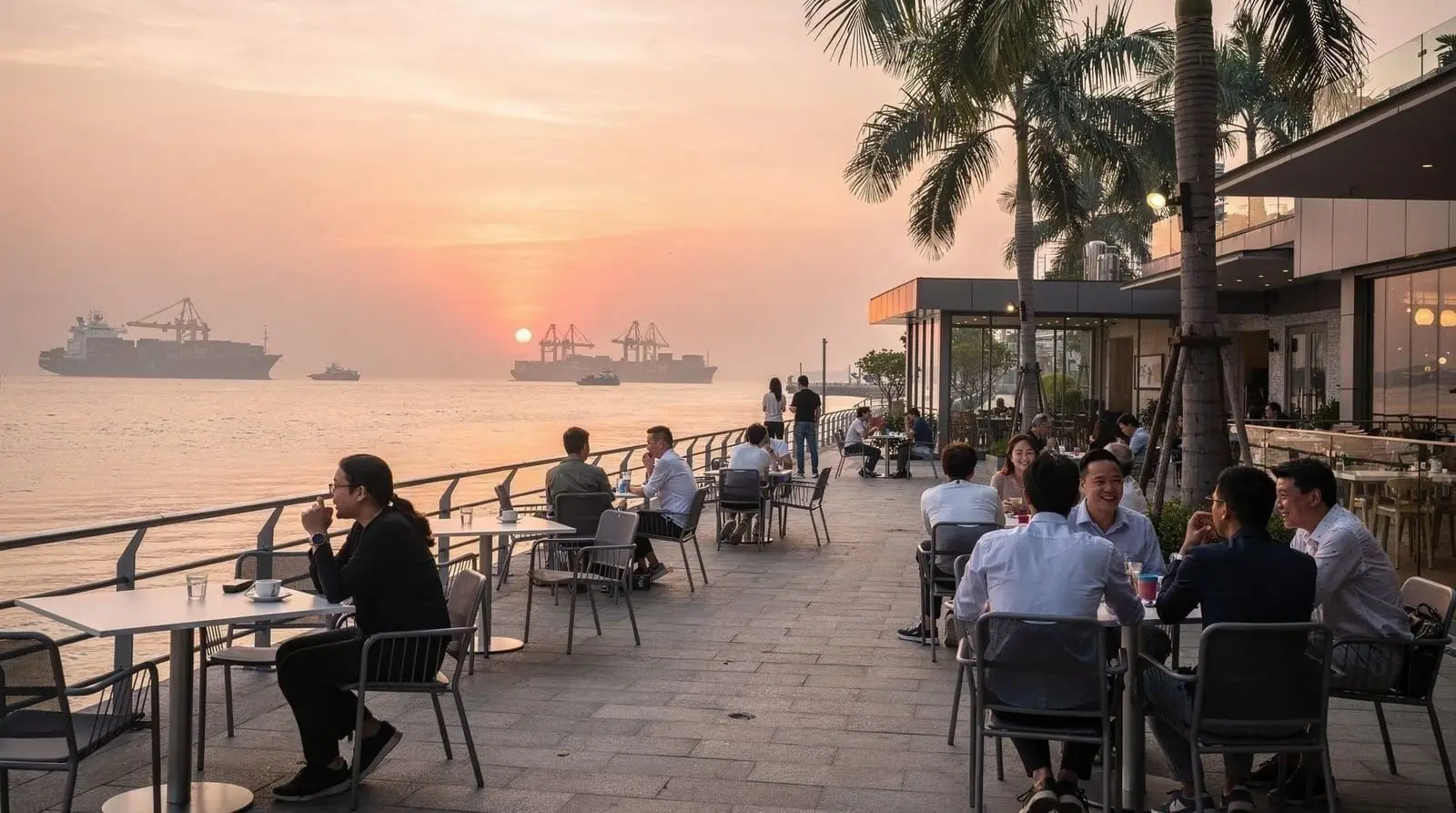
Nanshan is the western counterpart to Futian’s corporate efficiency — a district that runs on similar economic energy but has somehow developed a more human-scale character in the process. The area stretches from the hills above OCT-LOFT in the east to the ferry terminal at Shekou in the west, encompassing Shenzhen’s highest concentration of technology company headquarters, the city’s most established international neighborhood, and two of Shenzhen’s most visited attractions.
It’s also, for many travelers, the part of Shenzhen that surprises them. You expect tech campuses and shopping malls. You find a neighborhood where actual people live — where the restaurants have regulars, the coffee shops have community boards, and the weekend atmosphere on the Sea World plaza has the relaxed energy of a city that’s figured out how to enjoy itself.
| Where | West Shenzhen, Metro Lines 1, 2, 5, 9, 11 |
| Cost | Window of the World CNY 150–220; Sea World meals CNY 60–180 |
| Time needed | 1–2 full days; best combined with OCT-LOFT |
| Getting there | Line 1 to Window of the World, or Line 2 to Sea World |
| Best time | October–April; Shenzhen Bay Park least pleasant in summer humidity |
The Shekou neighborhood
Shekou (蛇口, literally “snake mouth,” named for its headland geography) was the first area within Shenzhen designated for foreign investment and development in 1979, effectively predating the formal SEZ declaration. The industrial and port infrastructure built here in the early 1980s attracted the first wave of foreign workers, diplomats, and entrepreneurs. By the 1990s, Shekou had established itself as the default international neighborhood — the place where expatriates found apartments, supermarkets with foreign goods, and restaurants that served something other than Cantonese food.
That history gives Shekou a character that Futian’s planned CBD lacks. The streets were built at a scale that allows walking. The residential blocks house actual communities. And the food scene — while smaller than many of Shenzhen’s other culinary clusters — reflects genuine international diversity rather than the Westernized-Chinese fare that dominates in tourist zones.
Sea World (SEA World) and the main plaza: The central gathering point of Shekou is Sea World — an entertainment and retail complex built around the Minghua, a retired French ocean liner permanently berthed as a hotel and events venue. The ship is genuinely there, permanently docked, with its funnels repainted and its promenade decks accessible. The plaza surrounding it has restaurants from multiple countries, bars, outdoor seating, and a casual market atmosphere on weekend afternoons.
The restaurants around Sea World plaza span Korean BBQ (CNY 120–180/person), Japanese ramen (CNY 60–90), Italian (CNY 80–160), and Western brunch options. Quality is consistently above the city average because the clientele includes enough international residents to demand it. The bars — concentrated on the north side of the plaza and along Harbour Road — are Shenzhen’s most established international nightlife scene.
Nightlife: Shekou’s bar strip along Harbour Road and the nearby streets functions as the main expat social hub for the western part of Shenzhen. A standard evening: craft beer at Arrow Factory Brewing’s Shekou taproom (imported and local craft on tap, CNY 35–65 per pint), followed by whisky at one of the Scotch-focused bars on the side streets. Live music most weekends at several venues. No cover charges except for special events.
Window of the World
Opened in 1994 by the OCT Group, Window of the World occupies 48 hectares in western Nanshan and contains 130 scaled replicas of global landmarks. The signature piece — the Eiffel Tower at 1:3 scale, standing 108 meters — is visible from the metro station before you enter. The park also has the Pyramids of Giza (at 1:1 scale for the main pyramid, which is large), the Leaning Tower of Pisa (full-height, accurate lean), the Sydney Opera House, Niagara Falls (with actual water), Stonehenge, the Parthenon, the Taj Mahal, and much more.
Purchase Window of the World entry tickets with skip-the-queue accessThe honest assessment: Window of the World is kitsch by design and manages to transcend that categorization through sheer execution quality. The models are better-maintained than you’d expect for a 30-year-old park. The night show — colored lighting synchronized across the major replicas, running at 19:30 and 20:30 — is genuinely impressive, particularly at the illuminated Tower. The park is large enough that even at moderate capacity it doesn’t feel crowded.
Ticket: CNY 220 (~USD 32) at gate; CNY 150–180 (~USD 22–26) online with advance booking. Children under 1.2 m: free. Students (Chinese ID): discounted rate. Evening-only entry (after 18:00): CNY 120 (~USD 18).
Hours: 10:00–21:30 weekdays; 10:00–22:00 weekends and holidays.
Getting there: Metro Line 1 to Window of the World station — direct connection to the park south gate, 3 minutes walk. From Futian Station: 15–20 minutes on Line 1.
Best approach for a day visit: Enter at 10:30 (before the tour group surge at 11:00), work through the European landmarks zone first (less crowded in the morning), break for lunch at the park’s Asia zone food court (CNY 50–80 per person; prices are higher than outside but not egregiously so), then catch the evening light show before exiting.
OCT-LOFT creative district
OCT-LOFT occupies a former industrial complex on Enping Street, converted into a creative district in stages between 2004 and 2010. The layout is a north block and south block connected by an elevated walkway. The south block is more commercial — design boutiques, brand concept stores, coffee chains. The north block is where the interesting gallery programming lives.
The district is Shenzhen’s answer to Beijing’s 798 or Shanghai’s M50, but considerably smaller and less self-conscious about its art-world status. You can walk the main strip in 20 minutes; a proper exploration of the galleries takes 2–3 hours.
Key spaces within OCT-LOFT:
He Xiangning Art Museum: Named for a prominent 20th-century Chinese artist and political figure. The permanent collection focuses on modern Chinese art; temporary exhibitions bring in international contemporary work. Free entry. Tuesday–Sunday, 09:00–17:00.
OCT Contemporary Art Terminal (OCAT Shenzhen): The flagship contemporary art institution in the OCT zone, operating since 2005 with a consistently strong exhibition program. Recent shows have included solo exhibitions of international artists alongside Chinese contemporary video art and installation. Admission: CNY 30–60 (~USD 4–9). Tuesday–Sunday, 10:00–18:00.
B10 Live: The music venue occupying a repurposed factory building in the north block. Capacity around 500. Programming covers indie rock, electronic, jazz, and occasional classical performances. Tickets: CNY 80–300 depending on act. Check schedule at b10live.com (Mandarin interface; Google Translate handles it adequately).
Independent galleries: Approximately 15 smaller galleries operate in the complex, ranging from artist-run spaces showing works for CNY 500–5,000 to commercial galleries dealing in established names. Most are free to enter; the quality varies dramatically. The best strategy is to walk through without preconceptions and enter any space that looks interesting.
Books and design: Page One Books (a Taiwanese chain with high-quality curation) has a branch in OCT-LOFT South with art books, architecture titles, and an English section. Several design boutiques sell locally-designed homeware, ceramics, and stationery.
Metro: OCT station (Line 1), Exit B, 3 minutes walk to main entrance. Entry to the district: free. Hours: district open continuously; galleries and shops 10:00–21:00.
Shenzhen Bay Park and coastal corridor
A 15 km linear park follows the Shenzhen Bay coastline south of Nanshan, connecting the Shenzhen Bay Bridge area in the west to Shekou in the east via a continuous promenade and cycling path. The park overlooks the bay and, on clear days (October–November), offers unobstructed views of the Hong Kong New Territories mountains across the water.
The park is genuinely used by Shenzhen residents for exercise — morning runs, evening cycling, weekend kite-flying (better wind than Lianhuashan), and occasional outdoor yoga classes. The cycling path runs uninterrupted for the full 15 km; the Meituan bike-share system has docking points at major park entrances, and bikes can be rented for CNY 1.5–2 per 30 minutes.
Entry: Free. Hours: Open all hours. Best sections: The mangrove observation platforms at the western end (Shekou Fisherman’s Wharf area) give close access to a small natural mangrove reserve. Bird-watching is possible here in autumn migration season (October–November).
Metro: Shenzhen Bay Park station (Line 9) for the central section; Sea World station (Line 2) for the Shekou end.
Tencent and the tech campus district
Tencent — the company behind WeChat, QQ, Honor of Kings, and several global investments — is headquartered in Nanshan. The Tencent Seafront Towers (腾讯滨海大厦), two connected towers in the Nanshan Software Technology Base area (near Binhai Metro station, Line 5), are recognizable by their distinctive sky bridge connector and the WeChat logo visible on the upper facade. The campus is not open for tourist visits, but the building is impressive viewed from the seafront road.
The broader Nanshan tech corridor — Software Park Phase 1 and 2, the Guangming area further north, and the Qianhai financial zone to the southeast — houses dozens of tech companies, financial firms, and startup incubators. Visitors with a professional interest in Shenzhen’s tech scene should note that the Shenzhen Technology Exchange (深圳技术交流) operates occasional open innovation events; check tech media Shenzhen for scheduled public events.
DJI’s flagship retail experience is near OCT (not the campus, which is in Nanshan’s interior). The DJI flagship store at Huaqiangbei is in Futian, 25 minutes east by metro.
Book a technology tour covering DJI, Huaqiangbei, and autonomous vehicle demonstrationsA one-day Nanshan and Shekou itinerary
For visitors with a single day to cover the district’s highlights: start at Window of the World by 10:30 am to beat the tour-group surge, spend 2–3 hours through the European and Asian landmark zones, break for lunch at the park’s food court or head to Sea World plaza (15–20 minutes by metro) for a wider choice. Spend the afternoon at OCT-LOFT, 10 minutes from Sea World, walking the galleries and picking up a coffee at one of the independent shops in the north block.
End the day back at Sea World or Harbour Road for dinner and a craft beer before catching an evening ferry from Shekou if you’re continuing to Hong Kong or Macau the next morning. This sequence minimizes backtracking and uses the district’s Line 1/Line 2 connections efficiently — see the Shenzhen in 3 days itinerary for how this slots into a longer trip.
Food in Nanshan and Shekou
International options: The Sea World plaza and the surrounding streets of Shekou have the broadest non-Chinese restaurant selection in Shenzhen. Consistently recommended options:
- Origin Coffee (多家门店): Australian-style specialty coffee. Oat latte CNY 35–40. Multiple Shekou locations; the one near the ferry terminal has sea views from the upper floor.
- Oktoberfest Shekou: German-style bar-restaurant with imported beer (CNY 60–100 per half-litre) and consistent German food (pork knuckle, pretzels, sausage plates). Not authentic, but reliable for a Western pub meal.
- Korean BBQ block (Gong Ye Er Road): Four or five Korean barbecue restaurants within 100 meters of each other. Quality differential is small; price differential is also small (CNY 100–160 per person with meat and side dishes). Arrive after 19:00 for the full evening service.
Local Cantonese: The residential streets 3–5 minutes walk behind Sea World have old-school Cantonese restaurants at fraction of the plaza prices. Wonton noodle soup: CNY 18–25. Clay pot rice (砂锅饭): CNY 35–55. Roast meats (siu mei) rice plate: CNY 28–45. These restaurants are regulars for the neighborhood’s working residents; the quality is consistent precisely because they can’t afford to slip.
Seafood: The wet market behind the Shekou Fisherman’s Wharf area has fresh seafood stalls selling live fish, crab, mantis shrimp, and shellfish. Adjacent restaurants will cook your purchase for a service charge (typically CNY 10–20 per dish in preparation fee, on top of the seafood cost). A fresh grouper meal for two this way: approximately CNY 150–250 (~USD 22–37).
Dim sum: Nanshan has multiple Cantonese dim sum restaurants in malls near Nanshan Metro station (Line 1). The Guanlan seafood restaurant chain has a Nanshan branch with above-average dim sum and weekend yum cha from 07:30. Expect CNY 65–110 per person.
Getting to and around Nanshan and Shekou
From Futian: Metro Line 1 westbound. Window of the World station: 15–20 minutes, CNY 4–5. Sea World station (Line 2): interchange at Chegongmiao or OCT, 20–25 minutes total.
From Luohu: Metro Line 1 westbound, 40–45 minutes straight through. No interchange required.
Shekou Ferry Terminal routes (all subject to seasonal adjustments — verify current schedules):
- Guangzhou Nansha Ferry Terminal: 90 minutes, CNY 100–150 (~USD 15–22). Multiple daily departures.
- Macau (Inner Harbour): 90 minutes, CNY 150–200 (~USD 22–30). Check TurboJet or Cotai Water Jet schedules.
- Hong Kong (China Ferry Terminal, Tsim Sha Tsui): 30–50 minutes, HKD 130–190 (~USD 17–24). Several departures daily from Chu Kong or First Ferry.
Shekou ferry terminal is Metro Line 2, Sea World station, then 10 minutes walk following signs to the terminal.
Didi from Futian: 25–35 minutes, CNY 30–55 depending on specific destination within Nanshan.
Where to stay in Nanshan and Shekou
Nanshan and Shekou have fewer accommodation options than Futian but a more pleasant neighborhood feel.
Upper range (CNY 800–1,500/night, ~USD 118–220):
- Westin Shenzhen Nanshan — excellent location near Sea World; pool; strong international standard
- Shenzhen Marriott Hotel Nanshan — business hotel with good metro access and consistent quality
Mid-range (CNY 350–750/night, ~USD 51–110):
- Ibis Styles Shenzhen Shekou — functional, well-located, decent breakfast
- Atour Hotel Nanshan (亚朵酒店) — Chinese business hotel chain with better-than-average rooms and a genuine book library in the lobby; solid value
Budget (CNY 200–350/night, ~USD 29–51): Very limited in the immediate Sea World/Shekou zone. Closest budget options are near Nanshan Metro station (5–8 minutes further east), where several business hotels operate in the CNY 180–300 range. Read reviews carefully.
Nanshan is a strong alternative base to Futian — particularly for travelers combining Shenzhen with ferry connections to Guangzhou or Macau, or for stays of 4+ days where neighborhood livability matters more than maximum metro coverage.
Choosing a Shenzhen base: Nanshan/Shekou vs Futian vs Luohu
Nanshan and Shekou is one of three realistic bases for a multi-day Shenzhen stay, and each suits a different traveler:
| Base | Character | Best for | Metro coverage |
|---|---|---|---|
| Nanshan/Shekou | Walkable, international, coastal | Longer stays, families, ferry connections | Good (Lines 1, 2, 5, 9, 11) |
| Futian | Business-district, efficient | Fast HSR access to Hong Kong, first-timers | Excellent (city-wide hub) |
| Luohu | Gritty, budget, border-adjacent | Shopping, street food, Lo Wu crossing | Good (Lines 1, 2, 3, 5) |
For most travelers spending 4 or more days in Shenzhen, Nanshan/Shekou offers the best combination of livability and things to do within walking distance. See the where to stay in Shenzhen guide for a fuller breakdown, and the Shenzhen metro guide for planning connections between districts.
Nightlife beyond Shekou’s main strip
Shekou’s Harbour Road bars are the best-known nightlife cluster in Nanshan, but a few other options are worth knowing. The OCT-LOFT area, 20–25 minutes east, has B10 Live for gigs and a handful of craft beer bars with a younger, more local crowd than Shekou’s expat-heavy scene — see the Shenzhen craft beer and bars guide for a fuller list across the city.
Rooftop options are limited in Nanshan compared to Futian, but the Westin Shenzhen Nanshan’s top-floor bar has reasonable Shenzhen Bay views for a quieter evening drink. For a full night out with contrast, pairing Shekou’s craft beer taproom early with a later stop in OCT-LOFT gives a sense of Nanshan’s range without needing to cross the city.
What to skip in Nanshan
Shenzhen Safari Park: A large zoo with standard captive animals. Unless you’re traveling with young children who specifically want it, skip it — it offers nothing distinctive compared to zoos elsewhere.
“Shenzhen beaches” near Nanshan: Multiple developments market themselves as beach resorts on the Nanshan western coast. The water quality in Shenzhen Bay is poor for swimming. For real coastal access, go to Dapeng Peninsula, 90 minutes east.
Qianhai Free Trade Zone: Marketed as Shenzhen’s financial future, Qianhai is still largely a construction zone in 2026. Not a visitor destination. If a tour or itinerary mentions it as a stop, treat that as a red flag for the overall itinerary’s usefulness rather than a genuine attraction.
Onward from Nanshan
- OCT Overseas Chinese Town — adjacent east, with theme parks and art spaces
- Shenzhen main guide — city overview and logistics
- Futian — 20 minutes east for Huaqiangbei and HSR to Hong Kong
- Dapeng Peninsula — 90 minutes east for beaches and hiking
- Pearl River Delta grand loop — 10 days — using Shekou ferry connections
- Shenzhen Bay and mangrove nature guide — more on the coastal park and birdwatching
- Things to do in Shenzhen — full activity list