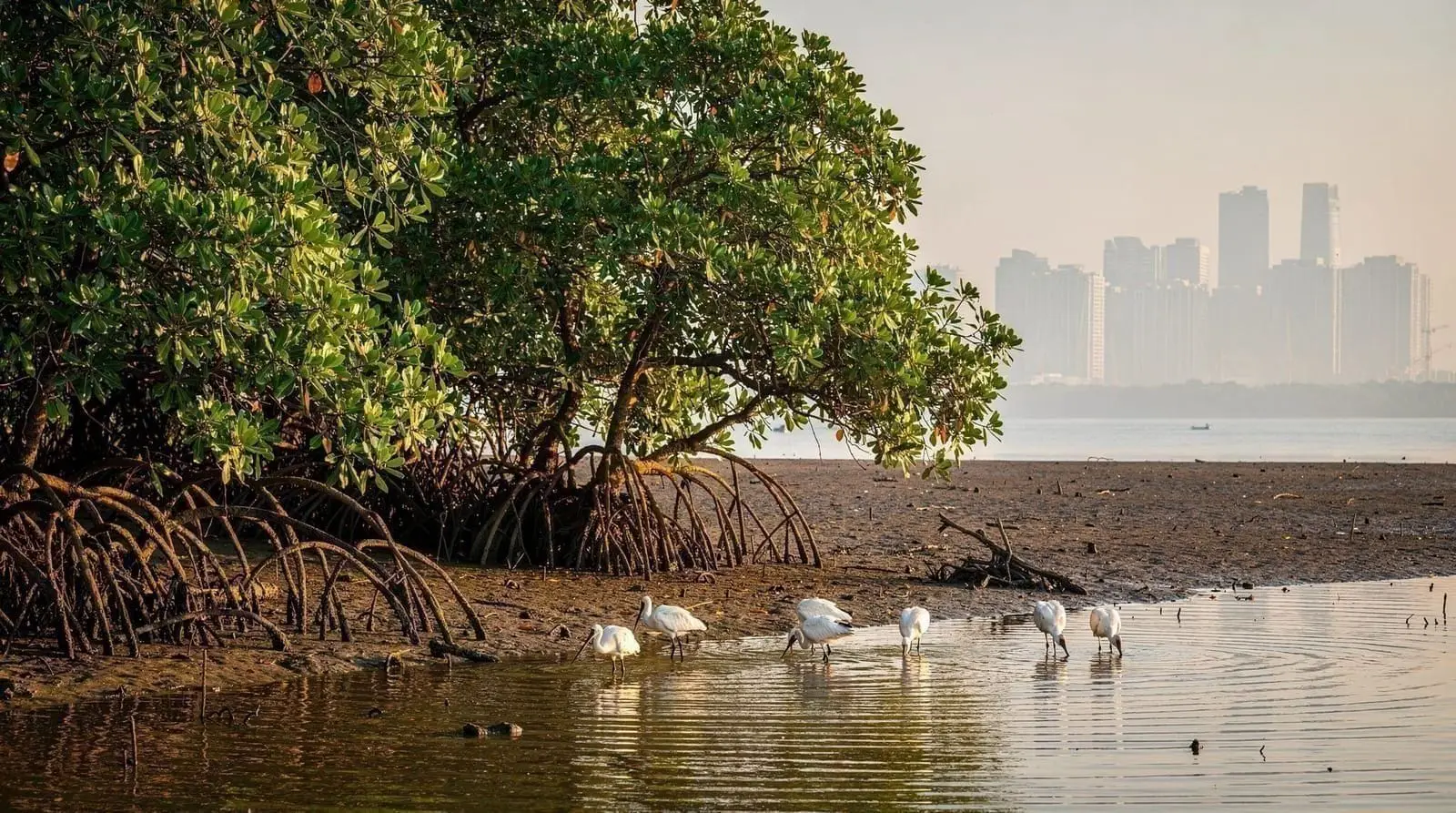
Shenzhen Bay and mangrove nature: Futian reserve and coastal parks
Is Shenzhen Bay worth visiting for nature in Shenzhen?
Yes — the Futian National Nature Reserve and adjacent Shenzhen Bay Park form one of the best urban birdwatching sites in East Asia. Over 190 species recorded, including endangered Black-faced Spoonbills. Peak season October–March. Entry to both parks is free.
The Shenzhen Bay shoreline holds a surprise for a city that arrived in 40 years: one of the most productive urban wetlands in Asia. The Futian Mangrove National Nature Reserve and the Shenzhen Bay Park together form a continuous green corridor along the bay’s northern shore, hosting over 190 bird species (including internationally protected breeding populations) and providing the city’s residents with a genuine natural escape a short metro ride from the financial district.
| Where | Futian district, along Shenzhen Bay’s northern shore |
| Cost | Free entry to the park and observation platforms |
| Time needed | 2–3 hours for the boardwalk and birdwatching; half a day if cycling the full 15 km |
| Getting there | Metro Line 11 Mangrove Bay Station or Line 1 Shawei Station |
| Best time | October–March for birdwatching; year-round for cycling and evening strolls |
The Futian Mangrove Reserve
Designated a national nature reserve in 1984, the Futian reserve covers 367 hectares of tidal mangrove forest, reed beds, and mudflat. Its central position — bordered by Futian CBD to the north, the Shenzhen-Hong Kong border to the south, and the bay to the west — makes it the most accessible urban wildlife reserve in the Pearl River Delta.
Why it matters for birds: The reserve sits on the East Asian–Australasian Flyway, one of the world’s great migratory routes connecting Siberia and Alaska to Australia and New Zealand. Millions of shorebirds pass through the Pearl River Delta every autumn and spring. The Futian mudflats are a critical refuelling stop for species including Black-tailed Godwit, Dunlin, Kentish Plover, and Mongolian Gull.
The reserve’s most famous residents are the Black-faced Spoonbill (黑脸琵鹭), an endangered species with a global population of only ~6,000. A wintering flock of 50–200 birds reliably uses the Futian mudflats November–February, making it one of the most accessible places in the world to see this species.
Visitor access: The reserve has restricted access to protect nesting areas, but a well-maintained observation platform and boardwalk on the eastern edge (accessible from Shenzhen Bay Park) allows excellent viewing of the mudflat activity. A second observation tower is on the western edge, accessible by walking south from Exit A of Shawei Metro Station (Line 1). No entry fee for the observation platforms.
A permit is required to enter the reserve interior; apply through the Futian Nature Reserve Administration (contact via Shenzhen Bay Park visitor centre). Occasional guided naturalist walks are organised through local birdwatching groups (Shenzhen Birdwatching Society, active on WeChat).
Shenzhen Bay Park
The park runs for 15 km along the bay shore, from the Binhai Avenue overpass in the east to the Shenzhen Bay Port bridge in the west. It is the city’s best linear green space: wide cycling and walking paths, beach areas, children’s play zones, exercise equipment, and unobstructed views across the bay to Hong Kong’s New Territories.
Cycling: Bicycle hire stations dot the park at 500m intervals (CNY 1.5/hour on a registered app, or CNY 50/day at kiosk rentals). A full bay-to-boundary cycle takes about 2 hours each way. The western section near the port bridge is least used and most scenic.
Swimming: A small beach area near the park’s western end is officially open for swimming June–September (lifeguards on duty). Water quality is fair but not comparable to Dapeng’s east-facing beaches — the bay water is estuarial. Most locals treat this as a paddling area for children rather than a swimming beach.
Views to Hong Kong: On clear days (October–March) the New Territories hills and Tin Shui Wai residential towers are visible across the 3.5 km of water. The perspective gives an unusually physical sense of how close Shenzhen and Hong Kong are.
Talent Park (人才公园): At the eastern end of the bay park, Talent Park is a recently built sculpture and garden space celebrating science and technology talent. It is popular with joggers and families and has a small artificial lake with pedal boats (CNY 30/30 min).
Birdwatching guide
Peak season: October to late March. The winter months (November–February) offer the greatest species diversity, as migratory shorebirds arrive from northern breeding grounds. Summer (June–August) has resident species but fewer migrants.
Top species by season:
- October–March: Black-faced Spoonbill, Grey Heron, Great and Little Egret, Eurasian Curlew, Common Sandpiper, Black-tailed Godwit, Terek Sandpiper
- April–May (spring migration): Yellow Wagtail, Whiskered Tern, Barn Swallow (passage)
- June–September (breeding residents): Chinese Pond Heron, Little Ringed Plover, Common Kingfisher
Best spots:
- The western observation tower (accessible from Shawei station, Line 1, Exit A): closest platform to the main mudflat roost. 07:00–08:30 is peak activity before the tide rises.
- The eastern boardwalk in Shenzhen Bay Park (near Mangrove Bay Metro Station, Line 11): good egret and spoonbill views at low tide.
- The reed-bed walkway midway through the park: herons and kingfishers year-round.
Equipment: A 10x42 binocular is sufficient for the platforms; a scope (20–60x) reveals finer details of distant roosting shorebirds. Photography requires at least a 500mm lens for quality shots.
Local resources: The Shenzhen Birdwatching Society (深圳观鸟协会) publishes weekly species sightings and organises free guided walks (Chinese-language, but open to foreign visitors). Their WeChat public account (搜索: 深圳观鸟协会) updates every Friday.
Planning your visit by season
| Season | Conditions | What to expect |
|---|---|---|
| Oct–Mar | Cool, clear, dry | Peak birdwatching, Black-faced Spoonbill flock present, best sunset photography |
| Apr–May | Warming, occasional rain | Spring passage migrants, fewer crowds on the boardwalk |
| Jun–Sep | Hot, humid, typhoon risk | Resident species only, beach paddling area open, evening cycling more comfortable than midday |
If a single visit has to fit around other Shenzhen sightseeing, aim for an early weekday morning October–March: the low tide plus the cooler air makes the two-hour window right after sunrise the single best slot for both birds and photography.
A half-day plan for a first visit
Start at Mangrove Bay Station and walk the eastern boardwalk while the tide is still low, watching for egrets and spoonbills from the platform. From there, either continue west along the cycling path toward Shawei Station (about 45 minutes at an easy pace) or cut inland to explore Talent Park’s sculpture garden and pedal-boat lake. Finish with a coffee at one of the cafés clustered around the Mangrove Bay exit. Those with more time can extend the loop toward Lianhuashan Park in central Futian, a green hilltop counterpoint to the flat coastal wetland, or combine the visit with a stop in Futian district itself for shopping and dining afterward.
Getting to Shenzhen Bay Park
Metro:
- Line 11 Mangrove Bay Station (湾畔红树林): central park access, closest to the boardwalk birdwatching point
- Line 1 Shawei Station (沙尾): western access, closest to the observation tower
- Line 11 Shenzhen Bay Port Station: east-of-bay access for the cycling start point
Cycling from Nanshan: The park is 10 minutes by bike from the Houhai area of Nanshan district along Binhai Avenue.
Walking: The park’s main entrance is a short walk from both Mangrove Bay and Shawei stations. No entry fee.
What else is nearby
Shenzhen Bay Port (口岸): The border crossing to Hong Kong is at the park’s western end. From here, the No. 5 cross-border bus goes directly to Hung Hom, Mong Kok, and Tuen Mun in Hong Kong (CNY 50–80). This makes a logical crossing point for those combining a bay walk with a Hong Kong day trip.
OCT Wetland Park (华侨城湿地公园): 20 minutes east by bike or metro, OCT Wetland is a smaller urban lake reserve inside the OCT complex in Nanshan. Entry is by free advance booking (OCT official WeChat). Less wild than Futian but peaceful, with waterfowl and walking paths.
Nanshan Shekou area: Shenzhen’s most expatriate-friendly district with international restaurants, cafés, and the Ferry Terminal for Hong Kong. See Nanshan and Shekou guide for details.
For more outdoor options in Shenzhen, the Dapeng fortress and beaches guide covers the peninsula’s hiking and coastal options. The Shenzhen with kids itinerary includes Shenzhen Bay Park as a family-friendly half-day. The Shenzhen destination guide covers the full city.
Also relevant for nature in the wider region: Nature and parks and the greater bay area theme parks guide for comparison between natural sites and built attractions.
Practical information
Opening hours: Shenzhen Bay Park is open 24 hours. The observation platforms are accessible dawn to dusk. The visitor centre (near Mangrove Bay station) is open 09:00–17:00 Tuesday–Sunday.
Entry fees: All free. Bicycle hire is pay-as-you-use via app.
Facilities: Toilets every 500m in the park. Vendors sell drinks and snacks near the main gates. No restaurants inside the nature reserve section; the Mangrove Bay Station exit has a cluster of cafés.
Photography rules: No tripods in the mangrove reserve section without a permit. Photography is fine from the public platforms. Drone flights are prohibited over the reserve.
Weather: Best October–March for nature (cool, clear, migratory season). Avoid typhoon season June–September for outdoor activities.
The ecology of the mangrove system
Mangroves are salt-tolerant trees and shrubs that grow in tidal zones — their interlocking prop roots trap sediment, build coastline, and provide nursery habitat for fish and crustaceans. The Futian reserve contains seven mangrove species, with Kandelia obovata (秋茄) and Aegiceras corniculatum (桐花树) dominant. The pneumatophores (breathing roots) that project upward from the mud are visible at low tide in the boardwalk sections.
The mangroves at Futian are not particularly large by tropical standards — the trees reach 3–5 metres, compared to 20–30 metres in Borneo or the Amazon. Their ecological value lies in their position as a refuelling stop on one of the world’s major bird migration routes, not in the mangrove scale itself.
Tidal cycle and bird activity: The mudflat is exposed at low tide, when shorebirds actively feed. At high tide, the mud disappears under water and birds roost on mangrove branches or the artificial rock islands installed specifically for that purpose. The most productive birdwatching happens in the 2–3 hours around low tide. Apps that show tidal predictions for Shenzhen Bay (Tides Near Me, Tides Chart) are worth checking before visiting.
Shenzhen Bay as urban habitat design
The Futian reserve is often cited by urban planners as a case study in integrating wildlife habitat into a megacity. Shenzhen’s urban development completely surrounds the reserve on three sides; the fourth is the international boundary with Hong Kong. The fact that it functions as a viable habitat for endangered species is partly good fortune (the military-zone legacy) and partly deliberate planning since the 1990s.
The reserve administration manages water levels in the inner lagoon, maintains artificial nesting platforms, and monitors species counts systematically. Data from Futian feeds into the global monitoring programme for Black-faced Spoonbill population trends — the winter count here is one of the sites used to assess whether the global population is increasing or declining.
Hong Kong’s Mai Po Marshes on the opposite shore of the bay is a much larger and more intensively managed wetland reserve — the two sites together form a continuous habitat that makes the bay one of the most important urban wetland complexes in Asia. Visiting both on a single trip is possible for very committed birdwatchers (Mai Po requires an advance permit from WWF Hong Kong).
Cycling the bay: the full route
The 15-km bay park cycling route from east to west is one of Shenzhen’s best urban cycling experiences. Here is the full route with what you will see:
East end (Mangrove Bay Station): Start here. The first 3 km follows the shoreline past the main wetland boardwalk and the egret roost trees. Watch for herons standing motionless in the shallows.
Central section (5–8 km): The park widens, with grass areas, children’s play zones, and outdoor fitness equipment. The city skyline of Futian CBD is visible to the north; across the bay, the New Territories mountains of Hong Kong appear on clear days.
Western section (10–15 km): Less visited, more scenic. The boardwalk passes reed-bed areas where reed warblers breed in spring. The final approach to Shenzhen Bay Port passes under the HZMB approach viaduct — an unusual juxtaposition of mega-infrastructure and wetland.
The full one-way cycle takes 90–120 minutes at a relaxed pace. Return by cycling back or by riding to Shenzhen Bay Port station and metro home.
Bike hire: Mobike, Hello Bike, and Meituan bikes are available throughout via smartphone apps (link WeChat or Alipay). Cost CNY 1.5–2.5 per 30 minutes. A few fixed hire points near Mangrove Bay station rent by the hour (CNY 20–30/hour) for visitors without Chinese apps.
Comparing Shenzhen Bay to other nature stops nearby
Shenzhen offers several green escapes, and they serve different purposes. Shenzhen Bay Park and the Futian reserve are the pick for wildlife and easy metro access; Lianhuashan Park offers hilltop skyline views and is better for an early-morning jog or kite-flying with locals; the Dapeng Peninsula is the pick for genuine beach swimming and coastal hiking, but requires a longer trip out of the city centre.
For visitors weighing up which green space to prioritise on a short trip, Shenzhen Bay wins on convenience and wildlife interest, while Dapeng wins on scenery and swimming. The Shenzhen destination guide has the fuller picture of how these fit into a wider itinerary, and the day trips from Shenzhen guide covers options further afield.
Shenzhen Bay Park’s public art and green corridors
The park has undergone several phases of beautification since 2010. The central section includes large sculptural installations, a lotus pond garden, and several viewing pavilions. The Talent Park section at the eastern end has memorial stones to prominent scientists, engineers, and innovators with connections to Shenzhen — an unusual civic statement in a city better known for commerce than academia.
Evening in the park is a social event: Shenzhen residents practice ballroom dancing, tai chi, badminton (on informal nets), and group exercise. The evening atmosphere is lively and distinctly local — a contrast to the tourist-heavy parts of Shenzhen. If you want to see ordinary Shenzhen life rather than tourist attractions, an evening at the bay park is one of the best options in the city.
Photography at the bay
Sunrise: The bay’s western orientation means sunrise is behind the city; photograph looking west at sunrise for silhouettes of mangroves and the bay.
Sunset: Outstanding. The sun sets over Zhuhai/Hong Kong direction across the bay; the HZMB bridge appears as a thread on the horizon on clear days. The Futian and Nanshan skyline lights up from behind during the golden hour.
Bird photography: Early morning low-tide sessions with a 500mm+ telephoto lens are the standard approach. The observation platforms are positioned at reasonable distances from the roost areas (50–200m). A 1.4x converter extends reach when the spoonbills are at the far end of the roost.
Drone policy: Strictly prohibited over the nature reserve. Technically permitted over the park sections but practically constrained by the proximity to Shenzhen Bay Port and its flight-restriction zone. Do not fly drones here without checking current regulations.
Frequently asked questions about Shenzhen Bay nature
Can I enter the Futian Mangrove Reserve itself?
The reserve interior requires a permit (apply via the visitor centre). The observation platforms and boardwalk sections adjacent to Shenzhen Bay Park are freely accessible and give excellent views of the mudflats and mangroves without needing a permit.
Are the Black-faced Spoonbills guaranteed to be there in winter?
Not guaranteed, but highly likely. The Futian mudflats are one of the most reliable sites in Asia for the species November–February. Check the Shenzhen Birdwatching Society’s current sightings before visiting. The birds typically roost on the exposed mudflat at low tide.
Is Shenzhen Bay Park suitable for children?
Yes. The park has cycling paths wide enough for family bikes, play equipment, a paddling area in summer, and Talent Park’s pedal boats. It is one of Shenzhen’s best family outdoor spaces.
Can I combine Shenzhen Bay Park with a Hong Kong border crossing?
Yes — this is a practical option. Walk or cycle to Shenzhen Bay Port at the park’s western end and cross into Hong Kong via the No. 5 cross-border bus to Hung Hom or Tuen Mun. Allow 1.5–2 hours for the crossing including customs on both sides.
Is the water quality at the bay park beach suitable for swimming?
Marginally acceptable June–September for brief swimming, but not recommended for serious swimmers or children below middle-school age. The water quality is fair rather than clean — it is an estuarial bay environment. For proper swimming, go to Dapeng’s east coast beaches (see Dapeng fortress and beaches).
How much time should I set aside for Shenzhen Bay Park?
Two to three hours covers the boardwalk, the observation platform, and a short section of the cycling path. Committed birdwatchers or cyclists doing the full 15 km route should allow half a day, ideally starting early to catch the low tide and cooler temperatures.
Is Shenzhen Bay Park free, and does it get crowded?
Yes, entry is free and there is no ticketed area. Weekday mornings are quiet even in peak birdwatching season; weekend evenings get busy with local families, joggers, and exercise groups, especially around Talent Park, but the atmosphere stays relaxed rather than overwhelming.
Top-rated things to do in Shenzhen
Verified deep-linked GetYourGuide tours. Book through these links and we earn a small commission at no cost to you.