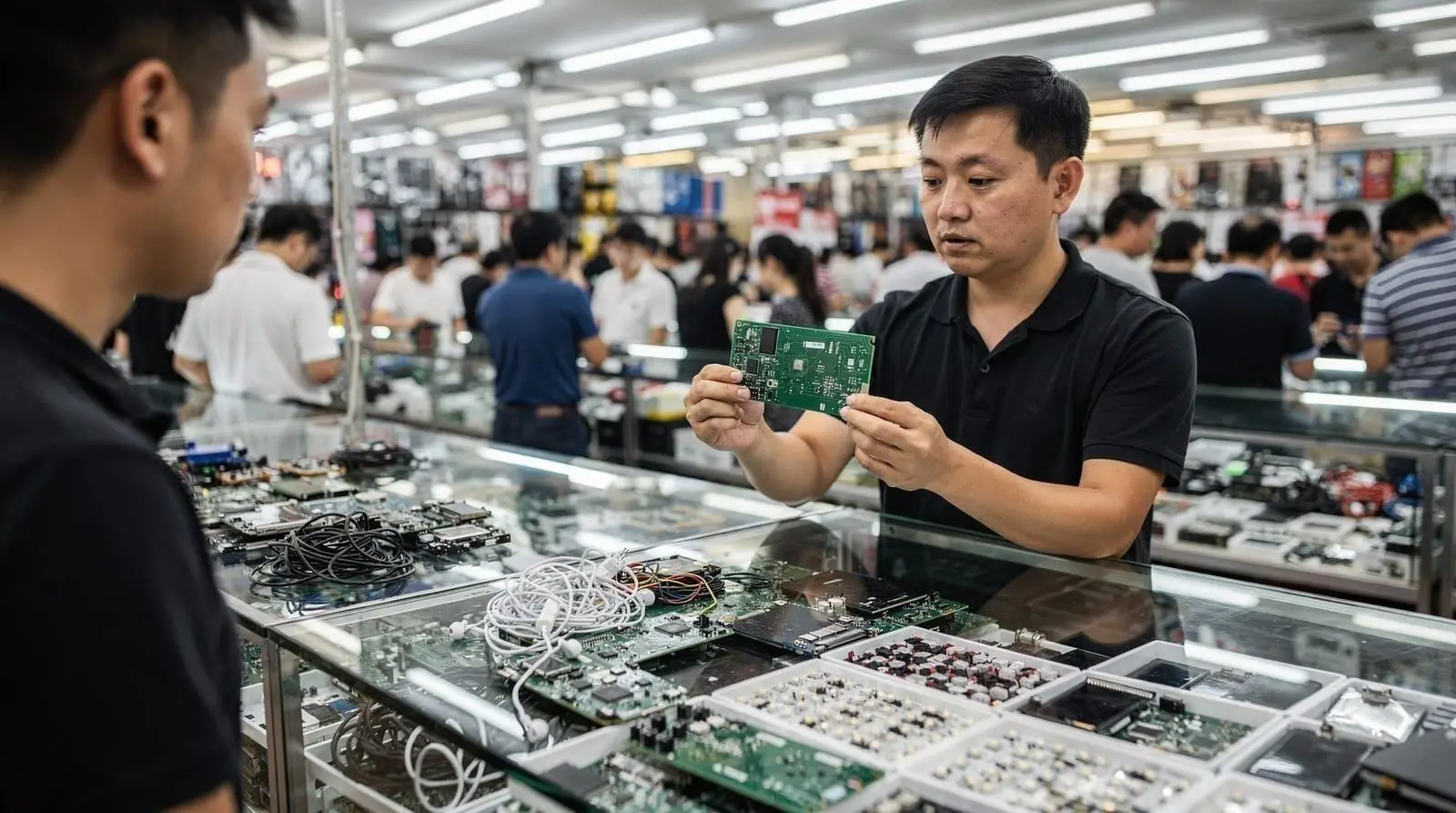
Huaqiangbei: the electronics district that resists description
There is no clear way to explain Huaqiangbei to someone who hasn’t been. The closest Western analogy would be an entire city block that functions as a combination of Amazon warehouse, maker hackerspace, counterfeit goods market, and serious professional components supplier — all stacked vertically across a dozen interconnected malls, operating at a density and speed that short-circuits normal shopping logic.
| Where | Futian district, Hua Qiang Bei metro (Lines 1 & 7) |
| Cost | Free to browse; purchases from a few CNY to CNY 1,000s |
| Time needed | 2–3 hours minimum for a genuine exploration |
| Getting there | Metro Line 1 or 7 to Hua Qiang Bei station |
| Best for | Makers, gadget shoppers, and anyone curious about Shenzhen’s manufacturing base |
For the fuller market-by-market breakdown, see the Huaqiangbei electronics market guide; if you’re new to the city entirely, start with first time in Shenzhen first.
Huaqiangbei (华强北) is a roughly 1-square-kilometre district in Futian, Shenzhen. It contains somewhere in the region of 80,000 individual vendors, shops, and stalls. It supplies component parts to manufacturers across China and increasingly worldwide. It is where the “grey market” in electronics (phones assembled from genuine components without brand authorisation) partly originates. And it is one of the most genuinely interesting places to spend half a day in any Chinese city.
What is here, specifically
The district clusters into recognisable zones:
SEG Electronics Market (赛格广场): The tallest market tower in the district, and historically the most famous. Lower floors are serious component suppliers — resistors, capacitors, connector cables, LED strips, microcontrollers, PCB services. Upper floors have consumer electronics, cables, and phone accessories. The component floors are primarily for professionals and makers; the upper floors are accessible to casual shoppers. Prices are genuinely at-cost, not tourist-adjusted.
Huaqiang Electronics World (华强电子世界): Next door to SEG, more consumer-facing. Phones, tablets, smart watches, earbuds, power banks, adapters. Mix of branded (legitimately purchased at volume), grey-market (assembled from genuine parts), and counterfeit (branded boxes, counterfeit internals). More on distinguishing these below.
Mingtong Digital City (明通数码城): Phone accessories, repair services, second-hand phones. The second-hand floor is genuinely useful — legitimately used iPhones and Samsung flagships at prices 15–30% below European equivalents, from vendors whose main business is resale and who have reputations to protect.
Yuanwang Digital Mall: Cameras, drones, audio equipment. DJI products here are often slightly cheaper than DJI’s own flagship store a few blocks away, from authorised resellers buying at volume.
Walkways and street level: Between the malls, street-level stalls sell cables, phone cases, battery banks, earphone tips, and the full range of accessories. This is fine for commodities; not for anything where quality matters.
What to actually buy (and what to avoid)
Good buys:
- USB cables, charging bricks, and power banks from brand-name vendors (Anker, Baseus, Ugreen, and similar have genuine distribution here). Prices are 20–40% below European retail.
- Accessories for specific devices — cases, screen protectors, stands, mounts. The variety is extraordinary; if it exists for your device, it’s here.
- Second-hand phones from reputable second-hand shops.
Examine the physical condition, ask for a power-on demonstration, and check the IMEI against manufacturer databases for the region.
- Electronic components, PCB prototyping services, and sensor modules if you are a maker or hardware developer. This is where the professional value is clearest.
- Drones from authorised DJI resellers — verify the warranty card and packaging carefully.
Avoid:
- “Branded” earbuds, smartwatches, or cameras from vendors on upper market floors where prices seem impossibly low. If AirPods Pro are offered at CNY 100 (~USD 14), they are counterfeit and will sound like it.
- Grey-market phones: these are assembled from genuine Apple or Samsung components but are not factory products.
They may pass superficial inspection but lack proper software authorisation, receive no official updates, and have no warranty channel. Not worth the risk.
- Any vendor who takes you to a separate “private room” to show you special inventory — this is how counterfeit goods are sold to people who feel they’re getting a deal. The Shenzhen tourist traps guide covers this pattern and others across the city, not just here.
The maker perspective: why Huaqiangbei matters globally
Hardware developers and makers from around the world make specific trips to Huaqiangbei. The reason: component availability and MOQ (minimum order quantity) are completely different here from anywhere else. You can buy 3 units of an obscure microcontroller, negotiate a custom PCB run of 50 units, source a specific motor driver for a robotics project, and get a custom cable assembled while you wait — all in one morning.
The depth of what’s available is genuinely hard to convey. A hardware developer friend described it as “the physical manifestation of DigiKey, except real and cheap and where you can ask why a component is failing.” The component floors of SEG and the specialist building at Zhongkang Rd are worth visiting for the experience alone even if you’re not buying anything.
Shenzhen’s identity as the world’s hardware manufacturing hub is not separate from Huaqiangbei — the market is both a consequence and a driver of that status. For more context, see the Shenzhen tech scene.
Practical navigation
Huaqiangbei has its own metro stop: Line 1 and Line 7, Hua Qiang Bei station. Exit A drops you at the northern end of the district; Exit B brings you to the market entrance.
Opening hours: Most markets open around 09:30–10:00 and close between 18:00 and 19:00 Monday through Saturday. Sunday hours are shorter and some component suppliers are closed. The street stalls operate slightly later. Avoid public holidays — many vendors close for Golden Week, Chinese New Year, and other major holidays.
Cash and WeChat Pay are both accepted. For significant purchases (phones, drones), confirm whether the vendor accepts WeChat Pay before negotiating the price. If your WeChat Pay or Alipay isn’t linked to a foreign card yet, sort that out before you come — see the WeChat Pay and Alipay for foreigners guide.
Navigation inside the malls requires some tolerance for disorientation. The directories exist but are hard to read; the floor plans make no spatial sense after you’ve taken two escalators and a bridge walkway. The pragmatic approach is to walk the ground floor of each major building systematically, then ascend one floor at a time. Allow at least 2–3 hours for a genuine exploration.
Join an insider Huaqiangbei tech tour with a local guide — a genuinely useful option on a first visit, as a knowledgeable guide can cut through the vendor landscape and identify which stalls are reputable for what you want.
A realistic itinerary for a half-day visit
09:30: Arrive at Hua Qiang Bei metro. Coffee from the Luckin Coffee at the market entrance (CNY 12–18).
10:00–11:00: Ground floor component walk of SEG Electronics. Don’t buy anything yet — just get orientation. Note which stall categories are on which floors.
11:00–12:00: Upper floors of Huaqiang Electronics World for consumer electronics. If you want a USB hub, cables, or accessories, this is the right time.
12:00: Street food on Huaqiangbei Road — jianbing or noodle soup from the stalls outside (CNY 10–25). Take a break from the sensory overload.
12:30–14:00: Mingtong Digital City for second-hand phones if relevant; Yuanwang Mall for drones and cameras. The DJI flagship store nearby is worth a visit even just to see the product range and the legitimate reference prices.
14:00: Exit before the afternoon crowd peaks. Lunch in the area or head toward Futian CBD.
What to bring
- A list of what you’re looking for (on your phone, not paper — paper gets lost). Shopping without a list in Huaqiangbei is like searching without search terms.
- Download the floor plans in advance from Dianping or Baidu Maps — the in-market directories are incomplete.
- Cash (CNY) for small vendors who prefer it; WeChat Pay for larger purchases.
- A power bank — the malls have spotty charging points and you will want your phone map.
Combining Huaqiangbei with the rest of your day
Huaqiangbei sits close enough to Futian CBD that it slots naturally into a half-day rather than needing its own full day. A common pattern: morning at Huaqiangbei, then metro to Futian’s Civic Centre or the Shenzhen Museum for the afternoon, or head south to Nanshan and Shekou for the evening if you want a contrast between grey-market gadget chaos and the more polished tech-corporate district.
Neither pairing feels rushed if you exit Huaqiangbei by early afternoon, per the itinerary above. If you’d rather see the neighbourhood options laid out fully before deciding where to base yourself, the best neighbourhoods in Shenzhen guide covers all of them side by side.
Frequently asked questions about Huaqiangbei
Is everything in Huaqiangbei fake?
No. The legitimate component supply chain running through Huaqiangbei is what powers much of global electronics manufacturing. Counterfeit consumer goods exist — primarily branded electronics from specific upper-floor vendors — but the majority of what is sold here is either genuine (cables, accessories, components) or grey-market (assembled from genuine parts, not factory-authorised).
Can I bring electronics from Huaqiangbei back home?
Genuine electronic components and personal accessories: yes, generally. Large quantities of consumer electronics may attract customs attention. Counterfeit branded goods can be confiscated and may result in fines. Check your home country’s customs rules before buying anything branded.
Do vendors speak English?
Some do, particularly those accustomed to dealing with foreign makers and business buyers. Many don’t — a translation app and some patience gets you far. Numbers are universally understood; prices are often shown on a calculator.
Is bargaining expected?
For accessories and commodities at street stalls: yes, some negotiation is expected. For fixed-price component sellers: no. For consumer electronics in enclosed shops: light negotiation is sometimes possible, particularly if you’re buying multiple items.
How do I get to Huaqiangbei from the hotel?
Huaqiangbei metro station (Lines 1 and 7) is the direct route. From Futian CBD, it’s 2–3 stations. From Nanshan/Shekou, it’s 20–30 minutes on Line 1.
Is Huaqiangbei worth it if I’m not a maker or tech enthusiast?
Yes, for the experience even without buying anything specialised — the sheer density and the window into how Shenzhen’s manufacturing economy actually functions make it interesting in its own right. Pair a shorter visit (60–90 minutes) with a nearby stop like Futian’s Civic Centre or head to Nanshan rather than allocating a full half-day if gadgets aren’t your main interest.
Top-rated things to do in Shenzhen
Verified deep-linked GetYourGuide tours. Book through these links and we earn a small commission at no cost to you.