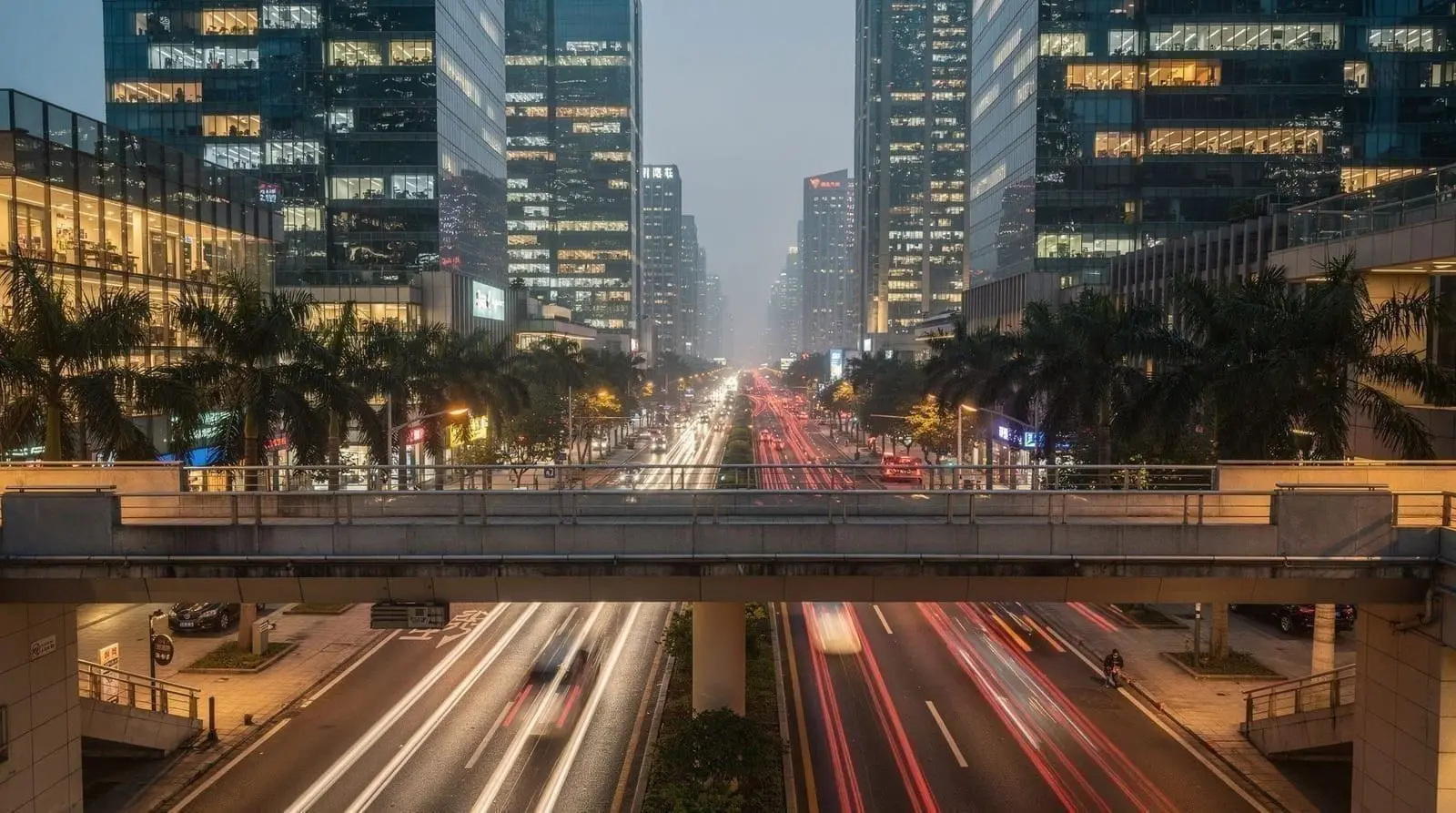
Best neighbourhoods in Shenzhen: an honest guide to where to stay and what each area is like
Shenzhen is frequently described as a homogeneous city of towers and malls, which is understandable if you only pass through the CBD. The reality is that different districts have genuinely different characters — some are first-time-friendly and convenient, some are culturally dense and disorienting in the best way, some are only worth visiting for specific purposes. This is a district-by-district read for travellers trying to decide where to base themselves and what to prioritise.
| Best for first visit | Futian |
| Best for food | Luohu |
| Best for tech/expat life | Nanshan/Shekou |
| Best for families | OCT district |
| Getting between districts | Shenzhen Metro, 40–50 min end to end |
For the full mechanics of getting around once you’ve picked a base, see the Shenzhen metro guide and the broader where to stay in Shenzhen guide.
Futian: the convenient centre
Futian (福田区) is the administrative and commercial CBD. It contains the Shenzhen city hall, the Shenzhen Museum, the Convention and Exhibition Centre, and a skyline of towers that represents the official face of the city. For first-time visitors, it is the most logical base.
Why stay here:
- Best metro connectivity — Lines 1, 2, 3, 4, 7, and 11 pass through or terminate here.
- Walking distance or short metro to Huaqiangbei electronics district (2–3 stops).
- Futian checkpoint (border crossing to Hong Kong) is accessible via Line 4.
- Hotels at every price tier; mid-range options (CNY 350–700) are particularly good value.
- Shenzhen Museum is free and provides essential context for the city’s history.
What it lacks:
- Atmospheric streets. Futian’s wide boulevards and tower blocks are built at a scale that discourages wandering. The street level is efficient but not particularly interesting.
- Neighbourhood food character. The best food here is in malls and chains rather than on neighbourhood streets.
Best area within Futian: The Civic Centre area around Lianhuashan Park has some of the city’s better walking — the park has views, a large Deng Xiaoping statue (a genuinely peculiar site in the park of a city he created), and the Shenzhen Concert Hall and Book City complex nearby. See the Lianhuashan Park guide for the best times to go and what else is around it.
Recommended hotels: Kerry Hotel Shenzhen (CNY 700–1,000; excellent pool and gym); Novotel Shenzhen Watergate (CNY 500–750; strong value for the location); Jinjiang Inn Shenzhen Civic Centre (CNY 180–260; solid budget option).
For a full destination brief, see the Futian district guide.
Nanshan and Shekou: expat-friendly and tech-forward
Nanshan (南山区) is the western district that contains Shenzhen University, the Tencent campus, the OCT creative zone, and Shekou — a sub-district on the waterfront that was the original economic development zone in the early 1980s and remains distinctly more international in character than the rest of the city.
Why stay here:
- Shekou Sea World has the highest concentration of international restaurants and bars in Shenzhen — good if you want a familiar option after days of exploration.
- OCT-LOFT is one of the most pleasant urban spaces in the city — former factory buildings converted to galleries, cafes, and design studios.
- Nanshan Bay and the coastal promenade are excellent for morning runs.
- Proximity to the Shenzhen Bay border crossing to Hong Kong (Bus K1 runs cross-boundary).
- The tech corridor walk (DJI store, autonomous vehicle sightings, innovation campuses) is here — see the Shenzhen tech scene guide for a full route.
What it lacks:
- Easy access to the eastern districts without a long metro ride. Nanshan is on the western end of Line 1; getting to Luohu takes 40–50 minutes.
- Relative lack of authentic street food compared to Luohu and Dongmen.
Best area within Nanshan: Shekou’s Sea World square for evenings; Nanshan Bay Park for mornings; OCT-LOFT for afternoons.
Recommended hotels: Sheraton Shenzhen Nanshan (CNY 650–900); Holiday Inn Express Shekou Nanshan (CNY 400–600); The OCT Hotel (CNY 550–800; directly beside OCT-LOFT).
For the full picture, see Nanshan and Shekou destinations.
Luohu and Dongmen: the oldest part of Shenzhen
Luohu (罗湖区) is the oldest commercial district in Shenzhen, sitting at the Lo Wu border crossing to Hong Kong. It is denser, older in building stock, and more chaotic in street character than Futian or Nanshan. It is also where the most authentic and varied street-food scene is, and where the city’s Cantonese and Chaoshan food heritage is most visible — the weekend eating through Shenzhen guide uses Luohu as its base for exactly this reason.
Why stay here:
- Immediately adjacent to the Lo Wu border crossing — if you’re day-tripping to/from Hong Kong repeatedly, this saves significant transit time.
- Dongmen Pedestrian Street: the most lively street-food and market area in central Shenzhen.
- Luohu Commercial City (just inside the border crossing): a massive shopping mall that has been simultaneously notorious for counterfeit goods and genuinely useful for tailoring, services, and electronics resale. Less counterfeit-heavy now than a decade ago, but still has a grey-market character.
- Lower hotel prices than Futian or Nanshan.
What it lacks:
- Comfort and polish. Luohu’s streets are busier and less orderly than the CBD. If you prefer clean, manicured urban environments, this is not the right base.
- Easy access to the tech corridor and OCT areas.
For food specifically: The strip around Hongling Zhonglu and Cuizhu Road has some of the best Chaoshan restaurants in the city. The wet market on Aiguo Road has an excellent cooked-food floor. The Dongmen night market (around 19:00–23:00) is worth the chaos.
Recommended hotels: Sheraton Shenzhen Hotel (CNY 600–900; good if you want reliability in an older district); Hilton Shenzhen Futian (this is actually near the Luohu/Futian boundary, CNY 700–1,000); Hanting Express Luohu (CNY 180–260; budget).
OCT (Overseas Chinese Town): the arts and culture district
OCT (华侨城 — Overseas Chinese Town) is a sprawling western district developed in the 1980s–2000s as a residential and theme park zone. It contains Window of the World, Splendid China Folk Village, and Happy Valley — Shenzhen’s three major theme parks — alongside the OCT-LOFT creative cluster, the OCT Contemporary Art Terminal (OCAT), and a large residential zone. If you’re deciding between the two big theme parks, the Window of the World vs Splendid China comparison breaks down which suits your trip better, and the Splendid China guide covers that park in detail.
Why visit (or stay here):
- Window of the World (世界之窗): a miniature-monuments theme park with scaled replicas of the Eiffel Tower, Pyramids, Taj Mahal, and 130 other landmarks. Kitsch, but earnestly executed. Worth a half-day. CNY 240 (~USD 34) adult entry.
- OCT-LOFT is directly accessible from OCT stations.
- The residential streets of OCT district are quieter and more liveable than the CBD.
What it lacks:
- Centrality. Getting from OCT to Luohu or Huaqiangbei requires 20–30 minutes on the metro.
See the Window of the World guide for detail on the theme park and what the visit is like.
Longhua: the manufacturing heartland
Longhua (龙华区) is where the production factories are — Foxconn’s main iPhone manufacturing complex is here, along with dozens of smaller operations. It is not a tourist district in any conventional sense, but it is where the reality of Shenzhen’s purpose is most legible.
Reasons to visit as a day trip:
- Shenzhen North HSR station is in Longhua — if you’re arriving by high-speed rail, you’ll pass through.
- Dafen Oil Painting Village (大芬油画村) is actually in Longgang district (east Shenzhen) but is often grouped with eastern district visits — bus or metro from Longhua.
- The factory aesthetic of Longhua — workers’ dormitories, canteens, logistics infrastructure — is interesting as industrial tourism if you’re thinking about supply chains.
Don’t stay here unless you have a specific reason (nearby factory meeting, Shenzhen North train connection). It lacks the food scene, walkability, and convenience of the western districts for leisure visitors.
Dapeng: for nature and escape
Dapeng Peninsula (大鹏半岛) in eastern Shenzhen is the exception to everything else in this guide — it is where Shenzhen has actual coastline, old fortress walls, and something resembling pre-industrial character. The Dapeng Fortress (大鹏所城) dates to the Ming Dynasty. The beaches at Xichong and Dongchong are among the best publicly accessible beaches in the Pearl River Delta.
Worth visiting as a day trip:
- 90–120 minutes from central Shenzhen by metro and bus, or 60–80 minutes by DiDi (approximately CNY 80–120 ride).
- Hiking on the coastal path between Xichong and Dongchong: excellent on a clear day, approximately 8km.
- Swimming at Xichong: free beach, seasonal lifeguard presence, facilities including food stalls.
Not ideal as a base unless you specifically want beach proximity — the daily commute to central Shenzhen sites would be impractical.
Book a private Shenzhen day trip customised to the neighbourhoods that interest youA note on safety by district
Shenzhen is, district for district, a very safe city by international standards — this doesn’t change much between Futian, Nanshan, and Luohu. The main practical differences are pickpocket risk (marginally higher in the crowded Dongmen and Luohu Commercial City areas) and how comfortable an area feels walking alone at night (Futian and Nanshan’s newer boulevards feel more anonymous and well-lit; Luohu’s older lanes are busier but less polished). See the is Shenzhen safe guide for the full picture, including scams to know about around Luohu Commercial City specifically.
Summary: where to stay based on your priorities
| Priority | Best district |
|---|---|
| First visit, maximum convenience | Futian |
| Tech and innovation focus | Nanshan/Shekou |
| Food, markets, Hong Kong day-tripping | Luohu |
| Arts, theme parks, creative culture | OCT district |
| Nature and beach access | Dapeng (day trip only) |
| Budget above all | Luohu or eastern Longhua |
Frequently asked questions about Shenzhen’s neighbourhoods
Which area of Shenzhen is best for families with children?
OCT district (for the theme parks, including Splendid China and Window of the World) and Nanshan (for OCT-LOFT’s family-friendly creative spaces and Shekou’s international food options). Families with young children tend to find Futian most comfortable for convenience and safety.
Is there a “tourist” neighbourhood in Shenzhen?
Not in the way that Bangkok has Khao San Road or Hong Kong has Tsim Sha Tsui. Shenzhen’s tourism infrastructure is relatively thin and dispersed. Shekou in Nanshan comes closest to an international visitor cluster, but it is not dominated by tourism.
Which neighbourhood has the best nightlife?
Shekou Sea World and the OCT area have the highest density of bars and late venues. Luohu has rougher, more local drinking establishments. Futian’s COCO Park has club-oriented venues. The bar scene does not rival Hong Kong at equivalent quality but is perfectly functional.
How far apart are Shenzhen’s districts?
Shenzhen is large east-west. From the western Shekou/Nanshan end to the eastern Luohu border crossing is approximately 45–50 minutes by metro. Dapeng Peninsula adds another 60–90 minutes. Plan your itinerary to cluster by district rather than criss-crossing daily.
Should I split my stay between two districts?
For trips of five nights or more, it can make sense — for example three nights in Futian for convenience and museums, then two in Nanshan/Shekou for the tech corridor and OCT-LOFT. For shorter trips, the packing and re-basing time usually isn’t worth it; pick one well-connected district (Futian is the safest default) and take day trips from there using the Shenzhen metro guide.
Top-rated things to do in Shenzhen
Verified deep-linked GetYourGuide tours. Book through these links and we earn a small commission at no cost to you.