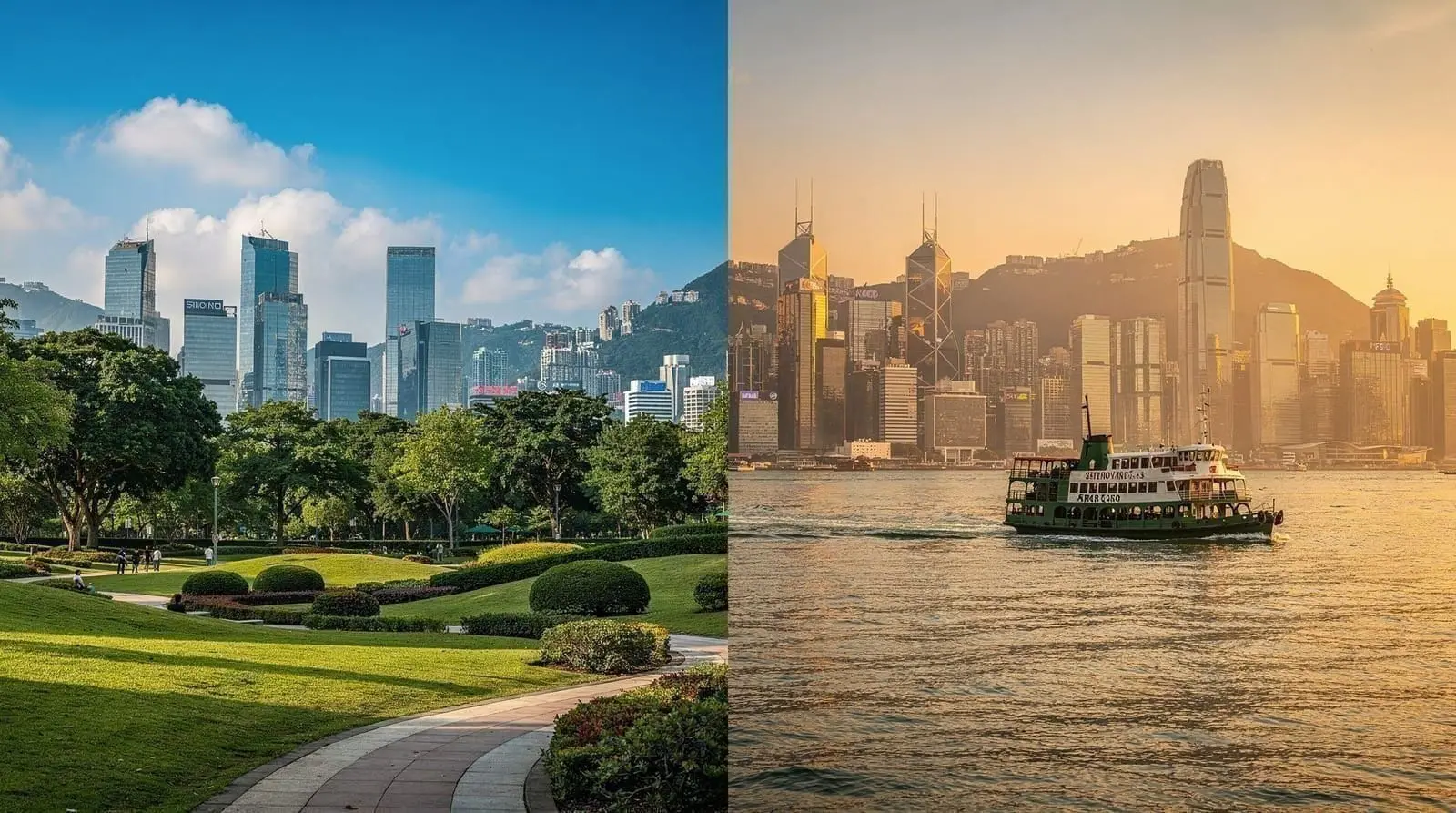
Shenzhen vs Hong Kong: which should you visit?
The question comes up in every Pearl River Delta travel forum thread: Hong Kong or Shenzhen? The comparison is imperfect because the two cities are barely similar — they share a border and a ferry ride, but they function differently, cost differently, feel different, and attract different kinds of travellers. This is a genuine breakdown, not a “visit both!” non-answer (though visiting both, given how easy the border crossing is, remains the obvious optimal choice).
| Currency | Hong Kong: HKD · Shenzhen: CNY (RMB) |
| Visa | Hong Kong: visa-free for most Western passports · Shenzhen: 240-hour transit exemption or L-visa |
| Typical daily budget | Hong Kong: around USD 70–130 · Shenzhen: around USD 40–70 |
| Getting between them | Futian–Lok Ma Chau metro crossing, under an hour door-to-door |
| Best for a first Asia trip | Hong Kong, English-friendly; add Shenzhen once you’re settled in |
The fundamental difference
Hong Kong is a global financial and commercial hub that has accumulated 150+ years of colonial overlay on a Cantonese foundation, is now a Chinese Special Administrative Region with a distinct legal system, and operates entirely in HKD with an open internet and no visa requirement for most Western passports. It is cosmopolitan in the sense that London or Singapore is cosmopolitan — internationally legible, English-functional, familiar in its rhythms.
Shenzhen is the opposite: a deliberately built city that did not exist in its current form 45 years ago, mainland Chinese in culture and governance, operating in CNY with the Great Firewall active, and genuinely novel in its emphasis on manufacturing, technology, and scale. It is not trying to be internationally legible. That is both its limitation and its interest.
Cost comparison (realistic 2026 figures)
Budget accommodation:
- Hong Kong: HKD 400–700/night (~USD 51–90) for a decent guesthouse in Mong Kok or Sham Shui Po.
- Shenzhen: CNY 180–350/night (~USD 25–49) for a clean, modern budget hotel in Futian or Nanshan.
Mid-range hotel:
- Hong Kong: HKD 1,200–2,500/night (~USD 154–320) at a decent 4-star.
- Shenzhen: CNY 500–900/night (~USD 70–125) for a comparable quality 4-star.
Meals:
- Hong Kong: HKD 80–150 (~USD 10–19) for a sit-down lunch; HKD 200–450+ for dinner at a proper restaurant.
- Shenzhen: CNY 40–80 (~USD 6–11) for lunch; CNY 100–200 (~USD 14–28) for a nice dinner.
Transit:
- Hong Kong MTR: HKD 4–55 per journey depending on distance.
- Shenzhen Metro: CNY 2–12 per journey.
The honest summary: Shenzhen costs roughly 35–50% less than Hong Kong across the board. If budget is a primary constraint, Shenzhen wins clearly. For specific calculations, see Shenzhen on a budget 2026.
What each city does better
Hong Kong is better for:
- Harbour views and the classic Asia skyline experience
- International-standard dining at the high end (Michelin-density is among the highest in the world)
- Nightlife with international legibility (Lan Kwai Fong for clubs; Soho and Kennedy Town for bars)
- Shopping for international brands without import markup
- Hiking (Dragon’s Back, MacLehose Trail, Lantau trails) — surprisingly excellent for a dense urban environment
- The transport experience itself: the Star Ferry, the Peak Tram, the double-decker trams on Hong Kong Island
- Ease: English is everywhere, payment is straightforward, the internet is uncensored
Shenzhen is better for:
- Electronics and tech at source prices (Huaqiangbei is unlike anywhere else on Earth for components and gadgets)
- Understanding contemporary China — how a modern Chinese city actually functions and feels
- Cost efficiency across food, hotels, and entertainment
- The manufacturing curiosity factor: OCT-LOFT creative park, the Dafen oil-painting village, innovation campuses
- Authentic migrant food diversity — every Chinese regional cuisine represented by people who actually grew up making it
- Shorter queues and less tourist infrastructure congestion at sights
Culture and character
Hong Kong has a distinct identity that is anxiously aware of being distinct. The Cantonese language, the local film culture, the street markets that have existed for decades, the specific neighbourhood character of places like Sheung Wan or Sham Shui Po — these feel irreplaceable because they are.
Shenzhen’s culture is harder to characterise because it is still forming. The city’s population is largely composed of internal migrants — people from Hunan, Sichuan, Fujian, Guangdong, Jiangxi — who came to work and stayed to build something. That creates an energy that is entrepreneurial and sometimes brusque, but also remarkably diverse for a Chinese city. You hear multiple Chinese languages on the street. You eat food from every region. There is less nostalgia here than almost anywhere in China, because there is very little to be nostalgic about — and that is oddly liberating as a visitor.
Who should choose which
Choose Hong Kong if:
- This is your first trip to Asia and you want a gentle entry point with English infrastructure and familiar signposts.
- You have limited time (3–4 days) and want maximum density of “classic” experiences.
- Your primary interest is food at the top end, nightlife, or international shopping.
- You do not have time or patience for navigating the VPN/payment/connectivity hurdles of mainland China.
Choose Shenzhen if:
- You are interested in technology, manufacturing, or contemporary Chinese urbanism.
- Cost matters and you want to stretch your travel budget.
- You’ve done Hong Kong before and want a different kind of understanding of the Pearl River Delta.
- You are comfortable with some navigational friction and enjoy figuring out cities that don’t code-switch for tourists.
Choose both if:
- You have 5 or more days — the border crossing by metro takes under an hour, and the contrast between the two cities is one of the sharpest in Asia.
See the 5-day Shenzhen and Hong Kong itinerary for a structured plan that splits the trip sensibly.
Which city fits your trip length
| Trip length | Recommendation |
|---|---|
| 2–3 days | Pick one city and go deep — a short trip split in two rushes both sides. |
| 3–4 days | Hong Kong alone for a classic first Asia trip, or Shenzhen alone if tech, budget, or contemporary China is the priority. |
| 5–7 days | Both — see the 5-day Shenzhen and Hong Kong itinerary for a workable split. |
| 7+ days | Both, plus a Guangzhou or Macau extension via the Greater Bay Area high-speed rail. |
Internet, apps, and getting around
The practical experience of the two cities diverges sharply once you’re actually moving around. Hong Kong runs on an open internet, contactless cards, and English signage on the MTR — you can land, tap an Octopus card, and go. Shenzhen requires more setup: the Great Firewall blocks most Western apps, so a working VPN and eSIM sorted before you land matters more than almost anything else on the packing list.
Payment is the other adjustment — cash is barely used day-to-day, and getting WeChat Pay or Alipay linked to a foreign card before arrival saves real friction. Once you’re set up, the Shenzhen metro is just as easy to navigate as Hong Kong’s MTR — clean, cheap, and English-signed at every station.
Safety and comfort
Both cities are very safe by international standards, with low violent crime and heavy CCTV coverage. The differences are more about comfort than risk: Hong Kong’s density, humidity, and hills can be tiring to walk in summer, while Shenzhen’s wider modern boulevards are easier on the feet but involve more walking between metro exits and entrances. For a fuller answer on day-to-day safety concerns — pickpocketing, scams, air quality, tap water — see is Shenzhen safe, which applies almost identically once you’re across the border.
The border crossing factor
The ease of moving between the cities is one of the genuine pleasures of this region. From Futian checkpoint in Shenzhen to Hong Kong MTR Lok Ma Chau station is a matter of a single immigration process and a metro ride. Most of the time it takes under an hour door-to-door. This means the Hong Kong versus Shenzhen question is somewhat artificial — you can sleep in affordable Shenzhen and day-trip into Hong Kong for a harbour experience, or sleep in Hong Kong and cross into Shenzhen for an afternoon of Huaqiangbei. Read the 2026 visa and border update to understand the specific paperwork requirements for your nationality.
Combine the Peak Tram, city walk, and dim sum in a single guided Hong Kong day — a good way to cover the HK essentials efficiently if you’re splitting the trip.
Frequently asked questions about Shenzhen vs Hong Kong
Is Hong Kong part of China?
Hong Kong is a Special Administrative Region (SAR) of China, operating under “one country, two systems.” It has its own currency (HKD), legal system (common law), and immigration controls. Crossing between Hong Kong and mainland China (including Shenzhen) requires passport immigration in both directions.
Do I need separate visas for Shenzhen and Hong Kong?
Most Western passport holders can enter Hong Kong visa-free. For Shenzhen (mainland China), they need either the 240-hour transit exemption, a standard L-visa, or qualifying for the GBA visa-on-arrival. These are entirely separate processes.
Which city has better food?
Depends what you want. Hong Kong has more Michelin-starred restaurants and is unmatched at the top end of Cantonese cooking. Shenzhen has better regional Chinese diversity at mid-range prices — if you want to eat Chaoshan fish balls, authentic Hakka pork belly, and hand-pulled Lanzhou noodles all in one day, Shenzhen is the place.
Is Shenzhen as photogenic as Hong Kong?
Hong Kong’s harbour skyline is one of the great urban views in the world — it is hard to match visually. Shenzhen has its own photographic interest: the vertical density of residential towers in Luohu, the neon districts of Huaqiangbei at night, the coastal parks at dusk. Different, but worth bringing a camera.
Is English widely spoken in Shenzhen?
Less than in Hong Kong. Metro signage is in English. Hotels catering to business travellers have English-speaking staff. Restaurants in expat areas (Shekou, parts of Nanshan) have English menus. In most other contexts, a translation app is a practical necessity.
Is it cheaper to base yourself in Shenzhen and day-trip into Hong Kong, or the other way round?
Basing in Shenzhen and day-tripping into Hong Kong is meaningfully cheaper overall, since accommodation and meals are the two biggest daily costs and both run roughly a third to a half less on the mainland side. The trade-off is the daily border crossing and the fact that Hong Kong’s best experiences — harbour views, nightlife — are better enjoyed without a return crossing looming. For a short trip, basing in whichever city holds your priority activities and day-tripping to the other for a single day works better than commuting across the border daily.
Top-rated things to do in Shenzhen
Verified deep-linked GetYourGuide tours. Book through these links and we earn a small commission at no cost to you.