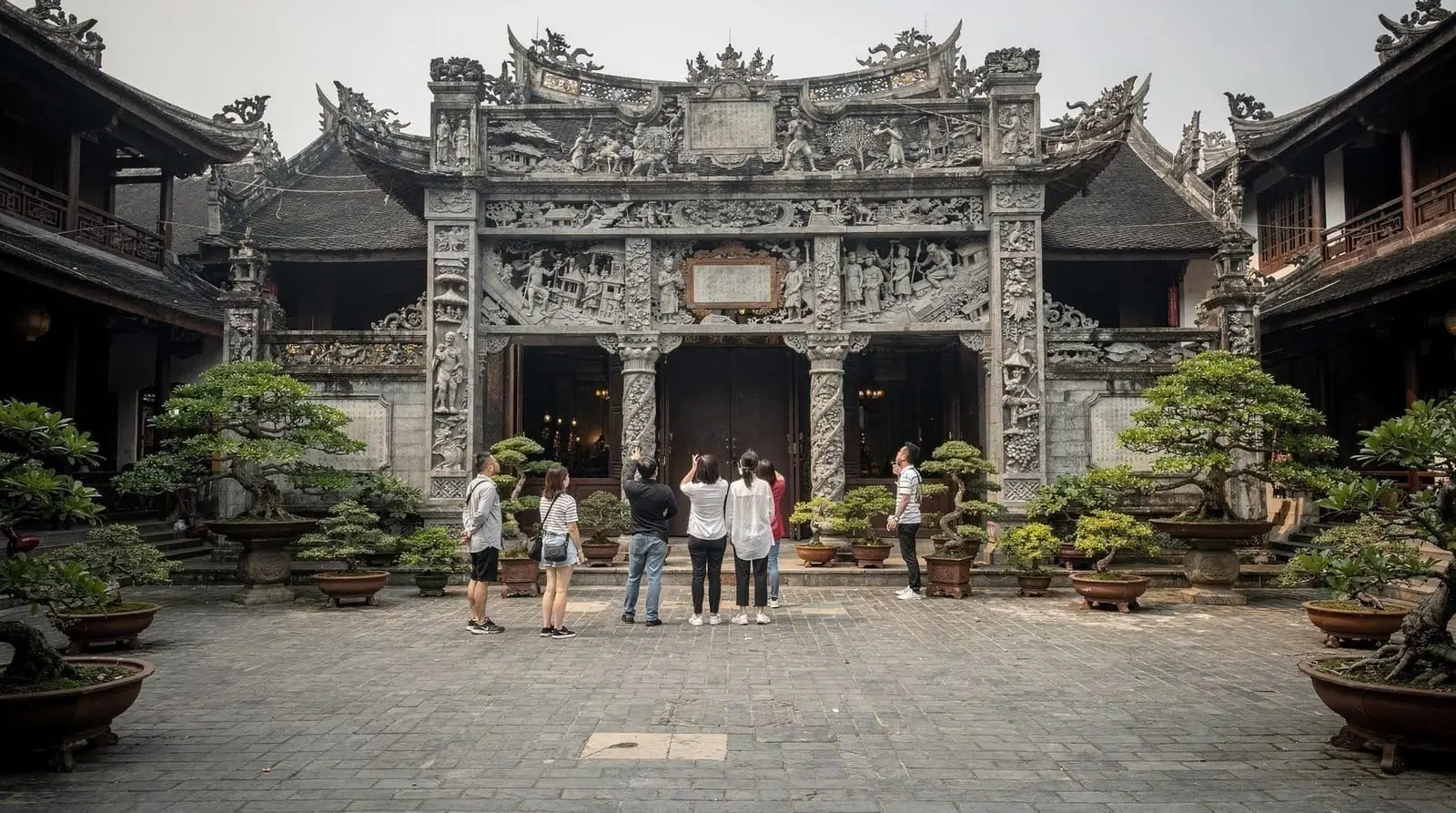
Chen Clan Academy Guangzhou: Qing craftsmanship and folk art museum guide
What is the Chen Clan Academy and is it worth visiting?
The Chen Clan Academy (Guangdong Folk Art Museum) is a 19th-century clan hall complex featuring some of the finest examples of Lingnan-style decorative craftsmanship in existence: elaborate carved stone screens, ceramic roof friezes, wood carvings, and iron castings. Entry is CNY 10 and it's worth 2–3 hours. Yes, it's worth visiting.
The Chen Clan Academy (陈家祠, Chénjiā Cí, also known as the Guangdong Folk Art Museum) is a Qing dynasty clan hall complex built between 1888 and 1894 on land now occupied by Guangzhou’s Liwan and Yuexiu districts. It was commissioned by members of the Chen clan from 72 counties across Guangdong Province to serve as a combined ancestral hall, school, and gathering place for the scattered Chen family. What makes it remarkable for visitors is not its historical function but its architecture: the building is effectively a showcase piece for every decorative craft of Lingnan culture at its late Qing height.
| Where | 34 Zhongshan 7th Road, Liwan District |
| Cost | around CNY 10 per adult |
| Time needed | 2–3 hours |
| Getting there | Metro Lines 1/8, Chen Clan Academy Station, Exit D |
| Best time | weekday morning, 09:00–11:00 |
The architecture: why it matters
The complex covers 13,200 square metres and consists of nine main halls arranged in a three-by-three grid, linked by corridors and flanked by two wings. Every surface that could be decorated was decorated, and the commissioning clans evidently hired the best craftsmen available from across Guangdong. The result is a compressed catalogue of regional craft traditions:
Ceramic roof friezes: The rooflines carry over 1,500 figures in polychrome ceramics — scenes from Chinese historical novels and operas, including characters from Romance of the Three Kingdoms and Journey to the West. The Shiwan kilns (in Foshan, visible on nearly every roof) produced these figurine-studded ridges, each scene narratively coherent when viewed from the courtyard. The level of detail at roofline distance is extraordinary; bring binoculars or a camera with optical zoom to see the individual faces.
Carved wood screens: The interior screens and partitions are carved openwork panels depicting landscapes, mythological scenes, and floral patterns in sandalwood and camphor wood. Some panels are 3–4 metres high with 15–20 layers of carving depth. The craftsmen used a technique called “through-carving” (通雕, tōngdiāo) that creates a three-dimensional effect when backlit. The central hall’s altar screen is the most elaborate; the side corridors contain a secondary series of screens that are less visited and equally detailed.
Stone carvings: The drum stones and pillar bases are carved in red sandstone; the window surrounds use blue-veined granite from Foshan. The technique is more restrained than the wood carving but equally skilled.
Iron casting: The cast-iron railings on the second-floor balconies are done in a technique associated with Foshan foundries. The patterns include chrysanthemums, phoenixes, and classical geometric forms. Unlike the organic decoration elsewhere, the iron work reads as more disciplined, more closely aligned with the export-craft tradition.
Brick carving: The exterior walls have inlaid brick carvings — narrative scenes pressed into the wall face rather than applied to it — that are easy to overlook if you’re walking through quickly. Slow down on the east and west wings.
What’s inside: the folk art museum
The Chen Clan Academy was converted into the Guangdong Folk Art Museum in 1959. The permanent collection includes:
- Ivory carvings (including several intricate “devil ball” pieces, concentric hollow spheres)
- Embroidery (Cantonese embroidery uses bright silk thread on satin; the technique is distinct from Suzhou and Hunan embroidery)
- Jade carving
- Ceramics from the Shiwan kilns (including the large animal figures that Shiwan pottery is famous for: buffaloes, goldfish, roosters)
- Paper-cutting
- Shadow puppetry
The museum’s collection quality is uneven — some display cases are exceptional, others are dated exhibits from the 1970s–80s with minimal context. The building itself consistently outperforms the interior collection; spend your time with the architecture first, then the museum pieces.
Practical visit information
Address: 34 Zhongshan 7th Road, Liwan District (中山七路34号), adjacent to Chen Clan Academy Metro Station.
Opening hours: 09:00–17:30 daily; last entry 17:00. Closed on Mondays (the folk art museum component is closed; the courtyard may be partially accessible).
Entry fee: CNY 10 per adult (~USD 1.40). No concessions listed; children under 1.2m often enter free. One of the most underpriced heritage sites in Guangdong.
Metro: Chen Clan Academy Station (陈家祠站), Lines 1 and 8, Exit D. The main entrance to the complex is 50 metres from the exit.
Time needed: 2–3 hours to cover the courtyards, roofline details, and the museum collection. Rushing through in 45 minutes means missing the carved panels and roof friezes.
Photography: Permitted throughout without tripods. The carved wood screens in the central hall photograph well in the diffused courtyard light; harsh noon sun creates shadows in the carved depth. Morning (09:00–11:00) is optimal for the east-facing screens.
Guided tours: Available at the ticket counter in Mandarin; English-language guided tours need to be arranged in advance (contact the museum’s administration office at least one day prior). Alternatively, the GYG-listed guided tours include English commentary that covers the craftsmanship context as well as historical background. Book a 2-hour English-guided tour of Chen Clan Academy
The surrounding Liwan area: Xiguan culture
The Chen Clan Academy sits in the old Xiguan (西关) area of Liwan District, Guangzhou’s former commercial and residential quarter for wealthy Cantonese merchants in the Qing and Republican eras. The streets immediately around the academy retain some of the original building typology — two- and three-storey shophouse terraces with carved wooden balconies and ground-floor commercial fronts. This is the neighbourhood that Guangzhou residents refer to when they talk about authentic local culture as distinct from the newer Tianhe CBD or the university districts.
Liwan Antique Market: 2 minutes’ walk east of the academy on Fangcaojie. Open daily; best selection on Sunday mornings from 08:00. Stalls sell Qing and Republican-era ceramics, woodwork, Shiwan pottery figures, old photographs, and a great deal of reproduction. Know what you’re looking at before paying significant amounts for anything. Browsing is free and enjoyable; the vendor negotiation is expected.
Longjin Road flower market: Cantonese flower culture is centred in Liwan; the covered flower market on Longjin Road East is operational daily but most vibrant before the Lunar New Year (weeks of fresh flower buying). Orchids, chrysanthemums, and osmanthus are primary; prices are lower than at hotels.
Lychee Bay (Lijiao Road area): A restored canal-side district 15 minutes’ walk south of the academy. The waterway is lined with banyan trees, teahouses, and covered walkways. The restoration is recent (early 2010s) and somewhat sanitised but the banyan canopy is genuine and old. Small dim sum restaurants and Cantonese teahouses are available from around 07:00. Take a Lychee Bay river cruise for a Cantonese waterway experience
Combining Chen Clan Academy with a Guangzhou day
The academy is best paired with the Xiguan neighbourhood walk and the nearby Lychee Bay area. For a morning-focused cultural day: Chen Clan Academy (09:00–12:00), lunch at a Cantonese restaurant in the Liwan area (the Guangzhou Restaurant on Wenchang South Road is the historic flagship of Cantonese cuisine), then either Shamian Island (15 minutes by foot or bus) or onward to the Canton Tower for the afternoon.
For an in-depth Guangzhou cultural experience combining the academy with a walking tour of Xiguan architecture, see our Shamian Island guide, which covers the adjacent colonial district.
The Cantonese food guide covers the restaurants within walking distance and in the Liwan area generally — morning tea (yum cha) at the Guangzhou Restaurant or Taotaoju is a logical pairing with the morning academy visit.
For visitors doing a two-day Guangzhou itinerary, the Chen Clan Academy and Shamian Island together form a coherent morning in the old western districts before the afternoon moves to the Tianhe CBD or the Pearl River waterfront.
Shopping and browsing after the visit
The Liwan Antique Market and Longjin Road flower market give the academy visit a natural second act without needing to travel far. Neither requires an entry fee, and both work well as a 30–45 minute wind-down after the concentrated detail of the halls. If you’d rather move on to food, the Guangzhou Cantonese food guide covers the Liwan restaurant scene in depth, including the historic dim sum halls a short walk away. For a wider view of the Liwan/Xiguan area and how it fits into a longer Guangzhou stay, see the Guangzhou destinations overview.
Frequently asked questions about Chen Clan Academy
What makes Chen Clan Academy different from other ancestral halls in China?
Most clan halls are architecturally competent but not exceptional as visitor experiences. The Chen Clan Academy was specifically built as a prestige project by a wealthy and dispersed clan with resources to hire the best craftsmen from all of Guangdong’s specialist craft centres — Foshan (ceramics, iron), Guangzhou (embroidery, ivory), and general Lingnan decorative arts. The commissioning intention was to create a building that demonstrated Cantonese cultural sophistication. It succeeded, and the result is the most elaborately decorated non-imperial clan hall in China.
Is the guided tour necessary or can I do it independently?
The building is navigable independently, and the CNY 10 admission is excellent value without a guide. However, the architectural details — why specific scenes were chosen for specific locations, what the ceramic figures represent in the narrative — are considerably richer with a guide who knows the material. For a purely visual visit, go independently. For cultural depth, the guided tour pays for itself in context.
Is Chen Clan Academy suitable for children?
Yes, better than average for a heritage site. The scale of the building, the vivid painted figures on the rooflines, and the craftwork details hold attention for children aged 8 and up. Under-7s enjoy the courtyard spaces and the colourful roof figures but may tire of the museum interior quickly. The site is largely flat and stroller-accessible.
How close is Chen Clan Academy to Shamian Island?
Approximately 2 km south, about a 20-minute walk or a CNY 12–18 taxi ride. The route between them passes through old Xiguan streets and is pleasant on foot if the weather is cool. A standard touring day combines both.
Can I visit Chen Clan Academy on the way between Shenzhen and Guangzhou?
Yes, if you’re already spending a day in Guangzhou. It’s not on the direct HSR-to-city-centre route, but Metro Lines 1 and 8 reach it easily from Guangzhou South or Guangzhou East stations in 20–30 minutes. It fits naturally into the western-districts morning of the two-day Guangzhou itinerary for day-trippers from Shenzhen.
Is photography allowed inside the museum galleries?
Yes, without tripods, throughout both the courtyards and the museum display rooms. Flash photography of the ivory and jade carvings is discouraged by museum staff due to light sensitivity, but standard phone and camera photography is unrestricted.
Top-rated things to do in Guangzhou
Verified deep-linked GetYourGuide tours. Book through these links and we earn a small commission at no cost to you.