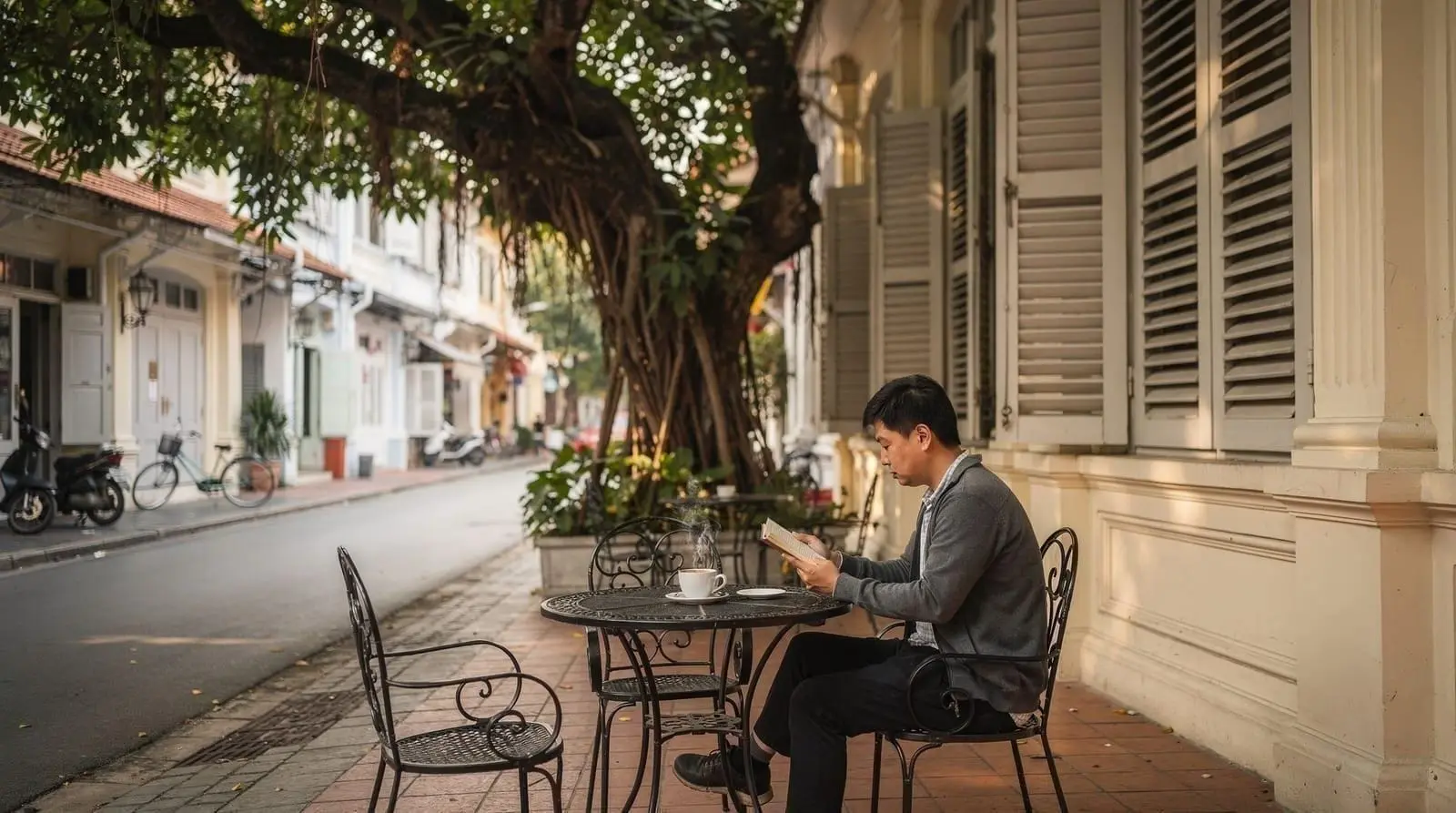
Shamian Island Guangzhou: colonial architecture, cafés, and a quiet morning walk
Is Shamian Island worth visiting in Guangzhou?
Yes, for a quiet 2-hour morning walk. Shamian is a small colonial-era island with 150 well-preserved European buildings, shaded banyan trees, and a handful of good cafés. It is not a full-day destination, but it is the most atmospheric and walkable old neighbourhood in Guangzhou — and rarely crowded.
Shamian Island (沙面岛, Shāmiàn Dǎo) is a 0.3-square-kilometre sandbank in the Pearl River, separated from the Liwan and Yuexiu districts of Guangzhou by two narrow canals. From 1859 until 1949, it served as the British and French concession area — the commercial and residential enclave assigned to foreign powers after the Second Opium War. The 150 European-style buildings that remain are now protected as a national cultural heritage zone; the island is essentially a pedestrianised colonial streetscape preserved inside one of China’s largest cities.
| Where | Liwan District, on the Pearl River |
| Cost | free to enter; cafés from around CNY 28 |
| Time needed | 1.5–2 hours |
| Getting there | Metro Line 1/6, Huangsha Station, Exit D |
| Best time | morning (07:00–10:00) for light and quiet |
What Shamian actually looks like
The island is small enough to walk end-to-end in 8 minutes. The main boulevard — Shamian Dajie — runs east-west through the centre, flanked on both sides by two-to-four-storey buildings in a range of European architectural styles: neoclassical with Ionic columns (the former British consulate), French baroque with ornamental ironwork (the former French hospital), and the standard Hong Kong-colonial shophouse form with deep shaded verandas on the first floor. About 30 of the 150 buildings have been converted to cafés, restaurants, or boutique hotels; the remainder are offices or residential.
What sets Shamian apart from most restored colonial districts in China is the banyan trees. The island has been landscaped since the colonial era with enormous banyan figs that now form an almost continuous canopy over the main boulevard. In summer, the tree shade brings the temperature down noticeably; in winter and spring, the light through the banyan roots makes it one of the best places in Guangzhou for photography.
The walk: a logical route
Start: East Bridge (沙面东桥), the pedestrian bridge over the eastern canal on Liuersan Road. From Chen Clan Academy Metro Station (Lines 1 and 8), a 20-minute walk south passes through the old Xiguan streets before reaching the bridge. Alternatively, take a Didi to Shamian Island from anywhere in central Guangzhou.
Shamian Dajie eastward walk: Walk west along the main boulevard. On the right (north side), the former British Consulate and the British Club building (now a hotel) are the most photogenic. The wrought-iron railings on the garden walls are original. On the left (south side), the French consulate complex — a series of interconnected whitewashed buildings — now houses government offices, but the facades face the street.
Side streets: Turn south off the main boulevard at any of the small lanes. The south side of the island faces directly onto the Pearl River; a narrow embankment walkway follows the water, with views across to the Haizhu shore. The embankment is not developed for tourism — it’s used by local residents for morning exercises and evening walks. That’s its value.
St Joseph’s Church: The Roman Catholic church on the western end of the island, built in 1890, is still in active use for Sunday Mass (in Cantonese). The interior is plain but the exterior facade and grounds are maintained. Open daily; entry free.
West Bridge: The western bridge connects to the Bingjiang West Road waterfront of Liwan District. Cross it if you want to continue to the Pearl River waterfront areas; return via the East Bridge if you’d prefer to loop the island.
Total walking time: 45–60 minutes at a photo-pausing pace for the whole island. Add 30–45 minutes for a café stop.
Cafés and restaurants on Shamian
Guangzhou Coffee (沙面咖啡): A local independent café in a restored 1920s building on the main boulevard. Serves espresso-based drinks at CNY 28–45, alongside Portuguese egg tarts (yes, a Macau influence), and a small menu of sandwiches and pastries. The interior retains original wooden floors and pressed-tin ceilings. Open from 09:00.
Shamian House Hotel Café: The Shamian Hotel (formerly the White Swan Hotel’s main competitor) has a ground-floor café open to non-guests. The terrace faces the main boulevard; good coffee (CNY 35–55), light Western breakfast options from 08:00. The hotel itself is worth a look for its colonial-era staircase.
White Swan Hotel (白天鵝賓館): Reopened after renovation in 2015; the riverfront café and dim sum restaurant at the White Swan are not cheap (dim sum from CNY 120–200 per person) but the setting — floor-to-ceiling river views, high ceilings, real camphor wood furniture — is exceptional. The White Swan was the first luxury hotel in mainland China post-1978 reform; it was where American consular families celebrated newly adopted Chinese daughters for a generation. The lobby’s indoor waterfall and ornamental goldfish pond are worth seeing.
Street food near the east bridge: Before crossing onto the island, the streets on the mainland side (around Renmin South Road) have morning food vendors. Look for 肠粉 (cheung fun / rice noodle rolls, CNY 8–14), 云吞面 (wonton noodle soup, CNY 12–18), and 皮蛋瘦肉粥 (century egg and pork congee, CNY 10–15). This is the authentic local breakfast option if you want to eat before the island café prices.
Shamian in context: what it was and what it is now
From 1859 to 1949, Shamian was a foreign enclave of approximately 700 European residents and a larger number of Chinese staff and vendors. The concession arrangement (imposed after the Second Opium War) meant that the island was technically under Chinese sovereignty but practically administered by the British and French with their own police, courts, and commercial regulations. Chinese residents of Guangzhou were not generally permitted to reside on the island, though they could work there.
The experience of walking Shamian today is consequently layered: the buildings are beautiful but their presence reflects a period of foreign territorial control. The banyan trees are not political; the architecture is. Guangzhou’s own attitude toward the concession-era heritage is pragmatic — the buildings are preserved as heritage assets and tourist attractions, the history is acknowledged but not prominently displayed. You will find more contextual signage (in Chinese) in the Yuexiu District Museum than on the island itself.
Photography: what works and what doesn’t
Morning light (07:00–10:00): The east-facing facades along the main boulevard catch direct morning sun. The banyan canopy creates dappled light patterns that photograph well in this window. Locals practising tai chi and seniors walking dogs under the banyans add human context.
Midday (11:00–14:00): Harsh overhead light flattens the building facades and creates unflattering shadows in the banyan roots. Not ideal for architecture photography.
Late afternoon and dusk: The west-facing French concession buildings on the western part of the boulevard catch warm afternoon light from around 15:00. The embankment at dusk, with the Pearl River lit by the sky, is one of Guangzhou’s better sunset photography spots.
Smartphone tip: Shamian’s colonial facades photograph well in portrait orientation (for Instagram vertical format); the boulevard with the banyan canopy above reads better in landscape.
Getting to Shamian Island
Metro: Huangsha Station (Metro Lines 1 and 6), Exit D. 10-minute walk south to the East Bridge entrance. Alternatively, Changshou Road Station (Line 1), Exit A, 15-minute walk.
Taxi/Didi: The address for navigation apps is 沙面大街 (Shamian Dajie), Liwan District. From Guangzhou South HSR Station: CNY 60–90 by taxi, 30–40 minutes. From Baiyun Airport: CNY 100–150, 40–60 minutes.
From Chen Clan Academy: 20-minute walk south through Xiguan streets; this is the recommended pairing of the two sites.
From Tianhe CBD: CNY 35–55 by taxi, 15–25 minutes. Metro: Lines 1 or 6 to Huangsha.
Combining Shamian with a Guangzhou day
Shamian works best as a morning stop (09:00–11:30) before moving to either Chen Clan Academy for the mid-morning or Canton Tower for the afternoon. For a two-day Guangzhou itinerary, Shamian and Chen Clan Academy together form a full morning programme covering both colonial and Cantonese heritage.
Shamian Island with children
The flat, traffic-free boulevard and shaded canopy make Shamian genuinely easy with young children — no steps, no crowds to navigate, and enough open lawn space near St Joseph’s Church for a break. There isn’t a dedicated children’s attraction on the island itself, so treat it as a pleasant walk rather than a destination activity; pair it with something more engaging for kids, such as the Pearl River waterfront or a short river cruise, rather than expecting the architecture alone to hold their attention for long.
For lunch after Shamian, the Liwan area has some of Guangzhou’s better traditional Cantonese restaurants; our Cantonese food guide covers the nearby options including the Guangzhou Restaurant on Wenchang South Road and the morning tea scene along Longjin Road.
Book a guided Xiguan and Shamian walking tour with a local guideFrom Shamian, direct ferries to Macau once operated from the nearby Zhoutouzui Pier; the current schedule should be verified locally, but Guangzhou-Macau ferry services provide an alternative to the HSR route for Pearl River Delta connections.
Frequently asked questions about Shamian Island
Is Shamian Island free to enter?
Yes, completely free. The island is a public street area; there is no gate, no ticket, no entrance procedure. Walk across either the East or West Bridge and you’re on the island. Individual attractions within the island (cafés, the White Swan Hotel facilities) have their own costs.
How much time should I spend on Shamian?
2 hours is a comfortable allocation: 60 minutes of walking the island and taking photographs, 45 minutes at a café, 15 minutes at the river embankment. You could walk the island in 30 minutes if you’re on a tight schedule. It is not a half-day destination on its own; pair it with Chen Clan Academy or the Pearl River waterfront.
Is Shamian Island worth visiting in hot weather?
It is better than most outdoor sites in Guangzhou during summer (June–September) because the banyan canopy provides consistent shade. Even so, 31–35°C with high humidity means a morning visit (before 11:00) is significantly more comfortable than a midday one. The cafés are all air-conditioned.
What is the difference between Shamian and Xiguan?
Shamian is specifically the colonial concession island with European-style buildings. Xiguan (西关) refers to the broader historical district of western Guangzhou surrounding the island, characterised by traditional Cantonese shophouses and merchant architecture. They are adjacent and usually combined in a visit; Xiguan is Cantonese vernacular architecture, Shamian is European colonial.
Are there accommodation options on Shamian Island?
Yes. The Shamian Hotel (now trading as part of a heritage hotel group) and the White Swan Hotel are both on the island. Both are mid-to-high range (CNY 600–1,500 per night). Staying on the island gives the significant advantage of experiencing it in the early morning before tourists arrive — the atmosphere at 07:00 is considerably different from 11:00.
How does Shamian Island compare to Hong Kong’s colonial architecture?
Shamian is more concentrated and more intact — a single small island entirely given over to concession-era buildings, whereas Hong Kong’s colonial architecture is scattered among modern development across a much larger area. If colonial-era streetscapes specifically interest you, Shamian is arguably the more coherent single destination; Hong Kong offers greater variety spread across more neighbourhoods.
Is there anywhere to buy souvenirs on Shamian Island?
A handful of small shops along the boulevard sell postcards, tea, and general Guangzhou souvenirs, but the island isn’t a shopping destination the way the nearby Liwan Antique Market near Chen Clan Academy is. If browsing and buying is part of your plan, budget time for that separate stop rather than expecting much selection on Shamian itself.
Top-rated things to do in Guangzhou
Verified deep-linked GetYourGuide tours. Book through these links and we earn a small commission at no cost to you.