Guangzhou Cantonese food guide: where to eat dim sum, roast meats, and local classics
Where should I eat Cantonese food in Guangzhou?
For morning dim sum, Guangzhou Restaurant (Wenchang South Road) and Taotaoju are the historic benchmarks. For roast goose, Bingsheng Pin (Tianhe and multiple locations) is the local reference. For wonton noodles, a bowl at a local hole-in-the-wall costs CNY 14–20 and is superior to hotel renditions. Guangzhou is the origin city of Cantonese cuisine; most places are good.
Cantonese cuisine originated in Guangdong Province, and Guangzhou is the capital of both the province and its culinary tradition. This matters practically: what you eat as “Cantonese” in Hong Kong, Macau, Shenzhen, or any Chinatown globally is a version of what was developed, refined, and standardised in Guangzhou restaurants over the past 200 years. Eating Cantonese food in Guangzhou is not the same as eating it elsewhere. The produce is the same day’s market. The chefs learned here. The customers are Cantonese.
| Where | Liwan District (historic core) and Tianhe (modern CBD) |
| Cost | around CNY 80–200 per person for a proper meal |
| Best time | 07:00–10:00 for morning tea, any evening for roast meats |
| Booking | not required except weekend mornings at flagship halls |
| Pairs with | Chen Clan Academy, Shamian Island |
Morning tea (yum cha): the cultural centrepiece
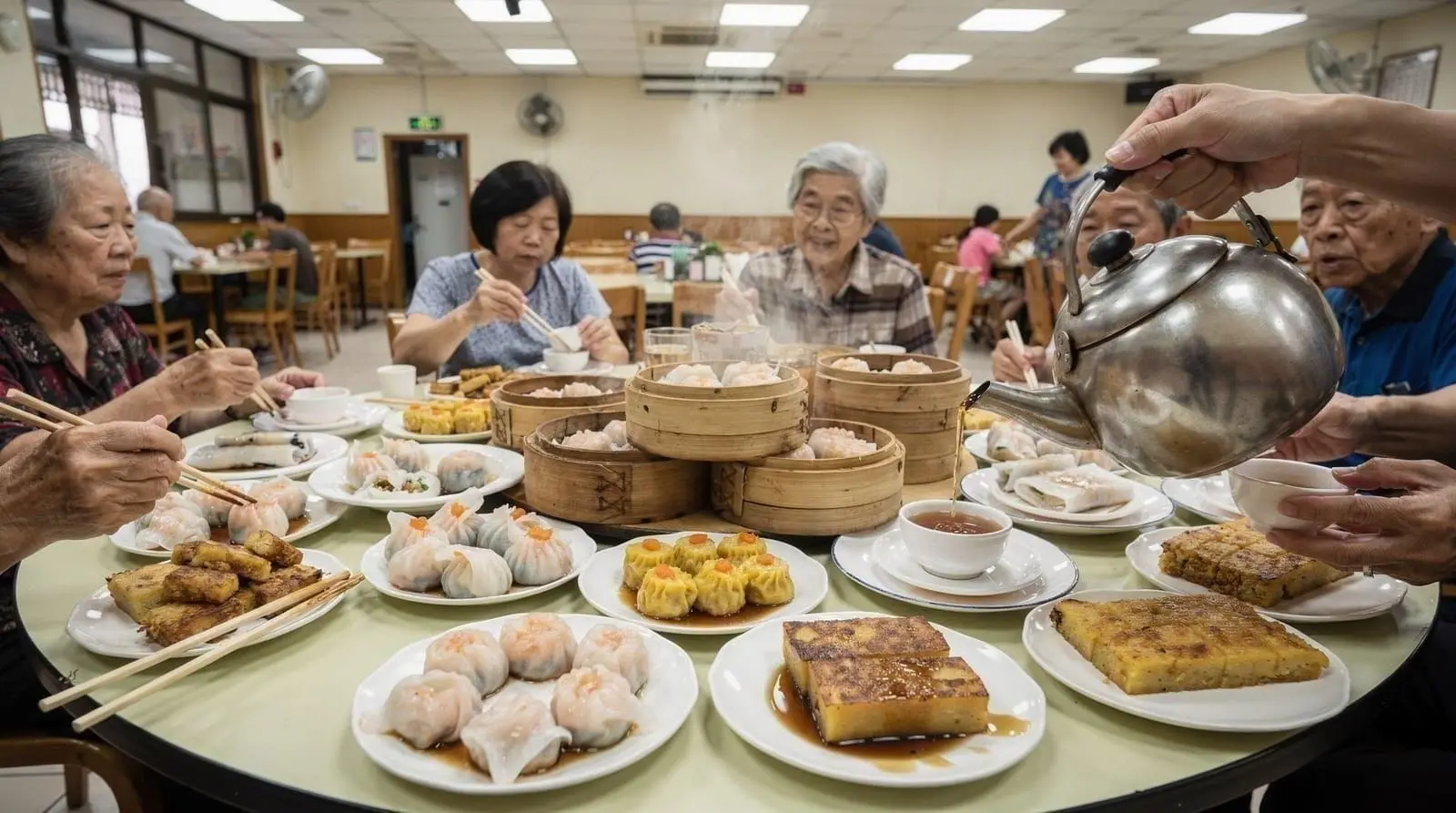
Morning tea — 早茶 (zǎochá) in Mandarin, “yum cha” in Cantonese — is not simply breakfast in Guangzhou. It is a social institution. Cantonese families, business associates, and elderly neighbours meet at dim sum halls from 07:00, ordering tea and a rotating sequence of small dishes (dim sum) delivered by pushcart or by order slip, and remaining through the morning. The meal can last three hours. The restaurant noise level at a genuine dim sum hall on a Sunday morning is considerable: carts clanging, orders shouted, families arguing amicably across tables. This is the correct experience.
Guangzhou Restaurant (广州酒家)
The historic flagship of Guangzhou Cantonese cuisine, open since 1935 on Wenchang South Road in the Liwan District. Multiple branches exist across the city but the Wenchang original is the reference. The menu runs to hundreds of items; the core dim sum ordering is via traditional slip-and-stamp card. Minimum order of 2–4 portions per dish; portions are 3–4 pieces each.
Must-order dishes: Char siu puff (叉烧酥), egg tarts (蛋挞), siu mai (烧卖), har gow (虾饺), lotus leaf sticky rice (荷叶糯米鸡), turnip cake (萝卜糕). The turnip cake here is pan-fried rather than steamed, with a crisped exterior.
Pricing: CNY 8–22 per dish at the 2026 rate; a full morning tea for two with 6–8 dishes and tea costs CNY 120–180. Weekend mornings require early arrival (before 08:00 for the most popular tables) or expect a 30–60 minute queue.
Hours: 07:00–14:30 for morning tea; full restaurant service continues through lunch and dinner.
Taotaoju (陶陶居)
Founded in 1880 in the Xiguan area, Taotaoju is considered the other historic anchor of Guangzhou dim sum. The original branch on Dishifu Road was renovated in the 2010s; the decor now leans toward Instagrammable restored-heritage without losing its function as a genuine dim sum hall. The quality is consistent with the Guangzhou Restaurant; the atmosphere is slightly more tourist-aware.
Notable for: traditional moon cakes (seasonal, pre-Mid-Autumn), a wide selection of breakfast-only dishes like 肠粉 (cheung fun, rice noodle rolls stuffed with shrimp or beef), and the bamboo steamer towers visible through the glass kitchen.
Pricing: Similar to the Guangzhou Restaurant; slightly higher per dish. CNY 130–200 per person for a full morning tea.
Local neighbourhood dim sum
The above two are historic landmarks. For the day-to-day Guangzhou experience, the best dim sum is in local neighbourhood restaurants with no tourist visibility:
Liwan District (near Chen Clan Academy): Any of the 粥粉面 (congee-noodle-rice) shops on Longjin West Road open from 06:00. Look for steamed rice noodle rolls (cheung fun) done to order: shrimp, char siu, or plain with soy sauce and sesame oil. CNY 8–14 per order.
Yuexiu District: The morning food stalls along Beijing Road (南段, south section) serve congee, fried dough (油条 yóutiáo), and soy milk from 07:00.
Tianhe District: The Zhujiang New Town area has higher-end dim sum restaurants aimed at the office crowd; quality is good, pricing is 20–30% higher than Liwan.
Roast meats (烧腊): the Cantonese barbecue tradition
Cantonese roast meats — roast goose, char siu (BBQ pork), roast duck, and roast suckling pig — are central to the cuisine. They are prepared in dedicated roast meat restaurants (烧腊店) and sold by weight to take away or eat in. Most restaurants have glass-fronted displays hanging the whole roasted animals at window level; you point to what you want and the cook chops it.
Bingsheng Pin (炳胜品味)
The most consistently recommended roast goose restaurant chain in Guangzhou with multiple branches (Tianhe, Yuexiu, Haizhu). The Tianhe branch on Linhe West Horizontal Road is the closest to the Guangzhou East Station HSR connection. The goose skin is the reference point: crispy, paper-thin, amber-coloured, unsauced. The interior meat is moist; the fat layer between skin and meat has rendered properly. Order a half portion (半只鹅, CNY 135–165 depending on size) unless you’re a table of four.
What to order with the goose: Congee (choose from plain rice congee or the seafood version), steamed vegetables with oyster sauce (时蔬, CNY 28–38), and the restaurant’s signature wonton soup (CNY 22–28 per person).
Pricing: A full meal for two with half a goose, vegetables, and congee costs approximately CNY 250–320.
Street-side roast meat shops
Throughout Liwan, Yuexiu, and Haizhu, small roast meat shops (operating from around 10:00) sell by the 100g: char siu from CNY 28–38/100g, roast goose from CNY 35–50/100g. A takeaway box of mixed roast meat over rice (烧腊饭, shāolà fàn) costs CNY 25–40 and is the standard Guangzhou working lunch. Better value than a restaurant; eat standing at the shop counter or take it to a nearby park.
Book a dim sum brunch experience with a local Guangzhou guideCantonese cooking has a capital of its own an hour south: a food tour of Shunde reaches the district Chinese food writers treat as the source, and it is a day trip rather than an expedition.
Wonton noodles and congee
Wonton noodles (云吞面, yúntūn miàn): The Guangzhou version of wonton noodle soup uses fresh thin egg noodles and shrimp-pork wontons in a clear, lard-enriched broth. The best bowls cost CNY 14–22 at small shops. Look for restaurants advertising 鲜虾云吞 (fresh shrimp wonton) — the wonton filling should be plump with visible shrimp, not a mixed meat paste. Notable local chain: Yannan Fei Wonton (燕南飞云吞) in multiple Liwan and Tianhe locations.
Congee (粥, zhōu): Cantonese congee is a long-cooked, silky rice porridge served with toppings. The fish congee (鱼生粥) uses raw fish slices added at the table to cook briefly in the hot porridge; the pork and century egg congee (皮蛋瘦肉粥) is the standard version. A bowl at a neighbourhood shop costs CNY 12–22.
Cantonese hot pot and seafood
Shunde hot pot (顺德打边炉): The original style of Cantonese hot pot from the Shunde district of Foshan. Unlike Sichuan hot pot (mala spice broth), Shunde hot pot uses a clear chicken-bone broth and focuses on the freshness of the ingredients — particularly fresh fish and hand-made fish paste. Available in Guangzhou at specialist restaurants in Tianhe and Haizhu; expect CNY 150–250 per person.
Seafood markets and restaurants: The Huangsha Aquatic Products Market (黄沙水产交易市场) in the Liwan District operates from the early hours and sells live seafood wholesale. Adjacent restaurants will cook what you buy (add CNY 15–25 per dish for cooking fee). This is the market-to-table experience; arrive before 10:00 for the widest selection.
The tourist trap problem in Guangzhou food
Guangzhou does not have as prominent a tourist trap food scene as some cities, because the city’s own standards are high and local customers are discerning. Exceptions:
Canton Tower restaurant: The revolving restaurant at Canton Tower (CNY 318–398 for dinner buffet) is priced for the altitude, not the food quality. You eat better for CNY 200 per person at Bingsheng Pin with actual Cantonese technique.
Hotel dim sum breakfasts: Five-star hotel dim sum in Guangzhou (Shangri-La, InterContinental) is technically competent and very expensive (CNY 200–350 per person). The Guangzhou Restaurant does it better for half the price. Book a neighbourhood place.
“Authentic Guangzhou kitchen” near tourist sites: Any restaurant that places laminated cards in English at the door and uses “traditional” in the name is probably optimised for tourist revenue rather than local loyalty. The best Cantonese food in Guangzhou has a handwritten menu, a full table of locals, and no English description.
Join a Guangzhou food tour and rice noodle roll workshop with local guideFood tours and structured tastings
For a structured introduction to the food landscape — particularly useful if you want to try multiple dish types without the navigation overhead — guided food tours covering Xiguan, Shamian, and the central markets run regularly. Book a Guangzhou morning tea and Cantonese opera food tour
These typically cover 4–6 tasting stops over 3–4 hours, including a dim sum hall, a cheung fun stall, a roast meat shop, and occasionally a Cantonese dessert shop (糖水 tángshuǐ, sweet soups). Prices range from CNY 250–450 per person including all tastings; check whether the tour price includes a guide-provided dim sum hall sit-down or just a tasting portion.
The broader food landscape: beyond Cantonese
Guangzhou is a migrant city. The food scene extends well beyond the canonical Cantonese repertoire:
Chaoshan cuisine: From the Chaozhou-Shantou region of eastern Guangdong. Seafood-focused; lighter soy flavours; famous for beef hotpot (牛肉火锅), braised goose, and a specific type of congee with toppings. Multiple Chaoshan restaurants in Tianhe and Haizhu districts. Expect CNY 150–280 per person.
Hunanese: Heavy, chilli-forward cooking that has significant following in Guangzhou. Restaurants on Dongshankou (东山口) and in the university districts.
Sichuan: Multiple price tiers from CNY 60-per-person mala hot pot places to higher-end Sichuan restaurants in Zhujiang New Town.
For a Guangzhou food journey that extends into Foshan and Shunde, see our guide to the Guangzhou Foshan food day trip — the Shunde district of Foshan is considered by many Cantonese the actual origin of the highest culinary standard in Guangdong.
Connecting to the broader PRD food scene
Guangzhou’s food culture connects to a broader Pearl River Delta gastronomic story: Cantonese cuisine in Guangzhou, Macanese-Portuguese fusion in Macau, and the migrant-food diversity of Shenzhen where the migrant workforce has brought every provincial Chinese cuisine to the same street. The food of the PRD is one of the best arguments for spending a week here rather than a day.
Guangzhou vs Hong Kong vs Shenzhen: where the same dishes taste different
Dim sum, roast meats, and wonton noodles exist in all three cities, but the character shifts noticeably from one to the next.
| Guangzhou | Hong Kong | Shenzhen | |
|---|---|---|---|
| Style | Origin-point, unpolished, local-first | Refined, faster-paced, trolley service now rare | Migrant-diverse, fewer historic institutions |
| Price | Lowest of the three for equivalent quality | Highest, especially at flagship halls | Mid-range, improving fast |
| Best for | Historic dim sum halls, roast goose | Michelin-tier execution, wider variety | Convenience, late hours, mixed provincial food |
If you’re building a Pearl River Delta trip around food specifically, doing all three back to back (as the Guangzhou-Shenzhen foodie itinerary does) makes the differences obvious in a way reading about them doesn’t.
Frequently asked questions about Cantonese food in Guangzhou
Do I need to book ahead for the historic dim sum halls?
Only for weekend mornings. On weekdays, walk-in is usually fine at the Guangzhou Restaurant and Taotaoju before 09:00. On Saturday and Sunday, arrive before 08:00 or expect a 30–60 minute wait for a table.
Is Guangzhou Cantonese food very spicy?
No. Cantonese cuisine is one of the least spicy major Chinese regional cuisines, built around freshness and natural flavour rather than chilli heat. If you want spice in Guangzhou, look for the city’s significant Sichuan or Hunanese restaurant scene instead, both well represented in Tianhe.
Top-rated things to do in Guangzhou
Verified deep-linked GetYourGuide tours. Book through these links and we earn a small commission at no cost to you.