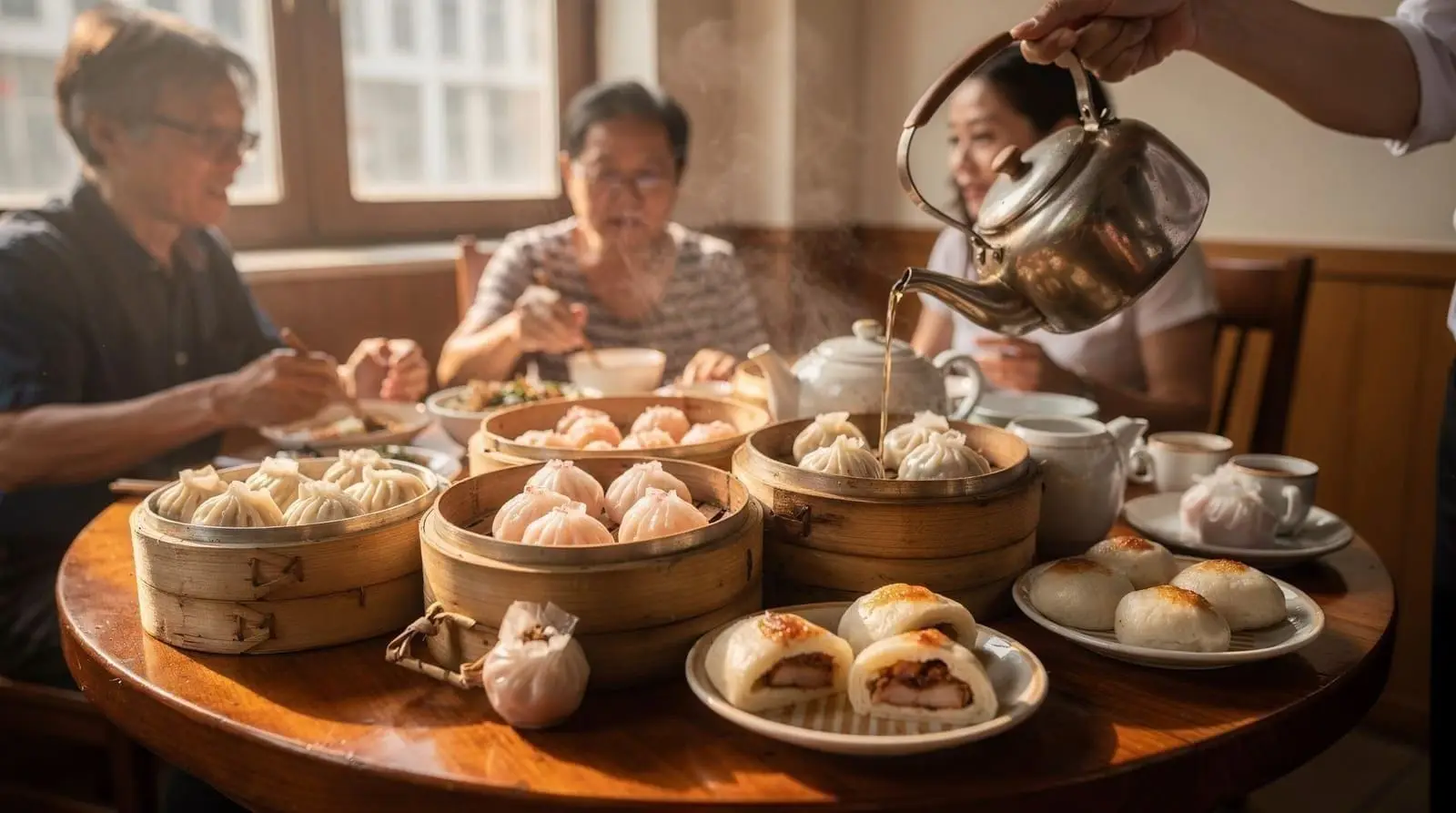
Shenzhen dim sum guide — where to eat and what to order
Where is the best dim sum in Shenzhen?
Shenzhen's best dim sum clusters in Futian (Crystal Jade, Maxim's Palace) and Luohu (Lianxiang Lou). Expect to pay CNY 60–120 (~USD 9–17) per person for a solid spread. Most teahouses serve until noon; arrive before 10am on weekends to avoid queues.
Shenzhen is not Guangzhou. That distinction matters when you’re hunting for dim sum. Guangzhou is the ancestral capital of Cantonese morning tea — the city where yum cha was perfected over centuries in family teahouses with bamboo steam baskets piled to the ceiling. Shenzhen, by contrast, is a migrant city barely four decades old, and its dim sum scene reflects that origin: you’ll find genuine Cantonese excellence alongside Chaoshan variations, modern hotel interpretations, and a few overpriced tourist traps near the border.
This guide cuts through the noise. These are real restaurants with real prices, organized by district so you can plan around your metro stop.
| Where | Futian (upscale), Luohu (traditional), Nanshan/Shekou (expat-friendly) |
| Cost | Around CNY 60–150 per person for a solid weekend spread |
| Time needed | 1.5–2 hours for a proper sitting |
| Getting there | Metro Lines 1, 2, 3, 4, 7, 9, or 11 depending on district |
| Best time | Weekday mornings, or before 9:30am / after 11:30am on weekends |
Understanding dim sum in Shenzhen
Dim sum — or yum cha in Cantonese — means “touch the heart.” It’s less a meal category than a ritual: steamed dumplings, roasted meats, sticky rice, and fried pastries shared over multiple pots of tea, from early morning to noon. In Shenzhen, the ritual survives but the cultural context is compressed. Most Shenzhen residents are migrants from across China, so the Cantonese teahouse tradition coexists with Chaoshan-style morning tea (lighter, more broth-focused) and Hakka variations.
Weekend mornings are the heart of Shenzhen dim sum culture. Families arrive between 8am and 10am, order from trolley carts or paper menus, and linger for two hours. Solo travelers and couples are welcome at most teahouses; just tell the server if you’re sharing or want a smaller table.
Price tiers:
- Budget: CNY 40–70 (~USD 6–10) per person — canteen-style teahouses in wet markets
- Mid-range: CNY 80–150 (~USD 11–22) per person — established Cantonese restaurants
- Upscale: CNY 200+ (~USD 29+) per person — hotel dim sum or premium chains
Best dim sum in Futian district
Futian is Shenzhen’s financial and administrative center, served by Metro Lines 1, 2, 3, 4, 7, 9, and 11 — effectively every major line passes through. The area around Futian Station and the CITIC Plaza cluster has the highest concentration of mid-range to upscale Cantonese restaurants. If you’re basing yourself in Futian, you can roll out of bed and be inside a teahouse within 15 minutes on any morning.
Lianxiang Lou (莲香楼) — Futian branch A Guangzhou institution with roots going back over a century, Lianxiang Lou’s Futian branch carries that heritage at slightly elevated Shenzhen prices. The char siu bao (roasted pork buns) and egg tarts are benchmarks. Weekend breakfast queues can run 30–40 minutes; arrive before 9am or after 11am. Budget CNY 80–120 (~USD 11–17) per person. Metro: Futian Station (Lines 2/3/4), 8-minute walk.
Crystal Jade (翡翠拉面小笼包) Chain dim sum with consistent quality and English menus — a reliable option if you’re newly arrived and want a no-stress introduction to dim sum. Crystal Jade is Singapore-origin but its dim sum credentials are solid. Har gow (shrimp dumplings) and siu mai (pork and shrimp open-top) are well-executed. CNY 70–110 (~USD 10–16) per person. Multiple Futian locations; nearest to Futian Station.
Maxim’s Palace Shenzhen (美心皇宮) The Hong Kong Maxim’s group runs trolley-service dim sum in the classic style — roaming carts, live chefs preparing items tableside, a voluminous menu. Prices are mid-to-high at CNY 120–180 (~USD 17–26) per person but the experience is authentic Hong Kong-style. Popular with expats and business travelers. Reservations recommended on weekends.
Best dim sum in Luohu district
Luohu borders Hong Kong at the Lo Wu crossing and was Shenzhen’s original commercial heart. The dim sum culture here has a more local, working-class edge — slightly lower prices, Cantonese grandmothers at the next table, more Cantonese spoken.
Wantian Restaurant (万田酒楼) A proper Cantonese teahouse in the older mould — noisy, crowded on weekends, bamboo steamers stacked high. The cheung fun (rice noodle rolls) and turnip cake are better than most competitors in this price bracket. CNY 50–90 (~USD 7–13) per person. Metro: Luohu Station (Line 1), 5-minute walk.
Seafood Village (海鲜村) Technically a seafood restaurant, but its weekend yum cha is one of Luohu’s best-kept non-secrets. The lobster dumplings aren’t cheap (CNY 38 for three pieces) but everything else runs standard prices. Ask for the Chinese-language dim sum menu; it’s more extensive than the English version. CNY 80–150 (~USD 11–22) per person.
Dim sum near Nanshan and Shekou
Nanshan and Shekou is the expat hub, so dim sum restaurants here are more accustomed to foreign diners, menus often have photographs, and English is more widely spoken.
Yue Xuan (粤轩) at Crowne Plaza Nanshan Hotel dim sum gets a bad reputation for being overpriced and bland, but Yue Xuan breaks the rule. The kitchen is Cantonese-trained, the shrimp paste is house-made, and the deep-fried taro dumplings have the right crisp-to-creamy ratio. Expect to pay CNY 150–220 (~USD 22–32) per person. Metro: Sea World Station (Line 2), 10-minute walk.
Ming Ge Restaurant (明阁) — Shekou area A Shekou staple for expat brunch converts. Dim sum runs until 2pm (later than most competitors), which makes it practical for late risers. The sticky rice in lotus leaf (lo mai gai) is a particular strength. CNY 90–140 (~USD 13–20) per person.
Choosing your district: quick comparison
| District | Price level | Atmosphere | Best for |
|---|---|---|---|
| Futian | Mid to upscale | Polished, business-friendly | First-timers wanting English menus and easy metro access |
| Luohu | Budget to mid | Loud, local, traditional | Authentic Cantonese teahouse atmosphere |
| Nanshan/Shekou | Mid to upscale | Relaxed, expat-comfortable | Late risers and hotel dim sum without the stiffness |
What to order — an honest starter guide
First-timers should anchor their order with four or five core dishes before exploring:
Non-negotiable classics:
- Har gow (虾饺) — shrimp dumplings in translucent rice wrapper; freshness indicator
- Siu mai (烧卖) — open-top pork and shrimp dumpling; benchmark for any kitchen
- Char siu bao (叉烧包) — roasted pork bun, steamed or baked; test the filling ratio
- Cheung fun (肠粉) — silky rice noodle rolls, plain or with shrimp/pork/beef
- Egg tart (蛋挞) — Portuguese-style or classic Cantonese pastry shell
Worth trying if you’re comfortable:
- Lo mai gai (糯米鸡) — sticky rice with pork and mushroom in lotus leaf
- Turnip cake (萝卜糕) — pan-fried, crispy exterior; a weekend staple
- Chicken feet (凤爪) — braised in black bean sauce; acquired texture but culturally essential
- Deep-fried squid (椒盐鱿鱼) — not traditional dim sum but often on extended menus
Skip at tourist-trap restaurants:
- Anything listed in English only on a separate “tourist menu” at different prices
- Lobster dim sum at unknown restaurants (quality highly variable; prices often manipulated)
Chaoshan-style morning tea — a distinct tradition
Shenzhen’s large Chaoshan (Teochew/Chaozhou) community has imported a parallel morning tea tradition that’s lighter and more broth-forward than Cantonese yum cha. Look for Chaoshan congee shops (潮汕粥店) open from 6am for a different take on morning dining — thin congee with fresh seafood, crispy dough fritters, and preserved vegetables alongside small plates of marinated goose and tofu.
Han Kee Chaoshan Porridge (汉记潮汕粥) One of Luohu’s better-known Chaoshan morning spots. Congee is CNY 15–25 per bowl; marinated goose platter CNY 35–60. Not dim sum in the Cantonese sense, but deeply satisfying and very local. Metro: Grand Theatre Station (Line 1), 12-minute walk.
For a deeper dive into this tradition, the Chaoshan cuisine guide covers the full breadth of Teochew food in Shenzhen, from cold marinated crab to hand-pounded beef meatballs.
Book a Shenzhen food tour with a local guide for a curated dim sum and local restaurant experience — especially useful on your first morning in the city.
The teahouse etiquette — what nobody tells you
Walking into a Cantonese teahouse for the first time can feel overwhelming. The noise, the speed of the trolleys, the assumption that you already know what you’re doing — none of it is explained on any menu. Here’s what the guidebooks leave out.
The tea tapping ritual (叩指礼, kòu zhǐ lǐ) When someone pours tea for you, you tap two fingers on the table rather than saying thank you aloud. This originates from a Qing dynasty story about the Qianlong emperor traveling incognito: his servants couldn’t bow to him without revealing his identity, so they tapped their fingers on the table as a symbolic kowtow. The custom is now universal across Cantonese teahouses. Two fingers, two taps — one tap means simple thanks; two means deep gratitude. Don’t overthink it; the tap is enough.
Washing the dishes At many traditional teahouses, especially in Luohu, the first thing you’ll see after sitting down is everyone around you pouring hot tea over their cups, chopsticks, and sometimes their small plates. This is a sanitation ritual carried over from an era when commercial kitchen hygiene was unreliable. It’s now more ritual than practical need, but participating marks you as culturally aware. Pour your first pot of tea over your cup into the slop bowl (废水桶) in the center of the table, then pour fresh tea to drink.
Claiming and marking your table Dim sum teahouses are organized chaos. When you arrive and the host points you to a large round table, you may share it with strangers — this is completely normal. If you want privacy, arrive early (before 9am) or book a private room at larger restaurants. At trolley-service restaurants, dishes are selected by flagging down the cart vendor. At menu-order restaurants, you fill in a paper menu and hand it to a server.
Topping up tea without asking Leave the teapot lid ajar — angled up or to one side — when it needs refilling. Staff will spot it and refill without you needing to signal. Placing the lid flat and closed means you’re satisfied. At many traditional teahouses, this unspoken system runs more smoothly than trying to get verbal attention in the noise.
Sharing etiquette Dim sum is communal. Order generously and share everything. Dishes arrive in sets of three or four pieces, designed for shared tables. Ordering one dish per person and eating it privately is technically possible but socially awkward in the teahouse environment. Let dishes rotate; try a little of everything. The total order always looks like too much until it isn’t.
Dim sum vs. Guangzhou: what Shenzhen does differently
Guangzhou will always be the spiritual capital of dim sum. The history is there, the volume of competing restaurants is there, and the sheer density of Cantonese expertise concentrated in the Pearl River Delta’s oldest city is unmatched. But Shenzhen, precisely because it’s a migrant city, does something Guangzhou can’t quite replicate: it makes dim sum a meeting point rather than a tradition.
The migrant influence Shenzhen’s dim sum teahouses serve a population that has come from every province in China. The kitchen staff at a Futian Cantonese restaurant might include chefs from Guangdong, Fujian, Jiangxi, and Sichuan working side by side. This cross-pollination means you’ll find dishes on Shenzhen dim sum menus that have no precedent in Guangzhou — xiaolongbao-adjacent items, Hakka stuffed dumplings presented as dim sum, or Chaoshan fish-paste preparations that Cantonese purists would never classify as yum cha.
The Chaoshan presence In Guangzhou, Cantonese morning tea is the unambiguous dominant tradition. In Shenzhen’s Luohu district, Chaoshan teahouses (operating with their own congee, marinated meats, and light broth ethos) compete directly with Cantonese teahouses on the same streets. Shenzhen is one of the few cities where you can meaningfully compare both traditions in the same morning. The Dongmen street food zone exemplifies this blending — Chaoshan vendors operate 50 meters from Cantonese teahouses.
Modern hotel dim sum Shenzhen’s hotels (particularly in Futian and Nanshan) have invested heavily in upscale Cantonese dining to serve the business traveler and convention market. This has produced a category of hotel dim sum that’s genuinely better than what’s available in many Guangzhou hotels — more refined execution, better sourced ingredients, and presentation calibrated for an international audience. It’s not the most authentic experience, but it’s also not the tourist-trap mediocrity you’d expect.
What Guangzhou still does better The breadth. Guangzhou has hundreds of teahouses spanning every price point, every subregion of Cantonese cooking, and every era from century-old institutions to contemporary innovation restaurants. Shenzhen has maybe 15–20 restaurants that meet a serious standard. If dim sum is the reason for your Pearl River Delta trip, Guangzhou deserves a day of your time. The Guangzhou–Shenzhen foodie itinerary structures a four-day comparison across both cities.
Dim sum and the wider Cantonese food scene
Dim sum is only the morning slice of Shenzhen’s Cantonese food culture, and understanding how it connects to the rest of the day’s eating helps make sense of the city’s food geography. The same teahouses that serve dim sum in the morning often become full Cantonese restaurants by evening, serving roast goose, clay pot rice, and stir-fried greens rather than steamed baskets — so a restaurant worth visiting for breakfast is frequently also worth a dinner reservation. Restaurants in Futian and Luohu with strong dim sum reputations are a reliable starting point if you want to explore Cantonese cuisine more broadly beyond the trolley cart format, and staff at these restaurants can usually recommend their own dinner menu highlights if you ask.
Seasonal dim sum specialties in Shenzhen
The core dim sum repertoire — har gow, siu mai, char siu bao — is available year-round. But Cantonese teahouse cooking is more seasonal than most visitors realize, and knowing what to look for in each season can significantly elevate a dim sum breakfast.
Spring (March–May) Spring is the season for fresh bamboo shoot dumplings (鲜笋饺), where the filling is crunchy young bamboo shoot with a light pork mixture. Some teahouses also feature spring onion oil dumplings and water chestnut cake (马蹄糕) in a lighter spring version. Seasonal taro preparations become more delicate in this period.
Summer (June–August) Summer brings lighter, cooling dim sum: crystal dumplings with fresh herbs, cooling mung bean preparations, and lotus root pastries. Some traditional teahouses reduce their menu in the deep summer heat — the rice flour and starch-heavy dishes don’t travel well on trolley carts in high humidity. Arrive early in summer months; items sell out faster.
Autumn (September–November) Autumn is arguably the best dim sum season. Crab roe dumplings (蟹粉饺) appear on higher-end menus as crab season opens. Chrysanthemum tea becomes a default teahouse offering — lighter and floral against the autumnal dim sum menu. Some restaurants run dedicated hairy crab dim sum sets in October and November at significant premium (CNY 180–300 per person), but the quality is exceptional.
Chinese New Year and Lunar New Year (January–February) The most festive dim sum season. Teahouses operate with special New Year menus for the weeks surrounding Lunar New Year: turnip cakes shaped like ingots, sweetened rice dumplings, and festive roasted pork preparations. Reservations become essential weeks in advance — every family in Shenzhen has New Year dim sum booked. If you’re visiting around the holiday period, book at least two weeks ahead; last-minute walk-ins at popular teahouses during CNY are essentially impossible.
Winter (December–February) Claypot dishes and heavier braised dim sum items appear. Sticky rice preparations become richer. Some seasonal Cantonese teahouses offer winter-only items like steamed glutinous rice cake (年糕蒸品) and braised preserved duck alongside the standard menu.
Pairing dim sum with your Shenzhen itinerary
Dim sum is a morning activity. Most teahouses stop serving by noon, and the window between 8am and 11am is when the food is freshest and the experience is most authentic. The good news: Shenzhen’s metro system makes it easy to build a full day around a dim sum morning, whatever district you’re starting from.
From Futian: morning tea + Ping An observation deck Start dim sum at Lianxiang Lou or Crystal Jade near Futian Station, then walk or ride to Futian’s Ping An Finance Centre observation deck for afternoon city views. The contrast — ancient morning ritual to hyper-modern skyscraper — is one of Shenzhen’s characteristic pleasures. Metro: Futian Station (Lines 2/3/4), then Line 2 to Shengzhen Bay for other Nanshan options.
From Luohu: dim sum + Dongmen street food exploration After early dim sum in Luohu, walk the streets to Laojie Station (Line 1) and explore the Dongmen street food zone before it gets too hot. The market area around Dongmen is more interesting in the cooler morning hours, when wet market vendors and breakfast stalls are still operating. The combination gives you a textured cross-section of Luohu’s food culture in a single morning.
From Nanshan/Shekou: dim sum + OCT Dim sum in Shekou, then take Metro Line 2 east to the OCT Overseas Chinese Town for the afternoon — the creative district parks, galleries, and OCT-LOFT are all walkable from the station. A leisurely dim sum followed by an afternoon in OCT makes a natural, unhurried day.
Metro logistics for dim sum Shenzhen’s metro system is covered comprehensively in the Shenzhen metro guide. The key lines for dim sum neighborhoods: Line 1 runs east-west through Luohu; Lines 2 and 9 serve Futian and connect to Nanshan; Line 4 goes north to Longhua. Off-peak hours (before 9am on weekends) mean trains are comfortable and unhurried.
Timing your arrival The 9am–11am window is peak occupancy at every popular Shenzhen teahouse. If you want to avoid queues on weekends, the two reliable strategies are: arrive before 9am (many teahouses open at 7am, and the earliest tables are often the most relaxed), or arrive after 11am when the main breakfast rush has cleared and you get the tail of the service. Weekend queueing at mid-range Shenzhen teahouses can run 30–60 minutes during peak hours — factor this into your day.
Book a guided Shenzhen food morning to have a local handle the navigation, ordering, and language — particularly valuable for first visits when the teahouse system is unfamiliar.
A first-timer’s ordering script
If the whole ritual feels intimidating on a first visit, this simple sequence works at almost any Shenzhen teahouse: order tea first (pu-erh is the safe default), then ask for one har gow, one siu mai, one order of cheung fun, and one char siu bao to start — these four dishes give a fair read on the kitchen’s quality without overcommitting. Watch what the table finishes fastest and order a second round of that dish, then branch out to something from the “worth trying” list once you’re comfortable with the pace. This approach avoids the common first-timer mistake of over-ordering ten dishes at once and having half of them arrive cold.
Practical tips for dim sum in Shenzhen
Hours: Most teahouses open 7am–noon for breakfast dim sum; lunch service varies (1–3pm). Dinner dim sum is rare outside hotel restaurants.
Reservations: Weekday dim sum rarely needs a reservation. Weekend dim sum at any well-regarded restaurant should be booked 1–3 days ahead via WeChat or phone. Hotels can book for you.
Payment: WeChat Pay and Alipay are standard; most Cantonese restaurants now accept foreign cards linked to either. Cash works everywhere. Carry CNY 200–300 per person as backup. For setup guidance, see the WeChat Pay and Alipay for foreigners guide.
Language: Point at neighboring tables’ dishes, use Google Translate’s camera function, or ask for the photo menu (照片菜单). Major chains have English menus. Independent teahouses rarely do, but staff are generally patient.
Ordering tea: Your server will ask what tea you want before anything else — this is mandatory. Pu-erh (普洱) or Tieguanyin (铁观音) are safe starting points; pu-erh is earthier and better with fatty dishes.
Dim sum for families and larger groups
Dim sum’s shared, order-as-you-go format makes it naturally well-suited to families and groups, more so than most Shenzhen restaurant formats. Round tables at Cantonese teahouses are designed for 8–10 people, and larger restaurants like Maxim’s Palace and Lianxiang Lou can accommodate bigger parties with advance notice — call or message via WeChat a day ahead for tables of six or more on weekends.
Children generally do well with the format: har gow, egg tarts, and lo mai gai are reliably kid-friendly, and the rotating trolley service keeps younger diners engaged without a long wait for a single dish. For families building a broader day around it, the Shenzhen with kids itinerary has other morning-friendly activities that pair naturally with an early dim sum sitting.
Getting there from central Shenzhen
All the districts mentioned are metro-accessible:
- Futian: Lines 1, 2, 3, 4, 7, 9, 11 — the city’s transport hub
- Luohu: Line 1 terminus at Lo Wu border crossing
- Nanshan/Shekou: Line 2 west terminus (Sea World Station)
For a broader Shenzhen food journey, pair dim sum morning with an afternoon exploring the Dongmen street food scene or Chaoshan cuisine. If you’re staying near the border, the Luohu district guide has hotel and logistics details. The where to stay in Shenzhen guide also maps accommodation by neighborhood relative to the main dim sum districts.
Frequently asked questions about dim sum in Shenzhen
Is Shenzhen or Guangzhou better for dim sum?
Guangzhou is the acknowledged capital of Cantonese cuisine and has a longer, deeper dim sum tradition. However, Shenzhen’s best Cantonese teahouses are genuinely excellent, and the added convenience of fewer tourists and lower prices at non-tourist-zone restaurants makes Shenzhen a strong choice. If you’re doing the Pearl River Delta loop, try both — read the Guangzhou–Shenzhen foodie itinerary for a four-day comparison.
How much should I budget for dim sum in Shenzhen?
A satisfying dim sum breakfast at a mid-range Cantonese restaurant runs CNY 80–130 per person (~USD 11–19). Budget teahouses (often in wet markets or older neighborhoods) can cost CNY 40–60. Hotel dim sum runs CNY 150–250 and isn’t meaningfully better than good independent restaurants.
Do I need to speak Chinese to eat dim sum in Shenzhen?
No. Major chains have English menus or photo menus. Independent teahouses are harder, but pointing at neighboring tables, using Google Translate’s camera mode (works offline if downloaded), or showing a photo of what you want all work reliably. Download a Chinese food vocabulary cheat sheet before you go.
What time should I arrive for weekend dim sum?
Arrive before 9:30am or after 11:30am. The 10am–11:30am window is peak congestion at every popular teahouse — expect 30–60 minute waits and the best dishes selling out from trolley carts.
Is dim sum the same as yum cha?
Yum cha (饮茶, literally “drink tea”) refers to the full ritual — going to a teahouse, ordering tea, and eating dim sum dishes over a long, social morning. Dim sum technically means the individual dishes. In practice, locals use the terms interchangeably. When you say you want “dim sum,” people understand you want the full yum cha experience.
Can foreigners pay with a foreign credit card at dim sum restaurants?
Most mid-range and upscale restaurants accept foreign Visa/Mastercard linked through WeChat Pay or Alipay. Some older independent teahouses are cash-only. Bring CNY cash as backup, particularly in Luohu’s older market-area restaurants.
Are there vegetarian dim sum options in Shenzhen?
Yes, though they require communication. Most Cantonese teahouses offer vegetable cheung fun, tofu skin rolls (腐皮卷), steamed vegetable dumplings, and turnip cake (cooked in vegetable oil at better restaurants). Inform your server of dietary needs at the start — “我吃素” (wǒ chī sù) means “I’m vegetarian.” Strict vegans should research Buddhist vegetarian restaurants (素食馆) separately.
Should I tip at Shenzhen dim sum restaurants?
No. Tipping is not customary at restaurants in mainland China, dim sum included, and staff neither expect nor are trained to handle it. A service charge is occasionally added automatically at upscale hotel restaurants (Yue Xuan, for instance), in which case no additional tip is needed.
What does the finger-tapping at dim sum mean?
Tapping two bent fingers on the table when someone pours your tea is the Cantonese gesture of thanks that substitutes for verbal acknowledgment in the noisy teahouse environment. It originates from a Qing dynasty custom — a symbolic kowtow derived from court etiquette. Two taps is the standard; use it every time your tea is poured and you’ll blend in immediately.
Can I get dim sum for dinner in Shenzhen?
Rarely as a dedicated sitting — dim sum is a morning-to-early-afternoon tradition, and most teahouses stop serving by 2–3pm. Some hotel restaurants (Yue Xuan, Ming Ge) offer limited evening dim sum menus, but the trolley-cart, full-spread experience is a breakfast and brunch activity here, not a dinner one.
Is it rude to order just one or two dishes for a solo visit?
No, though it’s less typical — most teahouses accommodate solo diners and small orders without issue, especially on weekday mornings when tables aren’t in high demand. On busy weekends, a very small order at a packed teahouse may draw a raised eyebrow if you’re occupying a large table, so consider sitting at the counter or a smaller table if available.
Top-rated things to do in Shenzhen
Verified deep-linked GetYourGuide tours. Book through these links and we earn a small commission at no cost to you.