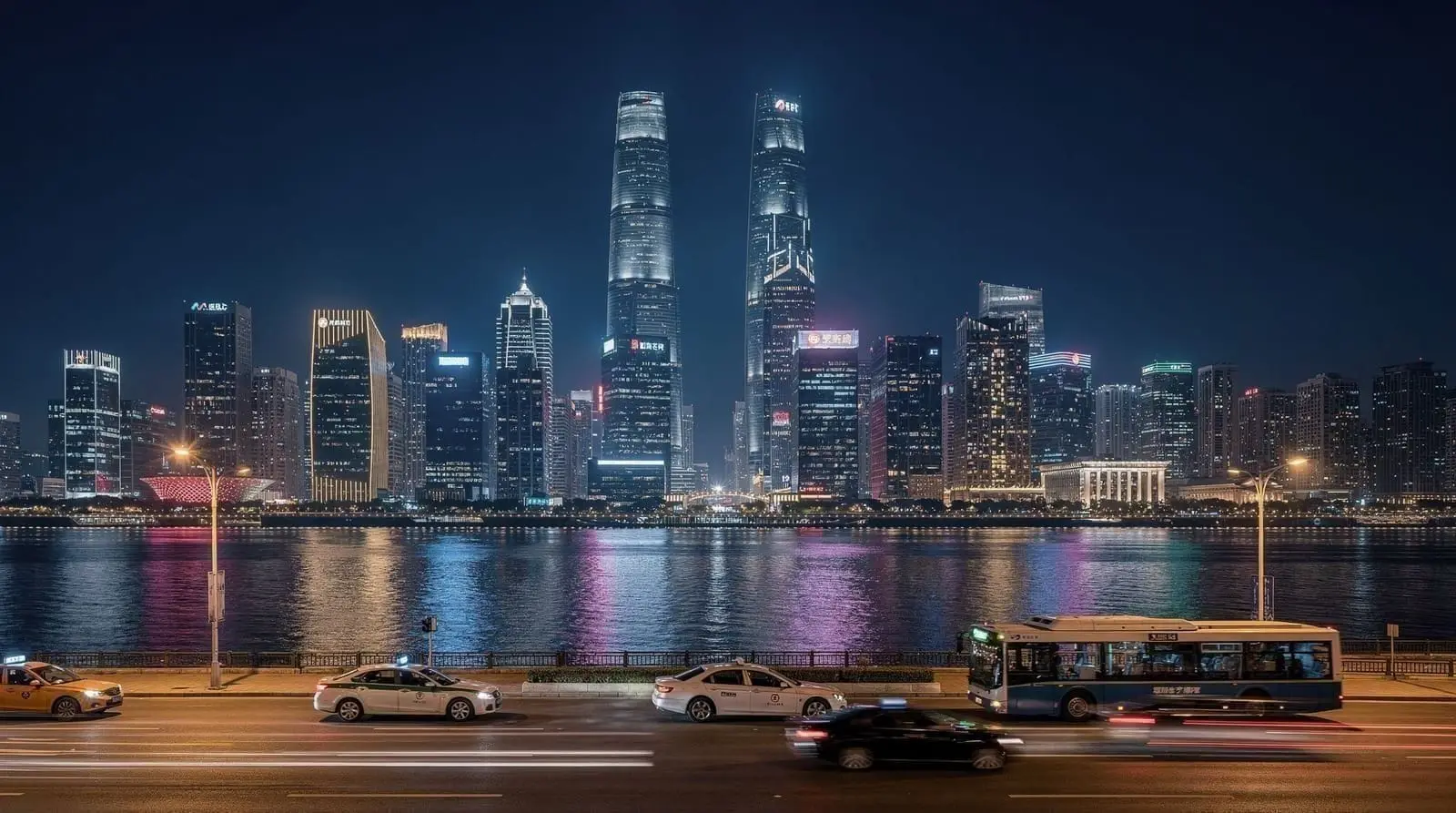
Guangzhou’s eastern half tells a different story from the antique lanes of Xiguan. Tianhe District is the city’s contemporary economic engine: a dense cluster of towers, malls, and cultural venues that rose from a largely undeveloped area after the 1987 National Games relocated to a then-suburban site. Today the Tianhe Sports Center complex is surrounded by some of China’s highest-grossing retail real estate, and the adjacent Zhujiang New Town (Pearl River New Town) is home to the city government’s most ambitious architectural commissions.
For visitors arriving at Guangzhou South station and proceeding into the city, Tianhe is often the first encounter with urban Guangzhou — and it makes a strong impression. The scale is unambiguous: 70-story towers, eight-lane boulevards, and underground metro concourses the size of airport terminals.
Tianhe complements rather than competes with the old city. For historic Guangzhou — dim sum, Chen Clan Academy, Shamian Island — see Yuexiu and the old city. For the overall Guangzhou experience including Canton Tower and Pearl River cruises, see Guangzhou. This guide focuses on Tianhe’s modern character.
| Where | Eastern Guangzhou, around Tianhe Sports Center and Zhujiang New Town |
| Cost | Metro ¥5–12/trip; meals ¥40–150; rooftop drinks ¥90–140 |
| Time needed | Half day to 1 day |
| Getting there | Metro Line 3 from Guangzhou South (25 min) |
| Best time | Year-round for shopping; October–April for riverside walks |
Getting to Tianhe from Guangzhou South and Hong Kong
From Guangzhou South station (where HSR trains from Shenzhen, 35 minutes, and Hong Kong, 55 minutes, arrive), take Metro Line 3 direct to Tianhe Sports Center — approximately 25 minutes, ¥7 ($1). This is the most used inbound corridor in Guangzhou and trains run every 2–4 minutes at peak hours.
From the Guangzhou East intercity rail terminal (arriving from Zhuhai, Dongguan, Foshan), Metro Lines 1 and 3 connect to Tianhe Sports Center in 10 minutes.
Within Tianhe, the automated APM (Automated People Mover, part of the Guangzhou Metro system) connects Tianhe Sports Center with Zhujiang New Town and the Pearl River waterfront in about 8 minutes. The APM uses the same metro card and runs every 2–3 minutes.
For broader PRD transport planning including the HZMB bridge route to Zhuhai and Macau, see the Pearl River Delta loop itinerary.
Zhujiang New Town: Guangzhou’s architectural showcase
The Zhujiang New Town (珠江新城) district, south of Tianhe Sports Center, was planned in the 1990s as a blank-slate CBD and now hosts one of the densest concentrations of signature contemporary architecture in China.
Guangzhou Opera House (广州大剧院): Designed by Zaha Hadid and completed in 2010, the Opera House is Guangzhou’s most significant piece of contemporary architecture. Two pebble-shaped volumes in granite and glass sit on the Pearl River bank, connected by a landscaped plaza. Even without a ticket, the exterior and plaza are worth 20 minutes. The smaller studio theater hosts Cantonese opera and chamber performances; the main hall (1,800 seats) presents international touring companies. Tickets start at ¥80 ($11) for opera and ballet; check the program at the Guangzhou Grand Theatre official site. Metro: Zhujiang New Town, exit B.
Guangdong Museum (广东省博物馆): The 2010 Rocco Yim-designed building resembling a lacquered treasure chest houses the provincial museum’s permanent collection of Cantonese ceramics, natural history, and Lingnan culture and trade history. Free entry (passport registration required at the gate). Closed Mondays.
Guangzhou International Finance Centre (IFC, 440 meters): The tallest building in Guangzhou. The Four Seasons Hotel occupies the upper floors (rooms from ¥2,400 / $335 per night, with restaurant meals at ¥300–500 / $42–70 per person providing a splurge-worthy skyline dinner).
Canton Tower (广州塔): Across the Pearl River from Zhujiang New Town, the 600-meter Canton Tower is the symbolic center of modern Guangzhou. The SkyView observation deck at 433 m costs ¥180 ($25); the outdoor skydeck is ¥120 ($17). Buy timed tickets online at weekends. The tower view from Zhujiang New Town’s riverbank, looking south across the water, is one of the defining images of contemporary Guangzhou. From here the full Guangzhou guide covers the tower visit logistics.
Ersha Island (二沙岛): Immediately east across the Haixin Bridge, Ersha Island is a quieter counterpoint to the CBD. The Guangdong Museum of Art and the Xinghai Concert Hall face the river; the island’s residential streets and riverside promenades are among the calmest in central Guangzhou. A pleasant 45-minute walk from Zhujiang New Town.
Book a full-day Guangzhou city tour covering Tianhe’s modern skyline and the old cityShopping in Tianhe
Tianhe hosts two of Guangzhou’s major shopping clusters:
Tianhe Sports Center complex: The area around the Sports Center concentrates mid-to-high-end malls — Teemall (天河城), CITIC Plaza (中信广场), and Times Square (时代广场). Teemall was one of China’s first large malls and remains high-traffic; it has an accessible food court on the lower level with Cantonese meals at reasonable prices (¥40–80 / $5.60–$11 per person). The surrounding streets have independent streetwear shops, bubble tea chains, and the kind of dense pedestrian commercial activity that defines Chinese city centers at this scale.
Taikoo Hui (太古汇): Developed by the Hong Kong property group, Taikoo Hui positions itself as Guangzhou’s premium mall — Hermes, Louis Vuitton, Brunello Cucinelli alongside respected independent restaurants and the Fang Suo Commune bookstore-lifestyle space. The latter is a genuinely good reason to visit: Fang Suo is a multi-story curated books and design goods shop that functions as a de facto cultural salon, with a terrace that becomes a gathering space in the evenings.
Zhujiang New Town retail: The K11 Mall near Liede bridge integrates contemporary art installations into a luxury retail environment (Patek Philippe, Bottega Veneta, high-end Chinese designers). The basement food hall is more democratic, with Japanese chains and Hong Kong-style cafe options at ¥60–120 ($8.40–$17).
Practical note on shopping in Guangzhou versus Shenzhen: Electronics and components are better sourced in Shenzhen’s Huaqiangbei district. Tianhe excels in fashion, cosmetics, and international brand retail. If you’re choosing between the two cities for a shopping focus, the purpose matters: tech = Shenzhen, fashion/lifestyle = Tianhe.
Food and drink in Tianhe
The Tianhe dining scene skews international and upscale compared to the old city, reflecting the concentration of business travelers and young professionals who work and live here.
Cantonese fine dining: The Guangdong Hotel (广东大厦) near Tianhe Sports Center serves reliable Cantonese banquet cuisine; business set lunches from ¥188 ($26) per person. The Jade River restaurant in the Westin hotel complex (Tianhe Road) has a well-regarded dim sum brunch on weekends and professional Cantonese kitchen through the week.
International options: Behind CITIC Plaza, a dense cluster of Japanese restaurants, Korean BBQ, and Southeast Asian chains offers moderate pricing (¥80–150 / $11–21 per person). Quality is consistent if unexciting — Guangzhou’s working business district handles this category competently without excellence.
Rooftop and terrace bars: The Pearl River promenade in Zhujiang New Town activates properly after dark, with hotel rooftop bars facing Canton Tower. The Mandarin Oriental Guangzhou’s Riverside Bar (Level 8) offers unobstructed Canton Tower views and cocktails at ¥90–140 ($13–20). The Fang Suo Commune terrace (Taikoo Hui, Level 5) is a lower-budget alternative functioning as an evening gathering space.
Late-night eating: The area around Tianhe North Road near Linhe West metro station has late-night Cantonese snack stalls operating after midnight — congee, fried dough sticks, and wonton noodle soup at ¥20–40 ($2.80–$5.60). These cater to the local late-night crowd, not tourists, which keeps quality honest and prices sensible. The Guangzhou–Shenzhen foodie itinerary maps this scene in detail. Note that late-night options thin out considerably after 01:00, so plan the timing of a post-nightlife meal accordingly if you’re coming from one of the Yanjiucheng bars.
Coffee: Guangzhou’s third-wave coffee scene is active and concentrated partly in Tianhe — Manner Coffee (multiple locations), Seesaw Coffee (Taikoo Hui), and Peet’s Coffee (from the US, well-executed locally) are the quality anchors. Most branches open by 08:00 and get genuinely busy with the local office crowd between 08:30 and 09:30 on weekdays — arrive slightly later or earlier if you want a seat rather than a takeaway.
Guangzhou nightlife in Tianhe
Tianhe is the geographic center of Guangzhou’s mainstream nightlife, though the most interesting scenes extend into adjacent districts.
Yanjiucheng bar zone (研究城, “Research City”): A pocket of bars, live music venues, and craft beer places south of Tianhe Sports Center, running along a pedestrian alley system. It functions as Guangzhou’s equivalent of Shenzhen’s OCT-LOFT bar zone or Hong Kong’s Lan Kwai Fong — concentrated, walkable, with a mix of students, young professionals, and expats. Entry is free; drinks run ¥40–80 ($5.60–$11) at most venues.
Craft beer: Draft Land (多乐啤, a Taiwan-origin craft beer bar) has a Tianhe location with 36 taps and no pretension. Guangzhou’s domestic craft beer scene, led by brands like Watt Brewery and East Wolf, has grown substantially since 2020. Both are available in Yanjiucheng venues.
Clubs: The major nightclubs are in Tianhe (Canvas, Cospace) and along the Pearl River (M Club). Cover charges ¥100–300 ($14–42). The crowd is predominantly Chinese professionals under 30; international DJ bookings happen but are less consistent than Shenzhen’s OCT-Loft or Hong Kong’s Lan Kwai Fong circuit. Dress codes are loosely enforced at the door — smart casual is generally sufficient, and trainers are fine at most venues except the higher-end options along the riverside.
Tianhe with limited time: what to prioritize
If you have only two or three hours in Tianhe rather than a full day, prioritize in this order: the Guangzhou Opera House exterior and plaza (20 minutes, free, unmissable architecture), the Pearl River promenade at Zhujiang New Town for the skyline view (30 minutes, best after 19:00), and either Taikoo Hui for the Fang Suo Commune bookstore or Canton Tower viewed from across the river, depending on whether you prefer indoor browsing or outdoor photography.
Skip the malls’ luxury floors unless you’re actually shopping — international brands here are priced the same as everywhere else and add little to a short visit. This condensed version works well as a stopover between a Guangzhou South arrival and onward travel, or as an evening add-on to a day mostly spent in the old city.
Hotels in Tianhe
Tianhe concentrates Guangzhou’s international hotel stock:
- Luxury: Grand Hyatt Guangzhou (¥1,800–3,500 / $250–490), Ritz-Carlton (¥2,200–4,000 / $307–557), Four Seasons in IFC (¥2,400–4,500 / $335–628).
- Business class: Marriott Tianhe (¥900–1,600 / $125–224), InterContinental (¥1,000–1,800 / $140–251), Sofitel Sunrich (¥800–1,400 / $112–196).
- Budget-smart: Vox Hotel near Tianhe Sports Center (¥380–550 / $53–77), Jinjiang Inn Tianhe Road (¥280–380 / $39–53). These are straightforward, clean, and significantly cheaper than anything comparable in Hong Kong.
For visitors primarily interested in the historic city and old-quarter eating rather than the modern commercial scene, staying near the old city in Liwan or Yuexiu (closer to Chen Clan Academy and Shamian Island) is often more convenient — see Yuexiu and the old city.
Practical notes
Connectivity: Tianhe’s mall WiFi networks are monitored; use your own data connection with a pre-installed VPN for Google Maps, WhatsApp, and Western social platforms. See our eSIM and VPN guide for China travel for 2026-verified options.
Transport connections from Tianhe: The airport express (Line 3 north extension to Guangzhou Baiyun International Airport, GZN) runs from Tianhe Sports Center in about 40–45 minutes, ¥12 ($1.70). Direct and convenient.
From Tianhe to the old city: Metro Line 1 west from Tianhe Sports Center to Chen Clan Academy takes 25 minutes (¥5 / $0.70). A day combining both areas works well: hotel breakfast in Tianhe, metro west to Chen Clan Academy and Xiguan for morning dim sum, return east for an evening riverside walk and dinner. See Yuexiu and the old city for the morning half.
Day trips from Tianhe: Foshan (35 min via Guangfo Metro from Changshou Road or Xilang) and Dongguan (30 min HSR from Guangzhou East) are the most time-efficient additions from Tianhe as a base. The Greater Bay Area 2-week itinerary uses Guangzhou as the regional hub for these extensions.
The Pearl River waterfront at night
The Zhujiang New Town riverside promenade is among the most impressive urban waterfront environments in China, particularly after 20:00 when the full building illuminations activate. The sequence of lit structures from east to west, as seen from the southern bank: Guangzhou IFC tower (440 m), Guangzhou CTF Finance Centre (530 m, China’s third-tallest building), the Chow Tai Fook Centre (530 m), and the entire Zhujiang New Town skyline reflected in the Pearl River. Canton Tower, across the river and illuminated in a changing color pattern, completes the scene from the south bank of the river.
The viewing walkway runs along Xinhao Road (Zhujiang New Town north riverbank), accessed from Liede metro station (Lines 4, APM). The promenade is crowded on weekend evenings from 20:00 to 22:00 with local and tourist photographers; weekday evenings are more relaxed. The Pearl River night cruise provides the on-water view — the riverbank promenade gives the panoramic overhead perspective.
Book a Pearl River night cruise past the Zhujiang New Town skyline and Canton TowerPhotography: The river reflection shots work best at the blue hour (30–45 minutes after sunset) before full darkness removes the sky gradient. A tripod is useful; the crowds often make a stable shooting position difficult to hold. The elevated walkway section near Liede Bridge offers unobstructed perspectives.
Guangzhou’s technology and startup scene in Tianhe
Guangzhou’s technology ecosystem is less globally prominent than Shenzhen’s hardware-manufacturing complex, but Tianhe is its center. The area around Tianhe Software Park (天河软件园) and the Science City corridor (10 km northeast, accessible by metro) concentrates Guangdong’s software and internet companies. NetEase, YY, and Lizhan are among the major companies with Tianhe headquarters.
For visitors with professional interest in the tech sector: the Tianhe area has a cluster of innovation hubs and co-working spaces that run English-language events and demo days, particularly during the autumn conference season (October–November). The Guangzhou International Tech Show (GITS) typically runs in November at the Canton Fair Complex in Haizhu — worth checking if your visit coincides.
Guangzhou’s contemporary art scene
The commercial gallery and art space concentration in Guangzhou skews toward Haizhu and Baiyun districts, but Tianhe has a few significant venues:
53 Art Museum (53美术馆) in Tianhe North: A mid-size contemporary art museum in a converted industrial building, with programming that emphasizes Guangdong-based artists and Lingnan art history in contemporary context. Entry ¥20–50 ($2.80–$7) depending on exhibition. Closed Mondays.
K11 Art Mall: The art installations integrated into the K11 retail environment vary in quality from decorative to genuinely interesting. A year-round program includes commissions by Chinese artists with specific responses to the space. The basement “art village” section is the strongest.
Taikoo Hui project space: Adjacent to the Fang Suo Commune bookstore, a small gallery-format space that changes monthly. Typically showing architecture, photography, or graphic design.
For more serious contemporary art engagement, the Guangdong Museum of Art on Ersha Island (Line 6, Ersha Island station) is the institutional anchor of the city’s art scene, with the most significant collection of post-1980 Cantonese contemporary art in the region.
Shopping honestly assessed: what Tianhe does well and doesn’t
What Tianhe does well: International and Chinese luxury brands (Taikoo Hui, K11, the Zhujiang New Town retail blocks); mid-range international fashion brands (H&M, Zara, Uniqlo, Japanese fast fashion, Korean cosmetics); professional services retail (optical shops, high-end tailoring in the CITIC Plaza area); food retail (Japanese convenience stores 7-Eleven and FamilyMart are ubiquitous and useful).
What Tianhe doesn’t do well: Electronics and hardware (go to Shenzhen’s Huaqiangbei for this); traditional Chinese crafts and antiques (the Xiguan antique streets in Yuexiu are far more interesting); generic souvenirs (buy these anywhere).
Price comparison: Luxury goods in Guangzhou’s Tianhe are priced identically to Hong Kong since the 2019 import duty changes. The advantage of buying in Guangzhou rather than Hong Kong is nil for duty-free purposes; the advantage of Shenzhen is the specific tech/hardware category that Tianhe simply doesn’t stock well.
Where to stay in Tianhe: by type of traveler
Business traveler on company account: Grand Hyatt, Ritz-Carlton, or Four Seasons. All are in Zhujiang New Town walking distance of the Opera House and corporate meeting facilities. Breakfast buffets at ¥200–280 ($28–39) per person.
Independent traveler who wants modern Guangzhou: Marriott Tianhe or InterContinental offers international-standard rooms at ¥900–1,600 ($125–224) with better-than-average breakfast and Metro Line 1 access to the old city within 25 minutes.
Budget-conscious traveler who needs Tianhe location: The Vox Hotel (¥380–550 / $53–77) is a concept hotel aimed at younger travelers with compact but well-designed rooms, ground-floor coffee bar, and a social-space lobby. Clean, functional, no room for assumptions about space — typical Tianhe new-development hotel.
Traveler who prefers the old city atmosphere: Stay in Liwan or Yuexiu District instead (see Yuexiu and the old city) and take the metro to Tianhe for the modern city experience. A Shamian Island guesthouse (¥400–800 / $56–112) gives an atmosphere Tianhe cannot offer.
Tianhe vs the old city: a quick comparison
Most visitors split time between Tianhe and the historic Yuexiu/Liwan area. Here’s the honest breakdown:
| Tianhe | Yuexiu / old city | |
|---|---|---|
| Character | Modern CBD, skyline, malls | Antique lanes, temples, Cantonese food |
| Best for | Shopping, rooftop bars, business hotels | Dim sum, Chen Clan Academy, Shamian Island |
| Nightlife | Yanjiucheng bars, nightclubs | Quieter, more local |
| Typical stay | Half day to 1 day | 1–2 days |
Neither replaces the other — see the Yuexiu and the old city guide for the historic half of Guangzhou, and the Guangzhou destination overview for how the two areas fit into a single visit.
A half-day Tianhe walking plan
For visitors with limited time, this sequence covers Tianhe’s essentials without backtracking: start at the Guangzhou Opera House plaza (Zhujiang New Town metro, exit B) for photos of the Zaha Hadid building, walk 10 minutes to the Guangdong Museum, then continue to Taikoo Hui for lunch at the Fang Suo Commune terrace or one of the mall’s restaurants.
Spend the afternoon shopping or browsing K11’s art installations, then walk the Pearl River promenade as evening falls for the illuminated skyline view across to Canton Tower. This covers architecture, culture, shopping, and the signature night view in around 5–6 hours, and connects directly to Liede metro station if you want to continue toward Guangzhou’s Canton Tower afterward.
Guangzhou airport access from Tianhe
Guangzhou Baiyun International Airport (GZN / CAN) — the third-busiest airport in China — is 30 km north of Tianhe. Metro Line 3 north extension from Tianhe Sports Center to the airport takes 40–45 minutes and costs ¥12 ($1.70). The airport express (Machine 3 direct trains, slightly faster than standard Line 3) runs from Airport South terminal in 35 minutes. Taxis from Tianhe to the airport: ¥80–150 ($11–21) depending on traffic, typically 40–60 minutes.
The airport has connections to most major Chinese cities and international routes to Southeast Asia, Middle East, Europe, and North America. For the Greater Bay Area exit strategy, the Shenzhen Bao’an Airport alternative is 65 km south and occasionally offers better international routing; check both when booking.