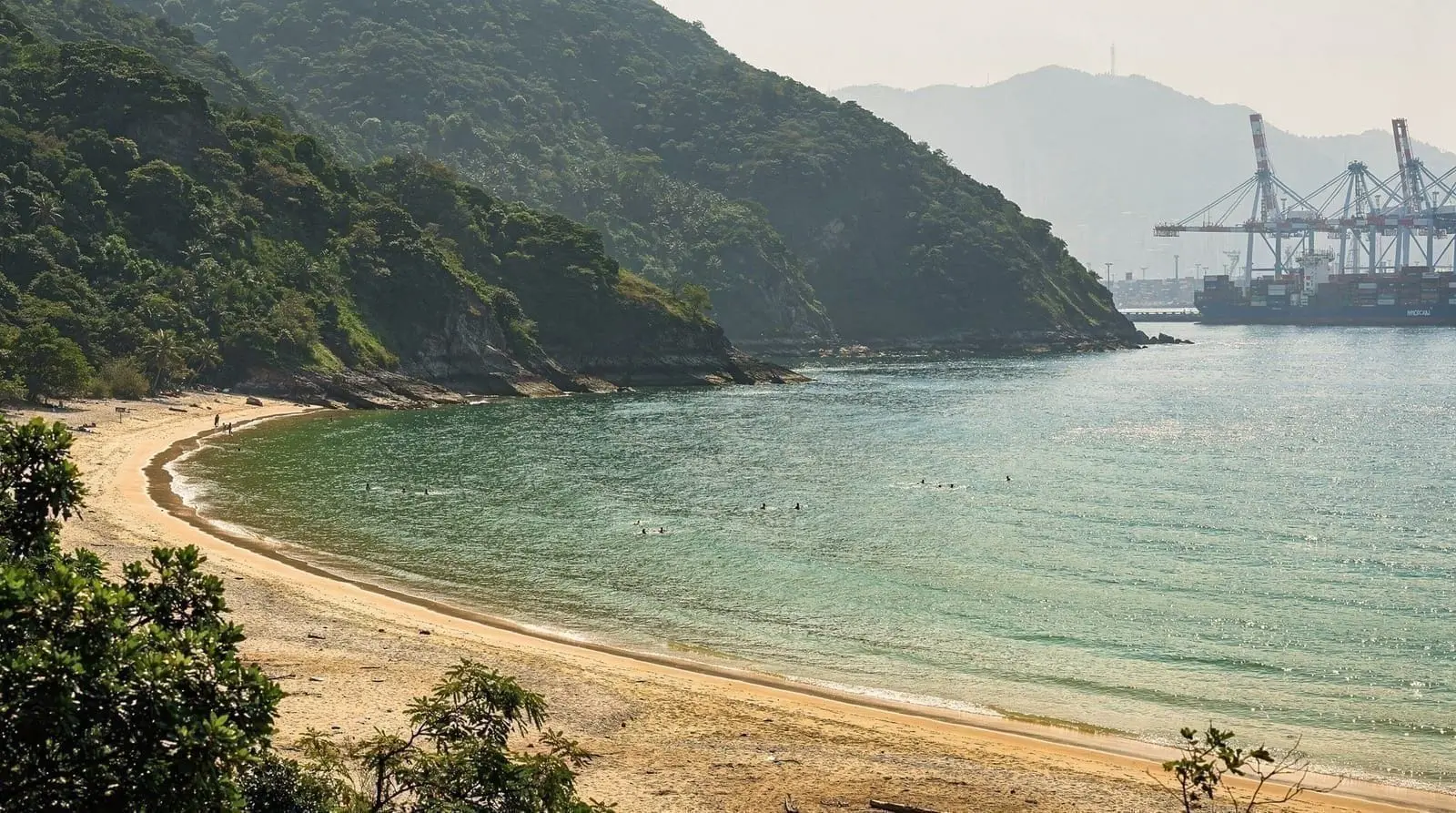
Yantian sits at the edge of Shenzhen’s visitor circuit — close enough to central Shenzhen to be a half-day trip from Futian, far enough from the main tourist attractions to be consistently overlooked. The district’s identity is divided between two economic realities that have little to do with each other: the Yantian International Container Terminal, one of Asia’s highest-throughput port facilities, and the coastal residential zone that runs along Daya Bay with older fishing communities, beach parks, and seafood restaurants that serve Shenzhen’s own residents on weekends.
That division is, paradoxically, what makes Yantian interesting to visit. You can swim at Dameisha Beach in the morning while container ships the size of city blocks idle in the bay behind you. You can eat fresh grouper at a restaurant where the bill is half what you’d pay in Shekou. You can walk 400 meters of Qing-dynasty arcade street and see zero tour groups. The industrial presence is not hidden, and the neighborhood life around it is genuine.
| Where | Eastern Shenzhen, along Daya Bay |
| Cost | Seafood meal for two around CNY 200–300; beach entry free |
| Time needed | Half day to full day; best paired with Dapeng Peninsula |
| Getting there | Metro Line 8 to Dameisha or Yantian station |
| Best time | October–April; avoid July–August weekend beach crowds |
Getting to Yantian
Metro (recommended): Metro Line 8 serves Yantian’s main points. Key stations:
- Dameisha station (大梅沙): directly serves Dameisha Beach, 10 minutes walk from the beach entrance
- Yantian station (盐田): central to the old town area and market streets
- Sha Tau Kok station (沙头角): northernmost Yantian station, near the border zone
Journey times from central Shenzhen:
- From Luohu (Sungang station, Line 3/8 interchange): 35–45 minutes to Yantian central stations
- From Futian (Futian station): 55–70 minutes via interchange at Sungang or Qinghu
- From Nanshan (OCT station, Line 1): 50–65 minutes via interchange at Chegongmiao and Sungang
Bus: Bus E11 connects Luohu to Yantian and continues toward Dapeng Peninsula, useful if combining both areas in one day. Journey Luohu to Yantian: approximately 45–55 minutes.
Didi:
- From Futian to Dameisha Beach: 45–60 minutes, CNY 60–90 (~USD 9–13)
- From Futian to Yantian Old Street: 50–65 minutes, CNY 65–95 (~USD 10–14)
- Within Yantian district: CNY 15–35 between most points
Metro Line 8E extension: The 8E line branches from Line 8 into the deeper Dapeng New District, useful for combining Yantian with Dapeng Peninsula in a single trip. From Yantian stations, continue southeast to Dapeng North station, then bus M557 to Dapeng Ancient City.
Dameisha Beach
Dameisha (大梅沙) is Shenzhen’s most accessible public beach — a 1.5 km crescent of sand on the Daya Bay coast, backed by a linear coastal park. It’s significantly more developed and managed than Xichong Beach on Dapeng Peninsula: paved promenade, organized beach sections with numbering, lifeguard stations, changing facilities (CNY 15 per person), public showers, and beach equipment rental.
What to expect: The water at Dameisha is cleaner than Shenzhen Bay (the bay near Nanshan) but less pristine than Xichong’s open coast. Visibility runs 2–4 meters in clear conditions. The beach sand is brownish-grey rather than white but is real sand (not gravel or artificial fill). Conditions are comfortable for swimming May–October.
The park surrounding the beach has cycling paths, an outdoor fitness area, basketball courts, and a skateboard park. This is a locally used recreational space, not just a tourist beach — which is precisely what makes it more interesting than a purpose-built resort beach would be.
Beach season: Officially May 1 to October 31 for full facilities (lifeguards, equipment rental, beach events). Off-season (November–April) sees reduced services but the beach remains open and free.
Entry: Free year-round since 2017 (previously charged CNY 30–50). Parking is paid; arriving by metro is significantly more convenient.
Beach equipment rental:
- Umbrella and chair set: CNY 30–50 (negotiable)
- Sun lounger: CNY 20–30
- Kayak (single): CNY 60–90/hour
- Beach volleyball: courts free on a first-come basis
- Inflatable rental (floats, rings): CNY 20–40
Metro: Dameisha station (Line 8), Exit A. Walk 10–12 minutes following signs to the beach park entrance.
Honest assessment of Dameisha: It’s a good urban beach. Not a great beach. The water is swimmable, the sand is adequate, the facilities are functional. The view across the bay includes container ships and the port cranes — which is either atmospheric or distracting depending on your perspective. For the world-class beach experience, go to Xichong or further. For a morning of swimming and a seafood lunch without a 2-hour transit, Dameisha is the right call.
Xiao Meisha (小梅沙): A smaller beach 4 km east of Dameisha. Slightly quieter; charges a CNY 20 entry fee. The beach is a bit smaller but the crowd is proportionally lower. Bus M452 connects the two in 15 minutes.
Yantian Old Street
The old town of Yantian has a 400-meter commercial street in the Republican-era arcade style (骑楼, qilou) common throughout Guangdong and overseas Cantonese communities — continuous covered walkways along the ground floor of 2–3 story buildings, shop fronts opening directly to the colonnade, residences above. The construction dates from the 1920s–1940s.
Unlike more aggressively touristed “old streets” in Chinese cities, Yantian Old Street has not been extensively renovated for visitors. The buildings have been stabilized and the drainage improved, but the street retains a working neighborhood function: a hardware shop, a traditional Chinese medicine dispensary, a convenience store, a few small restaurants.
The seafood restaurants at the eastern end of Old Street are more interesting than the street itself. Several have been in the same location for 20–30 years and serve the local fishing community. Prices for fresh fish: CNY 45–75 per jin (grouper, snapper); crab: CNY 70–120 per crab; stir-fried shellfish: CNY 25–45. No English menus; point at the tanks or use a translation app.
Getting there: Metro Line 8 to Yantian station, 10 minutes walk north following signs to the old town area.
Seafood in Yantian: the value case
The fishing heritage of eastern Shenzhen means seafood prices in Yantian run 30–40% below equivalent restaurants in central Shenzhen or Shekou. The reason: proximity to the source (fishing boats unload at Yantian Harbour), local clientele that won’t pay tourist premiums, and no hotel or convention trade to subsidize.
Best areas for seafood:
- Old Street east end and surrounding residential streets
- Yantian Harbour area (further east, 20 minutes walk from the Old Street or CNY 15 Didi)
- Along the coastal road between Dameisha and Xiao Meisha (several restaurants with sea views)
Standard seafood meal for two (at genuine local prices):
- Live grouper (石斑鱼, 400g): CNY 80–120
- Steamed crab: CNY 70–110 per crab (best October–January)
- Clams stir-fried with ginger and scallion: CNY 28–40
- Stir-fried water spinach (通菜): CNY 18–25
- Rice: CNY 3–5 per person Total: CNY 200–300 (~USD 29–44)
The morning fish market: Yantian Harbour has a small fish auction on weekday mornings (approximately 06:00–09:00) where overnight fishing boats unload and local buyers — restaurant owners, market vendors, and individuals — bid on the catch. Not a tourist show. Worth the early morning if you want to understand where Shenzhen’s eastern seafood comes from. Arrive before 07:00 for the most active period. Photography is generally welcomed as long as you stay out of the way of the working buyers and don’t block the loading area.
A half-day Yantian plan
For visitors with limited time, this sequence covers Yantian’s highlights efficiently: take Metro Line 8 to Dameisha station in the morning, spend 1–2 hours at the beach and coastal park (swimming if the season suits, or simply walking the promenade), then head to Yantian Old Street (a short Didi ride or bus connection) for lunch at one of the long-established seafood restaurants.
If time allows, walk the eastern end of the Greenway cycling path for views of the container terminal before heading back to central Shenzhen. This covers the beach, the seafood, and the industrial contrast that makes Yantian distinctive, all within about 5–6 hours including transit. Travelers with a full day can extend this into the eastern coastal trail toward Xiao Meisha, or continue on to Dapeng Peninsula for an overnight combining both areas.
The container port: industrial scale
The Yantian International Container Terminal handles approximately 14 million TEUs (twenty-foot equivalent units) per year — making it one of the five busiest container terminals in the world by throughput. The port is not open for tourist visits, but the scale is visible:
From the coastal road: The row of Panamax and post-Panamax gantry cranes — each standing over 50 meters high, with outreach spans crossing the full width of container ships — creates an industrial skyline along the bay. At night, the floodlit port operation continues 24/7 and the cranes are visually striking against the dark water.
From the Greenway cycling path: The coastal cycling path east of Dameisha Beach follows a clifftop route with unobstructed bay views. From the higher vantage points, you can see the container terminal in full operational context — ships being loaded and unloaded simultaneously, a constant procession of container trucks, the controlled choreography of a system moving millions of tonnes of goods.
Cycling the Greenway: rent a bike at Dameisha Beach entrance (CNY 15–30/hour, or use Hellobike app at CNY 2 per 30 minutes). The main cycling route east from Dameisha runs approximately 8 km before reaching Xiao Meisha.
Sha Tau Kok and the border zone
The northernmost part of Yantian district, Sha Tau Kok (沙头角), sits directly on the Shenzhen–Hong Kong border. The area has historical significance as one of the original cross-border market towns that existed in the zone between the two systems during the British Hong Kong era.
Until 2022, Sha Tau Kok’s main commercial street was a restricted military zone requiring special permits to access. Since partial opening, the central commercial area (Chung Ying Street, 中英街 — “China–England Street,” named for its divided political history) has been accessible for day visits from the Shenzhen side without full permits.
What’s there: A narrow market street that historically split between Chinese and Hong Kong jurisdiction (the street itself was the border). The southern side was in Shenzhen; the northern side in Hong Kong. Today the physical barrier has been consolidated but the historical character of a divided market town remains visible in the architecture. Some original buildings have been preserved; others replaced.
Access restrictions (2026): The main Chung Ying Street area is accessible from the Shenzhen side with standard identification. Some areas further into the Sha Tau Kok border zone may still require advance registration. Check current access rules via the Shenzhen government tourism bureau before planning a visit — the rules have changed frequently since 2022.
Metro: Line 8 to Sha Tau Kok station. Journey time from Yantian: 15 minutes. From Futian: approximately 70–80 minutes total.
Hiking in eastern Yantian
The hills behind Dameisha Beach form the western foothill zone of Wutong Mountain National Forest Park — Shenzhen’s highest mountain (943.7 meters) and a serious hiking destination. Entry points from Yantian are secondary to the main Luohu-side trailheads, but usable for shorter routes.
Eastern coastal trail: The trail from Xiao Meisha eastward follows the cliff tops toward the Dapeng New District boundary, approximately 8 km of coastal hiking with South China Sea views. This trail connects into the Dapeng Peninsula coastal trail network; committed hikers can combine the two for a multi-day east Shenzhen traverse.
Trail condition: maintained but not paved; some rocky sections. Trailhead: east end of Xiao Meisha Beach, signed. Allow 3.5–4 hours for the full 8 km route to the district boundary.
Nature reserves: The mangrove areas near the Yantian coastline (particularly north of the container terminal) have a small protected reserve accessible via the coastal road. Bird watching in autumn (September–November) is viable — migratory waders and shorebirds use the mudflat areas during the East Asia Flyway migration. Binoculars are useful but not essential; the birds are visible to the naked eye from the boardwalk sections closest to the mudflats.
Yantian vs Dapeng Peninsula: which beach day to choose
Both are eastern Shenzhen coastal escapes, but they suit different priorities:
| Yantian (Dameisha) | Dapeng Peninsula (Xichong) | |
|---|---|---|
| Beach quality | Adequate, urban, developed | Better sand, cleaner water |
| Travel time from Futian | ~55–70 minutes | ~90 minutes |
| Seafood prices | 30–40% below central Shenzhen | Similar or slightly higher (more tourist trade) |
| Character | Container port visible, locally used park | Ming-dynasty fort, more dramatic coastline |
| Best for | A shorter half-day escape | A full dedicated beach and hiking day |
If you only have one eastern Shenzhen day, go to Dapeng Peninsula — it’s more dramatic in every dimension. Yantian is the better choice when you want a shorter trip, or as a second day paired with Dapeng. See the day trips from Shenzhen guide for how both fit into a broader itinerary.
Where to stay in Yantian
Beach resort hotels (CNY 600–1,800/night): Dameisha Beach has several resort-style hotels running along the coastal road. The most established is the Starway Hotel Shenzhen Dameisha (CNY 500–900/night, ~USD 73–132) and a Wyndham-branded property. Weekend premiums of 30–60% apply in summer months. Book 3–4 weeks ahead for peak season (July–August) and Golden Week.
Budget guesthouses (CNY 150–400/night): Residential guesthouses (民宿) operate in the residential blocks immediately behind Dameisha Beach park. Quality varies. The better ones have been operating for 5+ years and have Ctrip reviews to show for it; the newer ones are untested. Look for ratings above 4.5 on Ctrip and reviews mentioning English-speaking staff if that matters to you.
Business hotels in Yantian town (CNY 250–500/night): If you’re combining Yantian with a Dapeng Peninsula trip and don’t specifically want beach access, the business hotels in Yantian town (near Yantian Metro station) are convenient and considerably cheaper than the beach-front properties.
Value calculation: Staying in Yantian makes financial sense if you’re doing 2+ days of eastern Shenzhen exploration (Yantian + Dapeng) and don’t want to commute from Futian each morning. For a single day trip, the 90-minute metro ride from Futian is manageable enough that you don’t need to stay.
Honest assessment of Yantian
Yantian is an authentic part of Shenzhen that rewards travelers who want to look beyond the obvious circuit. The beach at Dameisha is the most accessible genuine beach in the city. The seafood prices are the best value in Shenzhen’s eastern corridor. The Old Street and the fishing harbour have genuine neighborhood character. The port industrial landscape is unlike anything else in the city.
The honest caveat: Yantian is not a destination that will dominate your Shenzhen memories. Dapeng Peninsula is more dramatic in every dimension — the fort is better, the beaches are better, the seafood town (Nanao) has more character than Yantian Old Street. If you only have time for one eastern Shenzhen day trip, go to Dapeng.
If you have 2 days and want to explore east Shenzhen properly, Yantian is an excellent companion to Dapeng. The combination — Yantian for Dameisha Beach and the evening fishing harbour seafood, Dapeng for the fort and Xichong Beach — is a complete eastern Shenzhen itinerary that almost no Western travel guide currently covers.
Book a customizable private Shenzhen day tour that can be tailored to include eastern Shenzhen sitesOnward from Yantian
- Dapeng Peninsula — the natural pairing; 30–40 minutes further east by bus or taxi
- Shenzhen main guide — city-wide context and logistics
- Luohu — Metro Line 8 westbound, 35–45 minutes; shopping and street food
- Shenzhen in 3 days — eastern Shenzhen itinerary options on Day 3
- Shenzhen metro guide — for planning the Line 8 connections used throughout this guide
- Shenzhen Bay and mangrove nature guide — for comparing Yantian’s mangrove reserve with the western coastal park
- Things to do in Shenzhen