Dongguan sits between Shenzhen and Guangzhou, a 30-minute HSR ride from either. With a population approaching 10 million, it’s a large city by any standard — but it’s not a tourist city. The Pearl River Delta’s manufacturing boom concentrated disproportionately here: sporting goods, furniture, electronics components, shoes, and garments have been produced in Dongguan’s industrial parks at global scale since the 1980s. The city grew fast, functionally, and with no particular effort to make itself visually appealing.
That honesty stated, Dongguan has more to offer curious travelers than its reputation suggests. The food is excellent and unpretentious. The Songshan Lake technology district provides an unexpected visual spectacle. And scattered through the urban fabric are genuine Hakka and Cantonese cultural remnants — old villages, clan temples, and dim sum houses — that haven’t been polished for tourism precisely because the audiences who use them are local.
| Where | Between Shenzhen and Guangzhou, Pearl River Delta |
| Cost | HSR ¥30–50 each way; meals ¥15–120 depending on style |
| Time needed | Half day to 1 day, usually as an HSR stopover |
| Getting there | HSR 25–35 min from Shenzhen North, 20–35 min from Guangzhou South |
| Best time | October–April; avoid Chinese New Year when businesses close |
Getting to Dongguan
From Shenzhen: HSR from Shenzhen North or Shenzhen station to Dongguan takes 25–35 minutes; tickets ¥30–50 ($4.20–$7). Trains run frequently throughout the day on the Guangzhou–Shenzhen–Hong Kong corridor. The main Dongguan station serves the western Nancheng area; Dongguan West station is closer to Songshan Lake and Huawei campus.
From Guangzhou: HSR from Guangzhou South or Guangzhou East to Dongguan: 20–35 minutes (¥30–45 / $4.20–$6.30). Multiple trains hourly. Guangzhou East station (in Tianhe) is often more convenient than Guangzhou South for visitors already in the city center.
From Hong Kong: HSR from West Kowloon to Dongguan: approximately 55–70 minutes (¥110–160 / $15–22). A viable option for a Hong Kong–based day trip with an honest assessment of what you’ll find.
Within Dongguan: The city has a light rail network (Dongguan Rail Transit, two lines) but coverage is limited. Didi is reliable and inexpensive — ¥15–30 ($2.10–$4.20) across most of the city. Taxis are available at the HSR station. If you’re connecting onward from Shenzhen North or Futian, the Shenzhen metro guide covers how to reach the HSR stations from anywhere in the city.
Dongguan fits naturally into the Pearl River Delta Grand Loop itinerary as a half-day stop between Shenzhen and Guangzhou.
Songshan Lake and the Huawei Ox Horn campus
Songshan Lake (松山湖) is a planned technology district around an 8 km2 artificial lake in the western part of Dongguan. The tech park was established in 2001 and has attracted manufacturing-adjacent companies. The most dramatic development here is the Huawei Ox Horn Campus (华为牛角坡), completed in 2019.
Huawei built a European-themed campus on 1,900 acres: 12 sections each modeled on a different European city (Paris, Burgundy, Bruges, Verona, Granada, Oxford, and others), connected by a small internal train. The buildings are impeccably reproduced and surreally transplanted — a Rhine riverside with red-tiled Germanic gabled houses beside a lake surrounded by Guangdong subtropical vegetation. The campus is a private working facility and not open to general public access, but the perimeter along Songshan Lake provides exterior views of the architecture.
The lake shore itself is accessible by bicycle rental (¥30–50 / $4.20–$7 for 3 hours). A botanical garden on the eastern shore (¥10 / $1.40 entry) provides a pleasant backdrop. Several lakeside restaurants on the eastern shore serve standard Cantonese meals at ¥60–120 ($8.40–$17) per person.
Whether the campus architecture reads as interesting or unsettling probably depends on your feelings about corporate ambition expressed through large-scale European pastiche. Either way it’s unlike anything else in the Pearl River Delta and the lake setting is genuinely attractive.
Getting to Songshan Lake: Didi from Dongguan West HSR station to the lake takes 15–20 minutes and costs ¥25–40 ($3.50–$5.60). From central Dongguan station, allow 30–35 minutes by Didi.
Historic sites: Ke Yuan Garden and Hakka villages
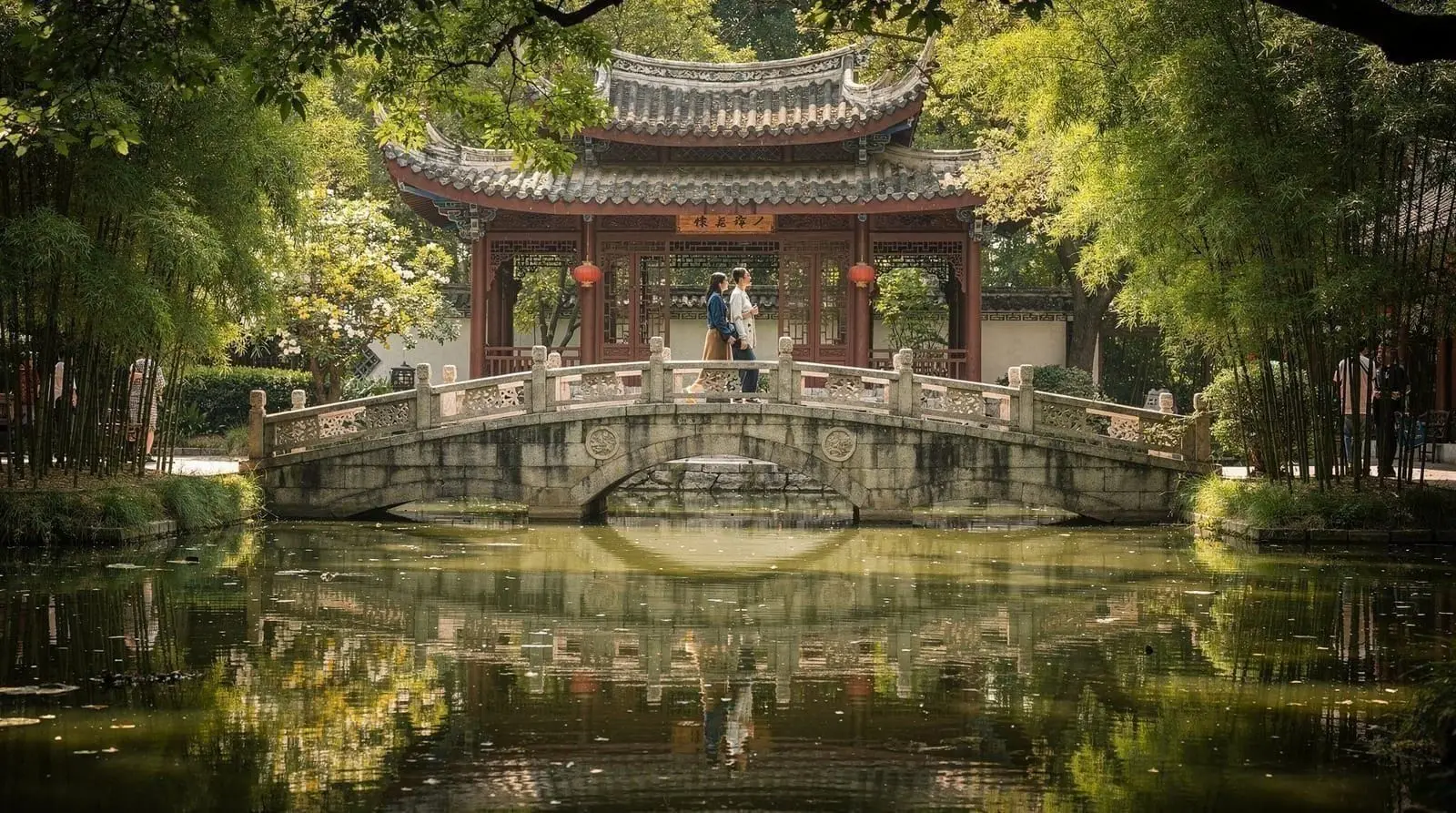
Ke Yuan Garden (可园, Ke Yuan): A Qing-era Lingnan scholar’s garden in Dongguan city center, built in 1850 by a retired Qing official. One of four famous Lingnan gardens in Guangdong Province, it’s smaller and less visited than those in Foshan or Panyu. The architecture — rockeries, pavilions, covered walkways, planted courtyards — follows the same compressed spatial logic as Suzhou gardens but with distinctly Cantonese aesthetics and planting. Entry ¥15 ($2.10). Allow 45–60 minutes. Metro: Dongguan Line 1 to South Gate station.
Nancheng historic district: The area around Dongguan’s original city center has surviving qilou arcades and a few intact lanes of pre-1950s shophouses. Less comprehensive than Guangzhou’s Xiguan but worth 30 minutes of walking if you’re based at the main station.
Nan She Ancient Village (南社古村) in Tangxia District: About 20 km from Dongguan station, this Hakka-influenced village dates from the Ming dynasty with over 150 Ming and Qing-era buildings intact — clan halls, residential lanes, ancestral temple, and the characteristic defensive tower architecture. It’s one of the more complete traditional village environments accessible from the HSR corridor. Entry ¥30 ($4.20). Reached by taxi (¥30–40 / $4.20–$5.60) or infrequent local bus from Tangxia town. Allow 90 minutes.
Weiyuan Fort (威远炮台) in Humen District: A First Opium War era fortification (1820s–1840s) on the Pearl River, including the site where Commissioner Lin Zexu destroyed British-held opium in 1839. The historical significance is considerable; the on-site museum covers the event and the subsequent war with more nuance than many Chinese institutions manage. Entry ¥25 ($3.50); about 35 km from Dongguan station by Didi (¥50–80 / $7–11).
Food in Dongguan
Dongguan’s food culture is one of its genuine strengths. The city absorbed workers from across Guangdong Province since the 1980s, and the local food scene reflects that diversity — Hakka, Teochew (Chaoshan), Cantonese, and Hokkien cooking all coexist at working-class prices.
Hakka cuisine: Dongguan has significant Hakka-origin population, particularly in the eastern districts. Hakka cooking emphasizes preserved and cured meats, tofu in diverse forms, and salt-baked preparations. In Qingxi and Fenggang towns (eastern Dongguan), specialized Hakka restaurants serve salt-baked chicken (盐焗鸡) at ¥80–120 ($11–17) whole, and braised pork belly with preserved vegetables (梅菜扣肉) as a lunch standard at ¥30–45 ($4.20–$6.30). The dish itself is identical in origin to the Hakka tradition found in Huizhou and Meizhou; Dongguan’s version tends toward a sweeter braising liquid.
Dim sum: The Nancheng and Dongcheng districts have traditional Cantonese tea houses opening at 6:30 a.m. for the factory-shift breakfast crowd. Xijiao Jiulou on Jiulong Ling Road is a large local institution with solid dim sum at ¥50–80 ($7–11) per person — quality matches Guangzhou mid-tier at about 60% of the price.
Teochew (Chaoshan) food: Dongguan’s Teochew-heritage community maintains a handful of authentic cold-brew tea houses and marinated goose restaurants in Dongcheng District. Cold-brew tea (功夫茶, gongfu cha) at a Teochew tea house is one of Dongguan’s more distinctive food-adjacent experiences: small terracotta pots, multiple steepings of Tie Guan Yin or Dan Cong oolong, served with preserved fruits. No charge beyond the tea purchase.
Factory area diversity: In the industrial zones of Changping and Houjie, Sichuan, Hunan, and Jiangxi migrant worker canteens serve spicy rice dishes at ¥15–25 ($2.10–$3.50) per meal. The density of regional Chinese cooking in a factory city like Dongguan is an inadvertent museum of China’s internal migration since 1985.
Late night: Dongguan’s manufacturing shifts mean 24-hour eating culture in the factory districts. The Dongcheng night market (东城夜市) near Dongcheng metro station has stalls from 20:00 to 03:00 with Cantonese congee, oyster omelets (Teochew style), and barbecue skewers. No English menus; point and gesture.
What Dongguan is and isn’t
Dongguan built its economy on manufacturing rather than tourism, and the city’s infrastructure and aesthetics reflect that priority. Most of the city consists of industrial parks, dormitory blocks for factory workers, and the mid-rise apartments of the growing middle class. There are no UNESCO sites, no internationally recognized attractions, and no English-language signage outside international hotels and the Songshan Lake area.
The city’s historical association with a specific type of entertainment industry (effectively eliminated in a 2014 national crackdown) no longer defines Dongguan’s reality but still shapes some travelers’ mental image of the city. Contemporary Dongguan is a working industrial city with good food, some genuine cultural heritage, and an interesting industrial character that rewards curiosity rather than conventional sightseeing.
The appropriate comparison is to other manufacturing cities that have begun diversifying their visitor appeal: think of Chengdu 20 years ago, or Wuhan before the pandemic. The question isn’t “is Dongguan worth visiting” in the way you’d ask about Hong Kong or Macau — it’s “is industrial China with good Hakka food and a bizarre Huawei campus interesting to me specifically?” For some travelers, absolutely.
Combining Dongguan with nearby destinations
Dongguan’s HSR position makes it a natural half-day insert into a longer PRD route:
- Shenzhen (30 min HSR): The full Shenzhen experience is the obvious paired destination.
- Guangzhou (30 min HSR): For Cantonese food, dim sum culture, Canton Tower, and Yuexiu and the old city.
- Foshan (60 min via Guangzhou HSR + metro): For Lingnan craft and Wing Chun culture.
- Huizhou (45 min HSR east): For Hakka villages and West Lake scenery.
The Shenzhen and Hong Kong 5-day itinerary includes a half-day Dongguan extension option for travelers with manufacturing industry interest.
Dongguan vs. Shenzhen and Guangzhou as an HSR stopover
| Dongguan | Shenzhen | Guangzhou | |
|---|---|---|---|
| Character | Working manufacturing city | Tech metropolis, futuristic city walking tours | Historic Cantonese capital |
| Sightseeing density | Low — scattered, requires curiosity | High — see the Shenzhen destination guide | High — see the Guangzhou destination guide |
| Best reason to stop | Huawei Ox Horn campus, Hakka food, HSR position | Everything — tech, parks, shopping | Food, Canton Tower, old town |
| Minimum time | Half day | 2–3 days | 2 days |
| English signage | Minimal outside hotels | Good | Moderate |
Dongguan rewards travelers who treat it as a curious half-day insert rather than a destination in its own right — pair it with either Shenzhen or Guangzhou rather than trying to build a trip around it.
Practical information
Accommodation: Business hotels near Dongguan station from ¥200–400 ($28–56) per night. International brands (Marriott, Sheraton, Holiday Inn) from ¥500–800 ($70–112). Most guests are factory buyers and business travelers on manufacturing supply chain visits; hotel English-language capability varies more than in Shenzhen or Guangzhou.
VPN: The Great Firewall applies fully. Install your VPN before crossing from Hong Kong or before departing Macau. See eSIM and connectivity guide for China for current options.
Cash: WeChat Pay and Alipay are standard for all local transactions. Carry ¥200–300 ($28–42) cash for older restaurants and market stalls. Factory district canteens rarely accept mobile payment.
Safety: Dongguan is a large working city and, like the rest of the Pearl River Delta, is safe for tourists by international standards — violent crime against visitors is rare. The main practical risks are the ordinary ones of any large Chinese industrial city: heavy truck traffic around the manufacturing zones, uneven pavements in older districts, and the general disorientation of a place with little English signage. Standard city-travel caution applies; nothing about Dongguan specifically elevates the risk profile above Shenzhen or Guangzhou.
Language: Cantonese and Mandarin are both spoken; Hakka and Teochew dialects persist in specific communities (Qingxi, Fenggang, Dongcheng). English is limited outside international hotels and the Songshan Lake tech zone — download a translation app with camera-based menu translation before arriving, and expect to point-and-gesture at smaller restaurants.
Weather: Subtropical, with hot humid summers (June–September, regular afternoon thunderstorms) and mild, drier winters (December–February). October–April is the most comfortable window for walking tours of Ke Yuan Garden or Nan She Ancient Village; midsummer heat makes the outdoor sections of Songshan Lake considerably less pleasant.
Connectivity: eSIM and local SIM options work the same way here as elsewhere in mainland China — see the eSIM and VPN in China guide and the WeChat Pay and Alipay for foreigners guide for setup before you arrive, since payment apps are essential in a city with limited card acceptance.
Dongguan’s economy and what it means for visitors
Understanding what Dongguan produces helps explain what you see. The city has been at the center of China’s export manufacturing system since the early 1980s, when Hong Kong manufacturers seeking lower-cost labor relocated production across the border. Today the city’s factories produce approximately 20% of the world’s footwear, a significant share of global furniture production, and a large proportion of consumer electronics components.
The Houjie and Humen districts are the most visitor-readable manufacturing zones: Houjie is the center of furniture manufacturing, with showroom cities covering millions of square meters that serve global wholesale buyers. The Humen International Textile City in Humen District is one of China’s largest garment wholesale markets, where fabric mills and clothing manufacturers from across Guangdong display their production for export buyers. These are not tourist destinations, but if you have professional or curiosity interest in global manufacturing supply chains, walking through them is genuinely educational.
The Weiyuan Fort (威远炮台) in Humen District gives historical context: this is where Commissioner Lin Zexu ordered British-held opium destroyed in 1839, triggering the First Opium War. The fort and adjacent museum are where Dongguan’s manufacturing present and its 19th-century commercial history intersect. Entry ¥25 ($3.50).
Songshan Lake as a technology landscape
The Songshan Lake National High-Tech Industrial Development Zone has a specific character worth understanding for visitors with technology industry interest. Unlike Shenzhen’s Nanshan/Futian tech districts — which function as dense urban mixed-use environments — Songshan Lake was planned as a campus park, with large lots, extensive green space, and a separation between company facilities that gives it an American technology park aesthetic.
Beyond Huawei’s Ox Horn Campus, the zone contains: Oppo R&D facilities (Oppo is one of China’s three major smartphone manufacturers alongside Vivo and Huawei, based in Dongguan); Vivo headquarters; and manufacturing and R&D facilities for dozens of component suppliers to the smartphone and electronics industries.
The Songshan Lake Ecological Park (松山湖生态园) is a 2 km2 public park within the zone with walking trails, a butterfly garden, and views over the lake. Free entry; pleasant for a 60-minute walk while waiting for a Didi after the Huawei campus exterior. The lakeside coffee shops serve consistent Cantonese-style café items (¥30–60 / $4.20–$8.40).
The Dongguan Basketball Association: an unexpected attraction
The Dongguan Leopards (东莞大益马坝豹) are one of China’s most consistently competitive professional basketball teams in the CBA (Chinese Basketball Association), Dongguan’s second-tier professional football club aside. Basketball culture in Dongguan is significant: the city has produced several CBA-level players and the factory dormitory courts that host evening games after work shifts have been part of the social fabric since the 1990s.
CBA games run October to April. The Dongguan Dongcheng Stadium hosts home games at ¥80–300 ($11–42) for tickets purchased through Damai (the Chinese Ticketmaster equivalent). Games are energetic and well-attended by a predominantly young, Chinese local crowd. No English commentary, but basketball translates. A genuinely local experience that has nothing to do with heritage tourism.
For visitors timing a trip around a game, checking the CBA schedule before booking HSR tickets is worth the five minutes it takes — fixtures shift week to week and the Dongguan Dongcheng Stadium is a 15–20 minute Didi from the main HSR station, easily combined with an evening arrival after a day spent at Songshan Lake or the Ke Yuan Garden.
A realistic half-day route through Dongguan
For a visitor stopping between Shenzhen and Guangzhou by HSR:
Arrive Dongguan station ~10:00 — Didi to Ke Yuan Garden (15 minutes, ¥20–30 / $2.80–$4.20).
10:30–11:30 — Ke Yuan Garden. Walk the scholar’s garden systematically, courtyard by courtyard. Photography is best in the morning before direct overhead light flattens the rockery texture.
11:30–13:00 — Walk northeast from Ke Yuan to the Nancheng commercial center. Lunch at a Cantonese tea house in the Nancheng area (¥50–80 / $7–11 per person for dim sum).
13:30–15:30 — Didi to Songshan Lake (30–35 minutes from Nancheng, ¥40–60 / $5.60–$8.40). Walk the Huawei campus perimeter along the lake path, visit the ecological park, coffee at a lakeside cafe.
16:00 — Didi to Dongguan West HSR station (15 minutes). HSR to either Shenzhen (25 minutes) or Guangzhou (30 minutes).
This covers Dongguan’s two most interesting visitor experiences (Lingnan garden + tech campus) without requiring a full day. If the Nan She Ancient Village is your priority instead, allocate the same total time but swap the garden and lake visits for the village and Teochew tea house experience in Tangxia.
Shopping: Dongguan’s wholesale furniture scene
For travelers with professional or serious personal interest in furniture and interior design, the Humen and Houjie districts host showroom complexes at a scale unmatched anywhere in China:
Dongguan International Furniture Expo Center (东莞国际家具博览中心): The largest single furniture showroom complex in the world by floor area. Over 3,000 manufacturers display production across 1.4 million square meters. The center caters to wholesale buyers from Southeast Asia, the Middle East, and Europe; retail visitors are welcome. Minimum order quantities apply for manufactured goods, but many exhibitors sell samples and display pieces at retail. Accessible by shuttle bus from Houjie town center.
The furniture ranges from MDF knock-offs of European classics to genuinely high-quality solid hardwood pieces at a fraction of equivalent European retail prices. The challenge for individual buyers is logistics: shipping a sofa from Dongguan to London or New York absorbs most of the price advantage. Best for buyers who can arrange sea freight.
Casual visitors without shipping arrangements can still browse the showrooms as a genuinely unusual sightseeing experience — walking a kilometre of full-scale furnished rooms styled in every aesthetic from baroque to minimalist Scandinavian is more visually interesting than it sounds, and entry is free. Photography is generally permitted in the public showroom areas, though some individual exhibitor booths ask visitors not to photograph specific designs, presumably to protect against copying. Allow at least an hour if you’re only browsing, and half a day if you’re a genuine furniture buyer meeting suppliers — the complex is large enough that a quick walk-through barely scratches the surface.
Canton Fair (Guangzhou) context: The furniture sections of the Guangzhou Canton Fair (April and October) display a selection of Dongguan production in a Guangzhou venue — relevant for buyers who don’t want to make the Dongguan trip but want to see the product range. The Guangzhou–Shenzhen foodie 4-day itinerary suggests a Dongguan half-day insert for food-focused travelers who want to experience the Hakka cooking tradition in its manufacturing city context, as a contrast to the refined Cantonese restaurant dining in Guangzhou itself.