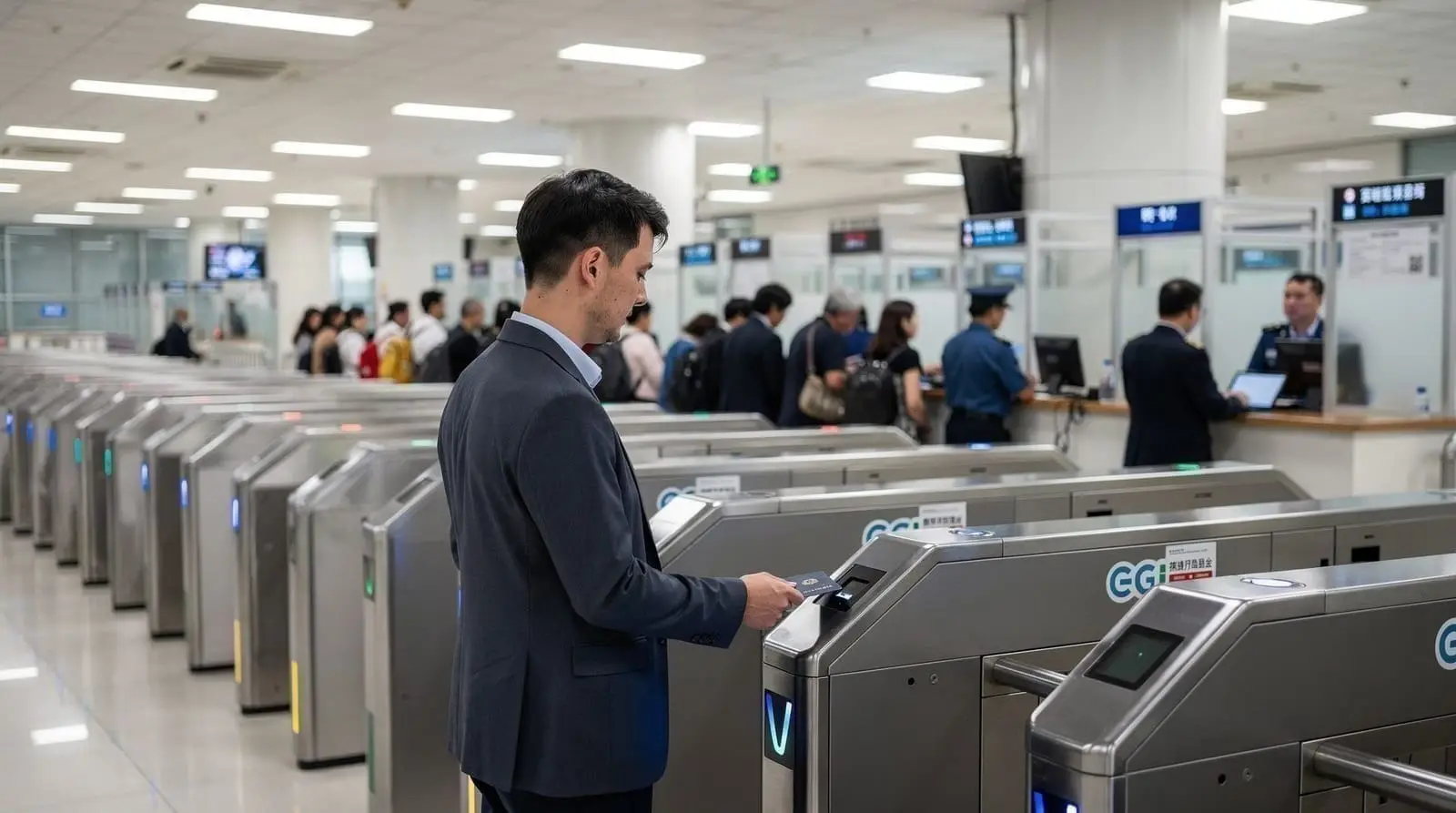
Shenzhen visa on arrival: who qualifies and how to get it
Can I get a Shenzhen visa on arrival?
Yes, if your passport is from one of around 150 eligible countries (excluding India, Afghanistan, Syria, Iran, and a few others). You can get a 5-day Shenzhen-only visa on arrival at Lo Wu, Huanggang, or Shekou border crossings. Cost is CNY 168 for most nationalities, CNY 314 for UK, and CNY 956 for USA. The VOA covers Shenzhen only — not Guangzhou, Dongguan, or the rest of mainland China.
The Shenzhen Special Economic Zone visa on arrival is one of the more convenient ways to enter mainland China for a short trip — no embassy appointment, no paperwork sent weeks in advance, no waiting. You show up at the right border crossing, queue for the VOA counter, pay the fee, and walk into Shenzhen with five days of legal stay.
But it comes with real limits that catch people out. It only covers Shenzhen. It cannot be extended. It is not available at the airport. And the cost varies dramatically depending on your passport nationality. This guide covers everything you need to know before you arrive at the border.
| Where to get it | Lo Wu, Huanggang, or Shekou border crossings only |
| Cost | around CNY 168 most nationalities, CNY 314 UK, CNY 956 USA |
| Duration | 5 days, single entry, Shenzhen SEZ only |
| Extension | not possible under any circumstances |
| Best for | short Shenzhen-only trips from Hong Kong |
What the Shenzhen SEZ visa on arrival actually is
China’s Shenzhen Special Economic Zone was established in 1980 as an experiment in market economics, and its special status has always included a separate entry regime. The VOA is a single-entry permit issued at the border crossing itself, valid for up to 5 days, covering the Shenzhen SEZ administrative area only.
It is different from two other policies that often get confused with it:
- The 240-hour (10-day) visa-free transit applies to about 55 nationalities, is free, and covers 24 provinces including Guangdong. See the China visa and 240-hour transit guide for details. If your passport qualifies for that policy, it is almost always the better option.
- The standard L-tourist visa must be arranged in advance at a Chinese embassy but covers all of mainland China for 30 days or more.
The Shenzhen VOA occupies the middle ground: wider nationality coverage than the 240-hour policy, no advance application required, but geographically restricted and short.
Which nationalities qualify
Approximately 150 countries are eligible for the Shenzhen SEZ VOA. This includes most of the world — but with significant exceptions. The following nationalities are not eligible and must apply for a standard L-visa in advance:
- India
- Pakistan
- Afghanistan
- Syria
- Iran
- A small number of other countries under active diplomatic restrictions
Most nationalities from the Americas, Europe, Southeast Asia, the Middle East (excluding Syria and Iran), Africa, and Oceania are eligible. If you are unsure whether your passport qualifies, check the visa tool on this site or confirm with the National Immigration Administration of China before travelling.
Citizens of the ~55 nations eligible for the 240-hour visa-free transit (USA, UK, EU states, Australia, New Zealand, Canada, Japan, South Korea, Singapore, and others) are also eligible for the Shenzhen VOA — but given the 240-hour policy is free and more flexible, the VOA is mainly used by this group when they arrive overland from Hong Kong rather than by air.
Cost by nationality (2026 fees)
The fee for the Shenzhen SEZ VOA is not uniform. China applies a reciprocal fee principle, charging nationalities roughly in proportion to what their countries charge for Chinese nationals to obtain visas.
| Nationality | VOA Fee (CNY) | Approx. equivalent |
|---|---|---|
| Most countries | CNY 168 | ~USD 23 / GBP 18 |
| United Kingdom | CNY 314 | ~USD 43 / GBP 34 |
| United States | CNY 956 | ~USD 132 / GBP 104 |
Payment is accepted in CNY cash at most crossings. Some crossings now accept WeChat Pay or Alipay. Credit cards are not universally accepted at the VOA window. Carry sufficient CNY or have a Chinese mobile payment method set up before arriving. The currency tool shows current exchange rates.
Where to get the Shenzhen VOA
The VOA is only available at three land border crossings between Hong Kong and Shenzhen. It is not available at Shenzhen Bao’an Airport or at sea ports other than Shekou.
Lo Wu (Luohu)
Lo Wu is the busiest and most accessible crossing. It connects directly to Lo Wu MTR station on Hong Kong’s East Rail Line (Line 10 from the 2022 extension), and on the Shenzhen side connects to Luohu station on Metro Line 1. For travellers coming from Kowloon or central Hong Kong without luggage, it is the most natural crossing point.
The VOA counter at Lo Wu is well-signposted and staffed during all operating hours. Queues for the VOA are typically shorter than the general entry queue but can build up on weekend mornings.
Operating hours: 06:30–00:00.
Huanggang
Huanggang is the only 24-hour crossing between Hong Kong and Shenzhen, which makes it uniquely useful for late-night arrivals or early departures. On the Hong Kong side it is served by cross-boundary coaches from multiple locations in Kowloon and the New Territories. On the Shenzhen side, Metro Line 7 stops at Huanggang station.
The VOA is available at Huanggang around the clock. Night-time queues are typically very short.
Shekou (ferry terminal)
Shekou is a ferry crossing, not a land border. The ferry terminal in Shekou (western Shenzhen) connects to the China Ferry Terminal in Tsim Sha Tsui, Hung Hom pier, and the Hong Kong–Zhuhai–Macau Bridge (HZMB) Hong Kong port. The crossing takes 30–60 minutes by ferry depending on the route.
The VOA is available at the Shekou International Cruise Terminal. Because the Shekou–Nanshan area is the tech and creative hub of Shenzhen, travellers visiting Tencent’s campus, OCT Loft, or Nanshan’s attractions will often find this the most convenient entry point — you arrive close to where you want to be.
Ferry schedules vary. Check current timetables before departure.
Step-by-step: getting the Shenzhen VOA
1. Cross to the border crossing. Travel to Lo Wu, Huanggang, or Shekou from Hong Kong by MTR, coach, or ferry as appropriate. See the Hong Kong–Shenzhen border crossings guide for transport details to each crossing.
2. Do not join the main immigration queue. Look for signs indicating “Visa on Arrival” or “签证” (qiānzhèng). At Lo Wu and Huanggang, the VOA counter is typically to the side of or before the main immigration halls.
3. Fill in the arrival card. An arrival/departure card is provided at the border. Complete it in block capitals. You need: your passport details, your accommodation address in Shenzhen (hotel name and address is fine), and your intended departure date.
4. Present your documents. The officer will want to see:
- Your passport (minimum 6 months validity beyond your intended stay, with at least one blank visa page)
- Your arrival card
- A hotel booking or accommodation address (printed or on screen — not always strictly required, but be prepared)
5. Pay the fee. CNY 168, CNY 314, or CNY 956 depending on your nationality. Cash is safest; confirm whether card or mobile payment is accepted at your specific crossing before relying on it.
6. Receive your VOA stamp. The stamp will note your permitted duration (5 days from the date of entry) and the territorial restriction (Shenzhen SEZ only). Keep your departure card — you surrender it when you leave.
Total time at the VOA counter: typically 15–30 minutes outside peak periods. Weekend morning queues (08:00–12:00) can extend this.
What the Shenzhen VOA covers and does not cover
Covered: The entire Shenzhen municipality, which is larger than many people expect. It includes Futian (the CBD), Luohu (the original commercial district), Nanshan (the tech district), Longhua (Huawei, Foxconn), Bao’an (the airport area), and Longgang. You can use the full Shenzhen metro network freely, visit any attraction within city limits, and travel to Dapeng Peninsula on the eastern coast.
Not covered: Anywhere outside Shenzhen’s administrative boundaries. This means:
- Guangzhou — not permitted
- Dongguan — not permitted
- Zhuhai — not permitted
- Anywhere else in China outside the Shenzhen SEZ
Crossing to Hong Kong or Macau is not an “exit from Shenzhen” that voids your VOA — those are separate customs territories with their own entry rules, and re-entering Shenzhen from Hong Kong would require a new VOA (or qualifying for the 240-hour transit). Plan your itinerary accordingly.
Extension: The Shenzhen SEZ VOA cannot be extended under any circumstances. If you want more than 5 days in Shenzhen, you must plan for a different visa type from the start.
How it compares to the 240-hour transit
If your nationality is on the 240-hour visa-free list, use that policy instead of the VOA — it is free, covers more of China, gives you 10 days, and does not require you to cross from Hong Kong first. The only scenario where the VOA is preferable for 240-hour-eligible nationals is if they are already in Hong Kong and want to visit Shenzhen for a few days, since the 240-hour policy applies at air entry points rather than land borders.
For travellers whose nationalities are on the VOA list but not the 240-hour list, the VOA is the only way to enter Shenzhen without an advance visa, and for a short stay it is the right choice. Just know it pins you to Shenzhen for 5 days.
Lo Wu vs Huanggang vs Shekou: which crossing to choose
The three crossings are not interchangeable in practice — each suits a different arrival pattern.
| Crossing | Best for | Hours | Typical queue |
|---|---|---|---|
| Lo Wu | Kowloon/central HK, no luggage | 06:30–00:00 | Short weekdays, longer weekend mornings |
| Huanggang | Late-night or early arrivals | 24 hours | Consistently short overnight |
| Shekou | Nanshan/Shekou-bound travellers, HZMB connections | Ferry schedule dependent | Moderate, tied to ferry timetable |
If your accommodation is in Nanshan or Shekou (near OCT Loft, Shenzhen Bay, or the tech district), Shekou is worth the ferry detour — you land close to where you’re staying instead of crossing the city again from Lo Wu. See the where to stay in Shenzhen guide before picking a crossing so it matches your hotel.
After the border: staying safe and avoiding rookie mistakes
Getting the VOA stamped is only the first step. Once you’re through, the same practical concerns apply as any first Shenzhen visit. Shenzhen is a generally safe, modern city, but read the is Shenzhen safe guide for the handful of real risks (mostly traffic and scooter lanes, not crime). New arrivals also routinely overpay at a handful of well-known spots — the Shenzhen tourist traps guide is worth ten minutes before you start exploring Futian or Nanshan.
If your 5 days include a side trip, note that the VOA does not cover the Dapeng Peninsula fortress and beaches any differently from the rest of Shenzhen — Dapeng is still inside the SEZ boundary, so it’s fine on a VOA. What it does not cover is any of the day trips from Shenzhen that cross into Guangzhou, Dongguan, or Zhuhai — those require the 240-hour transit or a full visa instead.
What to carry to the VOA counter
Being prepared means the VOA counter goes faster and reduces the chance of being turned away. Here is what to have ready:
Passport: Must be valid for at least 6 months beyond your planned stay and have at least one blank visa page. If your passport is near full or expiring within a year, renew it before travelling — a near-full passport can cause unnecessary complications at any border.
Accommodation confirmation: The arrival card requires a Shenzhen address. A hotel booking printout or the booking details on your phone screen is sufficient. If you are staying with a local contact, have their address written in Chinese characters — immigration officers may not be able to read Romanised transliterations of Chinese addresses.
CNY cash (or mobile payment): The most reliable payment method at the VOA window is cash in Chinese yuan. You can exchange currency in Hong Kong before crossing — exchange booths at or near the border crossings in Hong Kong are convenient, though rates vary. Some VOA counters now accept WeChat Pay or Alipay, but do not rely on this. Do not assume bank cards are accepted.
Onward plans (optional but useful): You may be asked about your travel plans in Shenzhen. Having a clear answer — “I am visiting Shenzhen for business/tourism, departing Friday via Lo Wu” — is helpful. You do not need to show proof of your departure booking, but knowing your plan instils confidence.
Completed arrival card: Available at the crossing, usually on a counter before the immigration hall. Fill in all fields clearly. If you make an error, ask for a new card rather than crossing things out.
Common mistakes to avoid
Arriving at the wrong crossing: The VOA is not available at every crossing. Futian/Lok Ma Chau does not issue VOAs — a surprisingly frequent error. If you need a VOA, use Lo Wu, Huanggang, or Shekou only.
Not checking nationality eligibility beforehand: The list of VOA-eligible countries changes occasionally. Confirm your nationality’s eligibility on the official National Immigration Administration website or the visa tool before you travel. Turning up at the border and being told you are ineligible is a wasted trip.
Misjudging the 5-day count: The clock starts on arrival day. Arriving Monday = days are Monday, Tuesday, Wednesday, Thursday, Friday. You must be out by end of Friday. Many travellers mistakenly think day 1 is the first full day.
Planning to visit Guangzhou or neighbouring cities: The VOA covers Shenzhen only. If your itinerary requires Guangzhou — whether for business, to catch a flight from Baiyun Airport, or as a day trip — you cannot do this on a Shenzhen VOA. Plan for a different visa type.
Arriving during the worst queue times: Weekend mornings (08:00–12:00) at Lo Wu in particular can see the general immigration queue stretch to 60–90 minutes. The VOA counter has its own queue and is typically shorter, but overall crossing time still increases. If you have flexibility, cross during the week or in the afternoon.
Shenzhen for short stays: what you can see in 5 days
Five days is enough to explore Shenzhen meaningfully — arguably more than most first-time visitors spend. The city is compact relative to its population, and the metro makes it easy to cross the major districts without a car.
A practical framework:
Nanshan (western Shenzhen): The tech and creative quarter. OCT Loft is a converted factory-turned-arts-district with galleries, coffee shops, and design studios. Window of the World is the famous theme park with miniature world monuments. Shekou waterfront has been redeveloped as Sea World, with restaurants, bars, and the cruise terminal. If you arrive via Shekou ferry, you are already here.
Futian (central): The modern CBD. Shenzhen’s gleaming financial district, the Civic Centre, Lianhuashan Park with its Deng Xiaoping statue and skyline views, and Coco Park for shopping and dining. The best metro interchange hub in the city.
Luohu and Dongmen: The original SEZ commercial heart. Dongmen walking street is a dense retail and food area, busiest in the evenings. Luohu Commercial City (directly at the Lo Wu crossing) is the famous market for fashion, electronics, and goods — its reputation for bargaining has mellowed somewhat, but it remains a spectacle.
Bao’an (northwestern): The airport area. Less tourist-focused, but the coastline around Bao’an has improved significantly in recent years, and the new Shenzhen Museum of Contemporary Art and Urban Planning is here.
Dapeng Peninsula (far eastern Shenzhen): Worth a half-day if beaches and history interest you. The Dapeng Ancient Fortress dates from the Ming dynasty. Xichong Beach is one of Shenzhen’s most attractive coastal spots. Getting there takes 60–90 minutes from central Shenzhen on Metro Line 8 plus a bus connection.
See the Shenzhen destinations overview for more detail on each area and the 3-day Shenzhen itinerary for a focused first-visit route that works well within a 5-day VOA window.
Why the VOA rules exist and why they’re strictly enforced
It’s worth understanding the logic behind the restriction, because it explains why border officers are unlikely to bend it. The Shenzhen SEZ VOA is a legacy of the zone’s original 1980 special-economic-zone status: a lighter-touch entry regime designed specifically to encourage short cross-border business and trade visits from Hong Kong, not general tourism across China. The policy was never intended to substitute for a full Chinese visa — it’s a narrow, geographically fenced convenience. That’s also why officers check the arrival card address closely: the system is built around the assumption that you are staying, and remaining, inside Shenzhen municipality for the full five days.
This also explains why the fee varies so much by nationality. China’s VOA and visa pricing broadly mirrors what a given country charges Chinese citizens for the equivalent visa — a reciprocity principle rather than an arbitrary tiering. UK and US nationals pay more because Chinese travellers pay comparatively more (and face more paperwork) for UK and US visas. It’s not a reflection of anything about Shenzhen itself.
Money and connectivity before you even reach the counter
A surprising number of VOA delays happen not at immigration but in the queue beforehand, because travellers arrive without CNY cash and try to sort out payment at the last minute. Hong Kong-side exchange counters near Lo Wu, Huanggang bus stops, and the Shekou ferry terminals in Tsim Sha Tsui all offer CNY exchange, usually at a worse rate than a bank but acceptable for a small VOA-sized amount.
If you’d rather not carry cash at all, get WeChat Pay or Alipay set up for foreigners before you leave home — the account linking process needs a working foreign number and takes 10–15 minutes, which is much easier to do calmly at home than at a border queue. Combine this with your eSIM and VPN for China setup and you land in Shenzhen able to pay, navigate, and message home immediately.
Settling in: payments, SIM, and connectivity
Setting these up before you arrive makes the first day in Shenzhen significantly smoother.
WeChat Pay and Alipay: Both platforms now support foreign-linked bank cards, allowing international visitors to pay directly from overseas accounts. Set one up before crossing — the setup process requires a functioning foreign phone number and a foreign Visa/Mastercard. The WeChat Pay and Alipay for foreigners guide covers each step. Once set up, you can pay for metro fares, restaurants, shops, and taxis without cash.
eSIM and VPN: China blocks most Western internet services — Google, WhatsApp, Instagram, Facebook, and many others are inaccessible without a VPN. Install a working VPN app on your phone before crossing (installing VPN apps is restricted within China). An eSIM with a Hong Kong or international data plan gives you usable, unfiltered connectivity in Shenzhen. Full details in the eSIM and VPN in China guide.
Getting around: The Shenzhen metro covers all major districts and runs until around midnight. Fares are CNY 2–12 depending on distance. Taxi apps (Didi, the Chinese equivalent of Uber) work well and are cheap by international standards.
Planning your 5 days in Shenzhen
Five days in Shenzhen is a reasonable amount of time to see the city’s main areas. A rough plan:
- Day 1: Arrive, get oriented. Check into your hotel, explore the neighbourhood around your accommodation.
- Day 2: Nanshan — Window of the World, OCT Loft Creative Park, Shekou waterfront.
- Day 3: Futian — central Shenzhen, the Civic Centre, Lianhuashan Park, COCO Park.
- Day 4: Luohu/Dongmen — the original SEZ commercial district, Dongmen walking street, Splendid China folk village nearby.
- Day 5: Dapeng Peninsula or Longhua — either a day at the beach and ancient fortress, or a look at the tech/industrial north.
Check the 3-day Shenzhen itinerary for a tighter version of this, and the Shenzhen destinations overview for area-by-area breakdowns.
Before you arrive, set up WeChat Pay or Alipay for foreigners and sort your eSIM and VPN — both are significantly easier to arrange before crossing the border.
Frequently asked questions about the Shenzhen visa on arrival
Is the Shenzhen VOA available at the airport?
No. The Shenzhen Special Economic Zone VOA is only issued at land border crossings — specifically Lo Wu, Huanggang, and Shekou. Travellers arriving by air who are not eligible for the 240-hour visa-free transit must have a valid L-visa or other visa arranged before travelling.
Can I visit Guangzhou on a Shenzhen VOA?
No. The VOA is restricted to the Shenzhen SEZ. Travelling to Guangzhou (or anywhere else in mainland China outside Shenzhen) would put you in violation of your entry conditions. If you want to visit Guangzhou, you need the 240-hour visa-free transit (if eligible) or a standard L-visa.
How many days is the Shenzhen VOA, exactly?
5 days. The calculation starts on the day of arrival (day 1), not the following day. If you arrive on a Monday, you must leave Shenzhen by the end of Friday. Do not count the day of arrival as a “free” day.
What if I want to extend my stay beyond 5 days?
The Shenzhen VOA cannot be extended. Your options are: exit Shenzhen (to Hong Kong or Macau) and attempt to re-enter with a new VOA, or apply for a standard L-visa in advance for your next visit. Note that re-entry via VOA is technically permitted but border officers may question travellers who appear to be “visa-running” repeatedly.
Can Indian nationals get the Shenzhen VOA?
No. Indian passport holders are not eligible for the Shenzhen SEZ VOA. Indian nationals must apply for a standard L-tourist visa at a Chinese embassy or consulate before travelling. Processing typically takes 4–7 business days.
Do I need a hotel booking to get the VOA?
Technically yes — the arrival card asks for an address in Shenzhen. In practice, immigration officers at the VOA counter may or may not ask to see a printed booking. Having a hotel confirmation ready on your phone or printed is strongly recommended. Attempting to enter without accommodation arranged is both practically difficult and a minor entry risk.
Can I use the Shenzhen VOA more than once on the same trip?
The Shenzhen SEZ VOA is a single-entry permit. If you exit to Hong Kong and want to re-enter Shenzhen, you need to obtain a new VOA at the border crossing. There is no official limit on how many times you can do this, but frequent VOA use on a single passport may attract questions from border officers.
Which crossing should I use if I’m staying in Nanshan or Shekou?
Use the Shekou ferry crossing. It lands you directly in the Nanshan/Shekou area, close to OCT Loft, Shenzhen Bay, and the tech district hotels, saving you a cross-city trip that Lo Wu or Huanggang arrivals would need. See the where to stay in Shenzhen guide for how this affects hotel choice.
Is Shenzhen safe for a short VOA trip?
Yes, generally very safe by international standards — low violent crime, heavy surveillance, and a well-run transport system. The main practical risks are traffic (scooters on shared paths) and a handful of well-known overpriced spots for first-time visitors. See the is Shenzhen safe guide and the Shenzhen tourist traps guide for specifics.
Top-rated things to do in Shenzhen
Verified deep-linked GetYourGuide tours. Book through these links and we earn a small commission at no cost to you.