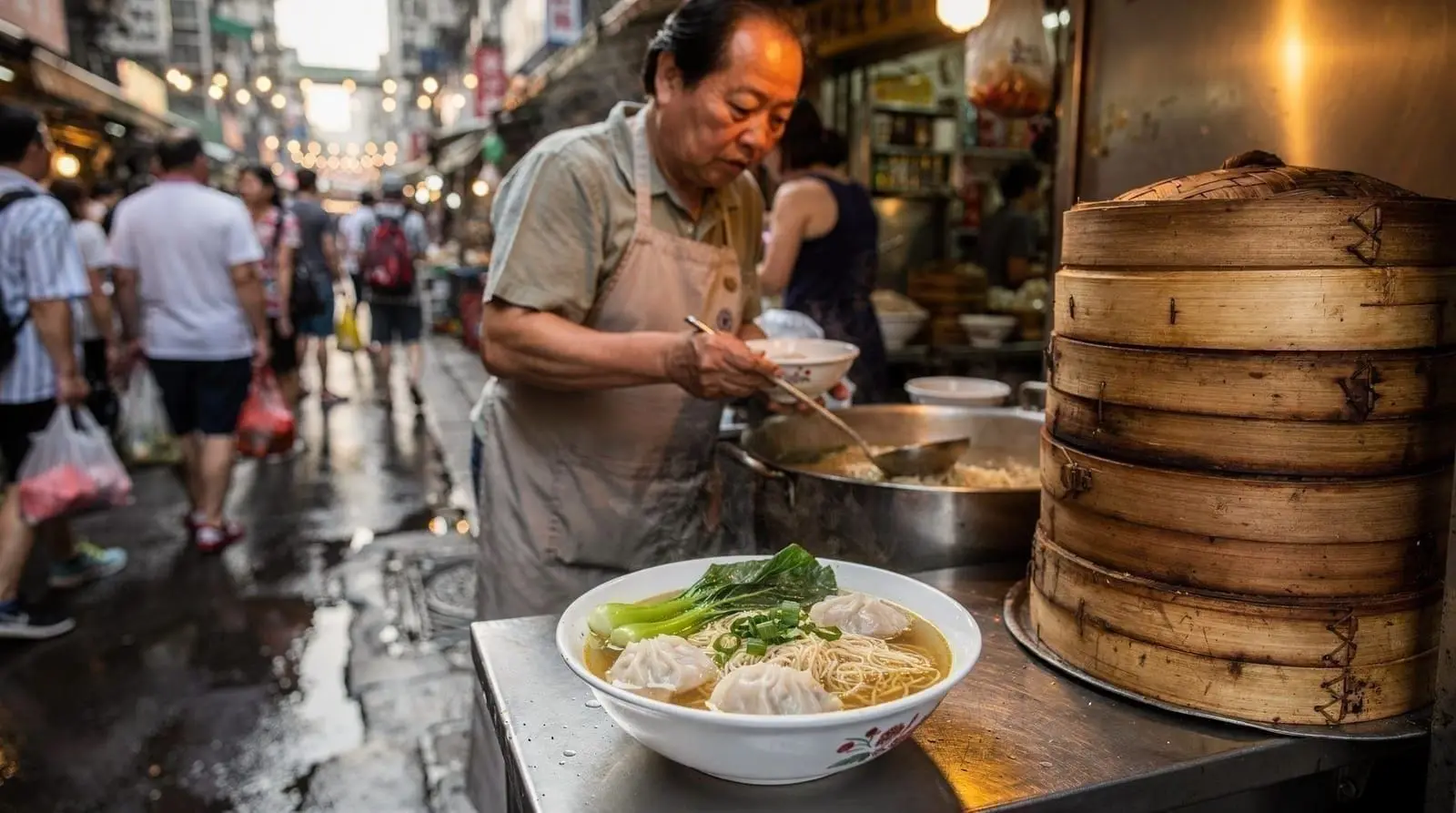
A weekend eating through Shenzhen
Shenzhen is not the city most people think of when they think about Chinese food. That is their loss. Because Shenzhen is the destination where 18 million migrants from every province of China converged to build something, and they brought their food with them. The result is one of the most internally diverse food cities in China — not in the sense of “restaurants representing different cuisines,” but in the sense that the people cooking Chaoshan fish balls, Hakka salt-baked chicken, and Hunanese smoked meats actually grew up making this food in the regions it comes from.
This is a two-day eating route. It is not exhaustive — Shenzhen has too many microcultures for that. It is designed to show you the range.
| Where | Luohu (Dongmen, Hongling Zhonglu), Futian, Nanshan (Shekou, OCT-LOFT) |
| Cost | Around CNY 610–880 for the full weekend eating well |
| Time needed | Two full days, six meals/stops |
| Getting there | Shenzhen Metro links every stop on this route |
| Best for | Travellers who want Shenzhen’s migrant food scene, not just Cantonese classics |
For the neighbourhoods behind these food stops, the best neighbourhoods in Shenzhen guide is a useful companion, and if this is your first visit, pair it with first time in Shenzhen for the basics of getting around.
Saturday morning: dim sum in the Cantonese tradition
Shenzhen is in Guangdong province, which means yum cha is a cultural institution here. The morning dim sum meal (zao cha or yum cha) is not a tourist experience in Shenzhen — it is what families do on weekend mornings. The better teahouses fill up by 09:00; arrive at 08:00 or 08:30 for the best selection.
Jing’s Restaurant (景餐廳) in Luohu: This is a large, slightly faded Cantonese teahouse that has been doing exactly the same thing for years. Har gow (shrimp dumplings) arrive tight and translucent; char siu bao (barbecue pork buns) are properly caramelised at the bottom. Per-person spend: CNY 60–90 (~USD 8–13).
Sunfull Restaurant (聖方餐廳) in Futian: Slightly more polished, popular with local business families on weekends. The steamed egg tart is a specialty here — ordered separately from the standard tart, it arrives warm with a wobbling custard centre. Per-person spend: CNY 80–120 (~USD 11–17).
For the curious: the trolley-cart service style of dim sum is dying out in Shenzhen (too inefficient by local standards); most places now use paper checkboxes or tablet ordering. The experience is slightly less theatrical but the food arrives hotter.
Saturday midday: the Dongmen street food circuit
Dongmen Pedestrian Street in Luohu is Shenzhen’s oldest commercial district and, frankly, a mess — in the best possible way. Stalls selling fashion knockoffs and phone cases share the alley with serious food vendors who have been in the same spot for a decade or more. Come between 11:00 and 14:00 when everything is operating. For a deeper dive into the stalls and the layout of the street, see the Dongmen street food guide.
Things to try in Dongmen:
- Stinky tofu (臭豆腐): Deep-fried squares with a fermented funk that smells more alarming than it tastes. Served with pickled cabbage and chili sauce. CNY 8–12 per portion.
- Jianbing (煎餅): A crepe-style street snack assembled to order — egg, scallion, crispy wonton, hoisin and chili paste. CNY 10–15.
- Oyster omelette (蠔烙): This is the Chaoshan contribution to Shenzhen street food — egg and potato starch cooked with fresh oysters and oyster sauce. Best eaten immediately, leaking hot at the edges. CNY 20–35.
- Luosifen (螺螄粉): Guangxi river snail rice noodles — aggressively sour and funky, with dried tofu skin and pickled bamboo. Not universally liked; essential to try. CNY 18–28.
Budget for Dongmen: CNY 60–100 covers a full midday sweep if you graze rather than sit.
Saturday afternoon: Chaoshan at Hongling Zhonglu
The Chaoshan people (from Chaozhou and Shantou in eastern Guangdong) have a food culture that is distinct from mainstream Cantonese cooking — more oceanic, plainer in presentation, built around fresh seafood, congee, and preserved vegetables. There is a cluster of Chaoshan restaurants along Hongling Zhonglu in Luohu district, targeting the large Chaoshan migrant community. The full Shenzhen Chaoshan cuisine guide covers more dishes and specific addresses if this becomes a favourite.
Chaoshan Beef Hot Pot (潮汕牛肉火鍋): The signature Chaoshan experience. Hand-sliced fresh beef (not pre-frozen) is cooked in a clear bone broth at the table in about 15 seconds — any longer and the meat toughens. The quality of the beef and the cleanliness of the broth are the entire point. Expect CNY 120–200 per person (~USD 17–28) at a good specialist restaurant. The chain Niu Ba Ba has reliable quality.
Chaoshan congee (潮汕白粥): Unlike the thick southern Cantonese congee, Chaoshan congee is very thin — almost rice-flavoured water — served alongside a spread of pickled vegetables, dried fish, and preserved eggs. Eaten for breakfast or as a light late meal. CNY 20–40 per person.
Fish balls (魚蛋): Made fresh and distinct from the rubbery factory versions served at convenience stores. A Chaoshan fish ball has a snap and freshness that is noticeably different. Buy them from a specialist stall, not a general noodle shop.
Saturday evening: craft beer and a meal in Shekou
Shekou in Nanshan district is where Shenzhen’s expat community (and a certain demographic of local professionals) congregates in the evenings. The Sea World area around a permanently docked former Italian cruise ship, the Minghua, has bars and restaurants in a concentration that would be remarkable for the size of the district. It is also the most immediately accessible part of Shenzhen for visitors from Hong Kong who are unaccustomed to navigating the city. The Shenzhen nightlife guide to Shekou and OCT has a fuller rundown of the bar scene if you want to extend the evening.
Bionic Brew: A proper craft brewery on Hai Bin Er Jie with their own beers on tap. The Nanshan Session Ale and a rotating mango wheat are reliably good. CNY 48–65 per pint. If craft beer is the point of the trip, the Shenzhen craft beer and bars guide lists the rest of the taprooms worth a detour.
Paulaner Brauhous: German brewery chain, which sounds incongruous in Shenzhen and is — but it is genuinely well-run, the pretzels are correct, and the beer garden atmosphere on a Saturday evening has its own logic. Good if you’ve eaten nothing but intense Chinese flavours for two days and want a palate reset. CNY 60–90 per beer.
For dinner in Shekou: Nong Tang on Taizi Road does serious Hunan cuisine — smoked pork, mao xue wang (blood curd and offal hotpot), and chili-fried dried fish. Ordering aggressively at Hunan restaurants: CNY 100–160 per person.
Sunday morning: Hakka breakfast and OCT-LOFT
Sunday morning, cross to Nanshan for a Hakka breakfast and then spend time at OCT-LOFT, a former factory complex converted to galleries, studios, and independent cafes. It is the most visually pleasant area in Shenzhen to spend a morning.
Hakka breakfast focuses on steamed cakes (fa gao), yam dumplings (wu jiao), and a soupy rice dish. The small Hakka breakfast shops near OCT East and in Longhua district open from 07:00. Per-person spend: CNY 25–45. If Hakka food turns out to be a favourite, the Shenzhen Hakka food guide covers the salt-baked chicken and stuffed tofu dishes worth seeking out for lunch or dinner too.
Café at OCT-LOFT: Multiple independent coffee roasters occupy the converted factory buildings. Coffee quality here is comparable to any specialty cafe in Hong Kong or Singapore. CNY 30–45 for a specialty coffee.
After breakfast, spend an hour in OCT-LOFT’s independent gallery spaces. Entry to the public areas is free; individual exhibitions charge CNY 20–50. The space itself — industrial brick and repurposed machinery — is the draw.
A note on dim sum beyond this route
If Saturday morning’s dim sum leaves you wanting more, the Shenzhen dim sum guide has a longer list of teahouses across Futian and Luohu, including which ones still run trolley service and which have moved to tablet ordering. Futian in particular has a denser cluster of polished, business-district teahouses than Luohu, useful if your schedule only allows one dim sum sitting and you want the more contemporary version of the experience.
Sunday midday: Sichuan and Hunan for the finale
By Sunday midday, you are ready for something with heat. Shenzhen has an enormous Sichuan and Hunan migrant population and the restaurants serving these communities are not adjusted for outsider heat tolerance.
Mala hot pot (麻辣火鍋): The defining Sichuan export. A shared pot of numbing-spicy broth (from Sichuan peppercorn and chili) into which you cook thinly sliced meat, vegetables, offal, and tofu at the table. The mainstream chain Haidilao (multiple Shenzhen locations) is very good and well-run, with the spectacle of noodle-pulling at the tableside. CNY 100–160 per person.
Hunan restaurant, no-fuss version: Look for the hand-written signs in markets or food courts near metro stations advertising Hunan home cooking (湘菜家常菜). A plate of chili-fried pork with garlic shoots (蒜苗炒臘肉) and steamed rice is CNY 30–45 and genuinely satisfying.
For a structured food-and-city tour that covers Shenzhen’s culinary geography with a local guide who can navigate menus and make recommendations:
Book a Shenzhen city tour with food recommendations from a local guideBudget for the weekend
| Category | Estimated spend (CNY) | USD equivalent |
|---|---|---|
| Saturday dim sum | 80–120 | 11–17 |
| Dongmen street food | 60–100 | 8–14 |
| Chaoshan beef hot pot | 150–200 | 21–28 |
| Shekou evening (dinner + drinks) | 150–220 | 21–31 |
| Sunday breakfast + coffee | 50–80 | 7–11 |
| Sunday mala hot pot | 120–160 | 17–22 |
| Total | 610–880 | 85–123 |
This is eating at local restaurants with intent, not budget backpacker food courts. At a pure budget level, the same weekend could be done for CNY 350–450 by focusing on street food and simple noodle shops. For a wider look at stretching a Shenzhen trip further, see the Shenzhen on a budget guide.
Frequently asked questions about eating in Shenzhen
Is the food in Shenzhen different from Hong Kong?
Yes, quite different. Hong Kong cooking is primarily Cantonese with strong Shanghainese and international influences. Shenzhen has Cantonese as a base but reflects the full range of Chinese regional cooking because of its migrant population. Chaoshan, Hakka, Hunanese, and Sichuan food are all significantly easier to find at authentic quality in Shenzhen than in Hong Kong.
Can I eat well in Shenzhen on a budget?
Extremely well. A satisfying lunch at a neighbourhood restaurant costs CNY 40–60 (~USD 6–8). Street food fills you up for CNY 15–30. Only the premium beef hot pot and craft beer evenings push costs higher.
Are there good vegetarian options in Shenzhen?
Better than in most Chinese cities. Buddhist vegetarian restaurants (素食館) are scattered across the city; the chain Green Common (also a Hong Kong brand) has Shenzhen locations. Tofu preparations across Chaoshan and Hakka cuisines also provide substantive meatless options. Tell the cook “wǒ chī sù” (I’m vegetarian) but expect some negotiation at traditional places.
Where is the best dim sum in Shenzhen?
For quality: the Cantonese restaurants in Futian CBD and Nanshan district. For authenticity and atmosphere: the older teahouses in Luohu. Avoid the hotel buffet dim sum marketed at tourists — quality is consistently lower and prices higher.
Do I need to speak Chinese to order at these places?
Not essentially, but it helps. Pointing at menu photos or neighbouring tables’ dishes works at most stalls and teahouses, and many Futian and Nanshan restaurants have picture menus or English translations. A translation app handles the rest. Learning a handful of dish names in advance (as used throughout this guide) makes ordering faster and more precise, especially for Chaoshan and Hakka specialities that rarely appear in English elsewhere.
Top-rated things to do in Shenzhen
Verified deep-linked GetYourGuide tours. Book through these links and we earn a small commission at no cost to you.