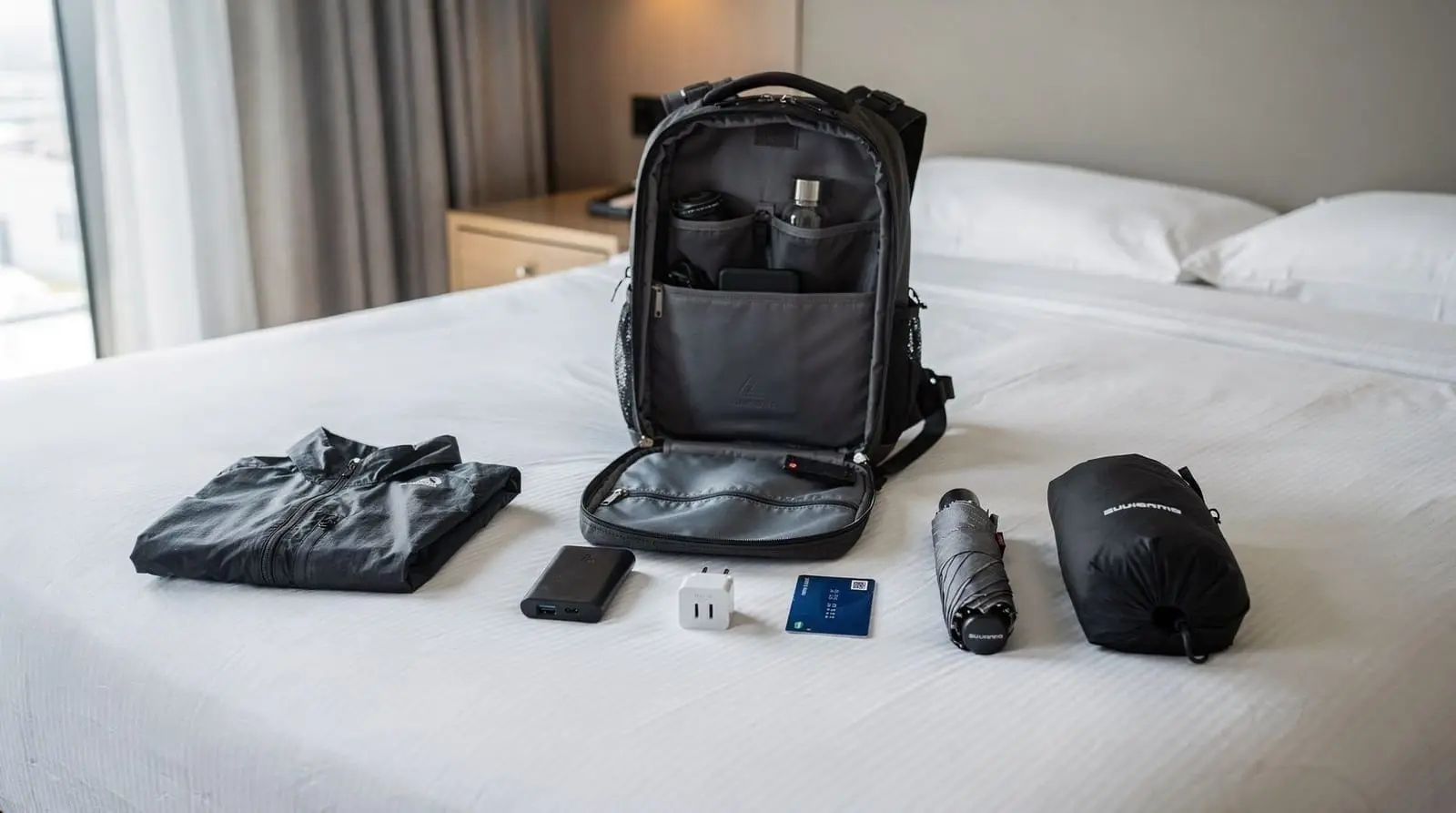
What to pack for Shenzhen (and the rest of the Greater Bay Area)
Packing for Shenzhen is 70% about the same things any Asian city trip requires, and 30% about specific preparation for China’s digital and regulatory environment. The tech prep in particular is easy to underestimate — failing to set up payment and connectivity before you land adds friction to everything else. This list is organised by category and is blunt about what’s actually necessary versus what you can easily buy locally. For the full context on why the tech prep matters so much, first time in Shenzhen covers the bigger picture beyond just packing.
| Prep before you leave | VPN, WeChat Pay/Alipay, offline maps, eSIM — all before landing |
| Hardest to buy locally | VPN subscription, prescription medication, dietary supplements |
| Easiest to buy locally | Cables, power banks, toiletries, umbrellas, sun cream |
| Cash buffer | Around CNY 500–1,000 for the first day |
| Adapter needed | Type A/C/I sockets — a universal adapter covers all cases |
The tech prep — do this before you leave home
This is the category where most travellers regret not preparing in advance.
VPN installed and tested: The Great Firewall blocks Google, Gmail, Google Maps, WhatsApp, Instagram, Facebook, Twitter, and most major Western media. You need a VPN to access these. The critical point: you cannot download a VPN app from inside mainland China because the App Store and Play Store are both inaccessible without one. Install and test it before departure. Recommended services with consistent mainland China track records as of 2026: ExpressVPN, NordVPN, Astrill. Buy a subscription and verify it works in your home country. The eSIM and VPN in China guide walks through the full setup step by step.
WeChat Pay or Alipay linked to your foreign card: This is not optional for comfortable Shenzhen travel — it is functionally mandatory. Download whichever you prefer, create an account, and link your Visa or Mastercard. Do the first linking in your home country where you have reliable internet access. WeChat’s international card integration requires a phone number verification that works better from outside China. Alipay’s international version (“Global Alipay”) is slightly more streamlined for first-time international users. See WeChat Pay and Alipay for foreigners for the exact linking steps and common failure points.
Offline maps downloaded: Google Maps’ offline function works but only covers areas not blocked by the firewall. Download the region’s offline map anyway as a backup navigation layer. Apple Maps is fully functional in mainland China (it uses Gaode Maps data, a domestic provider). Alternatively, download Gaode Maps (the app) or Baidu Maps international edition.
eSIM or data plan arranged: Your home roaming plan may work in mainland China if it routes via Hong Kong network nodes — check with your carrier explicitly. Some international SIM cards (particularly Hong Kong-sourced ones) work in mainland China and sidestep the firewall issue. Airalo and Nomad eSIM services both have China-compatible options that route via HK.
12306 or Trip.com app: For high-speed rail tickets between Shenzhen, Hong Kong, and Guangzhou. Easier to set up your account before arrival — the Greater Bay Area high-speed rail guide explains booking and station logistics in detail.
DiDi app: China’s dominant ride-hailing platform. Requires phone number registration; set up before landing. For getting around once you’ve landed, the Shenzhen metro guide is usually cheaper and just as fast for anywhere near a station.
Documents
- Passport (mandatory for border crossings, hotel check-in, train boarding, and some tourist sites).
- Printed or digital copy of your China visa or confirmation of your 240-hour transit exemption eligibility.
- Onward international flight confirmation (required at border for 240-hour transit travellers — have it accessible).
- Travel insurance documents — Shenzhen hospitals are generally good, but confirmation of coverage matters in an emergency. International SOS or Allianz are reliable for this region.
- Hotel address in Chinese characters for taxi drivers — copy the address from the hotel booking, or ask the hotel to send you the Chinese address.
Clothing by season
For a fuller month-by-month breakdown of weather, crowds, and events, see best time to visit Shenzhen. The quick version for packing purposes:
| Season | Typical weather | Pack |
|---|---|---|
| Oct–Nov / Mar–Apr | 20–26°C days, 15°C evenings | Light layers, a light jacket, walking shoes |
| Jun–Sep | Hot, humid, 30°C+, typhoon risk | Breathable fabrics, packable rain jacket, sandals |
| Dec–Feb | 10–14°C mornings, 18–22°C afternoons | Layering, light down jacket or fleece |
October–November and March–April (best seasons):
- Light layers — daytime 20–26°C, evenings can drop to 15°C.
- A light jacket or merino layer for air-conditioned spaces (malls, metro, restaurants run cold).
- Comfortable walking shoes — Shenzhen’s metro system involves significant walking between transfers.
- Light rain shell — brief rain showers can occur in March–April.
June–September (hot and humid):
- Light, breathable fabrics (linen, lightweight technical fabrics) — cotton becomes uncomfortable in 35°C humidity.
- Shorts and a change of shirt for afternoon activities.
- Compact packable rain jacket — typhoon season means unexpected heavy rain.
- Slip-on shoes or sandals for casual city days; avoid leather shoes that take a full day to dry.
- Cooling neck towel or small handheld fan (both are available for CNY 15–50 at convenience stores).
December–February (mild and dry):
- Layering is key — mornings and evenings can be 10–14°C, afternoons 18–22°C.
- Light down jacket or fleece.
- One warmer layer for January–February evenings.
- No heavy winter coat necessary unless you plan to go north to Guangzhou or beyond.
What you can easily buy in Shenzhen
Do not pack these unless you’re very brand-specific:
- Phone cables, chargers, and adapters — vastly better selection and lower prices in Huaqiangbei. The Huaqiangbei electronics market guide covers which buildings sell what and how to avoid counterfeit stock.
- Portable power banks — Anker, Baseus, and Romoss sell legitimately from authorised stores at 25–40% below European prices.
- Earphones and audio accessories — same.
- Basic toiletries — every 7-Eleven and FamilyMart stocks them (CNY 15–50 for shampoo, deodorant, sunscreen).
- Sunscreen in higher SPF (80+ is common in Chinese pharmacies — hard to find at equivalent SPF in Europe).
- Umbrellas — lightweight UV-blocking umbrellas (晴雨傘) are sold everywhere for CNY 20–60 and are better suited to Asian conditions than Western travel umbrellas.
Guided Huaqiangbei tech district tour — a good way to shop with someone who knows which stalls are trustworthy, rather than wandering in cold.
What you cannot easily replace locally
- Your VPN subscription. Non-negotiable.
- Prescription medications — Chinese pharmacies stock equivalent drugs but prescription requirements and brand names differ. Bring a full supply plus some buffer.
- Any very specific dietary supplement or formula that is not mainstream in Asia.
- High-quality sun protection clothing if you rely on UPF-rated fabric rather than sunscreen.
- Specific hiking or outdoor gear (standard quality is available but sizing for Western body types is inconsistent).
Electronics to bring
- Universal adapter (China uses Type A, C, and I; Type A plugs [same as US/Japan] are the most common). Your US-plug electronics work directly.
- A small portable router or travel router if you need to share a hotel ethernet connection or want to apply your VPN at the network level (convenient if travelling with multiple devices).
- Laptop if relevant — Chinese customs rarely scrutinises personal laptops, but keep your VPN ready.
- Camera with appropriate lenses. Drone: possible but regulated — if bringing a drone, check current CAA and Chinese CAAC regulations. Some drone models require flight permits that are difficult for short-stay visitors to obtain.
Money preparation
- Arrive with some CNY cash — CNY 500–1,000 is a reasonable buffer for the first day before you find an ATM. Some banks can order CNY in advance; the rate is usually not terrible.
- Tell your bank you’re travelling to China before you go — some banks flag Chinese ATM withdrawals as fraud without notice.
- Carry at least two payment methods (WeChat Pay + Alipay, or one app + one physical card).
Health and medical
- Diarrhoea medication (Imodium or equivalent) — traveller’s diarrhoea is rare in Shenzhen if you stick to cooked food, but the unfamiliar bacterial landscape occasionally causes issues.
- Antihistamines — pollution levels can trigger reactions in sensitive travellers. Shenzhen’s air quality is better than Beijing or Chengdu but not European city standards.
- Motion sickness tablets if you’re sensitive — the harbour ferry to Macau can be rough, and mountainous roads exist if you venture to Guangdong countryside.
- Hand sanitiser — not universally available in smaller restaurants and markets. Not obsessively necessary; a small bottle is enough.
- COVID-related: No specific requirements as of 2026; check current entry conditions.
The one thing most travellers forget
A physical print of your hotel’s Chinese-character address and a list of key phrases in pinyin/characters. When your phone dies (or your VPN is misbehaving) and you need to communicate with a taxi driver at midnight, having the address on a piece of paper is irreplaceable. “Going back to the hotel” is a situation that recurs daily; make it frictionless. Deciding where to stay in Shenzhen before you land also makes this easier — a hotel near a metro station is simpler to describe and find again than one tucked into a residential block.
Getting from the airport to your hotel
Shenzhen Bao’an International Airport connects to the city by metro (Line 11 express to Futian in about 30 minutes), taxi, or a pre-booked transfer. If it’s your first landing in mainland China and you’d rather not navigate a taxi queue with a dead phone and no cash yet, a pre-arranged transfer removes that friction entirely.
Private airport transfer from Shenzhen Bao’an Airport — worth considering for a first landing, especially if you arrive late or haven’t yet linked a payment app.
Frequently asked questions about packing for Shenzhen
Can I bring a VPN to China legally?
VPN use in China occupies a legal grey area. Individual tourists using VPNs are not a target of enforcement; the laws are applied primarily to providers and distributors. The practical reality: millions of foreign visitors use VPNs in China without incident. Do not install VPN apps on your devices while in China — do it before.
What adapter do I need?
China’s sockets are primarily Type A (flat parallel pins, same as US) and Type I (angled pins, same as Australia). A universal adapter covers all cases. European plugs (Type C/E/F) require an adapter. US-standard electronics work without a voltage converter as China uses 220V, but US electronics are designed for 110–240V input on modern devices — check your device’s input rating.
Is it safe to drink tap water in Shenzhen?
No. Use bottled water for drinking and brushing teeth. Bottled water is CNY 2–4 per 500ml at convenience stores. All hotels provide bottled water.
Should I buy a local SIM card in Shenzhen?
A local China SIM card gives you the best data speeds at mainland China prices. However: registering a Chinese SIM card requires your passport and is most straightforwardly done at a carrier store (China Mobile, China Unicom, or China Telecom). The process works but requires patience. An international eSIM that includes mainland China data (from Airalo or Nomad) avoids this friction entirely.
Can I buy travel insurance after I arrive?
Yes, some international providers allow this. However, most travel insurance requires purchase before you depart for full coverage (including pre-existing conditions and cancellation). Arrange before you leave.
Do I need to pack differently if I’m also visiting Hong Kong?
Slightly. Hong Kong needs none of the VPN or payment-app preparation — the internet is open and cards work everywhere — so the tech list shortens considerably on that side of the border. Clothing and health items stay the same for both cities since the climate is nearly identical. See Shenzhen vs Hong Kong for the fuller comparison if you’re planning to cross between them.
Top-rated things to do in Shenzhen
Verified deep-linked GetYourGuide tours. Book through these links and we earn a small commission at no cost to you.